

Introduction
Key man insurance is a life insurance policy a business takes out on someone whose loss would create immediate financial problems. Most business owners don't think about this coverage until they're standing at a funeral wondering how the company will make payroll next month. The honest answer is that most small businesses operate with a handful of people who know the client relationships, run the operations, or bring in the revenue. Lose one of those people, and the math changes fast.
What Key Man Insurance Actually Means
Key man insurance — also called key person insurance — is a life insurance policy a business takes out on someone whose loss would create immediate financial problems. The business pays the premiums, owns the policy, and collects the death benefit if that person dies. The coverage exists to replace lost revenue, cover the cost of finding and training a replacement, and keep the business running while everyone figures out what comes next.
Under IRS regulations, a key person is defined as someone who materially participates in an active trade or business as an owner, employee, or contractor. In practical terms, that's the founder who still closes every major deal, the lead engineer who designed the core product, or the operations manager who's the only one who knows how the fulfillment system actually works. These are the people whose absence would force the business to borrow money, turn away clients, or shut down entirely.
Why Small Businesses Need This Framework
The real question is not whether your business has key people — it does. The question is whether you've calculated what happens if one of them isn't there tomorrow. For most small businesses, the loss of a key person means lost revenue, delayed projects, and clients who start looking elsewhere. The death benefit from key man insurance provides cash to cover those gaps while the business stabilizes.
This isn't the same as business succession planning, which addresses ownership transfer and long-term continuity. Key man insurance solves a shorter-term problem: keeping the lights on and the payroll funded when someone essential is gone. The two strategies work together, but they serve different purposes.
For informational and educational purposes, understanding the framework means knowing who qualifies as a key person, how much coverage makes sense, and how the policy fits into the broader financial structure of the business. The goal is getting in the right range — not perfect precision, but enough coverage that the business doesn't fold because one person's expertise walked out the door.
What Risks Do Businesses Face Without Key Man Insurance?
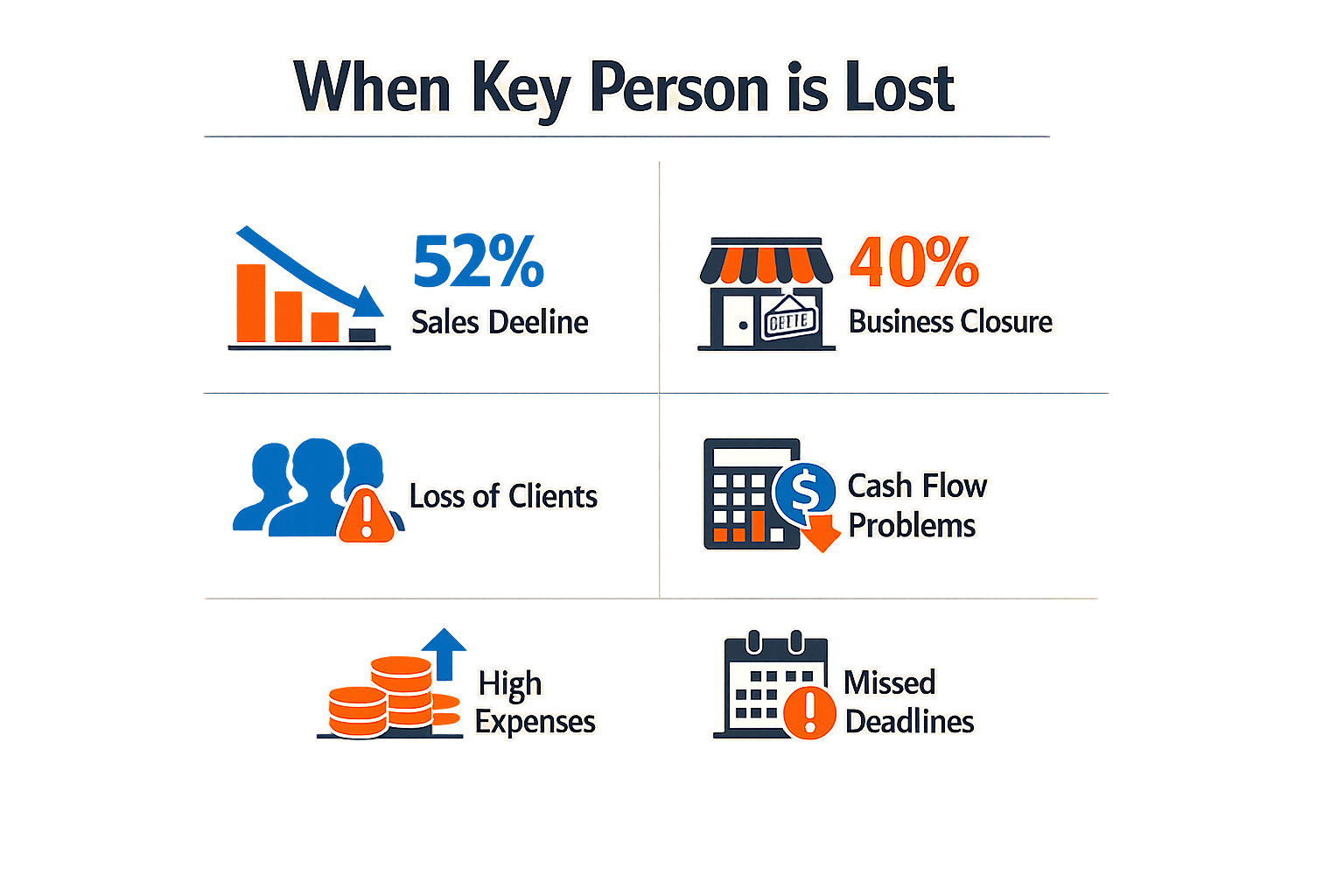
Most small business owners don't lose sleep over insurance policies. They lose sleep wondering what happens to their company if the person who lands every major contract suddenly isn't there to close deals.
The math is straightforward: when a key individual leaves — whether through death, disability, or departure — the business faces immediate financial pressure. Revenue drops while fixed costs remain. Clients question stability. Competitors circle. The business needs cash to recruit a replacement, cover lost sales, and reassure lenders that operations will continue. Without a financial cushion, those pressures compound quickly.
The Real Costs of Losing a Key Person
The financial impact shows up in three places. First, lost revenue — the key person's relationships, expertise, or production capacity don't transfer overnight. Second, replacement costs — recruiting, onboarding, and training a successor takes time and money, often six to twelve months of salary. Third, operational disruption — other employees pick up slack, projects stall, and strategic initiatives get delayed.
For businesses with loans or credit lines, the stakes are higher. Lenders evaluate risk based on the people running the operation. When a key person exits, loan covenants may trigger, credit lines may freeze, and refinancing terms may worsen. The business needs proof it can weather the transition — and that proof usually means cash reserves or insurance proceeds.
Why Most Businesses Remain Unprotected
The gap between risk and coverage comes down to three misconceptions. First, business owners assume their general liability or property insurance covers people — it doesn't. Second, they believe a key person's individual life insurance protects the business — it doesn't, because the family receives those proceeds. Third, they think the risk is too remote to justify the premium — until the key person is gone and the bills are due.
Without a dedicated policy owned by the business, there's no automatic funding mechanism when a key individual is lost. The company scrambles to redirect operating cash, secure emergency financing, or ask investors for bridge capital — all while trying to stabilize operations. Business succession planning addresses long-term ownership transitions, but key man insurance solves the immediate cash problem.
The cheapest coverage is the policy you have in place before you need it — after a key person is gone, the financial damage is already done.
The framework is simple: identify the individuals whose loss would create measurable financial harm, calculate the cost of replacing their contribution, and fund that gap with insurance proceeds. Most small businesses skip this step entirely, assuming they'll figure it out when the time comes. The honest answer is that by then, the options are limited and expensive.
How Do You Implement Key Man Insurance?
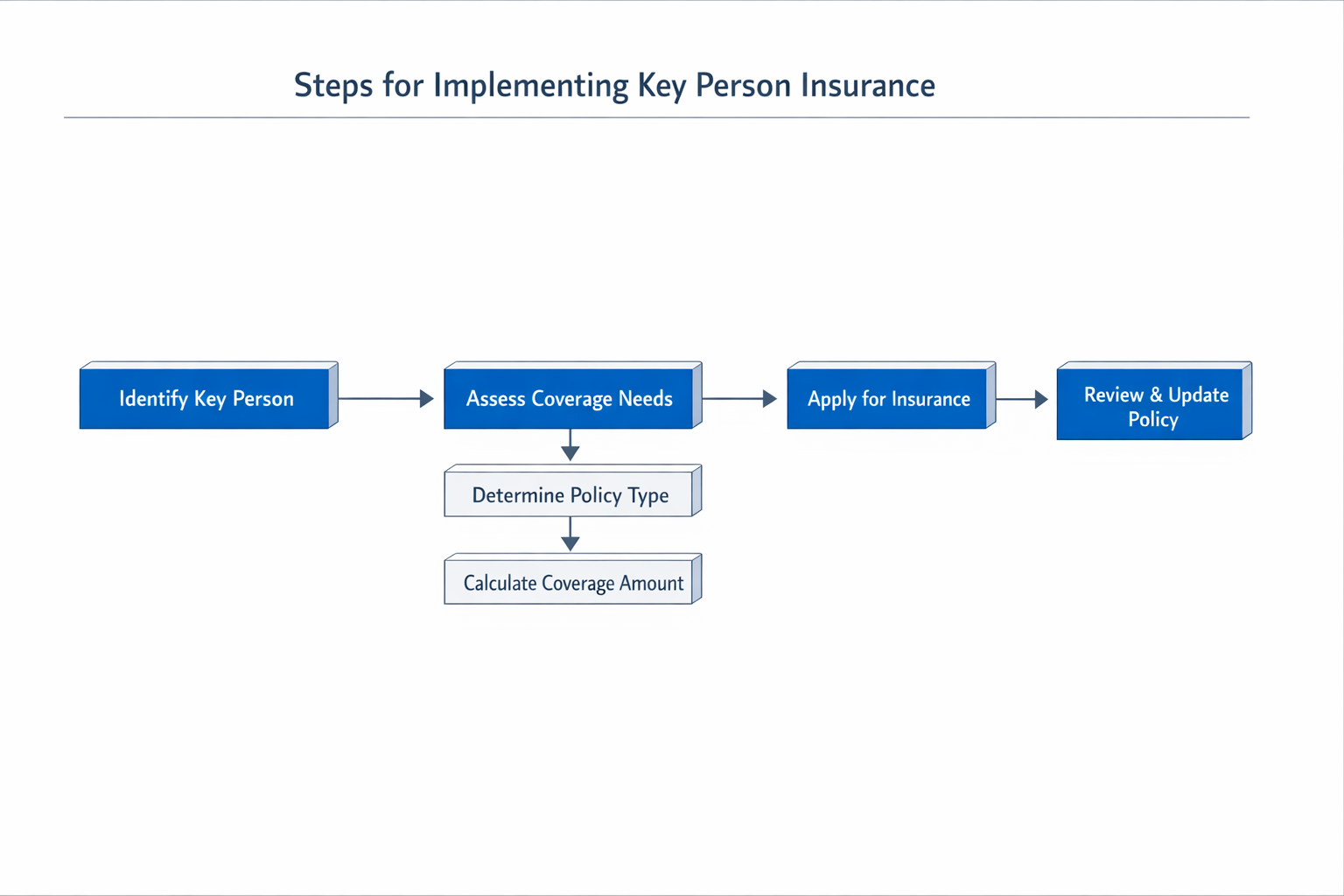
Identify Your Key People
Start by asking which individuals, if lost tomorrow, would create immediate financial disruption. The answer usually includes founders, top revenue generators, technical specialists with irreplaceable expertise, or key client relationship managers. In practical terms, these are people whose absence would trigger measurable revenue loss, require expensive replacement hiring, or force the business to delay critical projects.
For partnerships, the calculation looks slightly different. If your business structure is a partnership and one partner materially participates in daily operations, that person qualifies as a key individual worth insuring. The goal is getting in the right range — not every employee needs coverage, just the ones whose departure creates a financial gap the business can't absorb from operating cash flow.
Step 1
Calculate the coverage amount
Most businesses use a multiple of the key person's annual compensation — typically 5 to 10 times their salary — as a starting point. Factor in replacement costs, training time for a successor, and potential revenue loss during the transition period. A $100,000 policy might make sense for a mid-level manager; a key revenue generator might warrant significantly more.
Step 2
Choose the policy structure
Term life insurance is the most common choice for key man insurance because it provides straightforward death benefit coverage at a predictable cost. The business owns the policy, pays the premiums, and receives the death benefit if the insured key person dies during the coverage period. Permanent insurance is an option if the business wants cash value accumulation, but most small businesses prioritize affordability and simplicity.
Step 3
Determine who gets insured on multi-life policies
If your business has several key individuals, a first-to-die policy can cover multiple lives under one contract. The policy pays out when the first insured person dies, which can be a cost-effective approach for businesses with a leadership team rather than a single indispensable founder. The attained age of the oldest insured typically drives the premium calculation, so expect higher costs if your key people span a wide age range.
Establish Ownership and Beneficiary Designations
The business should be both the policy owner and the beneficiary. This structure ensures the death benefit goes directly to the company to cover the financial disruption caused by the key person's death. The insured employee has no ownership rights in the policy, and the death benefit is not part of their personal estate.
When the business holds legal title and has the enforceable right to designate the beneficiary, the arrangement stays clean for tax and succession purposes. If ownership or beneficiary rights get split between the business and the employee, the tax treatment can become murky — talk to a licensed financial professional before setting up anything other than a standard business-owned, business-beneficiary structure.
Coordinate with Business Succession Planning
Key man insurance works best when it's part of a broader business succession planning framework. The insurance proceeds can fund a buy-sell agreement, cover operating expenses during a leadership search, or provide working capital while the business stabilizes. Without a plan for how the money gets used, a death benefit is just cash sitting in the business account.
The honest answer: most small businesses set up key man insurance as a reactive measure after a close call or a competitor's loss. The businesses that get the most value from it are the ones that integrate the coverage into a documented succession plan before they need it.
Tips and Tricks

Once you've decided to implement key man insurance, a few practical considerations can help you get the most value from the coverage. The goal is getting in the right range — enough protection to keep the business stable without overinsuring and tying up capital unnecessarily.
Review Coverage When Business Circumstances Change
Your key person's value to the company isn't static. When revenue grows, when new product lines launch, or when the insured takes on additional responsibilities, the coverage amount you set two years ago may no longer match the financial exposure. Most businesses benefit from reviewing their key man insurance annually or whenever a major business milestone occurs. This doesn't mean buying a new policy every time — it means confirming that the death benefit still aligns with what the company would need to recruit a replacement, cover lost revenue, and reassure lenders or investors.
Understand How Ownership Transfers Affect Coverage
If your business is acquired or merged, the life insurance contract may continue under the new owner. The acquirer can maintain the policy to fund obligations related to the insured's employment — retirement benefits, pension commitments, or survivorship agreements. The contract terms may change to reflect the youngest surviving insured if the policy covers multiple people, so it's worth understanding how the death of one insured affects the remaining coverage. When structuring a sale or transition, clarify who will own the policy and how the death benefit will be allocated.
Coordinate With Your Broader Succession Plan
Key man insurance works best when it's part of a larger framework. If you've already mapped out business succession planning, the insurance proceeds can fund buy-sell agreements, cover training costs for new leadership, or bridge cash flow gaps during the transition. Without a succession plan, the death benefit might arrive with no clear instructions on how to deploy it. The insurance provides the capital; the succession plan provides the roadmap.
The insurance provides the capital; the succession plan provides the roadmap.
Know the Tax Implications Before You File a Claim
In most cases, life insurance death benefits are received tax-free. However, employer-owned life insurance is subject to specific reporting requirements and potential taxation unless certain exceptions are met. If the insured was a highly compensated employee or director, and the policy was issued with proper notice and consent, the proceeds may qualify for tax-free treatment. If the policy doesn't meet those requirements, part or all of the benefit could be taxable as ordinary income. Talk to a licensed financial professional or tax advisor before the policy is issued to confirm the tax treatment and ensure compliance with IRS rules.
Small business owners who offer retirement benefits like a SEP IRA or SIMPLE IRA should also consider how key man insurance fits alongside other tax-advantaged strategies, including the QBI deduction for pass-through entities.
Conclusion
Key man insurance isn't about predicting tragedy — it's about acknowledging that some people in your business are harder to replace than others. When a founder, top salesperson, or technical expert disappears overnight, the business doesn't just lose their work. It loses client relationships, institutional knowledge, and often the confidence of lenders and investors. The coverage creates breathing room to find a replacement, cover lost revenue, and reassure everyone that the business will survive the transition.
The framework is straightforward: identify the people whose absence would create immediate financial strain, calculate how much revenue or profit they generate or protect, and structure coverage that gives you 12 to 24 months to stabilize. Term policies work for most small businesses because the risk is highest during growth phases when cash is tight and key people are wearing multiple hats. As the business matures and revenue diversifies, the need often decreases.
For small business owners thinking about long-term stability, key man insurance fits into a broader risk management picture that includes business succession planning and employee benefit structures. The honest answer is that most businesses wait too long to put this coverage in place, usually because they're focused on immediate operational needs. But the cost of a term policy is modest compared to the cost of scrambling for capital or losing clients when a key person is suddenly gone.
When you're ready to take the next step, talk to a licensed insurance professional who understands business planning. They can help you calculate appropriate coverage amounts based on your specific situation and structure the policy so it aligns with your business's financial goals. The goal isn't perfect protection — it's getting in the right range so your business can survive a worst-case scenario without liquidating assets or taking on emergency debt.
Frequently asked questions
What is key man insurance?
Key man insurance is a life insurance policy that a business purchases on a critical employee, owner, or contractor whose death or disability would create significant financial hardship for the company. The business pays the premiums, owns the policy, and receives the death benefit to cover lost revenue, replacement costs, and operational continuity.
How much key man insurance coverage should a business carry?
Most businesses calculate coverage as 5 to 10 times the key person's annual compensation, adjusted for their revenue impact and replacement costs. A key revenue generator who brings in $500,000 annually might warrant $2-5 million in coverage, while a technical specialist might need $500,000-$1 million.
Who qualifies as a key person for insurance purposes?
Under IRS regulations, a key person is someone who materially participates in an active trade or business as an owner, employee, or contractor. Practically, this includes founders, top salespeople, lead engineers, operations managers, or anyone whose absence would trigger immediate financial disruption.
Are key man insurance premiums tax-deductible?
No. Premiums paid by a business for key man insurance are generally not tax-deductible. However, death benefits are typically received tax-free if the policy meets certain IRS requirements for employer-owned life insurance.
How does key man insurance differ from business succession planning?
Key man insurance provides immediate cash to cover short-term financial disruption when a critical person dies. Business succession planning addresses long-term ownership transfer and leadership continuity. The two strategies complement each other but serve different purposes.