
Introduction to SEP IRAs
Most people approach retirement savings the same way they approach New Year's resolutions — with good intentions and no framework. The result is predictable. When you're self-employed, the challenge is even sharper: no employer match, no HR department to walk you through the options, and no automatic payroll deduction nudging you to save.
A SEP IRA — Simplified Employee Pension Individual Retirement Account — addresses this gap directly. It's a retirement plan built for self-employed workers and small business owners who want to save substantial amounts without the administrative complexity of traditional employer plans. When considering retirement options as a self-employed individual, the SEP IRA often stands out due to its simplicity and flexibility.
The math works like this: you can contribute up to a significant percentage of your self-employment income, with contribution limits that exceed traditional IRAs by a wide margin. This makes the SEP IRA particularly valuable during high-income years when you want to shelter more earnings from current taxation. The contributions reduce your taxable income now, and the money grows tax-deferred until retirement.
Here's what that actually means in practical terms. If you're a freelance consultant, independent contractor, or small business owner with fluctuating income, a SEP IRA gives you the flexibility to contribute more in profitable years and less (or nothing) when cash flow is tight. There's no mandatory contribution schedule, and you're not locked into a fixed percentage year after year.
The real question is whether a SEP IRA fits your specific situation better than alternatives like a Solo 401(k) or SIMPLE IRA. For most self-employed individuals without employees — or with just a spouse on payroll — the SEP IRA offers the right balance of contribution power and administrative ease. The setup process is straightforward, ongoing paperwork is minimal, and you maintain full control over investment choices within the account.
This guide walks through what a SEP IRA is, how contributions are calculated, who qualifies, and how to avoid the common mistakes that can cost you either in missed savings opportunities or unexpected tax consequences. The goal is getting in the right range for your retirement needs without overcomplicating the process.
Discover what a SEP IRA is and how it benefits self-employed workers. Learn about contributions, eligibility, and tax advantages.
What Is a SEP IRA?
A SEP IRA — Simplified Employee Pension Individual Retirement Account — is a retirement plan designed specifically for self-employed individuals and small business owners. Instead of setting up a complex profit-sharing or pension plan with a trust, you adopt a SEP agreement and make contributions directly to a traditional IRA. The structure is straightforward: the employer makes contributions to individual IRAs established for each eligible employee, including the business owner.
How a SEP IRA Works
Under a SEP arrangement, contributions flow from the employer to traditional IRAs set up in each participant's name. For self-employed workers, you're both the employer and the employee — you contribute to your own SEP IRA based on your net self-employment income. The IRS treats these accounts as IRAs rather than employer plans for distribution purposes, which means they follow the same withdrawal rules as traditional IRAs once the money is in the account.
Individuals may also make their own separate contributions to the same IRA that receives SEP contributions, up to the regular IRA contribution limits. This dual-contribution feature gives you flexibility: your business can fund the SEP portion, while you personally can add traditional or Roth IRA contributions if you're eligible.
SEP IRA vs. Other Retirement Accounts
The difference between a SEP IRA and other retirement options comes down to simplicity and contribution structure. A SEP IRA has no annual filing requirements — no Form 5500, no discrimination testing, no loan provisions to administer. Compare that to a 401(k), which requires annual reporting and nondiscrimination testing, or a SIMPLE IRA, which involves mandatory employer contributions and salary deferrals.
| Feature | SEP IRA | Traditional IRA | 401(k) |
|---|---|---|---|
| Who contributes | Employer only | Individual | Individual + employer |
| 2025 contribution limit | Up to 25% of compensation* | $7,000 ($8,000 if 50+) | $23,500 + employer match |
| Annual reporting | None | None | Form 5500 required |
| Setup complexity | Low | Low | High |
*For self-employed: approximately 20% of net self-employment income after deducting half of self-employment tax
A SEP IRA sits between a traditional IRA and a full retirement plan. You get significantly higher contribution limits than a traditional IRA — potentially over $60,000 for 2025 depending on your income — without the administrative burden of a 401(k). The tradeoff: only the employer contributes, so if you want to defer salary as an employee, a SEP won't accommodate that.
The framework makes sense for solo practitioners, consultants, and small business owners who want to maximize retirement savings without hiring a third-party administrator. If your income fluctuates year to year, the flexibility to adjust contributions — or skip a year entirely — gives you control that more rigid plans don't offer.
Why a SEP IRA Matters for Self-Employed Workers
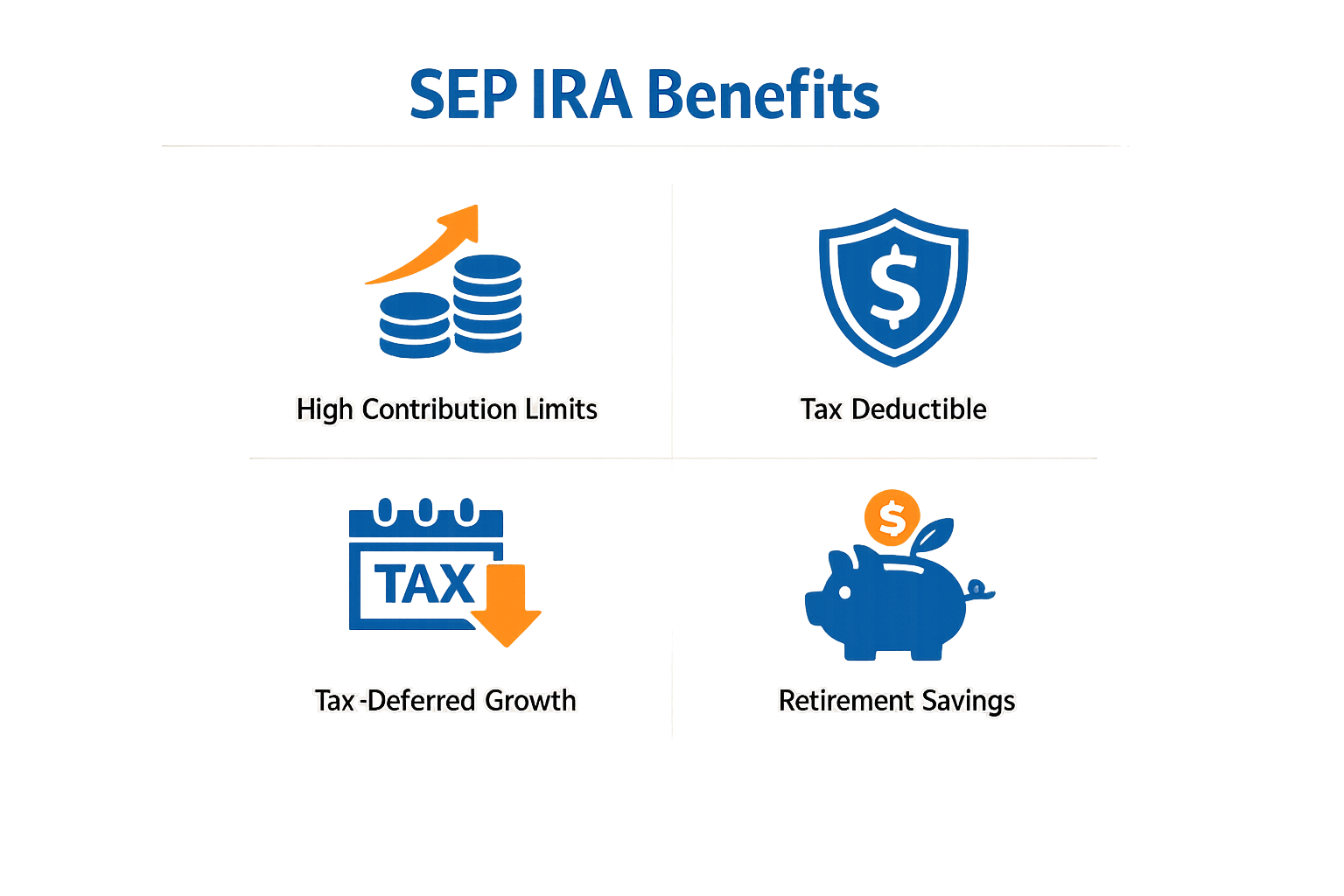
When you're self-employed, retirement planning sits squarely on your shoulders. No employer match. No automatic payroll deduction. No HR department handling the paperwork. The SEP IRA exists specifically to solve this problem — it's built for people who are both the employer and the employee.
The framework is straightforward. A SEP IRA gives you a way to save significantly more for retirement than a traditional IRA while keeping administrative work minimal. For self-employed workers juggling client deadlines, invoicing, and business operations, that simplicity matters.
Tax Advantages That Scale With Your Income
Contributions to a SEP IRA are tax-deductible, which means they reduce your taxable income in the year you make them. If you're a freelance consultant who earned $100,000 and contributed $20,000 to your SEP IRA, you're only taxed on $80,000. The math works like this: higher income years let you shelter more earnings, and leaner years require smaller contributions — or none at all.
This flexibility is rare in retirement accounts. You're not locked into a fixed monthly contribution. If you land a major contract in Q4, you can make a larger contribution before the tax deadline. If revenue dips, you can scale back without penalty.
Retirement Savings Without the Complexity
Most self-employed workers don't have time to manage complicated retirement plans. A SEP IRA requires no annual filings with the IRS, no discrimination testing, and no complex plan documents. You open an account with a financial institution, contribute what you can afford, and invest the funds. That's the entire administrative burden.
Compare that to a solo 401(k), which requires annual Form 5500 filings once your account balance exceeds $250,000, or a defined benefit plan, which demands actuarial calculations and professional plan administration. The SEP IRA strips retirement planning down to the essentials.
The Real Question: Is It Right for Your Situation?
A SEP IRA makes the most sense when you have income that varies year to year, you want to maximize tax-deferred savings, and you don't want to deal with administrative overhead. It's less ideal if you have employees you'd rather not cover, or if you want to make Roth (after-tax) contributions.
The framework isn't about finding the "best" retirement account — it's about matching the account structure to your business reality. For many self-employed workers, the combination of high contribution limits, tax deductions, and minimal paperwork puts the SEP IRA in the right range.
The goal isn't perfection — it's getting a retirement savings framework in place that you'll actually use.
How to Set Up a SEP IRA
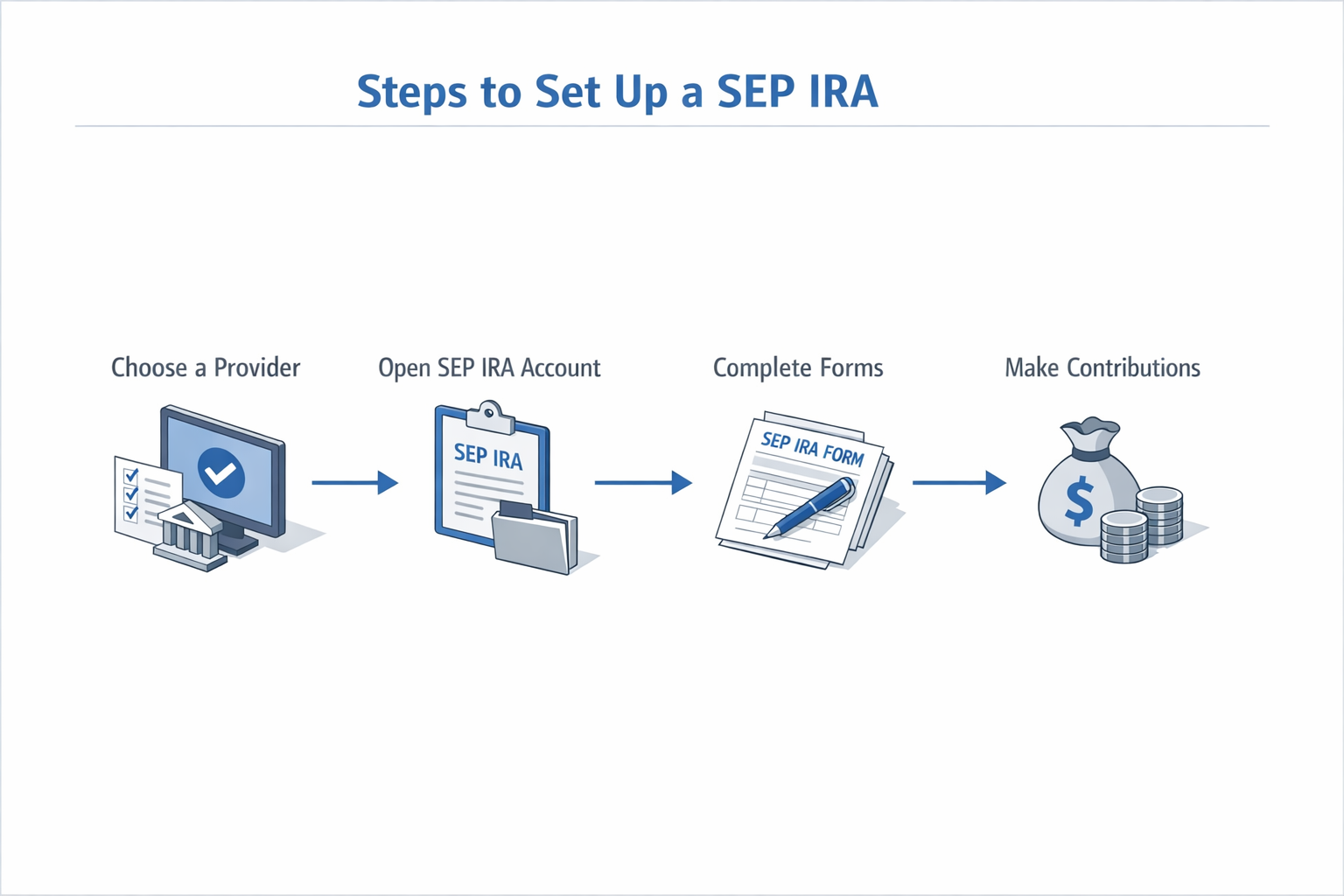
Setting up a SEP IRA is more straightforward than establishing most other retirement plans. The process doesn't require IRS approval or annual filings — you're working with a standard framework that financial institutions already know how to handle. Most self-employed individuals can complete the setup in an afternoon.
The math works like this: you choose where to open the account, sign the paperwork, and start contributing. No complicated plan documents, no annual Form 5500 filings, no testing requirements. If you have employees, you'll need to include them under the same contribution percentage you use for yourself, but the setup mechanics stay the same.
Choose a Financial Institution
SEP IRAs can be established with banks, insurance companies, or other qualified financial institutions. You're looking for a provider that offers the investment options you want — mutual funds, ETFs, individual stocks, bonds, or a combination. Most major brokerages and many banks offer SEP IRAs.
Compare fees carefully. Some institutions charge annual account maintenance fees, while others waive them if you maintain a minimum balance or set up automatic contributions. Transaction fees for buying and selling investments also vary. The difference between a low-cost provider and a high-fee one can compound to tens of thousands of dollars over a career.
Step 1
Open the account
Complete the financial institution's SEP IRA application. You'll provide basic information — name, Social Security number, date of birth, and beneficiary designations. The institution will ask whether you're establishing this as an employer (which you are, even if you're a sole proprietor with no employees).
Step 2
Adopt a written agreement
The IRS provides Form 5305-SEP, a model SEP agreement that most employers use. Your financial institution will typically provide this form as part of the account setup. By signing it, you're adopting the SEP plan. If you have employees, you must provide them with a copy of this agreement and information about their SEP IRA.
Step 3
Set up SEP IRAs for eligible employees
If you have employees who meet the eligibility requirements (generally anyone who has worked for you in three of the last five years, is at least 21 years old, and earned at least the minimum threshold), you must establish a SEP IRA for each of them. The employee chooses where their SEP IRA is maintained — you don't control that decision. You send contributions to whatever institution they select.
Understanding the Necessary Paperwork
The paperwork for a SEP IRA is minimal compared to other retirement plans. Form 5305-SEP is the core document — it's a two-page form that establishes the plan's terms. You don't file it with the IRS; you keep it with your business records.
If you have employees, you must give them a statement each year showing any contributions to their SEP IRAs. You must also provide notice of any excess contributions. The financial institution where you maintain your own SEP IRA will typically provide you with the forms and guidance you need to stay compliant.
Most self-employed individuals find the setup process takes less time than they expected. The framework is standardized, the forms are short, and financial institutions handle SEP IRAs routinely. The real work isn't in the setup — it's in the ongoing decisions about how much to contribute and how to invest those contributions.
Best Practices for Managing Your SEP IRA
Setting up a SEP IRA is the easy part. Managing it well over time requires a framework that keeps your contributions consistent, your investments aligned with your goals, and your account in compliance with IRS rules. Most self-employed workers approach their SEP IRA the same way they approach quarterly taxes — with good intentions and no system. The result is missed contribution deadlines, unbalanced portfolios, and avoidable tax complications.
Here's what effective SEP IRA management actually looks like in practice.
Contribute Consistently, Not Sporadically
The biggest advantage of a SEP IRA is flexibility — you're not locked into fixed monthly contributions. The biggest risk of a SEP IRA is that same flexibility. When income fluctuates, retirement savings tend to be the first expense that gets deferred.
The framework that works: treat your SEP IRA contribution as a percentage of net self-employment income, not a discretionary year-end deposit. If you're targeting 15% of your income for retirement, move that percentage into a separate savings account quarterly. When tax season arrives, you'll have the cash ready to fund your SEP IRA without scrambling or skipping the contribution entirely.
This approach also smooths out the psychological friction of large lump-sum contributions. Setting aside $3,000 per quarter feels manageable. Writing a $12,000 check in April feels like a crisis.
Diversify Your Investments — Don't Let Cash Pile Up
A SEP IRA is a retirement account structure, not an investment. The contributions you make sit in whatever investments you choose — stocks, bonds, mutual funds, or cash. Most self-employed workers open a SEP IRA, make their first contribution, and then forget to actually invest the money. The cash sits in a money market settlement fund earning minimal interest while the years pass.
The math works like this: a $10,000 contribution sitting in cash at 0.5% annual interest grows to $10,512 over ten years. The same $10,000 invested in a diversified portfolio averaging 7% annual returns grows to $19,672. The difference isn't rounding error — it's the entire point of tax-deferred compounding.
When you're ready to take the next step, talk to a licensed financial professional about asset allocation that matches your risk tolerance and timeline. For informational and educational purposes, a common starting framework for workers in their 30s and 40s is a mix of 70–80% stock index funds and 20–30% bond funds, rebalanced annually. Your specific situation may call for a different allocation.
Avoid Prohibited Transactions
The IRS gives you significant tax advantages with a SEP IRA. In exchange, there are strict rules about what you can and cannot do with the account. A prohibited transaction — like borrowing money from your SEP IRA, using it as collateral for a loan, or buying property for personal use — disqualifies the entire account. Once disqualified, the full balance becomes taxable income in that year, plus a 10% early withdrawal penalty if you're under 59½.
Most people don't realize how broad the prohibited transaction rules are. You can't lend money to yourself. You can't use the account to buy your business's inventory. You can't pay yourself a salary from SEP IRA funds. The account exists separately from your business and personal finances, and the IRS expects you to keep it that way.
If you need short-term access to cash, a SEP IRA is the wrong place to look. Build a separate emergency fund in a taxable savings account for business and personal needs.
Review and Rebalance Annually
Investment portfolios drift over time. If you start the year with 70% stocks and 30% bonds, a strong stock market might push that to 80% stocks by year-end. That's not inherently bad, but it does mean you're taking more risk than you intended. Annual rebalancing brings the portfolio back to your target allocation.
The framework: pick one date each year — your birthday, tax day, January 1st, whatever anchors in your memory — and review your SEP IRA. Check the current allocation, compare it to your target, and rebalance if any asset class has drifted more than 5 percentage points. Most brokerage platforms let you rebalance with a few clicks, and there are no tax consequences for trades inside a tax-deferred account.
This is also the time to review your contribution strategy for the coming year. If your income increased, consider raising your contribution percentage. If you're approaching retirement, you might shift toward more conservative investments. The goal is getting in the right range, not perfection.
Keep Records of Contributions and Statements
You must give yourself a statement each year showing contributions to your SEP IRA, and you need to keep records of those contributions for your tax filings. Most self-employed workers treat their SEP IRA like a set-it-and-forget-it account, then scramble at tax time trying to reconstruct what they contributed and when.
The straightforward approach: create a dedicated folder — physical or digital — for SEP IRA records. Every time you make a contribution, save the confirmation. Every time you receive a year-end statement, file it in the same place. When your accountant asks for documentation, you hand over the folder instead of digging through email archives.
This becomes especially important if you ever face an audit or need to calculate required minimum distributions in retirement. The IRS expects serialized records, not reconstructed estimates.
Common Mistakes to Avoid with a SEP IRA
Most self-employed workers set up a SEP IRA with the best intentions, then make one of a handful of predictable mistakes that cost them money or create compliance headaches. The good news: these errors are straightforward to avoid once you know what to watch for.
Missing the Contribution Deadline
The most common mistake is assuming the SEP IRA contribution deadline matches the calendar year. It doesn't. You can make SEP IRA contributions up until your tax filing deadline, including extensions — typically April 15 for most filers, or as late as October 15 if you file an extension. Missing this window means you lose that year's contribution opportunity entirely. There's no makeup provision.
Set a reminder for March each year to calculate your allowable contribution and fund the account before the deadline. If you're waiting on final business financials, file a tax extension to buy yourself until October — but don't wait until the last minute to move the money.
Forgetting to Include Eligible Employees
If you have employees, SEP IRA rules require you to contribute the same percentage of compensation for every eligible employee that you contribute for yourself. An eligible employee is anyone who is at least 21 years old, has worked for you in at least three of the last five years, and earned at least the IRS minimum (typically a few hundred dollars).
Before making your annual contribution, review your employee roster against the eligibility criteria. If you have even one part-time worker who meets the thresholds, you must include them at the same percentage you're using for yourself.
Confusing SEP Contributions with Personal IRA Contributions
Some people assume that because a SEP IRA is a type of IRA, they can make the standard personal IRA contribution on top of their SEP contribution. The math works differently. Your SEP IRA contribution is based on self-employment income and goes into the SEP account. You can still make a separate traditional or Roth IRA contribution (subject to income limits), but those are two different accounts with different rules.
The confusion usually happens at tax time when people try to deduct both. The SEP contribution is a business deduction on Schedule C or the equivalent; the personal IRA contribution is an adjustment to income on Form 1040. Keep the accounts separate and track the contributions separately.
Over-Contributing Based on Gross Income
The SEP IRA contribution limit is based on net self-employment income after you subtract half of your self-employment tax — not your gross revenue. A common mistake is calculating the contribution as a percentage of gross income, which overstates what you're allowed to contribute and creates a tax problem.
The actual calculation involves reducing your net earnings by half of your self-employment tax, then applying the contribution percentage. For most people, this works out to an effective maximum around 20% of net self-employment income, not the 25% often cited for employer contributions to employees. Use IRS worksheets or work with a tax professional to get the number right.
Neglecting Investment Management
Setting up the SEP IRA and making contributions is only half the job. The money still needs to be invested. A surprising number of people fund their SEP IRA and leave the cash sitting in a money market account earning minimal returns, assuming the account provider will automatically invest it.
Once the contribution hits your SEP IRA, you're responsible for choosing investments — typically a mix of stocks, bonds, and other assets aligned with your risk tolerance and timeline. If you're uncomfortable making those decisions, consider low-cost target-date funds that automatically adjust as you approach retirement. The goal is getting in the right range, not perfect optimization.
Withdrawing Too Early
SEP IRA funds are meant for retirement. If you withdraw money before age 59½, you'll owe ordinary income tax on the full amount plus a 10% early withdrawal penalty (with limited exceptions for disability, certain medical expenses, or first-time home purchases).
If you're self-employed and cash flow is unpredictable, maintain a separate emergency fund before maximizing SEP contributions. Don't treat your retirement account as a backup checking account.
Failing to Update Beneficiaries
When you open a SEP IRA, you designate beneficiaries who will inherit the account if you die. Life changes — marriage, divorce, births, deaths — but beneficiary forms often don't get updated. An outdated beneficiary designation overrides your will, which creates problems if your ex-spouse is still listed or if you've had children since you opened the account.
Review your SEP IRA beneficiary designations annually, especially after major life events. The form is usually available through your account provider's website and takes five minutes to update.
Mixing SEP and Solo 401(k) in the Same Year
If you're self-employed with no employees, both a SEP IRA and a Solo 401(k) are options — but you can't contribute the maximum to both in the same year. The IRS limits apply across all your retirement accounts combined. Some people set up both accounts thinking they can double their contribution room. They can't.
Pick one structure and stick with it for the year. If you're considering switching from a SEP to a Solo 401(k) (or vice versa), do it at year-end so you're not juggling two plans mid-year. The contribution limits overlap; you're not getting extra room by maintaining both.
The honest answer: most SEP IRA mistakes come from treating it like a simple savings account rather than a retirement plan with specific rules. The rules aren't complicated, but they are exact. When you're ready to take the next step, talk to a licensed financial professional or tax advisor who can review your specific situation and confirm you're staying compliant while maximizing your retirement savings.
Frequently Asked Questions About SEP IRAs
Most people approach retirement accounts with good intentions and a dozen unanswered questions. Here's what self-employed workers and small business owners ask most often about SEP IRAs.
Can I contribute to a SEP IRA if I have employees?
Yes, but here's the catch: if you contribute to your own SEP IRA, you must contribute the same percentage of compensation to every eligible employee's account. If you put in 15% of your net self-employment income, you put in 15% of each eligible employee's salary too. That's not a suggestion — it's a requirement. The framework is designed to prevent business owners from funding only their own retirement while excluding their team.
Can I make personal contributions to my SEP IRA?
Yes. The employer contribution — which you make to yourself if you're self-employed — doesn't prevent you from making additional personal contributions to the same IRA. The personal contribution follows traditional IRA rules and limits, which are separate from the SEP contribution limits. For informational and educational purposes, this means you can layer a personal IRA contribution on top of your SEP employer contribution, as long as you stay within the respective limits for each.
What happens if I miss the contribution deadline?
SEP IRA contributions can be made up until your tax filing deadline, including extensions. If you file for an extension to October 15, you have until that date to make your prior-year contribution. Missing that deadline doesn't create a penalty in the traditional sense — you simply lose the ability to make that year's contribution and claim the deduction. The math works like this: if you skip a year, you can't go back and make it up later.
Am I required to contribute every year?
No. SEP IRAs offer complete flexibility on contributions. You can contribute the maximum one year, skip the next year entirely, and contribute a different percentage the year after that. This flexibility makes the SEP IRA particularly useful for self-employed workers with variable income. When income is strong, you can save aggressively; when it's lean, you can skip contributions without penalty or paperwork.
Can I have both a SEP IRA and a traditional or Roth IRA?
Yes. You can maintain a SEP IRA alongside a traditional IRA or Roth IRA. The SEP contribution doesn't count against your personal IRA contribution limit. In practical terms, you could contribute the SEP maximum as an employer and still contribute separately to a Roth IRA as an individual, assuming you meet the income requirements for Roth contributions.
The SEP IRA's flexibility on annual contributions makes it one of the most forgiving retirement vehicles for workers with unpredictable income.
Do SEP IRA contributions reduce my taxable income?
Yes. SEP IRA contributions are deductible as a business expense, which reduces your adjusted gross income. For self-employed individuals, this deduction appears on Schedule 1 of Form 1040. The real question is timing: the contribution must be made by your tax filing deadline (including extensions) to count for that tax year, but the deduction applies to the year you're filing for, not the year you physically make the deposit.
What are the eligibility requirements for employees?
Employees must be included in the SEP plan if they meet three criteria: they're at least 21 years old, they've worked for you in at least three of the last five years, and they received at least $750 in compensation during the year (2025 threshold). You can use less restrictive requirements if you choose, but you can't be more restrictive. Once an employee is eligible, you must contribute the same percentage to their account that you contribute to your own.
Can I roll over my SEP IRA to another retirement account?
Yes. A SEP IRA can be rolled over to a traditional IRA, another SEP IRA, a 401(k), or certain other qualified plans without tax consequences, as long as you follow rollover rules. Direct trustee-to-trustee transfers are the cleanest method — the funds move from one institution to another without you taking possession, which avoids withholding and the 60-day rollover clock.
Conclusion: Planning for Your Future with a SEP IRA
A SEP IRA offers self-employed workers and small business owners a straightforward path to building retirement savings without the administrative burden of more complex plans. The framework is simple: generous contribution limits, immediate tax deductions, and flexibility to adjust contributions based on your business income each year. For most self-employed individuals, that combination makes the SEP IRA worth serious consideration as part of a retirement strategy.
The math works in your favor when you're earning enough to make meaningful contributions. With the ability to contribute up to 25% of net self-employment income (after adjustments) or a substantial dollar limit, you can build a retirement fund that scales with your business success. The tax advantages compound over time — every dollar you contribute reduces your current taxable income while growing tax-deferred until retirement.
Understanding the SEP IRA rules and how contributions are calculated is crucial for making informed decisions about your retirement strategy. The contribution deadlines, the calculation methods, and the distribution rules all matter when you're managing your own retirement timeline. Most people don't realize how much flexibility they have within the framework, or how to coordinate a SEP IRA with other retirement accounts when their situation evolves.
The honest answer: a SEP IRA isn't the right fit for everyone. If you have employees, the requirement to contribute equally for them changes the cost structure. If your income fluctuates significantly or you're just starting out, you might need more flexibility than a SEP provides. But for established self-employed workers with consistent income and no employees — or those who can afford to contribute for their team — the SEP IRA remains one of the most efficient retirement savings vehicles available.
Your retirement strategy depends on your circumstances, your timeline, and your goals. A SEP IRA is a starting point, not the complete answer. The framework gives you a solid foundation; the execution requires attention to contribution deadlines, investment choices, and how your retirement accounts work together over time. Most self-employed individuals benefit from building a retirement plan that adapts as their business grows — and the SEP IRA's simplicity makes that easier to manage year after year.