
Introduction
Choosing between a SIMPLE IRA vs 401k for small business retirement planning is about building a framework that works for your team without consuming resources you don't have. SIMPLE IRAs cost less and require less administration, making them attractive for businesses with fewer than 100 employees. Traditional 401(k)s offer higher contribution limits and more flexibility but come with steeper costs and compliance requirements.
A SIMPLE IRA (Savings Incentive Match Plan for Employees) operates like a scaled-down retirement plan designed specifically for small businesses. You contribute to employee accounts, employees can defer salary, and the IRS gives everyone tax advantages. A 401(k) works on similar principles but with more moving parts — higher limits, more investment options, and significantly more paperwork. For more context on how retirement planning fits into broader business strategy, see our guide on Business Succession Planning: Protecting Your Company's Future.
The real question isn't which plan sounds better on paper. The real question is which one you'll actually maintain year after year without it becoming a second job. That depends on your employee count, your budget for plan administration, and whether you're willing to trade simplicity for flexibility. Most businesses find their answer by looking at the numbers — both the contribution math and the administrative costs — rather than chasing theoretical advantages they'll never use.
This comparison breaks down the practical differences between SIMPLE IRA vs 401k for small business retirement planning. You'll see the contribution limits, the employer cost requirements, the administrative burden, and the eligibility rules that determine which plan fits your situation. The goal is getting in the right range for your business, not finding a perfect solution that doesn't exist.
The Problem: Choosing the Right Retirement Plan
Most small business owners approach retirement plan selection the same way they approach insurance shopping — they know they need something, but the options blur together until paralysis sets in. The stakes are real: pick the wrong structure and you're either overpaying for features you don't need or underserving employees who expected more. Neither outcome helps retention or morale.
The fundamental tension is straightforward. A SIMPLE IRA offers administrative simplicity and lower setup costs, which matters when you're running a 15-person operation without a dedicated HR department. A 401(k) delivers higher contribution limits and more design flexibility, but those advantages come with compliance requirements that can overwhelm a business still figuring out its payroll rhythm. The question isn't which plan is objectively better — it's which framework fits the constraints you're actually working with.
The cost structure compounds the decision. SIMPLE IRAs require mandatory employer contributions — either a dollar-for-dollar match up to 3% of compensation or a flat 2% nonelective contribution for all eligible employees, regardless of whether they participate. That predictability helps budgeting, but it also means you're committed even in lean years. A 401(k) lets you skip employer contributions entirely if cash flow demands it, but the administrative fees and annual testing requirements create their own financial drag. Most owners underestimate the ongoing compliance burden until they're already locked in.
Timing adds another layer of friction. SIMPLE IRAs must be established between January 1 and October 1 for new businesses, or by October 1 for existing businesses that didn't previously maintain a plan. Miss that window and you're waiting until next year. A 401(k) can be adopted as late as your tax filing deadline (including extensions), which gives you more runway but also invites procrastination. The setup timeline matters more than most owners realize — especially when year-end tax planning depends on getting deductible contributions in before December 31.
The real question is whether your business structure and employee expectations align with the plan's constraints. If you're a stable 20-person company where most employees value retirement benefits and you want to keep administration lean, the SIMPLE IRA framework likely fits. If you're growing quickly, anticipate crossing 100 employees, or have key employees who want to contribute more than the SIMPLE IRA ceiling allows, the 401(k) makes more sense despite the added complexity. The math works differently depending on where you sit in that range.
Solution Steps: Understanding SIMPLE IRA vs 401k for Small Business
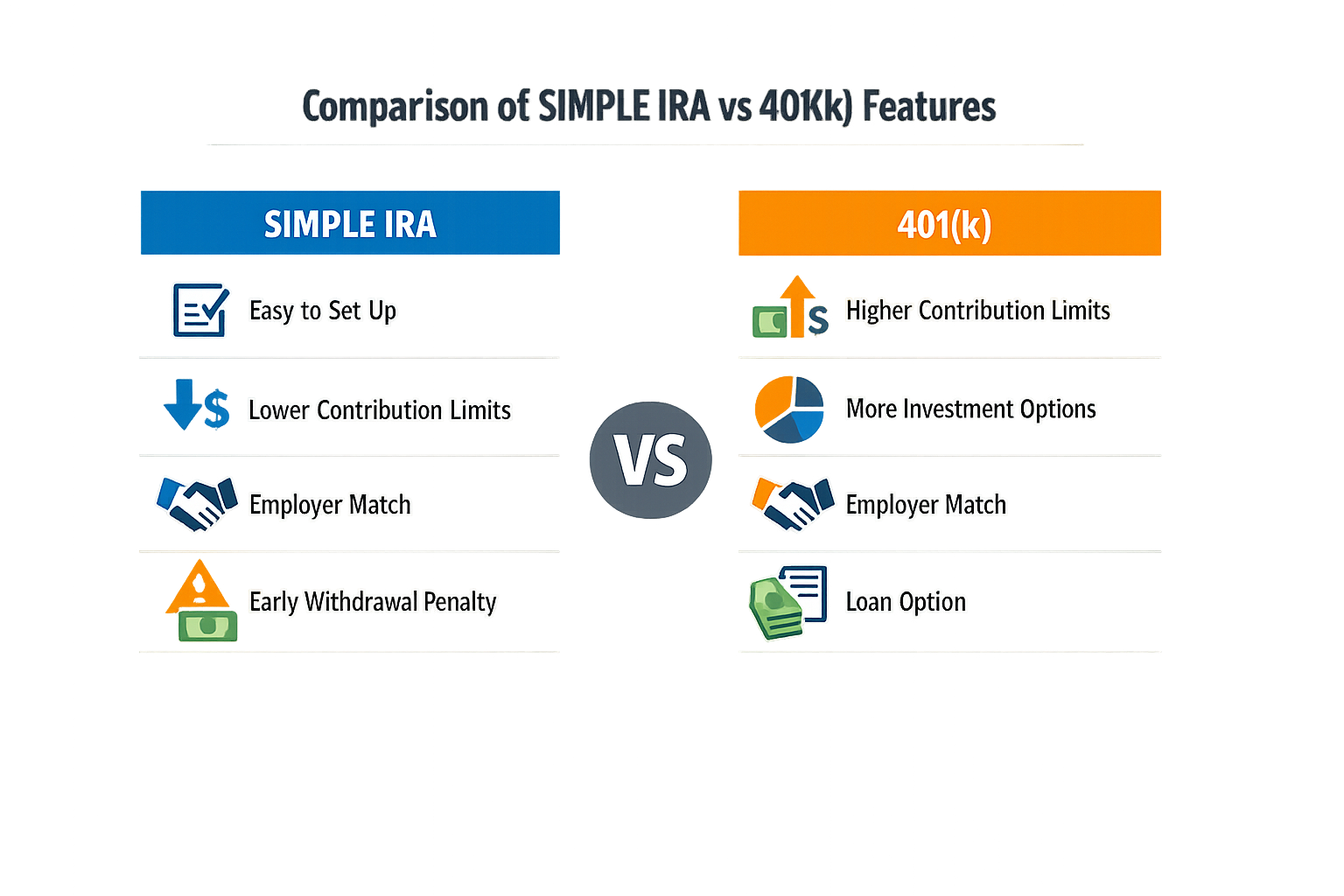
The difference between these two plans comes down to flexibility, cost, and administrative burden. Here's what that actually means in practical terms.
What Are the Eligibility Requirements?
A SIMPLE IRA works for businesses with 100 or fewer employees who earned at least $5,000 in the previous year. That's the threshold — if you're over 100, you're out. A 401(k) has no employee count restriction. You can offer it whether you have 5 employees or 500.
The SIMPLE IRA eligibility rule is straightforward. The 401(k) requires more paperwork but scales better as you grow.
How Much Can Employees Contribute?
For 2025, employees can contribute up to $16,500 to a SIMPLE IRA through salary reduction. That limit increases to $17,000 in 2026. Certain employers may allow a higher limit of $17,600 in 2025 under recent legislation.
A 401(k) allows significantly higher employee contributions — $23,500 for 2025 (increasing to $24,000 in 2026 for those under 50). If your employees want to save aggressively, the 401(k) gives them more room.
| Feature | SIMPLE IRA | 401(k) |
|---|---|---|
| Employee limit (2025) | $16,500 | $23,500 |
| Employee limit (2026) | $17,000 | $24,000 |
| Employer size cap | 100 employees max | No cap |
| Setup complexity | Low | Moderate to high |
What Are the Employer Contribution Requirements?
With a SIMPLE IRA, you must contribute. You have two options: match employee contributions dollar-for-dollar up to 3% of compensation, or make a 2% nonelective contribution to all eligible employees regardless of whether they participate.
A 401(k) doesn't require employer contributions. You can offer a match to encourage participation, but it's optional. That flexibility matters if cash flow is tight in a given year.
How Do Administrative Costs Compare?
SIMPLE IRAs are easier to administer. You don't file annual Form 5500 reports with the IRS. Setup costs are minimal, and ongoing administrative work is light. Employees own their accounts directly, which reduces your fiduciary responsibility.
401(k) plans require annual nondiscrimination testing, Form 5500 filings, and often a third-party administrator. Setup costs run higher, and you'll typically pay ongoing fees for recordkeeping and compliance. The trade-off: more design flexibility and higher contribution limits.
How Do Vesting and Withdrawal Rules Differ?
SIMPLE IRA contributions are always 100% vested immediately. Employees own everything from day one. Early withdrawals before age 59½ trigger a 10% penalty, but if the withdrawal happens within the first two years of participation, that penalty jumps to 25%.
With a 401(k), you control the vesting schedule for employer contributions. You can require employees to stay a certain number of years before they own the match. Employee salary deferrals are always immediately vested, but employer contributions can vest over time.
When Does Each Plan Make Sense?
A SIMPLE IRA works when you want straightforward setup, predictable costs, and minimal administration. It's a good fit for stable teams under 100 employees where contribution limits won't feel restrictive.
A 401(k) makes sense when you expect to grow beyond 100 employees, when key employees want to save more than the SIMPLE IRA allows, or when you want the flexibility to skip employer contributions in lean years. The higher administrative cost buys you design flexibility and scalability.
The math works like this: if your top concern is keeping costs and paperwork low, the SIMPLE IRA wins. If your top concern is maximizing savings potential and future growth, the 401(k) wins.
Neither plan is objectively better. The right answer depends on your company's size, growth trajectory, and how much employees want to save. Most small businesses start with the simpler option and graduate to a 401(k) as they scale.
Tips and Tricks for Choosing the Right Plan
Most small business owners approach retirement plan selection the same way they approach buying software — by comparing feature lists. The real question is which plan fits the way your business actually operates, not which one looks better on paper.
Start With Your Employee Count
The 100-employee threshold matters more than most people realize. If you have more than 100 employees who earned at least $5,000 in the preceding year, a SIMPLE IRA is off the table — the IRS draws a hard line there. For businesses sitting right at that boundary, the math works like this: count everyone who cleared the $5,000 mark, not just full-time staff. If you're close to 100 or expect to cross that line in the next few years, a 401(k) gives you room to grow without switching plans mid-stream.
Match Your Contribution Capacity to the Plan Structure
Here's what that actually means: a SIMPLE IRA requires you to contribute every year — either a 2% nonelective contribution for all eligible employees or a dollar-for-dollar match up to 3% of compensation. There's no skipping a year when cash is tight. A 401(k) gives you the option to contribute or not, depending on your circumstances. If your business has predictable cash flow and you want the discipline of mandatory contributions, the SIMPLE IRA framework works. If revenue swings year to year, the flexibility of a 401(k) is worth the extra administrative cost.
For informational and educational purposes, consider this: the contribution limits differ significantly. In 2024, employees can defer up to $16,000 in a SIMPLE IRA ($19,500 if age 50 or older). In a 401(k), those limits jump to $23,000 ($30,500 with catch-up contributions). If you or your employees want to save more than the SIMPLE IRA ceiling allows, that gap closes the decision.
Evaluate the True Cost of Administration
The straightforward answer: SIMPLE IRAs cost less to run because they require minimal paperwork and no annual filing requirements. Most providers charge a few hundred dollars per year, and the setup process takes weeks, not months. A 401(k) requires Form 5500 filings, nondiscrimination testing, and often a third-party administrator. Expect to pay several thousand dollars annually for a small plan.
But cost isn't just the invoice from your provider. Factor in your time — or your bookkeeper's time — dealing with plan administration. If you're running a 15-person company and everyone on your team wants to maximize their retirement savings, the extra cost of a 401(k) might be a better investment than the simplicity of a SIMPLE IRA that caps contributions too low.
Think About Future Flexibility
A common misconception: once you pick a plan, you're locked in. Not true, but switching costs money and creates gaps in coverage. If you start with a SIMPLE IRA and later want to move to a 401(k), you'll need to notify employees at least 60 days before the start of the election period, and you can't maintain both plans simultaneously. The transition takes planning.
If you're building a business you expect to scale — adding employees, increasing revenue, maybe bringing on investors — a 401(k) grows with you. A SIMPLE IRA works for businesses that plan to stay small and steady. Neither choice is wrong; the goal is getting in the right range for where your business is headed, not just where it is today.
For more context on retirement planning options for small teams, see our guide on What Is a SIMPLE IRA? A Guide for Small Teams. If you're self-employed, you might also consider a SEP IRA, which offers different advantages for solo entrepreneurs.
Consider Your Employees' Needs
Most people don't realize this, but employee participation rates often depend more on plan design than on the contribution match. A SIMPLE IRA with automatic enrollment (where employees must opt out rather than opt in) can drive higher participation than a 401(k) with a generous match that requires employees to take action. If your goal is getting everyone into the plan, the framework matters as much as the features.
Talk to your team. Find out how many are already maxing out their contributions in a SIMPLE IRA and hitting the ceiling. Find out how many aren't participating at all because they don't understand the options. The honest answer about which plan is better comes from understanding what your specific employees actually need, not what the average small business employee might want.
Conclusion
Choosing between a SIMPLE IRA vs 401k for small business retirement planning isn't about finding the objectively "best" plan — it's about finding the one that fits your business's size, budget, and growth trajectory. If you're running a company with fewer than 100 employees and want straightforward administration with mandatory employer contributions, a SIMPLE IRA delivers exactly that. If you need higher contribution limits, flexible employer matching, and room to scale as your business grows, a 401(k) is worth the additional complexity and cost.
The framework is simple: match the plan's structure to your current reality, not to where you hope to be in five years. A SIMPLE IRA works when your priority is getting a retirement plan in place quickly without hiring a benefits consultant. A 401(k) works when you're ready to invest in a more robust plan that rewards high earners and gives you control over employer contributions. Neither plan is a permanent decision — you can transition from a SIMPLE IRA to a 401(k) as your business grows, though the timing requires careful planning to avoid penalties.
The honest answer: most small business owners benefit from starting with the plan they can implement this year rather than waiting for the "perfect" setup. If you're not sure which structure aligns with your situation, business succession planning often surfaces the same questions about long-term employee retention and tax strategy. Understanding the QBI deduction can also help you maximize the tax benefits of either retirement plan structure. When you're ready to take the next step, talk to a licensed financial professional who can walk through the math specific to your payroll, employee count, and growth plans. The goal isn't perfection — it's getting your team into a retirement savings framework that actually works.
Frequently asked questions
Which is better for a small business: SIMPLE IRA or 401k?
A SIMPLE IRA vs 401k for small business decision depends on your employee count and growth plans. SIMPLE IRAs work best for companies with fewer than 100 employees seeking lower costs and minimal administration. A 401(k) suits businesses expecting growth, needing higher contribution limits, or wanting flexible employer match options.
What are the contribution limits for SIMPLE IRA vs 401k?
For 2025, employees can contribute up to $16,500 to a SIMPLE IRA ($17,000 in 2026). A 401(k) allows $23,500 in employee contributions for 2025 ($24,000 in 2026). The 401(k) provides significantly more room for employees who want to save aggressively.
How much does it cost to maintain each plan?
SIMPLE IRAs typically cost a few hundred dollars annually with minimal administrative burden and no Form 5500 filing requirement. A 401(k) costs several thousand dollars per year for small plans, requires annual nondiscrimination testing, and usually needs a third-party administrator.
Can I switch from a SIMPLE IRA to a 401k?
Yes, you can transition from a SIMPLE IRA to a 401(k), but you must notify employees at least 60 days before the election period and cannot maintain both plans simultaneously. The transition requires careful timing to avoid coverage gaps and potential penalties.
Related reading
QSEHRA Explained: A Health Benefit for Small Employers