
Introduction to SIMPLE IRA
Most small business owners don't lose sleep over retirement plan administration. They lose sleep over how to offer a competitive benefit without drowning in paperwork. That's the problem a SIMPLE IRA was designed to solve — a retirement plan framework that works for teams under 100 employees without the compliance burden of a traditional 401(k).
A SIMPLE IRA — Savings Incentive Match Plan for Employees — lets employees contribute to their retirement savings through payroll deductions while requiring the employer to make contributions on their behalf. The framework falls somewhere between offering no retirement benefit at all and committing to a full 401(k) plan with its associated administrative overhead.
The appeal is straightforward: if your business had 100 or fewer employees who received at least $5,000 in compensation last year, and you don't maintain another qualified plan, you can set up a SIMPLE IRA. Employees choose how much to contribute from their paychecks, and the employer contributes either a matching amount or a fixed percentage for all eligible employees, regardless of whether they participate.
Traditional SIMPLE IRAs follow the rules for traditional IRAs, while Roth SIMPLE IRAs follow Roth IRA rules — but both types carry additional restrictions that don't apply to standard IRAs. The structure trades flexibility for simplicity, which makes sense when the alternative is offering no retirement benefit because the administrative lift feels too heavy.
For small teams, the practical question isn't whether a SIMPLE IRA is the most tax-efficient retirement vehicle in theory. The question is whether it gets employees saving for retirement without requiring a benefits administrator on staff. The answer, for many businesses in that 10 to 100 employee range, is yes.
Learn what a SIMPLE IRA is, how it benefits small teams, and the essentials for setting one up.
What Is a SIMPLE IRA?
A SIMPLE IRA is a retirement plan designed for small businesses — specifically those with 100 or fewer employees who earned at least $5,000 in the prior year. The acronym stands for Savings Incentive Match Plan for Employees, and the framework is straightforward: employees contribute through salary deferrals, and the employer makes matching or nonelective contributions. Each eligible employee gets their own individual retirement account where contributions are deposited.
The plan comes in two flavors. A traditional SIMPLE IRA follows the same rules as a traditional IRA — contributions reduce taxable income now, and you pay taxes on withdrawals in retirement. A Roth SIMPLE IRA works like a Roth IRA — you contribute after-tax dollars, and qualified withdrawals are tax-free. Both types are subject to SIMPLE IRA-specific restrictions that don't apply to standard IRAs.
How SIMPLE IRAs Work
The mechanics are less complicated than most employer-sponsored retirement plans. Employees decide how much to defer from their paychecks (up to annual IRS limits), and the employer must choose one of two contribution structures: either match employee deferrals dollar-for-dollar up to 3% of compensation, or make a 2% nonelective contribution to all eligible employees regardless of whether they participate. The employer's choice determines the baseline commitment, but employees control their own deferral amounts.
SIMPLE IRAs sit between doing nothing and setting up a full 401(k). They require less paperwork than a 401(k) and no annual nondiscrimination testing, but they also come with lower contribution limits and a mandatory employer contribution. For a business with a handful of employees and no existing retirement benefit, the tradeoff often makes sense — the administrative load is manageable, and the structure forces a baseline level of retirement savings across the team.
Key Features
A few structural details define how SIMPLE IRAs operate in practice:
- Eligibility: Employees who earned at least $5,000 in any two prior years and are expected to earn at least $5,000 in the current year must be allowed to participate.
- Immediate ownership: All contributions — both employee deferrals and employer contributions — are immediately 100% vested. Employees own the money as soon as it hits the account.
- Two-year early withdrawal penalty: If you take a distribution within two years of first contributing, the standard 10% early withdrawal penalty jumps to 25%. After two years, the penalty drops back to 10% (if you're under 59½).
- No loans: Unlike some 401(k) plans, SIMPLE IRAs don't allow participant loans.
- Limited plan compatibility: If you maintain a SIMPLE IRA, you generally can't offer another employer-sponsored retirement plan during the same calendar year.
The framework is designed to be accessible for businesses that haven't offered retirement benefits before. The tradeoff is less flexibility than a 401(k) — you can't pick and choose who's eligible, you can't impose a vesting schedule, and you're locked into the contribution structure you choose at the start of each year.
Why a SIMPLE IRA Matters for Small Teams
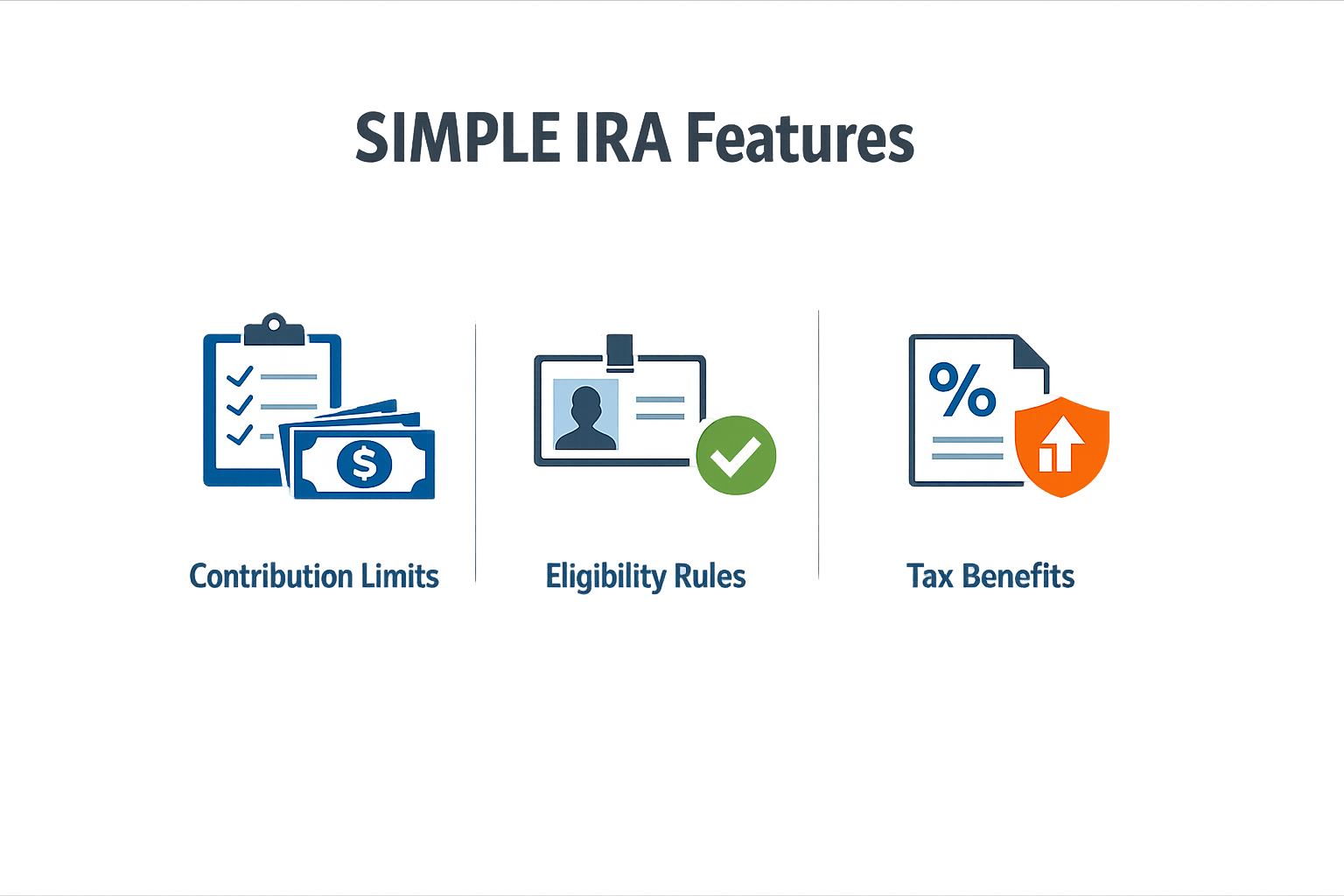
Most small business owners know they should offer retirement benefits. Fewer know how to do it without drowning in paperwork or hiring a benefits consultant. A SIMPLE IRA solves that problem — it's the retirement plan framework designed specifically for businesses with 100 or fewer employees.
The appeal is straightforward: employers get a plan that doesn't require annual nondiscrimination testing, Form 5500 filings, or a third-party administrator. Employees get a tax-deferred savings vehicle with employer contributions. The trade-off is lower contribution limits than a 401(k), but for many small teams, the administrative simplicity outweighs that constraint.
Why Small Teams Choose SIMPLE IRAs
The math works like this: if your business had 100 or fewer employees who earned at least $5,000 last year, you're eligible. You can't maintain another qualified retirement plan at the same time (unless it's for collective bargaining employees), but most small businesses aren't juggling multiple plans anyway.
Employees can make salary reduction contributions — money comes out of their paycheck before taxes, reducing their current taxable income. The employer then contributes either a matching contribution (dollar-for-dollar up to 3% of compensation) or a nonelective contribution (2% of compensation for all eligible employees, whether they participate or not). This structure gives employees immediate retirement savings and gives employers predictable contribution costs.
The Real Benefit: Participation Without Complexity
The framework matters because most small businesses can't afford a full-time benefits manager. A SIMPLE IRA shifts the account custody to individual IRAs held by employees — the employer facilitates contributions, but the financial institution handles the account administration. That division of labor keeps the employer's compliance burden manageable.
For employees, the benefit is equally practical. They control their own SIMPLE IRA, choose their investments (within the options offered by the financial institution), and take the account with them if they leave. Vesting is immediate — employer contributions belong to the employee right away, which is uncommon in small-business retirement plans.
SIMPLE plans let employees choose salary reduction contributions rather than receiving those amounts as regular pay — and employers contribute matching or nonelective contributions on top.
When It Makes Sense
A SIMPLE IRA works best when the business wants to offer a retirement benefit but doesn't have the bandwidth to manage a traditional 401(k). It's also worth understanding that once you adopt a SIMPLE IRA, you're committed for the calendar year — you can't switch mid-year to a different plan type without triggering penalties.
The contribution limits are lower than a 401(k) (for 2025, employees can defer up to $16,000, or $19,500 if age 50 or older), but for many small teams, those limits still provide meaningful retirement savings. The real question is whether the administrative simplicity justifies the lower ceiling — for businesses with 10 to 50 employees, the answer is often yes.
Depending on your circumstances, a SIMPLE IRA might be the most straightforward way to offer retirement benefits without hiring outside help. The framework assumes you'll handle payroll deductions and remit contributions, but it doesn't assume you have a benefits department.
How to Set Up a SIMPLE IRA
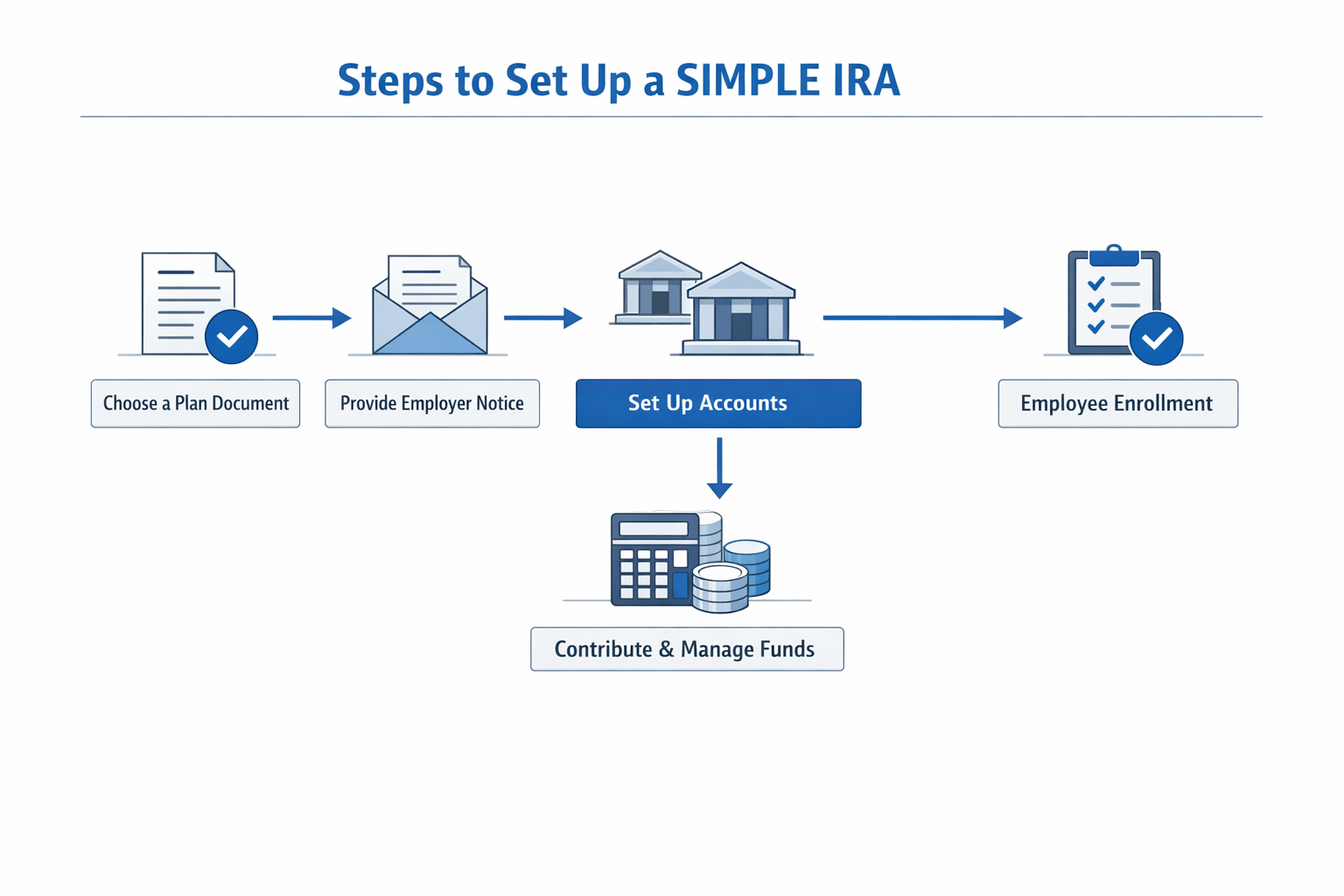
Setting up a SIMPLE IRA is straightforward, but it requires following specific IRS procedures and meeting deadlines. The process involves selecting the right forms, choosing a financial institution, and ensuring all eligible employees are enrolled. Most small businesses complete the setup in a matter of weeks, not months.
The framework is simpler than it sounds. You're essentially creating a structure that allows employees to defer salary and requires you to match or contribute. The IRS provides model forms that do most of the heavy lifting — you're not drafting plan documents from scratch.
Choosing the Right IRS Form
The first decision is which form to use. You have two options, and the choice depends on who selects the financial institution:
- Form 5304-SIMPLE: Use this if you want employees to choose their own financial institution. Each employee opens their SIMPLE IRA account at the bank, brokerage, or insurance company they prefer.
- Form 5305-SIMPLE: Use this if you select a single financial institution for all employees. Everyone's SIMPLE IRA accounts are held at the same place.
Most small businesses use Form 5305-SIMPLE because it's administratively cleaner — one institution, one point of contact, consolidated reporting. But if your team values investment choice, Form 5304-SIMPLE gives employees that flexibility.
Step-by-Step Setup Process
Once you've chosen your form, the setup follows a clear sequence:
Step 1
Complete the IRS form
Fill out all required fields on Form 5304-SIMPLE or 5305-SIMPLE. This includes your business information, the type of contribution formula you're using (match or non-elective), and any modifications to the standard plan provisions. Don't skip boxes — incomplete forms delay the process.
Step 2
Select and notify the financial institution
Choose a bank, brokerage, mutual fund company, or insurance company that offers SIMPLE IRA accounts. The institution must sign the form as the designated trustee or custodian. If you're using Form 5305-SIMPLE, this is your single provider; if you're using Form 5304-SIMPLE, you still need to designate at least one approved institution where employees can open accounts.
Step 3
Notify eligible employees
Provide each eligible employee with a copy of the completed form and a summary description of the plan. This notification must happen at least 60 days before the start of the plan year (or when they become eligible). The summary explains contribution options, matching formulas, and how to enroll.
Step 4
Set up individual SIMPLE IRA accounts
Each employee must have their own SIMPLE IRA account opened before the first contribution is made. If you're using Form 5305-SIMPLE, coordinate with your chosen institution to open accounts for all participants. If you're using Form 5304-SIMPLE, employees open their own accounts at their selected institutions.
Step 5
Establish the payroll deduction process
Set up your payroll system to withhold employee salary deferrals and calculate employer contributions. Contributions must be deposited to employee accounts within 30 days after the end of the month in which the amounts would otherwise have been paid to the employee.
Timing and Deadlines
The setup timeline matters. For a new SIMPLE IRA plan, you must complete setup between January 1 and October 1 of the year. If you're a new business (in existence less than a year), you can set up a SIMPLE IRA as soon as administratively feasible after your business starts.
The 60-day employee notification window is firm. Employees need that time to decide how much to defer and to ask questions. Missing this deadline means you can't start the plan on your intended date.
What Happens After Setup
Once the plan is operational, your ongoing responsibilities are limited:
- Deposit employee deferrals and employer contributions on time
- Provide employees with annual notifications about contribution limits and plan provisions
- Distribute IRS Form 5304-SIMPLE or 5305-SIMPLE to new eligible employees
- Keep records of contributions and participant information
You don't file annual reports with the IRS for a SIMPLE IRA. There's no Form 5500, no discrimination testing, no top-heavy rules. The administrative burden stays low, which is the point of the design.
Best Practices for Managing a SIMPLE IRA
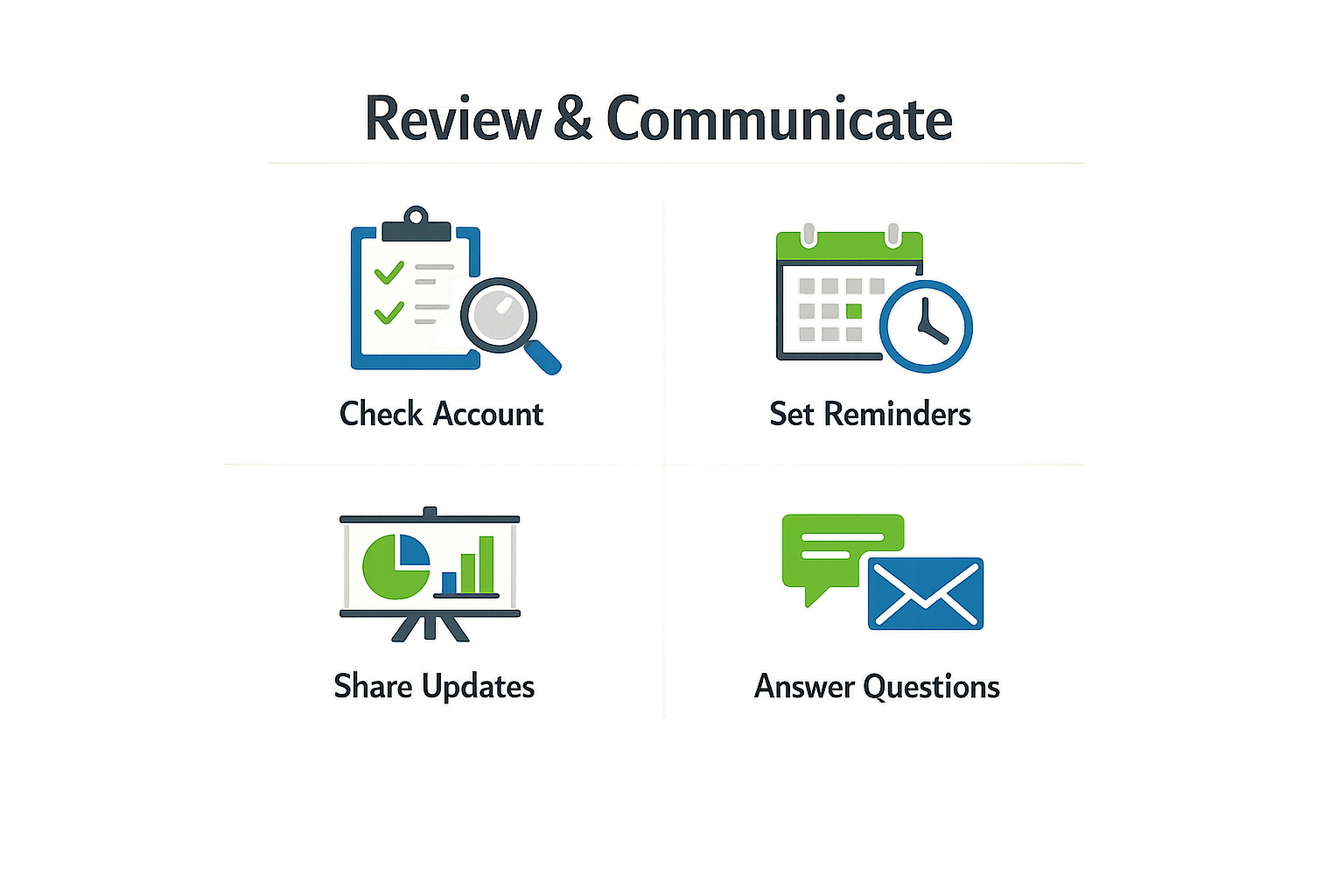
Setting up a SIMPLE IRA is straightforward. Keeping it running smoothly over years takes a framework. Most small teams start with good intentions and end up scrambling at year-end to fix avoidable problems. The difference is a few habits that make the plan work the way it's supposed to.
Communicate the Match Early and Often
Employees contribute more when they understand what the employer is putting in. The match is free money, but most people don't realize how much it adds up until someone shows them the math. Send a simple breakdown at the start of each year showing the contribution limit, the match percentage, and what that means in actual dollars for someone at their salary level. When employees see the employer kicking in 3% automatically, participation goes up.
Track Contribution Deadlines Like Tax Deadlines
Employer contributions have firm deadlines. Matching contributions are due by the tax filing deadline for the business (including extensions). Nonelective contributions follow the same schedule. Missing a deadline doesn't just delay the money — it can trigger penalties and disqualify the plan for that year. Mark the dates on the calendar when the plan starts, not when the year ends.
Choose Between Matching and Nonelective Contributions Based on Cash Flow
The two employer contribution options serve different purposes. Matching contributions reward employees who save and cost less when participation is low. Nonelective contributions (2% of compensation for all eligible employees) are predictable and don't penalize employees who can't afford to contribute. Most small teams start with matching because it feels fairer. If cash flow is tight or unpredictable, nonelective contributions are easier to budget because the total is fixed.
| Contribution Type | Cost Driver | Best For |
|---|---|---|
| Matching (up to 3%) | Employee participation rate | Teams with variable participation, tighter budgets |
| Nonelective (2%) | Total eligible payroll | Stable payroll, predictable budgeting |
Review the 100-Employee Threshold Annually
SIMPLE IRA plans are only available to employers with 100 or fewer employees who earned at least $5,000 in the prior year. If the business grows past that threshold, the plan can continue for two more years, but after that it must convert to a different structure or terminate. Check the employee count at year-end. If the team is approaching 100, start planning the transition early — converting to a 401(k) or other plan type takes months, not weeks.
Avoid Mixing SIMPLE IRAs with Other Retirement Plans
A business cannot maintain a SIMPLE IRA and another qualified retirement plan (like a SEP IRA or 401(k)) in the same calendar year. The restriction applies to the employer, not individual employees. Employees can still contribute to their own traditional or Roth IRAs outside the SIMPLE plan, but the employer cannot fund two plans simultaneously. If the business structure includes multiple entities, confirm with a tax professional that the controlled group rules don't accidentally disqualify the SIMPLE plan.
Understand the Two-Year Transfer Restriction
Employees cannot roll over or transfer funds out of a SIMPLE IRA to another retirement account during the first two years of participation without triggering a 25% early withdrawal penalty. After two years, the penalty drops to the standard 10%. This restriction catches people off guard when they leave the company or want to consolidate accounts. Make sure employees understand the timeline before they make a move that costs them a quarter of their balance.
Document Plan Changes in Writing
Any change to the employer contribution formula (switching from matching to nonelective, or vice versa) must be communicated to employees in writing at least 60 days before the start of the election period. The election period is the window when employees choose their salary reduction percentage — typically November for a calendar-year plan. Missing the 60-day notice requirement can invalidate the change and leave the employer stuck with the prior year's formula.
Common Mistakes to Avoid with SIMPLE IRAs
Most small businesses set up a SIMPLE IRA with good intentions and then stumble on the details. The plan looks straightforward on paper, but the IRS has built-in restrictions that don't apply to other retirement accounts. Miss one of these rules and the consequences range from employee confusion to tax penalties that land on both the employer and the employee.
Missing the Two-Year Restriction Window
The most common mistake involves the first two years of participation. During this initial period, participants face restrictions on distributions and contributions that don't exist in traditional IRAs. If an employee takes a distribution from their SIMPLE IRA within two years of their first contribution, the early withdrawal penalty jumps from 10% to 25%. Many small business owners don't communicate this clearly during onboarding, and employees learn about it the expensive way when they try to access funds early.
Treating SIMPLE IRAs Like Traditional IRAs
Another frequent error: assuming SIMPLE IRAs follow the same rules as traditional IRAs. They don't. SIMPLE IRAs are subject to additional restrictions that don't apply to standard IRAs, which means rollover rules, contribution timing, and distribution options all work differently. For example, individuals cannot make their own contributions to a SIMPLE IRA outside of the employer plan structure. The account exists exclusively within the employer-sponsored framework, and trying to treat it like a personal IRA creates compliance problems.
Failing to Track Employee Eligibility Properly
Small teams often operate informally, and that informality can create problems with SIMPLE IRA eligibility tracking. The plan is available to businesses with 100 or fewer employees who earned at least $5,000 in the previous year. When headcount fluctuates or part-time employees cross the compensation threshold, employers sometimes fail to update participation lists. The result: eligible employees get excluded, or the business exceeds the 100-employee cap without realizing the plan no longer qualifies.
Inconsistent Employer Contributions
The employer contribution isn't optional. Whether you choose the matching contribution (up to 3% of compensation) or the nonelective contribution (2% of compensation for all eligible employees), you must make that contribution consistently. Some employers treat it like a discretionary bonus and skip it during tight cash-flow months. That's not how SIMPLE IRAs work. The contribution is a plan requirement, and failing to meet it puts the entire plan's tax-qualified status at risk.
Poor Communication During Setup
Many small businesses set up the plan, hand employees a packet of forms, and assume everyone understands the framework. They don't. Employees need to know how salary reduction elections work, what the employer match structure looks like, and what happens if they leave the company or need to access funds early. When employers skip this step, participation rates stay low and employees make uninformed decisions about contribution amounts and investment allocations.
SIMPLE IRA FAQ
Can I contribute to both a SIMPLE IRA and a traditional or Roth IRA?
Yes. Contributions to a SIMPLE IRA through your employer do not reduce the contribution limits for a separate traditional or Roth IRA. The SIMPLE IRA operates under its own contribution framework, while your personal IRA follows standard IRA limits. If you're contributing to both, track each account's limits separately — the SIMPLE IRA limit for employee deferrals is higher than the standard IRA contribution cap.
Can employees make their own contributions to a SIMPLE IRA outside of payroll deferrals?
No. SIMPLE IRAs work differently from standard IRAs in this respect. Employees cannot make direct contributions to a SIMPLE IRA outside of salary reduction contributions coordinated through the employer. All employee contributions must come through payroll deferrals. Employer matching or nonelective contributions follow the same structure — everything flows through the plan framework, not through individual deposits.
What is a Roth SIMPLE IRA, and how does it differ from a traditional SIMPLE IRA?
A Roth SIMPLE IRA is an option that became available for tax years beginning after 2022. It allows employees to designate their salary reduction contributions as Roth contributions, meaning the money goes in after-tax and qualified distributions come out tax-free in retirement. Traditional SIMPLE IRAs use pre-tax contributions that reduce current taxable income but are taxed upon withdrawal. Employer contributions typically go into the traditional SIMPLE IRA side, even when an employee elects Roth treatment for their own deferrals.
Are there restrictions on withdrawing money from a SIMPLE IRA?
Yes, particularly in the first two years of participation. During that initial period, early withdrawals (before age 59½) face a 25% penalty instead of the standard 10% penalty that applies to traditional IRAs. After the two-year mark, the penalty drops to the standard 10% for early withdrawals. Required minimum distributions (RMDs) begin at age 73, following the same schedule as traditional IRAs.
Can a business maintain both a SIMPLE IRA and a 401(k) plan?
No. The SIMPLE IRA rules prohibit employers from maintaining another employer-sponsored retirement plan in the same calendar year. If you have a SIMPLE IRA, you cannot also contribute to a 401(k), SEP IRA, or other qualified plan during that period. This is one reason businesses sometimes outgrow SIMPLE IRAs — when they want more complex plan features or higher contribution limits, they need to terminate the SIMPLE IRA and transition to a different plan type.
What happens to a SIMPLE IRA if an employee leaves the company?
The account belongs to the employee. When someone leaves, the SIMPLE IRA stays in their name and they control it. After the two-year participation period, they can roll it into a traditional IRA or another employer's retirement plan without penalty. If they leave before the two-year mark, rolling the SIMPLE IRA into anything other than another SIMPLE IRA triggers the 25% early withdrawal penalty on the transferred amount.
Conclusion
A SIMPLE IRA is a retirement plan that allows employers to make contributions to traditional or Roth IRAs for their employees — through salary reduction contributions, matching contributions, or nonelective contributions. For small teams, it provides a straightforward way to offer retirement benefits without the administrative burden of larger, more complex plans.
The framework is designed for businesses with 100 or fewer employees who want to help their team save for retirement without navigating the compliance requirements of a 401(k). Employers must either match employee contributions up to 3% of compensation or make a 2% nonelective contribution for all eligible employees, regardless of whether they contribute.
The math is simple: employees can defer up to the annual limit from their paycheck, and the employer adds their required contribution on top. Employees own their accounts immediately — no vesting schedules — and the plan stays in place as long as the business doesn't adopt another qualified retirement plan.
If your team is small and you want to add a retirement benefit that doesn't require a full-time benefits administrator, a SIMPLE IRA is worth understanding. The setup process is minimal, the ongoing compliance is manageable, and the tax advantages work for both the business and the employees. When you're ready to take the next step, talk to a licensed financial professional who can walk through the specifics of your situation and help you choose the right plan structure for your team.