
Introduction
401(k) plans for small business owners are retirement savings vehicles that allow employees to contribute a portion of their paycheck before taxes are taken out. For business owners, it's also a qualified plan — meaning it offers a tax-favored way to save for retirement where you can deduct contributions made for employees, and earnings on those contributions are generally tax-free until distributed at retirement.
Most small business owners think about retirement plans the same way they think about health insurance — necessary, expensive, and complicated. The difference is that a 401(k) plan isn't just an employee benefit. It's a tax strategy that lets you save for your own retirement while deducting contributions you make for your team. That framework applies whether you're running a one-person consulting shop or managing a team of twenty.
The honest answer is that most small business owners don't set up a 401(k) because they assume it's only for larger companies with dedicated HR departments. In practical terms, the setup process has become more accessible, and the long-term tax advantages often outweigh the administrative work. If you're already comparing retirement options, understanding how a SIMPLE IRA stacks up against a 401(k) can clarify which structure fits your business model.
The goal here is straightforward: explain what a 401(k) plan actually involves for a small business, what it costs to set one up, and how to determine if it's the right move for your situation. This isn't about selling you on a specific provider or pushing you toward one retirement vehicle over another. It's about laying out the framework so you can make an informed decision when you're ready to take the next step.
How Do 401(k) Plans for Small Business Owners Address Common Challenges?
Most small business owners want to offer a retirement plan. The math is straightforward — tax deductions for the business, tax-deferred growth for employees, and a competitive edge in hiring. What stops them isn't the concept. It's the perception that setting up a 401(k) means hiring a benefits consultant, navigating federal compliance rules they don't understand, and writing checks they can't predict.
The honest answer: those concerns aren't entirely wrong. Qualified plans like 401(k)s are more complex than simpler alternatives. But the gap between complexity and impossibility is wide, and most small business owners overestimate where their situation falls on that spectrum.
The Compliance Misconception
A common misconception is that 401(k) plans require the same administrative burden regardless of company size. In practical terms, a five-person business doesn't face the same nondiscrimination testing challenges as a 500-person corporation. The rules are the same on paper, but the math works differently when your employee base is small and compensation is relatively flat.
The real question isn't whether you can handle the compliance — it's whether the benefits justify the setup cost and ongoing administration. For many small businesses, a SIMPLE IRA or SEP IRA is the better starting point. But if you're looking for higher contribution limits, profit-sharing flexibility, or the ability to design a plan that rewards key employees differently, a 401(k) becomes worth the extra structure.
The Cost Uncertainty Problem
The second barrier is cost opacity. Setup fees, recordkeeping fees, compliance testing, annual filings — the line items add up, and vendors don't always make it easy to see the total in advance. Small business owners operate on tight margins. When the cost structure isn't clear, the default decision is to delay.
Here's what that actually means: the cost of a 401(k) plan for a small business typically includes three buckets — startup costs (plan design and documentation), ongoing administration (recordkeeping and compliance), and investment fees (what participants pay inside their accounts). The first two are predictable once you know your plan structure and employee count. The third varies by investment lineup, but it's borne by participants, not the business.
For a business with fewer than 10 employees, annual administrative costs often run between $1,500 and $3,000, depending on plan complexity. Startup costs can range from $500 to $2,500. Those numbers aren't trivial, but they're also not the five-figure mystery many owners imagine.
The "Too Small" Assumption
Many small business owners assume 401(k) plans are designed for companies with 50 or 100 employees — that offering one with five or ten people on payroll is overkill. The framework doesn't support that assumption. A 401(k) works at any size. The question is whether the benefits (higher contribution limits, employer match flexibility, employee retention) outweigh the administrative lift for your specific situation.
Depending on your circumstances, the answer might be no. But it's worth understanding the actual trade-offs rather than dismissing the option because of company size alone.
Solution Steps for Setting Up a 401(k) Plan
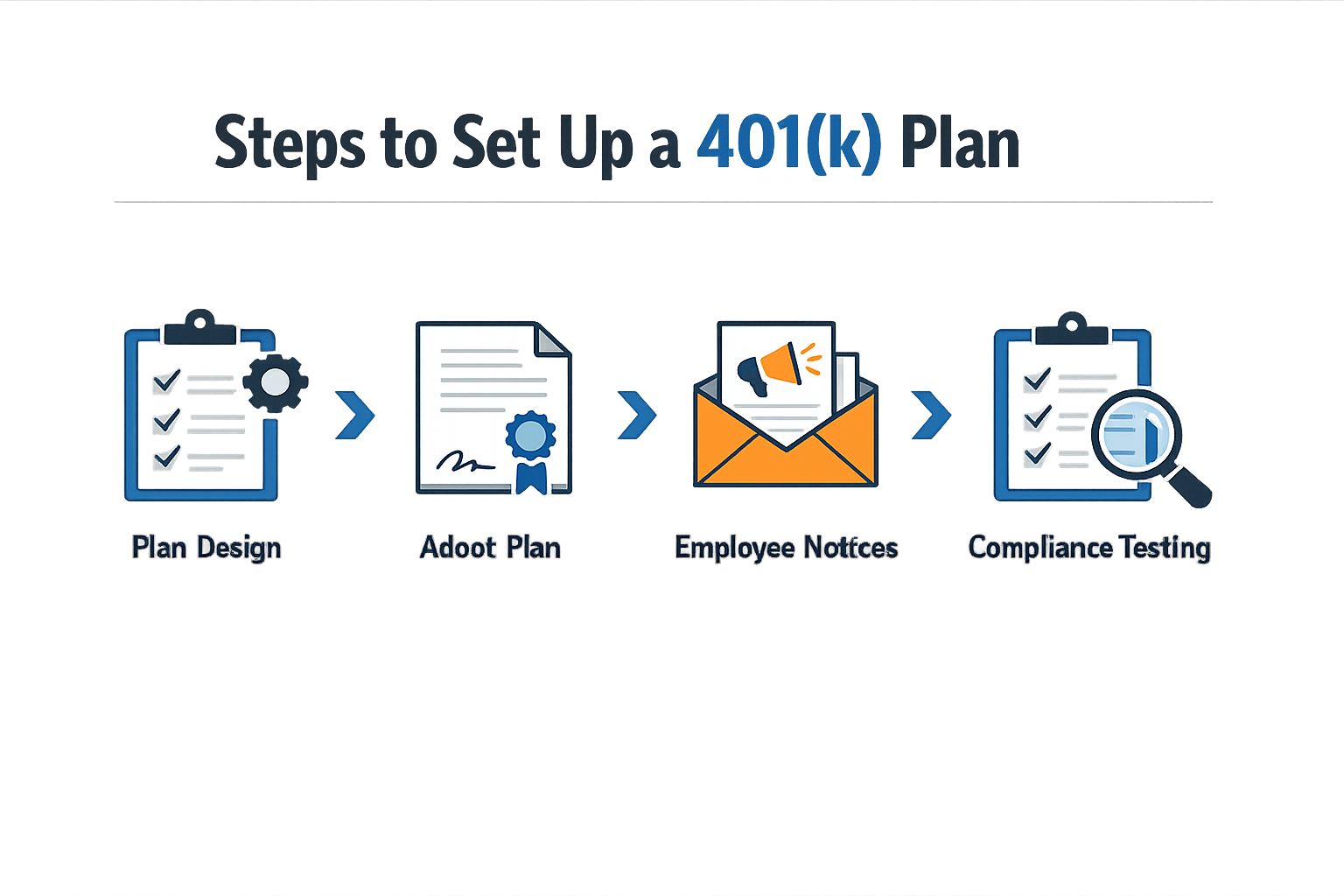
Setting up 401(k) plans for small business owners isn't as complicated as it sounds once you understand the framework. The process breaks down into a series of concrete decisions and administrative steps that most small business owners can complete within a few months. Here's what that actually means in practical terms.
Choose Your Plan Design
The first decision is selecting the type of 401(k) structure that fits your business. A traditional 401(k) allows employees to make pre-tax contributions through payroll deduction. You can also structure the plan as a profit-sharing or stock bonus arrangement that meets 401(k) requirements, giving you flexibility in how employer contributions work. Some businesses opt for a SIMPLE 401(k) if they have fewer than 100 employees and want lower administrative complexity, though contribution limits differ from standard plans.
The framework you choose determines your ongoing compliance obligations and how much flexibility you have with employer matching or profit-sharing contributions. Most small businesses start with a traditional 401(k) with optional employer match because it's straightforward and employees understand how it works.
Step 1
Adopt a written plan document
Your 401(k) must have a formal written document that spells out eligibility rules, contribution formulas, vesting schedules, and distribution provisions. You can use a pre-approved prototype plan from a financial institution or third-party administrator, or you can have a custom document drafted. The IRS provides a 401(k) Plan Checklist to help ensure your document covers all required elements. This isn't optional — the written plan is the legal foundation of everything that follows.
Step 2
Set up a trust for plan assets
Plan assets must be held in a trust separate from your business accounts. You'll need to designate a trustee — either an individual or an institution — who has fiduciary responsibility for managing the plan's investments and ensuring contributions are deposited on time. The trust protects employee contributions from business creditors and ensures the money is used solely for retirement benefits.
Step 3
Establish a recordkeeping system
You need a system to track employee deferrals, employer contributions, investment elections, and account balances. Most small businesses work with a third-party administrator or bundled service provider who handles recordkeeping, compliance testing, and participant statements. The recordkeeping system must also track eligibility and vesting for each employee, which becomes important when people leave the company.
Handle Compliance and Reporting Requirements
Once the plan is operational, ongoing compliance is non-negotiable. The IRS and Department of Labor require annual nondiscrimination testing to ensure the plan doesn't disproportionately benefit highly compensated employees. If your plan fails these tests, you'll need to make corrective contributions or refund excess deferrals, which creates unexpected costs and administrative headaches.
You'll also file Form 5500 annually with the Department of Labor once your plan has more than 100 participants or meets certain asset thresholds. Smaller plans may qualify for a simplified 5500-SF filing. Missing filing deadlines triggers penalties that add up quickly, so most businesses delegate this to their plan administrator.
Communicate the Plan to Employees
Your legal obligation includes providing employees with a Summary Plan Description that explains the plan in plain language — eligibility requirements, how to enroll, contribution limits, vesting schedules, and how to access their money. Employees must also receive annual updates about plan changes and periodic benefit statements showing their account balance and investment performance.
Most employees won't read dense plan documents, so consider holding an enrollment meeting where you walk through the basics and answer questions. The goal is getting employees to actually participate, which helps you pass nondiscrimination tests and makes the plan valuable for everyone.
For businesses considering simpler alternatives, a SIMPLE IRA may offer an easier administrative path with lower setup costs, though contribution limits and employer requirements differ from a 401(k).
Understanding Costs and Contribution Limits
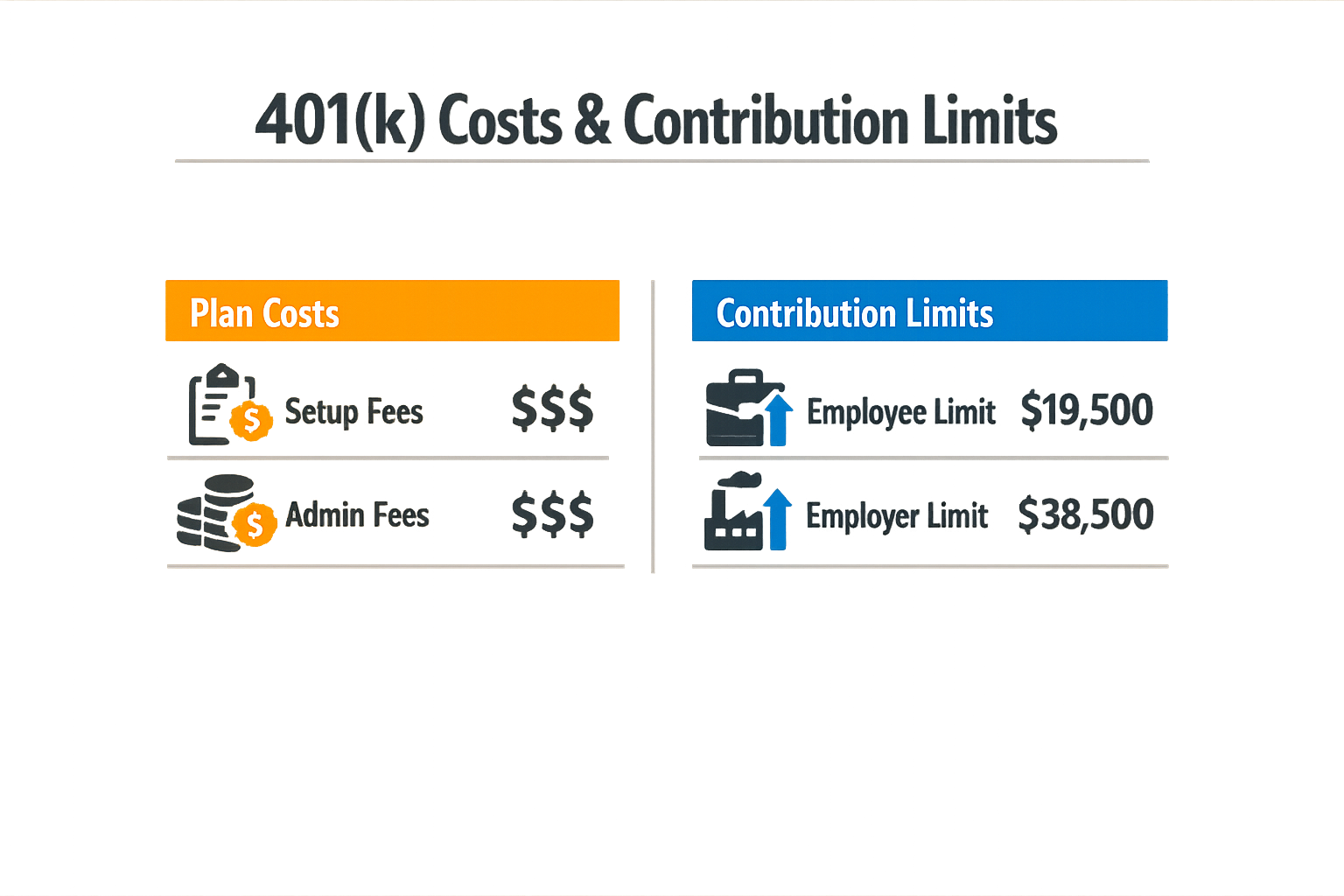
The math behind 401(k) plans for small business owners breaks into two categories: what it costs to run the plan, and how much you and your employees can put into it. Most small business owners underestimate the first and misunderstand the second. Here's what the numbers actually look like.
Setup and Administrative Costs
Setting up a 401(k) plan typically involves one-time setup fees and ongoing administrative expenses. Setup costs vary by provider and plan complexity, but expect initial fees for plan design, legal documentation, and compliance setup. Administrative costs recur annually and cover recordkeeping, compliance testing, Form 5500 filing, and participant statements.
Some providers charge per-participant fees (often $20 to $100 per employee per year), while others use asset-based pricing (typically 0.25% to 1% of plan assets annually). The structure you choose depends on your employee count and expected account balances. A business with ten employees and modest account balances might pay less with per-participant pricing; a business with higher earners and larger balances might prefer asset-based fees.
Contribution Limits for Employees and Employers
Contribution limits depend on the plan type. For traditional 401(k) plans, employees can defer a portion of their salary up to the annual limit set by the IRS. Employers can make matching or profit-sharing contributions on top of employee deferrals, subject to overall limits.
For SIMPLE 401(k) plans — designed for businesses with 100 or fewer employees — the rules are different. Compensation used to calculate contributions is generally limited to $350,000 in 2025. SIMPLE plans have lower contribution limits than traditional 401(k) plans, but they also have simpler compliance requirements and lower administrative costs.
| Plan Type | Employee Contribution Focus | Employer Contribution Options | Compensation Cap (2025) |
|---|---|---|---|
| Traditional 401(k) | Higher annual limits | Matching, profit-sharing, or both | $350,000 |
| SIMPLE 401(k) | Lower annual limits | Required match or nonelective | $350,000 |
The difference between these plan types matters when you're projecting costs. A SIMPLE 401(k) requires employer contributions — either a matching contribution or a flat nonelective contribution — which means guaranteed annual expense. A traditional 401(k) gives you more flexibility: you can match, you can skip matching in lean years (if your plan document allows), or you can make discretionary profit-sharing contributions when cash flow supports it.
How Plan Design Affects Your Budget
Your plan's cost structure depends on decisions you make during setup. A safe harbor 401(k) — which includes mandatory employer contributions — eliminates certain compliance testing requirements but locks in annual contribution expenses. A traditional 401(k) without safe harbor provisions gives you contribution flexibility but requires annual nondiscrimination testing, which adds to administrative costs.
If you're comparing 401(k) options to other retirement vehicles, What Is a SIMPLE IRA? A Guide for Small Teams walks through a simpler alternative that works for businesses under the 100-employee threshold. The tradeoff: lower contribution limits in exchange for reduced administrative complexity.
The cheapest plan on paper isn't always the cheapest plan in practice — factor in the time you'll spend on compliance, not just the provider's quoted fees.
Planning for Annual Increases
Contribution limits and compensation caps adjust periodically based on cost-of-living changes. The $350,000 compensation limit for 2025 represents an increase from prior years, and similar adjustments happen to employee deferral limits and overall contribution caps. When you're budgeting for a 401(k) plan, build in room for these increases — both in terms of what you can contribute and what your matching obligations might become as limits rise.
The framework: estimate your total annual cost as the sum of fixed administrative fees, per-participant charges (if applicable), and your expected employer contributions based on employee participation rates. Most providers can run projections showing cost scenarios at different participation levels. Ask for those numbers before you commit.
Tips and Tricks for Small Business Owners

Setting up 401(k) plans for small business owners is one thing. Running them effectively is another. Most small business owners focus on the setup mechanics and then wonder why participation stays low or administrative headaches pile up. The difference between a plan that works and one that creates problems often comes down to a few practical decisions made early.
Choose the Right Plan Structure for Your Team Size
The framework that works for a three-person business looks different from what a 25-person company needs. If you have fewer than 100 employees and want to minimize administrative burden, a SIMPLE plan might make more sense than a traditional 401(k). SIMPLE plans require employer contributions — either a 2% nonelective contribution for all eligible employees or a matching contribution of up to 3% of compensation — but they eliminate most compliance testing and reduce paperwork. Many financial institutions will help you set up a SIMPLE plan, which removes much of the setup friction.
For businesses with more complex needs or higher contribution goals, a traditional 401(k) or Safe Harbor 401(k) provides more flexibility. Safe Harbor plans require specific employer contribution formulas but bypass annual nondiscrimination testing, which can be worth the cost if you have highly compensated employees who want to maximize their deferrals.
Use Automatic Enrollment to Boost Participation
Most employees don't actively choose to enroll in retirement plans — they intend to, then forget, then years pass. Automatic enrollment flips the default. New hires are enrolled at a set contribution rate (commonly 3% of pay) unless they actively opt out. The math works like this: participation rates in plans with automatic enrollment typically run 20 to 30 percentage points higher than plans requiring employees to opt in.
Automatic enrollment also helps with compliance testing in traditional 401(k) plans. Higher overall participation rates make it easier to pass nondiscrimination tests, which means highly compensated employees can contribute more without triggering refunds. If you're considering what is a SIMPLE IRA as an alternative, keep in mind that SIMPLE plans don't allow automatic enrollment — employees must actively elect to participate.
Automatic enrollment in 401(k) plans can increase participation rates by 20 to 30 percentage points, solving one of the biggest challenges small businesses face.
Communicate the Plan in Plain Language
Employees won't value a benefit they don't understand. Most plan materials are written in compliance language that obscures the actual value. Here's what that actually means: instead of handing employees a 40-page summary plan description, create a one-page overview that explains how much they can contribute, what the employer match is (if any), when they're vested, and how to enroll.
Schedule a short group meeting when you launch the plan or when new employees join. Walk through the basics — contribution limits, investment options, the concept of tax-deferred growth. Answer questions on the spot. The goal isn't making everyone a retirement expert; it's removing the friction that keeps people from starting.
Review Your Plan Annually
Retirement plan rules change. Contribution limits adjust. Your business grows or contracts. An annual review keeps the plan aligned with your current situation. Set a recurring calendar reminder each fall to check:
- Updated contribution limits for the coming year
- Whether your current plan structure still fits your employee count and budget
- Participation rates and whether automatic features need adjustment
- Administrative costs compared to what other providers charge
- Investment options and whether they still make sense
This doesn't require hiring a consultant every year. For straightforward plans, an hour with your plan administrator or financial institution contact is often enough to spot issues before they become problems.
Conclusion
Setting up 401(k) plans for small business owners isn't as complicated as it sounds. The framework is straightforward: choose between a traditional 401(k), Safe Harbor, or solo 401(k) based on your employee count and administrative preferences, understand the setup and ongoing costs, and build contribution strategies that work for both your business budget and your employees' retirement goals. Most small business owners who hesitate do so because they assume the compliance burden outweighs the benefits — but the math works differently when you factor in tax deductions, employee retention, and your own retirement savings potential.
The real question is whether a 401(k) aligns with where your business is headed. If you're looking to attract and retain talent in a competitive market, a retirement benefit moves you from the "job" category to the "career" category in candidates' minds. If you're a solo operator or working with a spouse, a solo 401(k) lets you shelter significantly more income than an IRA while maintaining full control. If you're somewhere in between — a handful of employees, steady revenue, and a desire to build long-term value — a Safe Harbor plan removes most of the testing headaches and creates a predictable cost structure.
For informational and educational purposes, this article covered the setup process, cost benchmarks, contribution limits, and compliance basics. Your specific situation will determine which plan type makes the most sense and when you're ready to take the next step. Talk to a licensed financial professional and a qualified plan administrator who can walk through your employee demographics, cash flow patterns, and long-term business goals. They'll help you model the actual costs and tax benefits based on your numbers, not generic examples.
The honest answer: a 401(k) plan is one of the most tax-efficient ways to build retirement assets while running a business, but it's not the only option. SEP IRAs and SIMPLE IRAs offer simpler administration with different contribution structures. The goal is getting in the right range for your situation — not chasing the absolute maximum contribution limit if the administrative cost doesn't justify it. Start with the framework that fits your current reality, and adjust as your business grows.
Frequently asked questions
What are 401(k) plans for small business owners?
401(k) plans for small business owners are qualified retirement plans that allow employees to contribute pre-tax salary deferrals while giving business owners tax deductions for employer contributions and the ability to build their own retirement savings.
How much does it cost to set up 401(k) plans for small business owners?
Setup costs typically range from $500 to $2,500, with annual administrative costs between $1,500 and $3,000 for businesses with fewer than 10 employees, depending on plan complexity and provider.
What contribution limits apply to 401(k) plans for small business owners?
Contribution limits vary by plan type and are set annually by the IRS. Traditional 401(k) plans generally allow higher employee deferrals and employer contributions than SIMPLE 401(k) plans, with compensation caps of $350,000 in 2025.
Can a business with only a few employees offer 401(k) plans for small business owners?
Yes. 401(k) plans work at any company size, including solo operations. The question is whether the benefits justify the administrative costs for your specific situation.
How do 401(k) plans for small business owners compare to SIMPLE IRAs?
401(k) plans offer higher contribution limits and more design flexibility but require more administrative work and compliance testing. SIMPLE IRAs have lower limits but simpler setup and ongoing administration for businesses with fewer than 100 employees.