
Introduction
Most self-employed professionals don't lie awake wondering about retirement plan acronyms. They lie awake wondering if they're saving enough and whether they're using the right vehicle to get there.
The short answer: if you're self-employed or run a business with no employees other than a spouse, you're likely choosing between two main retirement plan structures — the SEP IRA and the Solo 401(k). Both let you save significantly more than a traditional IRA, but they work differently under the hood.
Here's what that actually means. A Simplified Employee Pension (SEP) IRA is a retirement plan that allows self-employed individuals to contribute to their retirement savings with minimal paperwork. A Solo 401(k) is a retirement plan designed specifically for self-employed individuals and business owners with no employees, allowing for higher contribution limits compared to a SEP IRA. The difference between them isn't just technical — it affects how much you can save, how you manage the plan, and what flexibility you have down the road.
The framework for choosing between them comes down to three questions: How much do you want to contribute? How much administrative complexity can you handle? And do you need features like loans or Roth contributions? For many self-employed individuals, understanding these trade-offs is the difference between maximizing tax-advantaged savings and leaving money on the table.
This guide walks through the practical differences between SEP IRA and Solo 401(k) plans — contribution mechanics, administrative requirements, and the scenarios where each one makes sense. The goal is getting you in the right range for your situation, not prescribing a one-size-fits-all answer. When you're ready to take the next step, you'll know which questions to ask and what factors matter most for your specific circumstances.
Understanding the Challenge: Choosing the Right Retirement Plan
When you're self-employed, retirement planning doesn't come with a benefits department and an enrollment packet. You're responsible for building your own safety net — and the framework you choose determines how much you can save, how much flexibility you have, and how complicated your tax filing becomes.
Most self-employed individuals approach the solo 401k vs SEP IRA decision the same way they approach other business choices: they research for a few hours, get overwhelmed by the jargon, and either pick the first option that sounds reasonable or postpone the decision entirely. Neither outcome is ideal when you're talking about decades of compounding growth.
The Real Consequences of Choosing Wrong
The wrong retirement plan doesn't just cost you in setup fees — it costs you in missed contribution opportunities. If your income fluctuates significantly year to year, a plan that worked when you were earning less might leave money on the table when you have a strong year. If you later hire employees, a plan that seemed simple when you were solo can become administratively complex or legally untenable.
The complexity isn't just in the contribution math. Qualified plans like the Solo 401(k) offer increased flexibility in plan design compared to SEP arrangements, but that flexibility comes with more administrative requirements. The trade-off between simplicity and control is real — and the right answer depends on your specific situation, not on which plan sounds better in a headline.
Why the Decision Feels Harder Than It Should
Part of the challenge is that both plans are legitimate, IRS-approved vehicles designed for the same general audience. There's no obvious "winner" — just different frameworks that fit different business models and income patterns. A freelance consultant with steady six-figure income faces a different calculation than a contractor whose revenue swings 40% year over year.
The other part is that most educational content treats these plans as interchangeable or presents them in a vacuum, without addressing the second-order questions: What happens if you want to add a Roth component? What if you need a loan from the plan? What if your spouse works in the business? These aren't edge cases — they're common scenarios that change the math significantly.
Solution Steps: Analyzing SEP IRA vs. Solo 401(k)
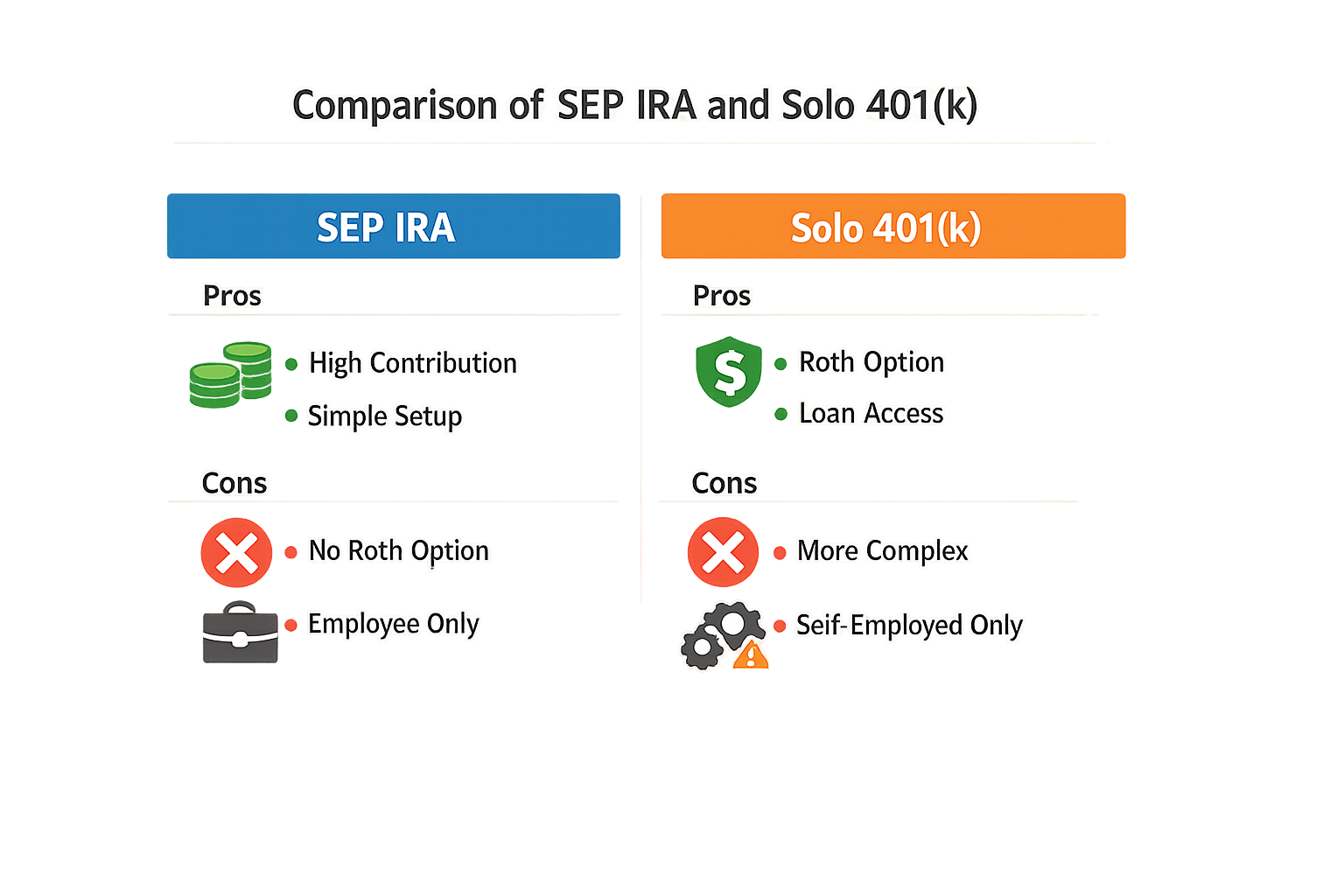
The framework for choosing between these two plans comes down to three factors: how much you want to contribute, how much complexity you're willing to handle, and whether you need a loan option. Here's what each plan actually does.
SEP IRA: The Simplified Option
A SEP IRA provides a simplified method for making contributions to a retirement plan. You adopt a SEP agreement and contribute directly to a traditional SEP IRA — no trust required, minimal paperwork.
Contribution limits for 2025: the smaller of $70,000 or 25% of your compensation. The math works like this: if you're self-employed, your contribution percentage is based on net self-employment income after deducting half of your self-employment tax and the SEP contribution itself. For most self-employed individuals, that 25% effectively becomes around 20% of gross income.
The setup is straightforward: you can establish a SEP IRA as late as your tax-filing deadline (including extensions) and still claim the deduction for that year. There's no annual filing requirement with the IRS — no Form 5500.
The drawback: SEP IRAs don't allow employee deferrals or catch-up contributions. You're limited to employer contributions only, which means you can't set aside additional personal salary deferrals the way you can with a 401(k).
Solo 401(k): The Flexible Framework
A Solo 401(k) is designed for self-employed individuals and business owners with no employees other than a spouse. The structure is more complex, but the contribution flexibility is significantly higher.
Contribution limits for 2025: up to $23,500 in employee deferrals, plus employer profit-sharing contributions up to 25% of compensation, with a combined maximum of $70,000 (or $77,500 if you're 50 or older and qualify for the $7,500 catch-up contribution).
Here's the practical difference: if you earn $100,000 in self-employment income, a SEP IRA lets you contribute roughly $20,000. A Solo 401(k) lets you contribute the full $23,500 as an employee deferral, plus around $18,500 in employer contributions — about $42,000 total. For higher earners, that gap matters.
| Feature | SEP IRA | Solo 401(k) |
|---|---|---|
| Employee deferrals | Not allowed | Up to $23,500 (2025) |
| Catch-up contributions (age 50+) | Not allowed | Additional $7,500 |
| Employer contributions | Up to 25% of compensation | Up to 25% of compensation |
| Combined maximum (2025) | $70,000 | $70,000 ($77,500 with catch-up) |
| Annual IRS filing (Form 5500) | Not required | Required if assets exceed $250,000 |
| Loan provisions | Not allowed | Allowed (up to $50,000 or 50% of account) |
| Roth contributions | Available (post-2022) | Available |
The Solo 401(k) also allows loans — you can borrow up to $50,000 or 50% of your account balance, whichever is less. That's not a feature most people plan to use, but it's worth understanding when you're comparing emergency access to funds.
Setup and Administrative Differences
SEP IRAs require almost no ongoing administration. You open the account, make contributions, and file nothing with the IRS. Most self-employed individuals can set one up in an afternoon.
Solo 401(k) plans require a formal plan document and, once your account balance exceeds $250,000, an annual Form 5500-EZ filing. The setup takes more time upfront, and you'll need to stay on top of annual compliance. For more context on how small business owners navigate 401(k) plans, including setup costs and administrative requirements, that framework applies here too.
When Each Plan Makes Sense
SEP IRA fits when you want simplicity, don't need to maximize contributions beyond the 25% employer limit, and prefer minimal paperwork. It's a starting point for self-employed individuals who are getting their retirement savings on track without adding administrative burden.
Solo 401(k) fits when you want to contribute more than a SEP IRA allows, you're 50 or older and want catch-up contributions, or you value the flexibility of loan provisions. The tradeoff is the setup and ongoing compliance work.
The honest answer: most self-employed individuals earning under $150,000 find the SEP IRA sufficient. Higher earners, or those who want to front-load retirement savings aggressively, typically benefit from the Solo 401(k) structure.
Tips and Tricks for Choosing the Right Plan
Most people approach the solo 401k vs SEP IRA decision by comparing contribution limits and calling it done. The real question is how these plans fit your income pattern, your administrative tolerance, and your long-term retirement strategy. Here's the framework for making that call.
Start with Your Income Pattern
If your income swings wildly year to year — common for consultants, freelancers, and seasonal businesses — a SEP IRA gives you maximum flexibility. You contribute what you can afford each year with no prior commitment. In a lean year, you contribute nothing. In a windfall year, you max it out. The Solo 401(k) requires annual filing once assets exceed $250,000, which adds administrative overhead regardless of whether you contribute that year.
For stable, predictable income, the Solo 401(k) pulls ahead. The employee deferral component lets you shelter up to $23,000 (2024) or $23,500 (2025) of your compensation before calculating your employer contribution. That two-step structure often results in higher total contributions at the same income level compared to a SEP IRA's single employer-only contribution.
Consider Your Loan and Roth Needs
The Solo 401(k) is the only option if you want a Roth contribution option or the ability to borrow from your plan. SEP IRAs don't permit loans, and all contributions are pre-tax only. If you're in your 30s or 40s and expect your tax rate to rise in retirement, the Roth Solo 401(k) feature is worth the extra paperwork. If you might need short-term access to retirement funds without triggering early withdrawal penalties, the loan provision matters.
That said, borrowing from retirement savings is a framework decision, not a feature to chase. Most financial professionals recommend exhausting other liquidity options first. But if your business has lumpy cash flow and you want a backstop, the Solo 401(k) provides it.
Evaluate Your Administrative Bandwidth
The SEP IRA wins on simplicity. Setup takes an afternoon. Annual maintenance is minimal — you file no separate tax return for the plan, and most custodians charge low or zero fees. You contribute by moving money from your business account to the SEP IRA, and you're done.
The Solo 401(k) requires more structure. You adopt a plan document, often through a brokerage or third-party administrator. Once plan assets exceed $250,000, you file Form 5500-EZ annually. If you're adding a Roth component or taking loans, you track those separately. For someone running a one-person operation, that's manageable but not trivial. If administrative tasks make you procrastinate, the SEP IRA keeps you compliant by default.
The best retirement plan is the one you'll actually fund consistently — administrative friction kills more retirement strategies than suboptimal contribution limits.
Plan for Required Distributions
Both SEP IRAs and Solo 401(k) plans are subject to required minimum distributions (RMDs) once you reach age 73. Distributions follow IRA rules, including tax treatment and income tax withholding. If you're still working past age 73 and don't own more than 5% of the business, the Solo 401(k) lets you delay RMDs until you retire. Since most self-employed individuals own 100% of their business, this exception rarely applies — but it's worth understanding if you're in a partnership structure.
For informational and educational purposes, the tax advantages of both plans can be offset by penalties for excess contributions, early withdrawals, or missed RMDs. The framework is straightforward: contribute within limits, leave the money alone until retirement, and take distributions on schedule. Violate any of those rules, and the tax benefits evaporate quickly.
Match the Plan to Your Business Structure
If you have a spouse on payroll or might hire employees in the next few years, the Solo 401(k) gets complicated fast. Adding non-owner employees to a Solo 401(k) converts it to a standard 401(k) with full ERISA compliance, nondiscrimination testing, and significantly higher administrative costs. The SEP IRA handles employees more gracefully — you contribute the same percentage of compensation for everyone, including yourself, with minimal additional paperwork.
For true solopreneurs with no employees and no plans to hire, the Solo 401(k) offers more contribution flexibility. For anyone with a spouse who works in the business or expects to grow a team, the SEP IRA scales more predictably. Learn more about 401(k) plans for small business owners to understand how adding employees changes your options.
Conclusion: Making Your Decision
The choice between a solo 401k vs SEP IRA comes down to your specific situation — income patterns, whether you want to save aggressively in lean years, and how much administrative work you're willing to handle. Neither plan is universally better; both offer tax-deferred growth and substantial contribution limits for self-employed individuals.
The Framework for Your Decision
If your income fluctuates and you want maximum contribution flexibility, a solo 401(k) gives you the ability to contribute as an employee (up to $23,000 in 2024, or $30,500 if you're 50 or older) regardless of profit levels, plus employer contributions based on net earnings. If you want simplicity and don't need loan access or Roth options, a SEP IRA offers straightforward employer-only contributions up to 25% of compensation (or 20% of net self-employment income after the deduction for half of self-employment tax), with minimal paperwork and no annual filing requirements until assets exceed $250,000.
The math works like this: a solo 401(k) often allows higher total contributions when you're maximizing both employee deferrals and employer contributions, but a SEP IRA can be easier to administer and works well when your income is consistent and high enough that the 25% limit gets you where you need to be. Most people don't realize that employer contributions to a SEP IRA don't affect the amount you can separately contribute to a traditional or Roth IRA — you can still make personal IRA contributions up to the annual limit.
When You're Ready to Take the Next Step
Talk to a licensed financial professional who can review your specific tax situation, income projections, and retirement timeline. The right plan depends on factors beyond contribution limits — including whether you plan to hire employees, how you want to structure catch-up contributions, and whether you value features like participant loans or Roth conversions. For more guidance on retirement planning strategies for business owners, see our guide on 401(k) for Small Business Owners: Plans, Setup, Costs, and Limits.
The honest answer: both plans are strong tools for building retirement savings. The goal is getting in the right range for your situation, not finding a perfect plan that doesn't exist. Choose the framework that fits your income pattern and administrative tolerance, then contribute consistently — that's what moves the needle over time.