
Introduction
Self-employment tax is the 15.3% levy that covers Social Security and Medicare for people who work for themselves. When you were an employee, your employer paid half of your payroll taxes. Now that you're self-employed, you're covering the full amount.
Most people don't lie awake wondering about self-employment tax. They lie awake wondering why their tax bill feels so much heavier than it did when they had a W-2 job. The answer: you're paying both sides of the payroll tax equation.
Here's what that actually means in practical terms. If you're a self-employed individual — someone who operates a business for themselves and isn't incorporated — you're responsible for calculating and paying self-employment tax on your net earnings. This includes sole proprietors, partners in a business, and even part-time freelancers. The IRS doesn't distinguish between your full-time consulting practice and your weekend side hustle. If you're earning income from work, the tax applies.
The real question is how to plan for it. Unlike traditional employment where taxes come out of each paycheck automatically, self-employment tax requires you to estimate your earnings, calculate what you owe, and make quarterly payments throughout the year. Many freelancers discover this the hard way when they file their first tax return and realize they owe thousands more than expected. Understanding the framework helps you avoid that scenario and build tax planning into your business operations from day one.
This guide walks through what self-employment tax covers, how to calculate it, when to pay it, and strategies for managing it as part of your overall financial plan. The goal is getting in the right range for your quarterly estimates and understanding how self-employment tax intersects with retirement planning options like SEP IRAs and Solo 401(k)s that can reduce your taxable income. Worth understanding: self-employment tax isn't optional, but how you plan around it makes a significant difference in your cash flow and long-term financial picture.
Understanding the Problem: What Is Self-Employment Tax?
Most people working traditional jobs never think about Social Security and Medicare taxes — their employer handles half, and payroll deducts the other half automatically. When you work for yourself, you're both the employer and the employee. That's where self-employment tax comes in.
What Self-Employment Tax Actually Covers
Self-employment tax is the mechanism that funds Social Security and Medicare for people who don't have an employer withholding these taxes from a paycheck. If you're a freelancer, independent contractor, or small business owner with net earnings of $400 or more, you're responsible for paying this tax on top of your regular income tax.
The math works like this: employees and employers each pay 7.65% of wages toward Social Security and Medicare. When you're self-employed, you pay both halves — the full 15.3%. That breaks down to 12.4% for Social Security and 2.9% for Medicare.
Why This Matters for Freelancers and Business Owners
The self-employment tax obligation catches many new freelancers off guard. Unlike traditional employment where taxes are withheld throughout the year, self-employed individuals must calculate and pay these taxes themselves — typically through quarterly estimated payments.
Failure to pay the correct self-employment tax has consequences beyond the immediate tax bill. If you underpay, you may not receive full credit toward your Social Security and Medicare benefits later. The IRS expects you to file Schedule SE (Form 1040) and report your income accurately.
For context, understanding tax obligations is part of the broader financial planning framework — similar to how you might approach life insurance tax rules when structuring your overall financial picture.
The Calculation Framework
Net earnings include your distributive share of partnership income (excluding separately stated items like capital gains) and income from sole proprietorships or single-member LLCs. They don't include income passed through to S corporation shareholders in the form of distributions — those follow different rules.
When figuring your net earnings, you take into account the income tax deduction for the deductible part of self-employment tax and any contributions made to qualified retirement plans on your behalf. This creates a circular calculation that most tax software handles automatically, but the framework is worth understanding.
The difference between gross income and net earnings from self-employment determines your actual tax obligation — deductions matter.
The practical impact: a freelancer with $60,000 in gross income might have $50,000 in net earnings after business deductions. The self-employment tax applies to that net figure, not the gross.
Solution Steps: Navigating Self-Employment Tax
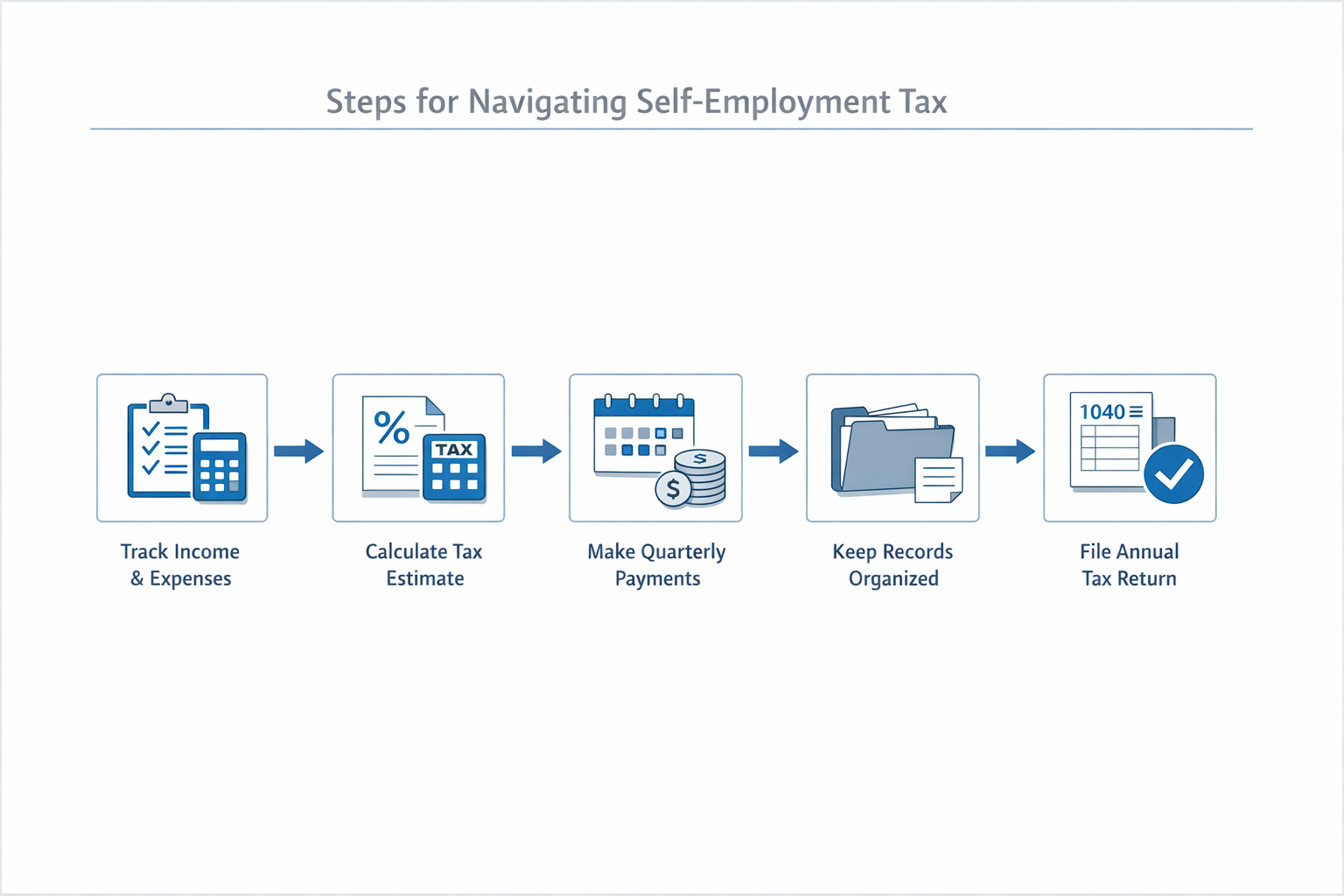
Managing self-employment tax isn't as complicated as it sounds once you understand the framework. The process breaks down into a few clear steps that repeat each year.
Calculate Your Net Self-Employment Income
Step 1
Determine your net profit
Start with your gross income — everything you earned from clients or customers. Subtract your ordinary and necessary business expenses. The result is your net profit, which appears on Schedule C (Form 1040) line 31 if you're a sole proprietor, or Schedule F line 34 if you're a farmer.
Your net profit is the foundation for everything that follows. If you had a loss for the year, you generally won't owe self-employment tax for that period.
Step 2
Apply the self-employment tax rate
For net earnings of $102,000 or less, multiply your net profit by 15.3%. This covers both the Social Security portion (12.4%) and the Medicare portion (2.9%). For earnings above $102,000, the calculation changes: multiply the amount by 2.9% and add $12,648 to account for the Social Security cap.
The math works like this because Social Security tax only applies to earnings up to a certain threshold, while Medicare tax applies to all income without a cap.
File Schedule SE and Pay What You Owe
Step 3
Complete Schedule SE
Schedule SE (Form 1040) walks you through the calculation step by step. Enter your net profit from Schedule C or F, apply the appropriate rate, and the form calculates your total self-employment tax. This amount transfers to your Form 1040.
Most tax software handles Schedule SE automatically once you enter your business income and expenses. If you're filing by hand, follow the line-by-line instructions in the IRS Schedule SE instructions.
Step 4
Make quarterly estimated payments
Self-employment tax isn't withheld from your income the way payroll taxes are for employees. You're responsible for paying it throughout the year via quarterly estimated tax payments. Use Form 1040-ES to calculate and submit these payments in April, June, September, and January.
Claim Your Deduction for Half the Tax
Here's where the system gives something back. You can deduct one-half of your self-employment tax as an adjustment to income on Form 1040. This deduction reduces your adjusted gross income, which can lower your overall tax bill and affect eligibility for other tax benefits.
The deduction appears on Schedule 1 (Form 1040), line 15. Multiply your total self-employment tax by 50% to get the deductible amount. This happens automatically in most tax software.
Track Everything for Next Year
Set up a system now to make next year easier. Keep separate records for business income and expenses, save receipts, and maintain a mileage log if you use your vehicle for business. When tax season arrives, you'll have everything you need to calculate your net profit accurately.
For retirement planning, understanding your income opens the door to tax-advantaged savings options like SEP IRAs and Solo 401(k)s. These accounts let you set aside a portion of your income while reducing your taxable income. Learn more about retirement account options to understand how different account types work.
The goal is getting in the right range with your quarterly payments — close enough that you're not hit with penalties, but not so much that you're giving the IRS an interest-free loan.
If your income varies significantly month to month, you can use the annualized income installment method to adjust your quarterly payments. This approach matches your payments more closely to when you actually earned the income, which can prevent overpayment early in the year.
Tips and Tricks for Managing Self-Employment Tax
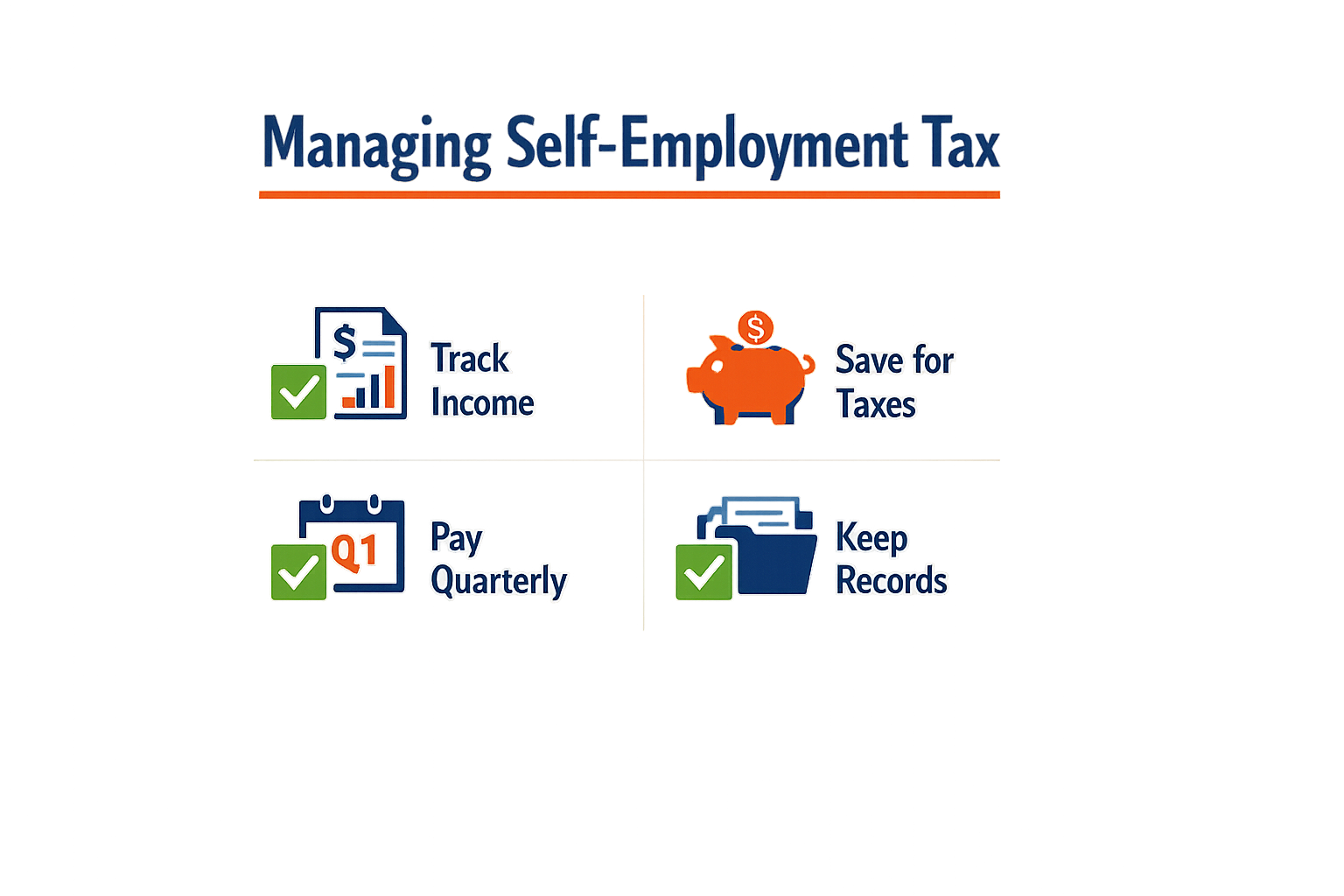
Managing self-employment tax doesn't have to feel overwhelming. Most freelancers and business owners find the process straightforward once they establish a few practical habits. Here's what that actually means in practical terms.
Get Schedule SE Right the First Time
The most important step is filling out Schedule SE (Form 1040) accurately. This form calculates your self-employment tax based on your net earnings. If you make a mistake here, you risk underpaying — which triggers penalties — or overpaying, which means you're giving the IRS an interest-free loan.
Start with your net profit from Schedule C, Schedule F, or your Schedule K-1 if you're a partner. The math works like this: your net earnings get reduced by the deduction for half of your self-employment tax, which creates a circular calculation that Schedule SE handles for you. Double-check every line before filing.
Reduce Your Taxable Income Through Retirement Contributions
Self-employed individuals can lower their tax burden by contributing to retirement plans like a SEP-IRA or Solo 401(k). When you make contributions to these accounts, you reduce your net earnings, which in turn reduces the amount subject to self-employment tax.
The calculation requires you to subtract both your retirement plan contributions and the deductible portion of your self-employment tax from your compensation. This is one area where the framework gets a bit circular, but the result is worth understanding: every dollar you contribute to a qualified retirement plan reduces your current tax bill while building your future financial security.
For informational and educational purposes, many freelancers find that maximizing retirement contributions is one of the most effective tax-planning strategies available. Talk to a licensed financial professional about which retirement account type makes sense for your specific situation. If you're also thinking about long-term savings for other goals, understanding 529 contribution limits can help you balance education savings with retirement planning.
Track Deductions Throughout the Year
A common misconception is that self-employment tax is calculated on your gross income. In practical terms, you pay self-employment tax on your net profit — revenue minus business expenses. That means every legitimate deduction you track reduces your tax bill.
Keep records of:
- Home office expenses (if you qualify)
- Business mileage and vehicle expenses
- Professional development and education
- Software subscriptions and equipment
- Health insurance premiums (which may also be deductible on Form 1040)
The goal is getting in the right range for your actual business expenses. Don't inflate deductions, but don't leave money on the table either. Most people don't realize that meticulous record-keeping from January through December makes tax season straightforward instead of stressful.
Step 1
Set up a separate business account
Open a dedicated checking account for business income and expenses. This creates a clean paper trail and makes it easier to calculate net profit accurately when tax time arrives.
Step 2
Make quarterly estimated payments
If you expect to owe $1,000 or more in taxes (including self-employment tax), the IRS requires quarterly estimated payments. Calculate these using Form 1040-ES and pay them in April, June, September, and January to avoid underpayment penalties.
Step 3
Review your numbers mid-year
Don't wait until December to assess your tax situation. A mid-year check-in lets you adjust estimated payments, increase retirement contributions, or make other strategic moves while you still have time to act.
Account for Elective Deferrals in Your Calculations
If you've set up a retirement plan that allows elective deferrals — like a Solo 401(k) — make sure these amounts are properly accounted for in your contribution calculations. The deduction worksheet has specific steps for this, and missing them can throw off your entire tax return.
The honest answer is that the interaction between self-employment tax, retirement contributions, and income tax can get complex. The framework is designed to encourage retirement savings while funding Social Security and Medicare, but the calculations require attention to detail.
When You're Ready to Take the Next Step
These strategies give you a starting point for managing self-employment tax efficiently. Depending on your circumstances — business structure, income level, family situation, and long-term goals — additional planning opportunities may exist.
The real question is whether you're capturing all the deductions you're entitled to while staying compliant with IRS requirements. Most freelancers benefit from at least one consultation with a tax professional who can review their specific situation and identify planning strategies tailored to their business.
Conclusion
Self-employment tax is the mechanism that ensures freelancers, independent contractors, and small business owners contribute to Social Security and Medicare — the same programs that traditional employees fund through payroll withholding. The difference is that self-employed individuals pay both the employer and employee portions, which is why the 15.3% rate feels steep when you first encounter it. The math works like this: you calculate your net earnings, apply the 92.35% adjustment, then multiply by the tax rate. If your net earnings are $400 or more, you're required to file Schedule SE and pay what's due.
The framework isn't as complicated as it sounds once you understand the moving parts. You deduct half of your self-employment tax when calculating your adjusted gross income, which reduces your overall tax burden. You also get credit toward your future Social Security and Medicare benefits — but only if you pay the correct amount. Failure to pay the proper self-employment tax can result in not receiving all the credits you're entitled to, which affects your retirement and disability coverage down the line.
Most people don't realize that managing self-employment tax effectively starts with consistent record-keeping and quarterly estimated payments. Waiting until April to address a full year's liability creates cash flow problems and potential penalties. The goal is getting in the right range with your estimates and adjusting as your income changes. When you're ready to take the next step, consider working with a tax professional who understands self-employment income — they can help you navigate deductions, retirement account contributions, and state-specific rules that affect your overall tax picture. For more on tax-advantaged savings strategies that can reduce your taxable income, see Life Insurance Tax Rules.
The honest answer is that self-employment tax is a permanent part of working for yourself, but it's also manageable when you build it into your financial planning from the start. Talk to a licensed tax professional about your specific situation, especially if you're transitioning from W-2 employment or scaling your business. The information here is for educational purposes — your circumstances will determine the exact strategies that make sense for you.
Frequently asked questions
What is the self-employment tax rate for 2026?
The self-employment tax rate is 15.3% — 12.4% for Social Security and 2.9% for Medicare. This rate applies to your net earnings from self-employment after business deductions.
Who must pay self-employment tax?
You must pay self-employment tax if you're a sole proprietor, independent contractor, partner in a business, or otherwise in business for yourself with net earnings of $400 or more.
How do I calculate my self-employment tax?
Calculate your net profit from Schedule C or F, multiply by 92.35%, then apply the 15.3% rate. For earnings above the Social Security wage base ($102,000 in recent years), only the 2.9% Medicare portion applies to the excess.
When are self-employment tax payments due?
You make quarterly estimated tax payments (which include self-employment tax) on April 15, June 15, September 15, and January 15 using Form 1040-ES.
Can I deduct self-employment tax?
Yes. You can deduct one-half of your self-employment tax as an adjustment to income on Schedule 1 (Form 1040), which reduces your adjusted gross income.
Does self-employment tax apply to S corporation distributions?
No. S corporation shareholders pay themselves a reasonable salary subject to payroll taxes, but distributions beyond that salary are not subject to self-employment tax.
Related reading
UTMA Account: UGMA vs. UTMA Custodial Accounts for Your Child