Introduction
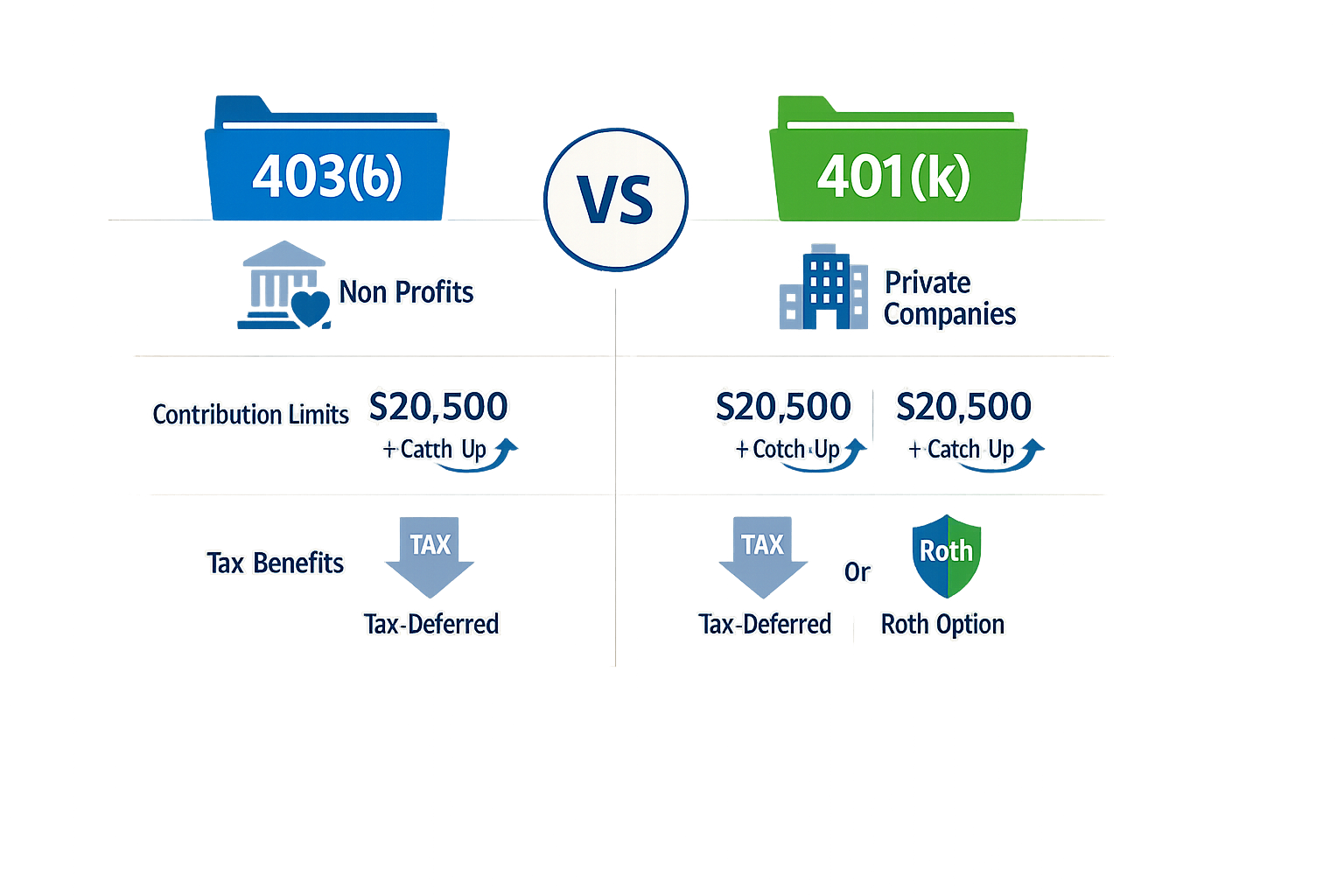
A 403b plan is a tax-advantaged retirement savings account offered by public schools, nonprofits, and certain religious organizations, while a 401(k) serves private-sector employees.
Most people don't choose between a 403b plan and a 401(k) — their employer makes that choice for them. The real question is understanding what you have and how to use it effectively.
The confusion is understandable. Both are employer-sponsored retirement plans. Both let you contribute pre-tax dollars. Both grow tax-deferred until retirement. The names themselves — strings of numbers and letters from the tax code — don't exactly clarify matters.
Here's what that actually means for your situation: if you work for a public school, university, hospital, or nonprofit organization, you likely have access to a 403b plan. If you work for a private company, you're probably looking at a 401(k). The framework is similar, but the details matter when you're planning how much to save and where to put those dollars.
The honest answer: most people don't realize these plans share the same fundamental tax advantages. Contributions reduce your taxable income today. The money grows without annual tax bills. You pay ordinary income tax only when you withdraw funds, typically in retirement when your tax bracket may be lower. That structure applies whether the plan code starts with 401 or 403.
Worth understanding: the difference between these plans isn't about which is "better" in some absolute sense. It's about which one your employer offers, what investment options come with it, and how the administrative details affect your day-to-day experience as a participant. The goal is getting in the right range of contributions for your circumstances, regardless of which plan type you're using.
Understanding the Confusion Between 403(b) and 401(k) Plans
Most people don't realize that the retirement plan on their desk isn't the same one their friend at a different employer has — even when both plans look nearly identical on paper. The 403b plan and the 401(k) share enough similarities that it's easy to assume they're interchangeable. They're not.
The confusion starts with the basics. Both plans let you contribute pre-tax dollars, both offer employer matching in many cases, and both cap your annual contributions at the same limit. On the surface, they appear to be the same product with different labels. That assumption falls apart when you look at who can offer them, what investment options they include, and how the rules around administration actually work.
Why the Names Don't Help
The tax code naming convention — 403(b) versus 401(k) — tells you nothing about what the plans do. These labels reference specific sections of the Internal Revenue Code, not functional differences. A 403b plan is designed for employees of public schools, certain nonprofits, and religious organizations. A 401(k) plan is designed for private-sector employers. The eligibility framework is the first real distinction, but most people don't encounter it until they change jobs and discover their new employer offers a different plan type.
The Investment Options Gap
A common misconception is that all retirement plans offer the same menu of investment choices. In practice, 403b plan options historically offered a narrower range, often limited to annuities and mutual funds. While recent rule changes have expanded what's available, the structure of many 403(b) plans still reflects that legacy. The framework matters because it affects how much control you have over your portfolio and what fees you pay.
401(k) plans, by contrast, typically offer a broader selection of mutual funds, target-date funds, and sometimes brokerage windows that let you invest in individual stocks. The difference isn't universal — some 403(b) plans now rival 401(k) plans in flexibility — but the historical pattern created an expectation gap that still confuses people comparing the two.
Administrative Complexity and Employer Burden
Another source of confusion: the administrative requirements for employers sponsoring these plans. 401(k) plans are subject to nondiscrimination testing under ERISA, which means employers must prove that the plan doesn't disproportionately benefit highly compensated employees. This testing adds compliance costs and administrative overhead.
Many 403(b) plans, particularly those offered by public schools and churches, are exempt from ERISA. That exemption simplifies administration for the employer but can also mean fewer protections and less oversight for participants. The real question is whether the lighter regulatory touch translates into lower costs or just less transparency. The honest answer: it depends on how the specific plan is structured.
The retirement plan you're offered isn't a choice — it's a function of where you work and what tax category your employer falls into.
The lack of clarity around these plans isn't just a labeling problem. It's a structural issue rooted in how the tax code carved out different rules for different types of employers. Understanding which plan you have matters less than understanding what your specific plan allows, what it costs, and how it fits into your broader retirement strategy.
What Are the Key Differences Between a 403b Plan and a 401(k)?
Both 403(b) and 401(k) plans fall under the qualified plan category, which means they offer tax-deferred growth and allow employers to deduct contributions. But the similarities largely end there. The framework for each plan reflects the different worlds they serve — one designed for educators and nonprofit workers, the other for private-sector employees.
Eligibility: Who Can Participate
The most straightforward difference is who qualifies. A 403b plan is available exclusively to employees of public schools, certain tax-exempt organizations under Section 501(c)(3), and some ministers. If you work for a hospital system, university, or public school district, you're likely looking at a 403(b).
A 401(k) plan, by contrast, is offered by for-profit companies. If your employer is a corporation, LLC, or partnership operating in the private sector, your retirement plan will be a 401(k). The eligibility distinction isn't about the quality of the plan — it's about the tax status of your employer.
Contribution Limits and Tax Treatment
Both plans share the same annual contribution limits. Contributions are deducted from your paycheck before taxes, and earnings grow tax-free until you take distributions in retirement. The mechanics of tax deferral work identically in both structures.
Where the plans diverge is in how those limits are applied in practice. Some 403(b) plans allow for a special 15-year catch-up provision if you've worked for the same qualifying employer for at least 15 years. This is separate from the standard age-50 catch-up contribution and can provide additional savings capacity for long-tenured employees in education or nonprofit sectors.
Investment Options and Plan Structure
The investment menu is where you'll notice the most practical difference. A 401(k) plan typically offers a broad range of mutual funds, often including target-date funds, index funds, and actively managed options. Employers have significant flexibility in designing the investment lineup.
A 403b plan historically offered only annuity contracts, though most now include mutual funds as well. The investment options can be narrower, and some plans still lean heavily on insurance products. Depending on your circumstances, this can mean fewer low-cost index fund choices compared to a typical 401(k).
| Feature | 403(b) Plan | 401(k) Plan |
|---|---|---|
| Eligibility | Public schools, nonprofits, ministers | For-profit employers |
| Contribution limits | Same annual limits under Section 415 | Same annual limits under Section 415 |
| Investment options | Annuities and mutual funds (historically narrower) | Broad mutual fund selection |
| Special catch-up | 15-year service provision available | Standard age-50 catch-up only |
Distribution Rules and Access
Both plans restrict early distributions, generally penalizing withdrawals before age 59½. However, 403(b) plans have unique distribution rules that can affect when and how you access your funds. The regulatory framework governing 403(b) distributions includes specific provisions that differ from standard qualified plan rules.
In practical terms, this means the paperwork and timing for taking money out of a 403b plan can be more restrictive, particularly for older contracts. If you're considering a rollover or early withdrawal, the rules for a 403(b) plan may require additional steps compared to a 401(k).
Employer Match and Vesting
Both plans can include employer matching contributions, but the structure varies by employer. A 401(k) plan often includes a standard match formula — say, 50% of the first 6% you contribute. Vesting schedules, which determine when employer contributions become fully yours, also follow similar patterns in both plan types.
The difference is less about what's possible and more about what's common. Nonprofit employers offering 403(b) plans may have different budget constraints or contribution philosophies than for-profit companies, which can influence match generosity and vesting timelines.
Administrative Complexity
From the employer's perspective, 403(b) plans were historically simpler and less expensive to administer. Recent regulatory changes have narrowed that gap, but 403(b) plans still tend to have fewer compliance requirements than 401(k) plans, particularly around nondiscrimination testing.
For you as a participant, this administrative difference is mostly invisible. What matters is understanding the specific rules of your plan, regardless of which type it is.
Tips for Choosing Between 403(b) and 401(k)
The honest answer: most people don't actually choose between a 403b plan and a 401(k) — their employer makes that decision for them. If you work for a public school, hospital, or nonprofit, you're getting a 403(b). If you work for a for-profit company, you're getting a 401(k). The real question is how to maximize whichever plan you have access to.
That said, understanding the framework helps you make better decisions within your plan. Here's what that actually means in practical terms.
Start with the employer match
The math works like this: if your employer offers a match, that's guaranteed return on your contributions. Most people don't realize this is the single most important factor in retirement plan decisions — not the plan type, not the investment menu, but whether you're capturing the full match.
Contribute at least enough to get the maximum employer match. If your employer matches 50% of the first 6% you contribute, put in that 6%. Leaving matching dollars on the table is leaving free money behind.
Evaluate your investment options
Both plan types offer investment choices, but the quality and cost of those options vary significantly by employer. Look at the expense ratios on the funds available to you. Lower-cost index funds generally serve most people better than higher-cost actively managed funds over the long term.
If your 403b plan limits you to high-cost annuity products, that's worth understanding. Some 403(b) plans offer both mutual fund and annuity options — the mutual fund side typically has lower fees. For informational and educational purposes, review your plan's fee disclosure documents to see what you're actually paying.
Consider catch-up contributions as you approach retirement
Both 403(b) and 401(k) plans allow catch-up contributions for participants age 50 and older. These additional contributions can help you accelerate savings in the years before retirement. The framework is straightforward: if you have the income and you're behind on retirement savings, catch-up contributions let you put away more than the standard annual limit.
The goal is getting in the right range for retirement readiness — not optimizing between two plans you probably don't get to choose between anyway.
Think about Roth options
Many employers now offer Roth versions of both 403(b) and 401(k) plans. The difference between traditional and Roth contributions comes down to when you pay taxes: now (Roth) or in retirement (traditional).
If you expect to be in a higher tax bracket in retirement, Roth contributions may make sense. If you expect to be in a lower bracket, traditional contributions typically work better. For most people early in their careers, Roth contributions deserve consideration — your tax rate is likely lower now than it will be later.
Participants should consider the implications of designated Roth accounts, especially regarding lifetime distribution rules and how these accounts are treated for tax purposes.
When to talk to a licensed financial professional
Your specific situation may warrant professional guidance, particularly if you're changing jobs and deciding what to do with an existing 403(b) or 401(k) balance, if you're self-employed and considering additional retirement savings vehicles, or if you're coordinating retirement savings with other financial goals like education funding or estate planning.
A licensed financial professional can help you understand how your retirement plan fits into your broader financial picture. When you're ready to take the next step beyond maximizing your current employer plan, that's the conversation worth having.
Conclusion
The short answer: a 403b plan and a 401(k) share the same contribution limits and tax-advantaged structure, but they're designed for different employers. If you work for a public school, nonprofit hospital, or qualifying religious organization, you have a 403(b) plan. If you work for a for-profit company, you have a 401(k). The math works the same — the difference is who's offering it.
Most people don't realize that the real question isn't which plan is better, but whether they're using the plan they have effectively. Both 403(b) and 401(k) plans let you contribute pre-tax dollars, grow investments tax-deferred, and potentially receive employer matching contributions. The framework is nearly identical. What matters more is your contribution rate, your investment choices within the plan, and whether you're capturing the full employer match if one is offered.
In practical terms, understanding the differences between these retirement plans helps you know what to expect from your employer's offering and how to maximize it. A 403b plan must include specific material terms around eligibility, benefits, limitations, and distribution options — the same structural requirements that govern 401(k) plans. Both are written defined contribution plans that follow strict IRS guidelines.
When you're ready to take the next step, review your current plan documents to understand your vesting schedule, investment options, and any employer matching formula. Talk to a licensed financial professional about how your retirement plan fits into your broader financial picture, including other savings vehicles, Social Security projections, and your target retirement age. The goal is getting in the right range for your circumstances — not chasing the perfect plan type, but using the plan you have to build the retirement you want.
FAQ
What is a 403b plan?
A 403b plan is a tax-advantaged retirement savings account available to employees of public schools, tax-exempt organizations under Section 501(c)(3), and certain ministers. Contributions are made pre-tax, and earnings grow tax-deferred until withdrawal in retirement.
How does a 403b plan differ from a 401(k)?
The main difference is eligibility: a 403b plan serves nonprofit and educational employees, while a 401(k) serves private-sector workers. Investment options also differ — 403(b) plans historically offered annuities and mutual funds, while 401(k) plans typically provide broader fund selections.
Can I contribute to both a 403b plan and a 401(k)?
You can have both types of accounts if you work multiple jobs, but the IRS contribution limit applies to your total elective deferrals across all employer plans combined, not separately to each plan.