Introduction
Most people approach mutual fund selection the same way they approach New Year's resolutions — with good intentions and no framework. The result is predictable: portfolios stuffed with funds chosen based on last year's performance, brand recognition, or a casual recommendation from a colleague.
To evaluate mutual funds effectively, you need a systematic approach that examines costs, performance, and risk-adjusted returns. Mutual funds are pooled investment vehicles where multiple investors contribute capital that a professional manager invests according to stated objectives. When structured properly, they offer diversification, professional management, and accessibility that individual stock picking rarely matches. The challenge isn't finding mutual funds — thousands exist — but identifying which ones deserve a place in your portfolio.
The difference between a well-chosen fund and a poorly chosen one compounds over decades. A fund charging excessive fees or consistently underperforming its benchmark can cost you tens of thousands of dollars in retirement savings. For context, understanding retirement account types like IRAs and 401(k)s helps you determine where these funds fit in your overall financial plan.
This article walks through the practical framework for evaluating mutual funds worth investing in. You'll learn which metrics matter, which ones don't, and how to build a selection process that works whether you're choosing funds for a workplace retirement plan or a taxable brokerage account. The goal is getting in the right range — not finding the single "perfect" fund, which doesn't exist.
For informational and educational purposes, the principles here apply to most mutual fund categories — stock funds, bond funds, balanced funds, and index funds. The specific numbers and thresholds adjust based on fund type, but the evaluation framework remains consistent.
Problem Statement
Most people approach mutual fund selection the same way they approach buying a car without test-driving it — they rely on what sounds good in the marketing materials. The result is predictable: portfolios full of funds that looked attractive on paper but don't align with their actual goals, risk tolerance, or timeline.
The Overwhelm of Too Many Choices
The mutual fund universe contains thousands of options. Morningstar tracks over 8,000 mutual funds across dozens of categories. When faced with that many choices, most investors either freeze or grab whatever their coworker recommended. Neither approach builds a portfolio you can trust when markets turn volatile.
The categories themselves create confusion. Large-cap growth, mid-cap value, international equity, emerging markets, balanced funds — the labels assume you already know what you're looking for. Without a framework for what each category does in a portfolio, comparing funds becomes an exercise in comparing numbers you don't fully understand.
The Knowledge Gap
Expense ratios, turnover rates, Sharpe ratios, alpha, beta — the metrics that matter for evaluating mutual funds read like a foreign language to most investors. Fund companies don't make it easier. Prospectuses run 50+ pages of dense disclosures written for compliance, not clarity.
Most investors default to the one number they do understand: past performance. The problem is that past returns tell you what happened, not what's likely to happen next. A fund that dominated the last five years might be overexposed to the exact sectors poised to underperform in the next five.
The Cost of Poor Decisions
Choosing the wrong mutual funds doesn't just mean missing out on better returns. High expense ratios compound against you year after year. A fund charging 1.5% annually versus one charging 0.5% costs you thousands of dollars over a decade on a modest portfolio — money that comes directly out of your retirement account or education savings.
Tax efficiency matters too, but most investors don't discover it until tax season. Actively managed funds with high turnover can generate capital gains distributions that create tax bills even in years when you didn't sell anything. That's a painful surprise when you're trying to build wealth in a taxable account.
The timing problem compounds everything. Investors tend to chase performance, buying funds after they've already had their run and selling after they've dropped. The math is brutal: buy high, sell low, repeat. Without a clear evaluation framework, emotion drives decisions that would look obviously wrong on paper.
How Do You Evaluate Mutual Funds?
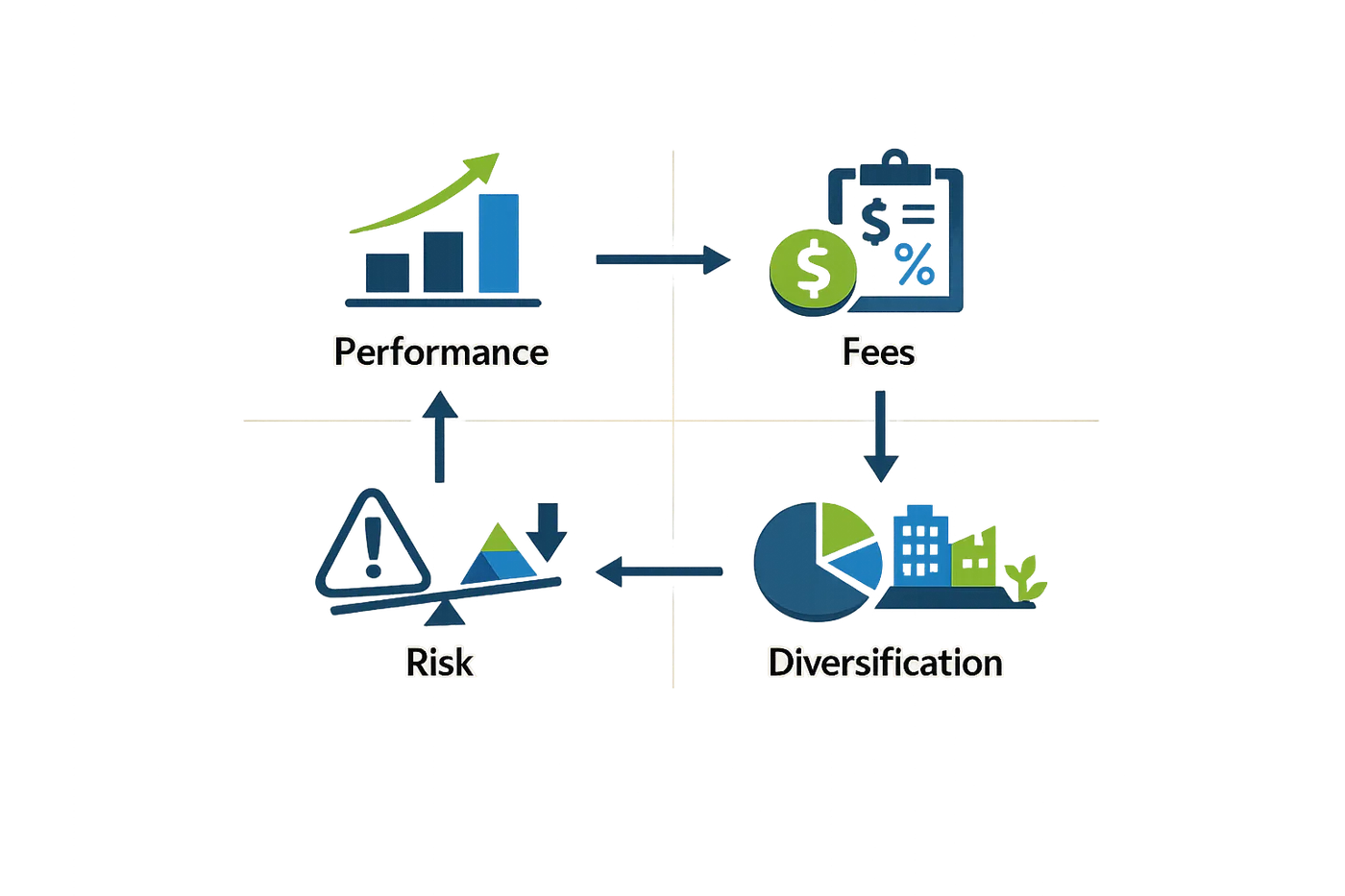
Evaluating mutual funds requires a structured approach. The framework below breaks the process into manageable steps, focusing on the criteria that separate funds worth your attention from those that aren't.
Step 1: Define Your Investment Objectives
Before you look at a single fund, clarify what you're trying to accomplish. Are you building retirement savings in a 401(k) for Small Business Owners? Saving for education expenses? Generating income in retirement? Your timeline, risk tolerance, and financial goals determine which fund categories make sense.
Step 1
Establish your framework
Write down your investment timeline (how many years until you need the money), your comfort level with market volatility, and whether you need growth, income, or a balance of both. This becomes your filter for every fund you evaluate.
Most investors need a mix of asset classes — stocks for growth, bonds for stability, and potentially other categories depending on circumstances. Your objectives tell you which mix makes sense, and that mix tells you which fund types to evaluate.
Step 2: Examine Expense Ratios and Fees
The expense ratio is the annual fee a fund charges, expressed as a percentage of your investment. A fund charging 1.5% takes $150 per year from every $10,000 you invest. Over decades, high fees compound against you.
Look beyond the expense ratio for other costs: front-end loads (sales charges when you buy), back-end loads (charges when you sell), and 12b-1 fees (ongoing marketing expenses passed to investors). Funds with multiple fee layers rarely justify the extra cost.
Step 3: Review Performance History and Consistency
Past performance doesn't guarantee future results, but it reveals how a fund has handled different market conditions. Look at returns over multiple periods — one year, three years, five years, and ten years if available.
The math works like this: a fund that returned 12% annually over ten years but swung wildly year to year may not suit you better than one that returned 10% with less volatility. Consider both the absolute return and the consistency.
Step 2
Compare against benchmarks
Every fund should beat its benchmark index over time, after fees. If a large-cap stock fund can't outperform the S&P 500 over five or ten years, the fund isn't adding value — you'd do better in a low-cost index fund tracking that benchmark.
Step 4: Assess Risk-Adjusted Returns
Raw returns tell half the story. Risk-adjusted metrics tell you whether a fund earned its returns through skill or excessive risk-taking. Two common measures:
| Metric | What It Measures | What to Look For |
|---|---|---|
| Sharpe Ratio | Return per unit of risk | Higher is better; above 1.0 suggests good risk-adjusted performance |
| Standard Deviation | Volatility of returns | Lower means less volatility; compare to similar funds |
A fund with high returns and high volatility may not fit your risk tolerance. A fund with moderate returns and low volatility might be the better choice, depending on your circumstances.
Step 5: Evaluate Fund Management and Strategy
For actively managed funds, the portfolio manager's tenure and track record matter. A fund that performed well under one manager may not continue that performance under new leadership. Look for managers who've been with the fund through at least one full market cycle.
Understand the fund's investment strategy. Does it focus on growth stocks, value stocks, or a blend? Does it concentrate holdings in a few sectors or diversify broadly? The strategy should align with your objectives and complement your other holdings.
The goal is getting in the right range — a fund that matches your timeline, risk tolerance, and complements the rest of your portfolio without duplicating what you already own.
Step 6: Check Portfolio Holdings and Diversification
Review the fund's top ten holdings and sector allocation. If you already own individual stocks or other funds, avoid unintentional concentration. Owning three different funds that all hold the same top-ten tech stocks doesn't give you diversification — it gives you amplified exposure to those companies.
A well-diversified fund spreads risk across multiple sectors and securities. For stock funds, that typically means holding at least 50 to 100 different companies. Bond funds should diversify across issuers, maturities, and credit qualities.
Step 7: Verify Minimum Investment and Account Requirements
Funds set minimum initial investments, often ranging from $1,000 to $10,000 for retail investors. Some waive or reduce minimums for retirement accounts or if you commit to automatic monthly investments. Make sure the fund's minimums fit your current situation and that you can meet any ongoing requirements.
Certain funds are only available through specific account types or platforms. Verify you can access the fund through your brokerage or retirement plan before you complete your evaluation.
What Criteria Should You Use to Evaluate Mutual Funds?
Once you understand the evaluation framework, a few practical strategies can help you make smarter decisions and avoid common mistakes. These aren't secret techniques — they're habits that keep you focused on what matters and prevent emotional reactions from derailing your plan.
Start with Your Asset Allocation, Not the Fund
Most people pick funds first and hope they add up to a balanced portfolio. That's backward. Decide how much of your portfolio belongs in stocks, bonds, and other asset classes based on your timeline and risk tolerance, then find funds that fill those slots. A great fund in the wrong allocation bucket doesn't help you.
For example, if your target is 70% stocks and 30% bonds, look for stock funds and bond funds separately — don't let a hot-performing fund convince you to overweight one category. The framework matters more than any single holding.
Compare Funds Within the Same Category
Comparing a large-cap growth fund to a small-cap value fund is like comparing a sedan to a pickup truck. They serve different purposes. When you're evaluating options, compare funds with similar investment mandates — large-cap blend to large-cap blend, international equity to international equity.
This keeps the comparison fair and makes it easier to spot which fund offers better value for the same job. Category-specific benchmarks (like the S&P 500 for large-cap U.S. stocks) give you a reference point that actually means something.
Look for Consistency Over Flash
A fund that beats its benchmark by 15% one year and trails by 10% the next isn't necessarily better than a fund that quietly outperforms by 2% to 3% every year. Consistency matters because it means the fund's strategy works across different market conditions, not just when one sector gets hot.
Check performance over multiple periods — one year, three years, five years, ten years if available. If a fund only shines in one window, dig into what changed. Manager turnover, strategy drift, or a lucky bet on one sector can all create short-term spikes that don't repeat.
Don't Ignore the Prospectus
The prospectus isn't exciting, but it's the legal document that tells you what the fund actually does. Skim the investment objective, the principal strategies, and the principal risks sections. You'll learn whether the fund can use derivatives, how much it can concentrate in one sector, and what kinds of securities it's allowed to buy.
If the prospectus describes strategies you don't understand or risks you're not comfortable with, that's a signal to keep looking. You don't need to memorize it, but you should know what you're signing up for.
Avoid Chasing Last Year's Winners
Funds that topped the performance charts last year get the most attention and the most new money. They also tend to underperform over the next few years. This isn't a mystery — it's reversion to the mean. Strategies that work exceptionally well in one environment often struggle when conditions shift.
Instead of chasing recent winners, look at funds that have delivered solid risk-adjusted returns over longer periods. A fund that consistently ranks in the top third or top half of its category is often a better bet than one that swings between the top 10% and the bottom half. For more on building a balanced approach to long-term savings, see SEP IRA Contribution Limits for 2026: What You Need to Know.
Understand How the Fund Fits Your Account Type
Where you hold a fund matters as much as which fund you hold. Tax-efficient funds (like index funds with low turnover) work well in taxable accounts. Funds that generate a lot of short-term capital gains or dividend income make more sense in tax-deferred accounts like IRAs or 401(k)s, where you won't pay taxes on those distributions until you withdraw the money.
If you're building a portfolio across multiple account types, think about tax location — putting the right funds in the right accounts — as part of your strategy. It's a simple step that can save you money every year without changing your allocation. For education savings specifically, consider a Coverdell Education Savings Account for tax-advantaged growth.
Check for Manager Tenure and Strategy Drift
A fund's track record reflects the decisions of the people running it. If the manager who built that record left two years ago, the historical performance tells you less about what to expect going forward. Look for funds where the current manager has been in place for at least three to five years, ideally longer.
Also watch for strategy drift — when a fund's actual holdings start to diverge from its stated objective. A fund that's supposed to invest in large-cap U.S. stocks but starts loading up on small-caps or foreign equities is taking risks you didn't sign up for. The annual report and the holdings list (usually available on the fund company's website) will show you what the fund actually owns.
The best fund for your portfolio is the one that does its job consistently, fits your allocation, and doesn't surprise you with hidden costs or unexplained risks.
Rebalance, Don't Set and Forget
Once you've chosen your funds, the work isn't over. Over time, some funds will grow faster than others, and your allocation will drift away from your target. Rebalancing — selling a bit of what's grown and buying more of what's lagged — keeps your portfolio aligned with your plan.
How often? Once or twice a year is usually enough for most people. More frequent rebalancing can trigger unnecessary taxes and trading costs. Less frequent rebalancing lets your allocation drift too far. The goal is getting in the right range, not hitting a precise number every month.
Conclusion
Evaluating mutual funds doesn't require a finance degree — it requires a framework. The difference between a portfolio that compounds steadily and one that erodes from fees and underperformance comes down to asking the right questions before you invest: What does this fund cost? How has it performed relative to its benchmark and peers? Does the manager's strategy align with your risk tolerance and time horizon?
The math works like this: a fund charging 1.5% annually instead of 0.5% costs you roughly 25% of your potential returns over 30 years, assuming identical performance. That's not a rounding error — it's the difference between retiring comfortably and working longer than you planned. Most people don't realize expense ratios compound against them the same way returns compound for them. Understanding that single fact changes how you evaluate every fund on your shortlist.
Here's what that actually means in practical terms. Start with low-cost index funds as your baseline. If an actively managed fund charges more, it needs to demonstrate consistent outperformance after fees — not just in one strong year, but across full market cycles. Look at the fund's Sharpe ratio to understand whether it's delivering returns worth the volatility you're accepting. Check manager tenure to confirm the person responsible for the track record is still making the decisions. And verify the fund's asset size falls in the sweet spot — large enough for stability, small enough to execute its strategy without drag.
For informational and educational purposes, these evaluation steps provide a starting point. Your specific situation — tax bracket, retirement timeline, existing holdings, risk capacity — determines which funds belong in your portfolio. A 529 plan for a toddler's college fund has different requirements than a rollover IRA for someone five years from retirement. The framework stays the same; the application adjusts.
When you're ready to take the next step, talk to a licensed financial professional who can review your full financial picture and help you match funds to goals. The honest answer is that no article can replace personalized advice tailored to your circumstances. But understanding how to evaluate mutual funds worth investing in puts you in control of the questions you ask and the answers you accept. That's the goal — getting in the right range before you commit a dollar, so the money you invest has the best chance to grow the way you need it to.
Most portfolios aren't built in a day. They're built one informed decision at a time, with a clear understanding of what you own and why you own it. Start there, and the rest follows.
Frequently asked questions
What is the most important metric when you evaluate mutual funds?
The expense ratio is often the most predictive metric because it directly reduces your returns every year. A fund charging 1.5% versus 0.5% costs you thousands of dollars over time, regardless of performance. After fees, examine risk-adjusted returns (Sharpe ratio) and consistency relative to the fund's benchmark.
How do you evaluate mutual funds for retirement accounts?
To evaluate mutual funds for retirement accounts, focus on expense ratios, long-term performance (10+ years if available), manager tenure, and tax efficiency. In tax-deferred accounts like IRAs and 401(k)s, prioritize funds with strong risk-adjusted returns and low costs, since you won't pay taxes on distributions until withdrawal.
Should you evaluate mutual funds based on past performance?
Past performance is one data point, not a prediction. Use it to understand how a fund handled different market conditions, but never choose a fund based solely on recent returns. Funds that topped the charts last year often underperform in subsequent years due to reversion to the mean.
What is a good expense ratio for mutual funds?
For broad-market stock funds, expense ratios below 1% are reasonable; below 0.5% is better. Bond funds should typically charge below 0.75%. Index funds often run 0.20% or less. Any fund charging above these thresholds needs to demonstrate consistent outperformance to justify the extra cost.
Learn how to evaluate and choose mutual funds to invest in to build a strong investment portfolio.
Table of Contents
- Introduction — Introduce the concept of mutual funds and the importance of choosing the right ones for investment.
- Problem Statement — Discuss the common challenges investors face when selecting mutual funds, including lack of knowledge, overwhelming choices, and potential for poor investment decisions.
- How Do You Evaluate Mutual Funds? — Outline a clear, structured approach to evaluating and selecting mutual funds, including key criteria to consider and steps to follow.
- What Criteria Should You Use to Evaluate Mutual Funds? — Provide practical advice and common strategies to help investors make informed decisions when selecting mutual funds.
- Conclusion — Summarize the key takeaways from the article and encourage readers to apply the outlined strategies in their investment journey.
- Table of Contents