
Introduction to Coverdell Education Savings Accounts
Most families don't lose sleep over the mechanics of education savings accounts. They lose sleep over whether they'll have enough saved when tuition bills arrive. The difference between those two concerns is the framework — and that's where a Coverdell ESA enters the picture.
A Coverdell ESA is a tax-advantaged savings vehicle that lets families set aside money for education expenses without paying taxes on the growth, as long as the funds go toward qualified expenses. The account works similarly to a Roth IRA in structure: you contribute after-tax dollars, the money grows tax-free, and distributions come out tax-free when used for education. The framework is straightforward, but the details matter.
What makes Coverdell ESAs worth understanding is their flexibility. Unlike some education savings options, these accounts cover expenses from kindergarten through graduate school. That range includes tuition, books, supplies, equipment, and in some cases room and board. For families planning education funding across multiple stages — say, private elementary school now and college later — that breadth is the point. If you're exploring retirement savings options for your own financial planning, a SEP IRA might fit self-employed workers who need similar tax advantages.
The contribution limit is $2,000 per year per beneficiary. That's not per account — it's per child. If three grandparents and two parents all want to contribute to separate Coverdell ESAs for the same child, the total across all five accounts can't exceed $2,000 in any given year. The math works like this: the IRS tracks the beneficiary, not the number of accounts.
Income limits phase out your ability to contribute as your modified adjusted gross income rises. For 2025, single filers start losing contribution eligibility at $95,000 and are fully phased out at $110,000. Married couples filing jointly see the phase-out begin at $190,000 and complete at $220,000. If your income exceeds those thresholds, you can't contribute directly — though a lower-earning spouse or relative might still qualify.
The honest answer about Coverdell ESAs: they're not the only option, and for many families they're not the primary option. The $2,000 annual cap means you'll likely need additional savings strategies if you're funding four years of college. That's where the comparison to 529 plans becomes relevant — and where understanding both frameworks helps you build the right combination for your circumstances.
Understanding the Need for Education Savings
Most families don't lie awake wondering about tax-advantaged education accounts. They lie awake wondering how they'll pay for college without derailing their own retirement or saddling their kids with six-figure debt.
The math is straightforward: education costs have been rising faster than general inflation for decades. Tuition, fees, room, and board at four-year institutions continue to climb, and that's before factoring in books, technology, and living expenses. For families with young children, the gap between current savings rates and projected college costs grows wider every year the conversation gets postponed.
The real question is whether you have a framework for closing that gap. Without a dedicated savings strategy, most families end up choosing between three uncomfortable options: taking on substantial parent or student loan debt, asking their child to work full-time while attending school, or limiting educational choices based purely on cost. A structured approach to education savings creates a fourth option — one where you're making intentional decisions years in advance rather than reactive ones when the tuition bill arrives.
Why Tax-Advantaged Accounts Matter
The difference between saving in a regular taxable account and a tax-advantaged education account comes down to how much of your money actually works for you. In a standard savings or brokerage account, you pay taxes on interest, dividends, and capital gains every year. Those tax payments reduce the amount available to compound.
Tax-advantaged accounts like Coverdell ESAs and 529 plans flip that structure. Contributions aren't tax-deductible at the federal level, but the account grows tax-free. When you withdraw funds for qualified education expenses, the distributions come out tax-free as well. That means every dollar of growth stays in the account, compounding without the annual tax drag.
For informational and educational purposes, here's what that actually means in practical terms: if you're in a moderate tax bracket and your investments generate returns over 15 or 20 years, the tax-free growth can add thousands of dollars to your available education funds compared to taxable savings. The longer the timeline, the more significant the difference.
The Framework for Education Savings
A solid education savings strategy starts with three questions. First, how much time do you have before the funds are needed? Second, what's a realistic monthly or annual contribution given your other financial priorities? Third, what level of control and flexibility do you need over investment choices and eligible expenses?
Those answers determine which account type fits your situation. Some families prioritize maximum investment flexibility and the ability to cover K-12 expenses. Others want state tax deductions and higher contribution limits. Neither approach is inherently better — the goal is getting in the right range for your circumstances and timeline.
What most people don't realize is that education savings doesn't have to be an all-or-nothing decision. You can start with one account type, adjust contributions as income changes, and layer in additional strategies as your child gets closer to college age. The framework matters more than perfection. For a broader view of tax-advantaged savings strategies that complement education planning, see What Is a SEP IRA? A Guide for Self-Employed Workers.
The cheapest college is the one you can afford without sacrificing your retirement security or your child's financial independence after graduation.
When you're ready to take the next step, the honest answer is this: talk to a licensed financial professional who can review your specific situation, including income, tax bracket, state residency, and timeline. Education savings accounts offer real benefits, but the details — contribution limits, income phase-outs, qualified expense definitions — matter enough that personalized guidance pays for itself.
What Is a Coverdell ESA?
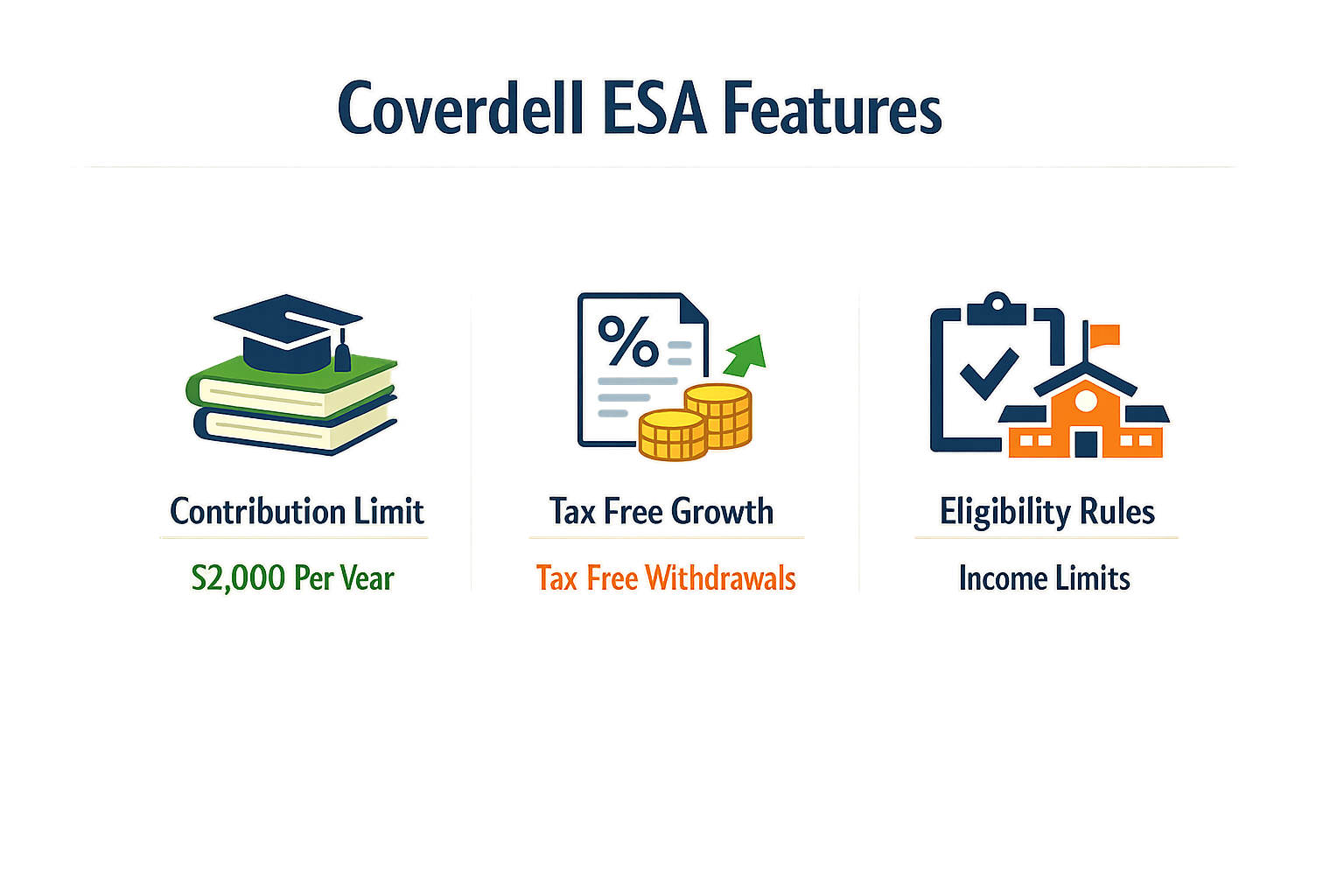
A Coverdell ESA — often called a Coverdell Education Savings Account — is a tax-advantaged account designed to help families save for education expenses. The framework is straightforward: you contribute after-tax dollars, the account grows tax-free, and distributions come out tax-free when used for qualified education expenses. It's not as complicated as it sounds once you understand the basic mechanics.
The account works for a wide range of education costs, not just college. That flexibility is one of the features that sets Coverdell ESAs apart from other education savings vehicles.
How Contributions Work
The total contributions to all Coverdell ESAs for a single beneficiary cannot exceed $2,000 per year. This is a hard cap that applies across all accounts set up for that child — if a parent, grandparent, and aunt each open separate Coverdell ESAs for the same beneficiary, the combined contributions from all three accounts still can't exceed $2,000 for the year.
Contributions to a Coverdell ESA are not tax-deductible. You're funding the account with money you've already paid taxes on. The tax benefit comes later, in the form of tax-free growth and tax-free withdrawals for qualified expenses.
Tax Benefits and Growth
Here's what that actually means in practical terms: once money is in the account, it grows tax-free. You won't pay taxes on investment gains, dividends, or interest while the funds remain in the Coverdell ESA. When distributions are made for qualified education expenses, those withdrawals are also tax-free — both the original contributions and the earnings come out without triggering a tax bill.
The math works like this: if distributions for a year don't exceed the beneficiary's adjusted qualified education expenses at an eligible institution, the beneficiary won't owe tax on those distributions. The amount of qualified education expenses allocated to your distributions is tax-free.
Qualified Education Expenses
Coverdell ESAs can be used for both K-12 and higher education expenses. Qualified expenses include tuition, fees, books, supplies, equipment, and in some cases room and board. For K-12, expenses like tutoring and academic support services may also qualify. For college and graduate school, the range of qualified expenses broadens further.
The account must be used for the designated beneficiary's education. If funds are withdrawn for non-qualified expenses, the earnings portion of the distribution is subject to income tax and a 10% penalty.
The real advantage of a Coverdell ESA is the combination of tax-free growth and flexibility across all levels of education.
Account Structure and Control
A Coverdell ESA is a custodial account, meaning an adult controls it on behalf of the beneficiary until the beneficiary reaches the age of majority. The account owner makes investment decisions and determines when and how funds are distributed. This structure is similar to other tax-advantaged education accounts, though the specific rules around control and beneficiary changes vary.
Funds in a Coverdell ESA must be distributed by the time the beneficiary turns 30, unless the beneficiary has special needs. If funds remain in the account past that age, they must be distributed within 30 days, and the earnings portion will be subject to tax and penalties. Alternatively, the account can be rolled over to another eligible family member before the deadline.
For families looking at other retirement and savings strategies, understanding how different tax-advantaged accounts work together is worth the effort. A SEP IRA operates on similar tax-deferred principles, though it's designed for retirement rather than education.
Who Qualifies for a Coverdell ESA?
Opening a Coverdell ESA isn't complicated, but it does come with specific eligibility requirements — both for the person contributing and for the beneficiary. Here's what that actually means in practical terms.
Income Limits for Contributors
The IRS sets income thresholds that determine whether you can contribute to a Coverdell ESA. Individuals with a modified adjusted gross income (MAGI) of less than $110,000 can contribute the full amount. For married couples filing jointly, that threshold rises to $220,000.
If your MAGI exceeds these limits, your contribution amount phases out gradually. Once your income reaches $110,000 (single) or $220,000 (joint), you're no longer eligible to contribute. The math works like this: the closer you get to the upper limit, the smaller your allowed contribution becomes.
Who Can Be a Beneficiary
Any child under age 18 can be named as a beneficiary of a Coverdell ESA. Special needs beneficiaries don't face the age 18 cutoff — they can continue to receive contributions regardless of age, as long as they meet the IRS definition of having special needs.
The beneficiary doesn't need to be your child. You can open a Coverdell ESA for a grandchild, niece, nephew, or any other individual who meets the age requirement. Multiple people can contribute to the same beneficiary's account, but the total annual contributions from all sources can't exceed $2,000 per beneficiary.
Setting Up the Account
You'll open the account through a financial institution that offers Coverdell ESAs — typically banks, brokerage firms, or mutual fund companies. The account is established in the beneficiary's name, but the adult who opens it (the responsible individual) controls how the funds are invested and when distributions are made.
For families exploring retirement and education savings together, understanding how different tax-advantaged accounts work is worth the time. What Is a SEP IRA? A Guide for Self-Employed Workers covers another flexible savings vehicle that may fit into your broader financial framework.
Common Misconceptions About Eligibility
A common misconception is that you need to be the beneficiary's parent to open a Coverdell ESA. That's not accurate — any adult who meets the income requirements can establish and contribute to an account for an eligible beneficiary.
Another point worth understanding: the income limits apply to the contributor, not the beneficiary or the beneficiary's parents. If a grandparent with income below the threshold wants to contribute but the parents earn too much, the grandparent can still fund the account.
The $2,000 annual limit applies per beneficiary, not per contributor — coordinate with family members to avoid exceeding it.
Comparing Coverdell ESAs to 529 Plans
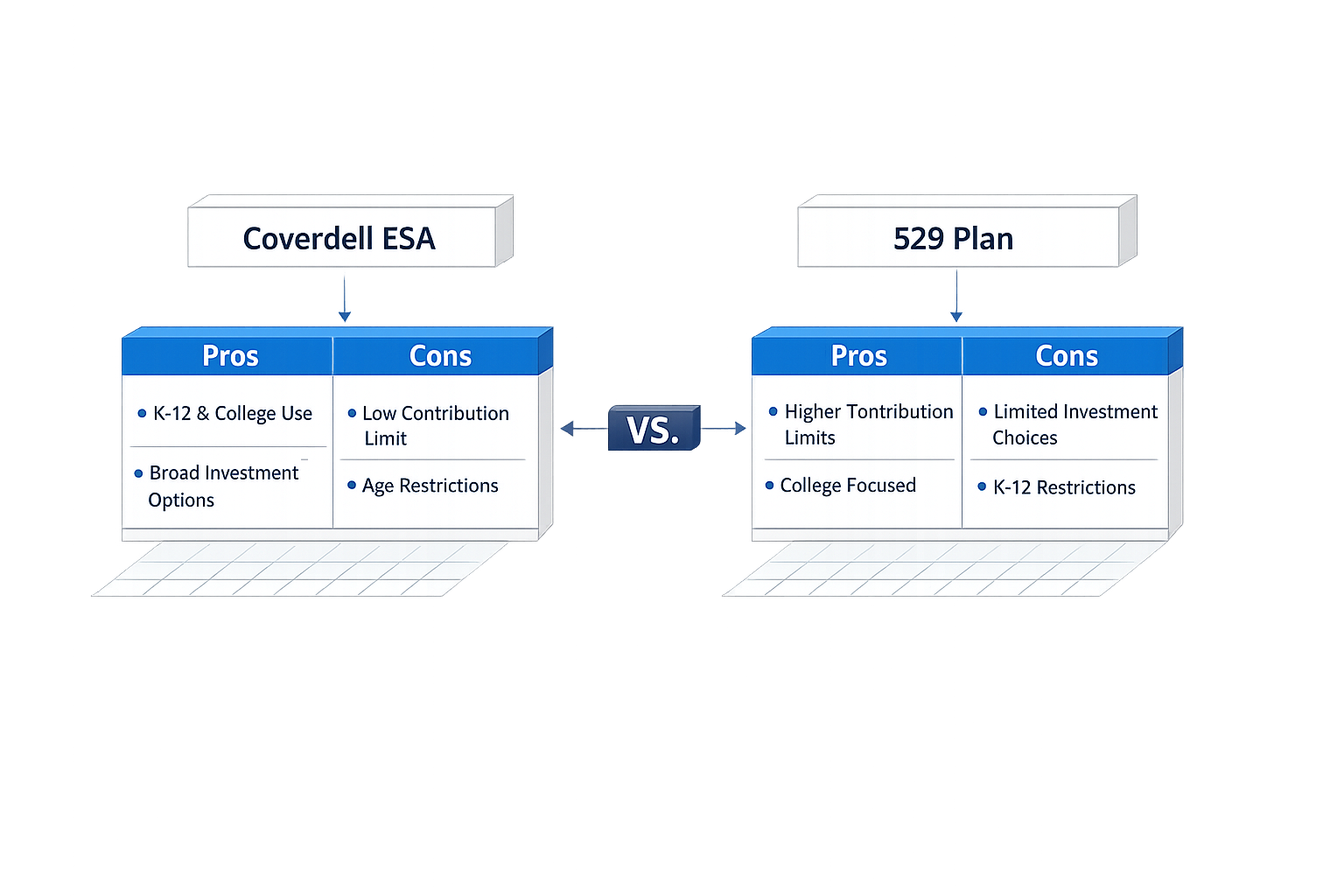
Most families approach education savings the same way they approach assembling furniture — they pick whichever option looks simplest and hope it works. The difference between a Coverdell ESA and a 529 plan is worth understanding because the right choice depends on what you're saving for and how much control you want over the investments.
Both accounts offer tax-free growth and tax-free distributions when the money goes toward qualified education expenses. That's the shared framework. Where they differ is in contribution limits, investment flexibility, and what counts as a qualified expense.
Contribution Limits and Timing
The Coverdell ESA caps contributions at $2,000 per beneficiary per year, regardless of how many accounts are opened for that child. A 529 plan has no annual federal contribution limit — many states allow total contributions well into six figures before restricting further deposits.
The Coverdell ESA also requires that all contributions stop when the beneficiary turns 18, and the account must be distributed by age 30. A 529 plan has no age restrictions on contributions or distributions, which makes it more flexible for families saving over longer timeframes or for older students returning to school.
| Feature | Coverdell ESA | 529 Plan |
|---|---|---|
| Annual contribution limit | $2,000 per beneficiary | No federal limit |
| Contribution deadline | Beneficiary age 18 | No age limit |
| Distribution deadline | Beneficiary age 30 | No age limit |
| Investment control | Full control | Limited to plan options |
| K–12 expense coverage | Yes | Tuition only (up to $10,000/year) |
Investment Flexibility
A Coverdell ESA functions like a self-directed account — you can invest in individual stocks, bonds, mutual funds, or other securities, depending on where you open the account. That level of control appeals to families who want to build a specific portfolio or adjust allocations frequently.
A 529 plan restricts you to the investment options offered by the plan, typically a menu of age-based portfolios or static fund allocations. You can change your investment selection twice per calendar year or when you change the beneficiary. The trade-off is simplicity — most 529 plans offer target-date portfolios that automatically shift from aggressive to conservative as the beneficiary approaches college age.
Qualified Education Expenses
Both accounts cover tuition, fees, books, supplies, and required equipment for college and graduate school. Both also cover room and board for students enrolled at least half-time.
The Coverdell ESA extends to K–12 expenses beyond tuition — things like tutoring, uniforms, computer equipment, and internet access for elementary and secondary students. A 529 plan covers K–12 tuition up to $10,000 per year, but not the broader category of K–12 expenses that a Coverdell ESA allows.
When Each Account Makes Sense
A Coverdell ESA works best for families who want investment control, plan to use the funds for K–12 expenses, and can work within the $2,000 annual contribution limit. It's also a practical option for families whose income falls within the contribution phase-out range and who want to diversify their education savings strategy.
A 529 plan works best for families saving larger amounts, those who prefer a hands-off investment approach, or those saving for beneficiaries who may attend school later in life. Many states also offer tax deductions or credits for 529 contributions, which can make the state plan more attractive than a Coverdell ESA depending on your circumstances.
For families managing multiple financial goals, a SEP IRA or other retirement account might take priority over education savings, especially if the parents are self-employed and behind on retirement funding. Education savings vehicles don't replace the need for a retirement framework — they complement it.
The cheapest college fund is the one you actually use — pick the account structure that fits how you save, not the one that looks best on paper.
Tips for Maximizing Your Coverdell ESA
Most people open a Coverdell ESA and then treat it like a savings account they forget about until tuition bills arrive. The real value comes from understanding how the account works with other education benefits — and how to avoid the tax traps that catch families off guard.
Coordinate Distributions With Other Education Accounts
If you're using both a Coverdell ESA and a 529 plan in the same year, the math gets tricky. When total distributions from both accounts exceed your qualified education expenses, you need to allocate those expenses between the two accounts before calculating the tax-free portion of each distribution. The IRS doesn't do this for you — you track it, or you pay taxes on money you thought was tax-free.
The framework: match distributions to expenses in real time, not at tax season. If your Coverdell ESA distributes $3,000 and your 529 distributes $8,000, but qualified expenses total $10,000, you'll owe taxes on $1,000 of those distributions. Allocate expenses to each account proportionally to keep the tax-free treatment intact.
Don't Double-Dip on Tax Benefits
You can't use the same expenses to claim multiple tax benefits. If you use Coverdell ESA funds to pay for a semester, you can't also claim the American Opportunity Credit or Lifetime Learning Credit based on those same costs. The IRS treats this as double-dipping — and it's one of the most common mistakes families make when trying to maximize education savings.
Here's what that actually means in practical terms: if tuition is $15,000 and your Coverdell ESA distributes $5,000, you have $10,000 in out-of-pocket expenses that could qualify for education tax credits. Use the Coverdell ESA distribution for non-tuition qualified expenses like books or equipment, and pay tuition out of pocket to preserve your credit eligibility.
The cheapest education funding strategy isn't the one with the lowest fees — it's the one that coordinates tax benefits without leaving credits on the table.
Track Qualified Expenses Carefully
Qualified education expenses for a Coverdell ESA include more than just tuition. K-12 expenses, books, supplies, computer equipment, and even internet access can qualify — but only if you can document them. The IRS doesn't audit every distribution, but when they do, you need receipts that match the distribution amounts.
Keep a folder (digital or physical) for each tax year with:
- Receipts for tuition, fees, books, and equipment
- Documentation of K-12 expenses if applicable
- Distribution statements from the Coverdell ESA
- Records showing how you allocated expenses between accounts
For more on tax-advantaged savings strategies that work alongside education accounts, see QBI Deduction Explained: How Business Owners Save on Taxes.
Plan Around the Age 30 Distribution Deadline
Coverdell ESAs require distributions by age 30, or the account gets hit with taxes and penalties. If your beneficiary doesn't use all the funds for education, you have two options: roll the balance to another family member under age 30, or take the distribution and pay the price.
The math works like this: any portion of a distribution not used for qualified expenses gets taxed as ordinary income, plus a 10% penalty on the earnings portion. If the account has $5,000 left and $2,000 of that is earnings, you'll pay income tax on the full $5,000 and a $200 penalty on the earnings.
Use the Account for K-12 Expenses Strategically
Coverdell ESAs cover K-12 expenses, but the $2,000 annual contribution limit means you're not funding private school tuition with this account alone. Use it for the expenses that 529 plans didn't cover until recently: computers, educational software, internet access, tutoring, and school supplies.
The goal is getting in the right range for your overall education funding strategy. If you're paying $15,000 per year for private elementary school, a Coverdell ESA covers about 13% of that cost — helpful, but not a replacement for other savings. Think of it as the account that fills gaps, not the primary vehicle.
Rebalance Based on the Beneficiary's Timeline
Coverdell ESAs allow a wide range of investment options, which means you control the risk level. When the beneficiary is young, you can invest more aggressively. As they approach college age, shift to conservative investments to protect the balance from market volatility.
A common misconception: you need to pick investments once and leave them alone. The honest answer is that a Coverdell ESA works best when you adjust the allocation every few years based on how close the beneficiary is to needing the funds. Five years out from freshman year, you want stability, not growth.
Conclusion: Making the Right Choice for Education Savings
Choosing the right education savings account comes down to understanding what matters most for your situation — income limits, contribution flexibility, investment control, and how you plan to use the funds. The Coverdell ESA offers broader qualified expense coverage than most alternatives, including K–12 costs, but the $2,000 annual contribution cap and income phase-outs mean it works best as part of a larger strategy rather than as a standalone solution.
The framework is straightforward: if you need flexibility for elementary and secondary education expenses and want granular investment control, the Coverdell ESA fits. If you're prioritizing higher contribution limits and state tax benefits, a 529 plan makes more sense. Most families benefit from understanding both options and choosing based on their income level, the beneficiary's age, and their timeline to education expenses.
Here's what that actually means in practical terms: the account you open today should align with the expenses you'll face tomorrow. A Coverdell ESA shines when you're funding private school tuition or need to cover computer equipment and tutoring costs before college. A 529 plan dominates when you're focused on maximizing college savings with larger annual contributions. The math works differently for every family, and the right answer depends on your specific circumstances.
Worth remembering: you're not locked into one choice forever. You can coordinate distributions from both account types in the same year, as long as you allocate expenses properly to avoid double-dipping on tax benefits. The goal is getting in the right range for your education funding needs, not finding a perfect one-size-fits-all solution.
When you're ready to take the next step, talk to a licensed financial professional who can walk through your income situation, timeline, and education goals. For families navigating multiple savings vehicles and tax-advantaged accounts, understanding retirement options like a SEP IRA can help you see how education savings fits into your broader financial picture. The honest answer: most people don't realize how much coordination matters across different account types until they start mapping out contributions and withdrawals.
The difference between a well-structured education savings plan and a haphazard one isn't complexity — it's clarity about what you're funding and when. Start with the framework, adjust for your circumstances, and build from there.
Learn about Coverdell Education Savings Accounts, their qualifications, and how they compare to 529 plans for education savings.