
Introduction to Custodial Accounts
Most parents don't lie awake wondering about custodial account structures. They lie awake wondering how to build something meaningful for their kids without losing control or creating a tax mess.
A custodial account is a brokerage account where an adult manages investments on behalf of a minor until that child reaches legal adulthood. The account belongs to the child from day one — the custodian just controls it temporarily. Once the child hits the age of majority (typically 18 or 21, depending on state law), the account transfers to them completely. No negotiations, no conditions.
Here's what that actually means in practical terms: when you open a UTMA account or UGMA account, you're making an irrevocable gift. The money is the child's property, not yours. You can't take it back if your circumstances change or if you decide the child isn't ready for it. The custodian manages the account, makes investment decisions, and can withdraw funds — but only for the child's benefit.
The framework is straightforward: one adult custodian, one minor beneficiary, and a transfer date determined by state law. The custodian can be a parent, grandparent, or any trusted adult. Investment options typically include stocks, bonds, mutual funds, and other securities — the same range you'd find in a standard brokerage account.
Why Custodial Accounts Matter in Financial Planning
Custodial accounts serve families who want to transfer wealth to the next generation outside of education-specific savings plans. Unlike 529 plans or Coverdell ESAs, custodial account funds can be used for anything — college, a first home, starting a business, or general living expenses.
The tax treatment follows a specific pattern. The first portion of investment income in a custodial account is tax-free, the next portion is taxed at the child's rate, and earnings above that threshold face the "kiddie tax" — taxed at the parents' marginal rate. This structure makes custodial accounts most efficient for families with modest investment balances or those willing to manage the tax implications carefully.
Most people don't realize that custodial accounts also affect financial aid calculations differently than parent-owned assets. Because the account is in the child's name, it can reduce need-based aid eligibility more significantly than a 529 plan would. For families prioritizing college funding, this difference is worth understanding before opening an account.
The real question for most families: do you want maximum control (keeping assets in your name longer) or maximum flexibility (allowing the child to use funds for any purpose)? Custodial accounts optimize for flexibility at the cost of control. Once that transfer age hits, the money is theirs.
Understanding the Differences: UGMA vs. UTMA
Most parents hear "UGMA" and "UTMA" and assume they're interchangeable — two names for the same thing. They're not. The difference between these two custodial account types comes down to what you can transfer and when the child takes control. That distinction matters when you're deciding how to structure a gift that could fund college, a first home, or a business decades from now.
What UGMA and UTMA Actually Mean
UGMA stands for Uniform Gifts to Minors Act. UTMA stands for Uniform Transfers to Minors Act. Both create custodial accounts — accounts where an adult manages assets on behalf of a minor until that minor reaches the age of majority. The custodian controls the account, but the assets legally belong to the child from the moment they're transferred. That's non-negotiable: once you fund the account, you can't take the money back.
The real question is what you can put into each account. UGMA accounts hold financial assets — cash, stocks, bonds, mutual funds, insurance policies. UTMA accounts hold all of that plus real property: real estate, patents, royalties, fine art. If you're transferring anything beyond standard financial instruments, you need a UTMA account. If you're sticking with stocks and cash, either works.
The Age-of-Transfer Difference
The second difference is when the child takes over. UGMA accounts typically transfer at age 18 or 21, depending on your state. UTMA accounts often allow you to extend custodianship to age 25 in some states. That extra control window matters if you're worried about handing a 18-year-old a six-figure account with no strings attached.
Here's the framework: if your state offers UTMA, it usually supersedes UGMA. Most states have adopted UTMA, which gives you more flexibility on both asset types and transfer age. A handful of states — South Carolina and Vermont, for example — still operate under UGMA rules only. Check your state's statute before you open the account, because the transfer age is set by state law, not by your preference.
| Feature | UGMA | UTMA |
|---|---|---|
| Assets allowed | Cash, securities, insurance | All UGMA assets plus real estate, patents, royalties, tangible property |
| Age of transfer | 18 or 21 (state-dependent) | 18, 21, or 25 (state-dependent, often more flexible) |
| State availability | All states | Most states (a few UGMA-only states remain) |
| Irrevocability | Yes — assets belong to the child immediately | Yes — assets belong to the child immediately |
Why the Confusion Persists
The terms get used interchangeably because in most states, UTMA has replaced UGMA as the governing statute. When someone says "UGMA account," they often mean "custodial account under whichever act my state uses." Financial institutions don't always distinguish clearly in their marketing materials, which adds to the confusion.
In practical terms, if you're opening a custodial brokerage account today, you're almost certainly opening it under UTMA rules unless you're in one of the few UGMA-only states. The brokerage will tell you which act governs the account when you complete the paperwork. The key is understanding that the choice isn't entirely yours — your state's law determines the framework, and you work within it.
For parents weighing custodial accounts against other savings vehicles like 529 plans, understanding these structural differences is the starting point. A 529 gives you more control and better financial aid treatment, but it restricts spending to education. A UTMA account is the child's money, period — they can spend it on anything once they reach the age of transfer. That flexibility is an advantage if you want the child to have options; it's a risk if you're concerned about how an 18-year-old will handle a lump sum. For more on structuring long-term financial plans that balance control and flexibility, see Business Succession Planning: Protecting Your Company's Future.
How to Choose Between UGMA and UTMA Accounts
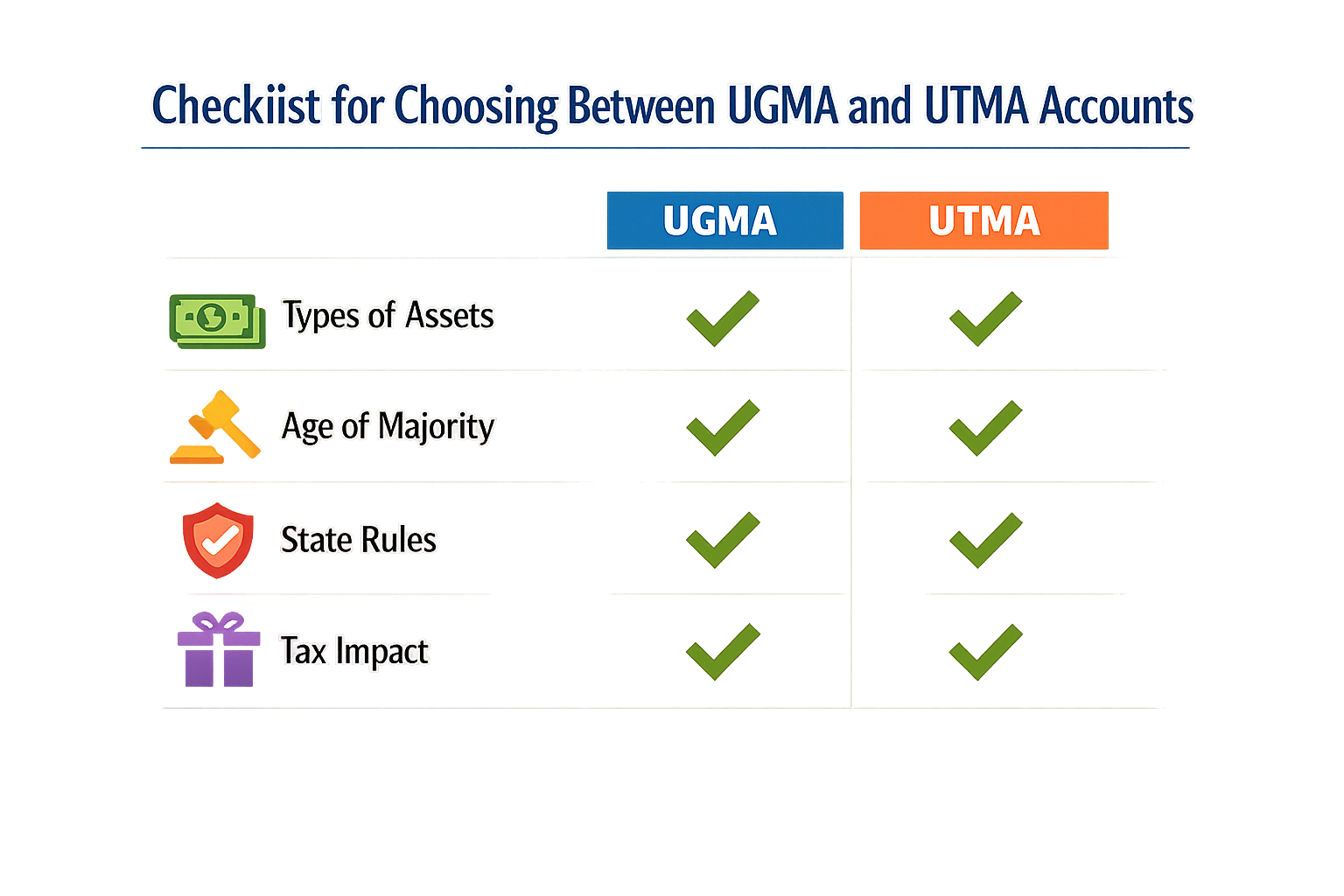
The decision between a UGMA and UTMA account isn't complicated once you understand what each one allows you to hold. The real question is what you plan to transfer and when you want the child to take control.
Step 1: Identify What Assets You Plan to Transfer
Step 1
Inventory your assets
Start by listing what you want to put into the account. If you're planning to transfer only cash, stocks, bonds, mutual funds, or insurance policies, either account type works. If you're considering real estate, vehicles, or other physical property, you'll need a UTMA account — UGMA accounts don't accept those assets.
Most families stick with financial assets, which makes the choice simpler. If real estate or tangible property is part of your plan, the UTMA account is your only option.
Step 2: Check Your State's Age of Termination Rules
Step 2
Confirm state-specific age requirements
The age at which the child gains full control varies by state and account type. UGMA accounts typically terminate at 18 or 21, depending on state law. UTMA accounts often allow the custodian to extend control until age 21 or 25 in some states. Check your state's specific rules before opening the account — this decision is permanent once the account is established.
If you want more time before the child takes control, and your state allows it, the UTMA account gives you that flexibility. If your state treats both accounts the same, the asset type becomes the deciding factor.
Step 3: Evaluate Your Goals and the Child's Needs
Step 3
Align the account with your objectives
Consider what you're saving for and how much control you want the child to have at termination. Custodial accounts give the child full ownership at the age of termination — they can spend the money however they choose. If that concerns you, or if your primary goal is education funding with more control, a 529 plan or Coverdell ESA might be a better fit than either custodial account.
Before opening a custodial account, it's advisable to evaluate your goals and those of the child, and consider consulting with a tax professional or attorney. The decision is irrevocable — contributions cannot be revoked, and the minor beneficiary cannot be changed.
Step 4: Understand the Commitment You're Making
There are no limits on the dollar amount of gifts or transfers that can be made to a UTMA account, but amounts above $19,000 per year will require a federal gift tax form to be filed. The same rule applies to UGMA accounts. If you're planning large transfers, factor in the gift tax reporting requirement.
When the Choice Is Straightforward
For most families, the decision comes down to two questions: Are you transferring anything other than financial assets? Does your state allow you to extend the termination age with a UTMA account? If the answer to both is no, either account works the same way. If you're transferring real estate or want to delay termination, the UTMA account is the clear choice.
Tips for Managing Custodial Accounts Effectively
Opening a custodial account is straightforward. Managing it well over 18 years is where most families either build real momentum or let the account drift. The framework below keeps you on track without requiring constant attention.
Start with a contribution rhythm
Most people fund custodial accounts in bursts — birthday checks, tax refunds, the occasional windfall. That works, but a predictable monthly deposit compounds faster. Even $100 a month adds up to meaningful balances by the time the child reaches adulthood. Automating contributions removes the decision fatigue and keeps the account growing steadily.
The account is irrevocable, so only contribute what you're comfortable letting go. If you might need the money back for your own retirement or emergencies, keep it in your name instead.
Align investments with the timeline
Custodial accounts hold securities, not just cash. The investment mix should match how long the money will stay in the account. For a toddler with 15 years until college, a stock-heavy portfolio makes sense — there's time to ride out market swings. For a teenager three years from adulthood, shifting toward bonds and cash protects the balance from a sudden downturn right before the transfer.
Many custodians offer age-based portfolios that automatically adjust as the child gets older. These work well if you prefer a hands-off approach. If you're managing the investments yourself, review the allocation once a year and rebalance when the mix drifts too far from your target.
Understand the tax picture
The first $1,300 of unearned income in a custodial account is tax-free or taxed at the child's rate (typically 10%). Income above that threshold may trigger the "kiddie tax," which taxes unearned income at the parent's marginal rate. This usually isn't a problem for accounts with modest balances, but it's worth tracking if the account generates significant dividends or capital gains.
Keep records of contributions and any gifts that funded the account. When the child eventually sells investments, they'll need the cost basis to calculate capital gains. Most custodians track this automatically, but it's your responsibility to ensure the records transfer when the account changes hands at adulthood.
Plan for the handoff
The money becomes the child's at the age of majority — 18 or 21, depending on your state and whether you opened a UGMA or UTMA account. That's not negotiable. If you're concerned about an 18-year-old having unrestricted access to a five-figure account, consider funding the account more conservatively or exploring alternatives like a 529 plan (which stays under your control) or a trust (which lets you set conditions on distributions).
Some families use the approaching transfer date as a teaching moment. Walk the child through the account balance, explain how the investments work, and discuss options for using the money responsibly. It won't guarantee perfect decisions, but it's better than handing over the account with no context. For more on structuring long-term financial plans that balance control and flexibility, see our guide on business succession planning — the principles around phased transfers apply to family wealth conversations too.
Watch the financial aid impact
Custodial accounts are considered the child's assets, and the FAFSA formula assesses student assets at 20% compared to 5.6% for parent assets. Translation: a $10,000 custodial account reduces aid eligibility by roughly $2,000, while the same $10,000 in a parent's name reduces it by $560.
If financial aid is a priority, spend down the custodial account in the child's junior and senior years of high school — pay for test prep, a laptop, or other education-related expenses before you file the FAFSA. Once the balance is lower, the aid impact shrinks.
The account is the child's asset from day one, even though you control it — that distinction matters for taxes, financial aid, and what happens at the age of majority.
Conclusion: Making the Right Choice for Your Child
Choosing between a UGMA and UTMA account comes down to what you plan to transfer and when you want your child to take control. UGMA accounts work well when you're focused on financial assets — stocks, bonds, mutual funds, and cash. UTMA accounts add flexibility by allowing real estate, intellectual property, and other tangible assets. Both give your child full legal ownership at the age of majority in your state, typically 18 or 21, with no exceptions or extensions.
The framework is straightforward: if you're starting with cash and securities and want a simple setup, UGMA does the job. If you anticipate transferring property or want the option to hold a wider range of assets, UTMA is the better fit. Neither account type lets you change your mind later — once assets go into a custodial account, they belong to the child, and the transfer is irrevocable.
The Real Question Is Control and Timing
Most parents don't lose sleep over the technical differences between UGMA and UTMA. They worry about whether their child will be ready to manage a significant sum at 18 or 21. That's a legitimate concern. Custodial accounts offer no mechanism to delay access, restrict spending, or redirect funds if circumstances change. If that level of control matters to you, a 529 plan or a trust structure may be worth exploring alongside or instead of a custodial account.
The other consideration is financial aid. Both UGMA and UTMA accounts are reported as the child's asset on the FAFSA, which reduces aid eligibility by 20% of the account value — a steeper impact than parent-owned accounts or 529 plans. If college funding is the primary goal and financial aid is a factor, run the numbers before committing to a custodial account.
When You're Ready to Take the Next Step
If you've decided a custodial account fits your goals, the setup process is simple. Most brokerage firms and banks offer UGMA and UTMA accounts with low minimums and straightforward paperwork. You'll name the child, designate yourself or another adult as custodian, and fund the account. From there, you manage the investments until the child reaches the age of majority.
For families looking at broader estate planning or business succession strategies, custodial accounts are one piece of a larger framework. If you're balancing multiple goals — education funding, wealth transfer, business continuity — business succession planning can help you see how custodial accounts fit alongside trusts, insurance, and other tools.
The honest answer is that UGMA and UTMA accounts are straightforward tools for transferring wealth to a child, but they're not the only tools. The goal is getting in the right range for your family's needs — balancing flexibility, control, tax efficiency, and your child's readiness to manage assets. When those factors line up, custodial accounts do exactly what they're designed to do.