
Introduction to Coverdell Education Savings Accounts
Most families don't plan for education costs the way they plan for retirement — they know it's expensive, but the framework for saving feels unclear. The Coverdell ESA (Coverdell Education Savings Account) is one tool designed to address this gap, offering tax advantages for families saving for educational expenses. While not as widely known as 529 plans, the Coverdell ESA has distinct features that make it worth understanding.
The Coverdell ESA is a tax-advantaged savings account that allows contributions to grow tax-free, provided the funds are eventually used for qualified education expenses. According to IRS guidelines, contributions to a Coverdell ESA aren't deductible, but amounts deposited in the account grow tax-free until distributed. When distributions don't exceed a beneficiary's adjusted qualified education expenses at an eligible educational institution, the beneficiary won't owe tax on those withdrawals.
Here's what sets the Coverdell ESA apart: the $2,000 annual contribution limit per beneficiary is substantially lower than what most 529 plans allow, but the account can be used for a broader range of educational expenses, including K-12 costs. This flexibility matters for families who want to cover private school tuition or other elementary and secondary education expenses, not just college.
Who Can Contribute to a Coverdell ESA
The Coverdell ESA comes with income restrictions that don't apply to 529 plans. Higher-income families may find themselves unable to contribute directly, which narrows the pool of eligible savers. The account must be established for a designated beneficiary who is under age 18 or has special needs, and contributions must stop once the beneficiary reaches age 18 unless they qualify under special needs provisions.
The tax treatment is straightforward: the amount of qualified education expenses allocated to distributions from a Coverdell ESA is tax-free. The math works like this — if your distributions for the year don't exceed your adjusted qualified education expenses, you won't pay tax on the earnings portion of those distributions. If distributions do exceed qualified expenses, a portion becomes taxable.
For informational and educational purposes, it's worth noting that the Coverdell ESA isn't the only education savings vehicle available, and it's not necessarily the right fit for every family. The framework here is understanding how the account works, who qualifies, and where it fits in the broader landscape of education savings strategies. When you're ready to take the next step, talk to a licensed financial professional about your specific situation and which savings approach aligns with your income level, education goals, and tax circumstances.
The Problem: Rising Education Costs
Most families don't lie awake worrying about education savings accounts. They lie awake worrying about whether they'll be able to afford the education their kids need.
The math is straightforward: the cost of education has been rising faster than most families' incomes for decades. Whether you're planning for private elementary school, college tuition, or graduate programs, the price tag keeps climbing. A family that starts saving when a child is born has roughly 18 years to build a fund that will cover expenses that might double or triple during that same period.
The real question is whether to save at all or how to save in a way that doesn't leave money on the table. Putting cash in a standard savings account means paying taxes on any interest earned and missing out on tax-free growth. Keeping funds in taxable investments means capital gains taxes chip away at returns. The framework for education savings exists specifically to address this problem — accounts designed to grow tax-free when used for education.
The Gap Between Cost and Preparation
Here's what that actually means in practical terms: families who start late or contribute inconsistently often find themselves covering the shortfall with student loans, parent PLUS loans, or out-of-pocket payments that strain current cash flow. The difference between planning ahead with a tax-advantaged account and scrambling at enrollment time is the difference between paying for education with pre-tax growth and paying with after-tax dollars plus interest.
The honest answer is that no single savings vehicle solves every family's needs. Income limits, contribution caps, and qualified expense definitions all shape which accounts make sense for your specific situation. Understanding the 529 plan contribution limits alongside other options helps you see where each tool fits in the overall strategy.
The goal isn't perfection — it's getting in the right range with a plan that matches your income, timeline, and the type of education expenses you expect to cover.
That's where the Coverdell ESA enters the picture. It's not the largest account by contribution limit, and it's not available to every income level, but it covers a broader range of qualified education expenses than most alternatives. For families who qualify and want flexibility across K–12 and higher education, it's worth understanding how it works and where it fits.
Understanding the Coverdell Education Savings Account
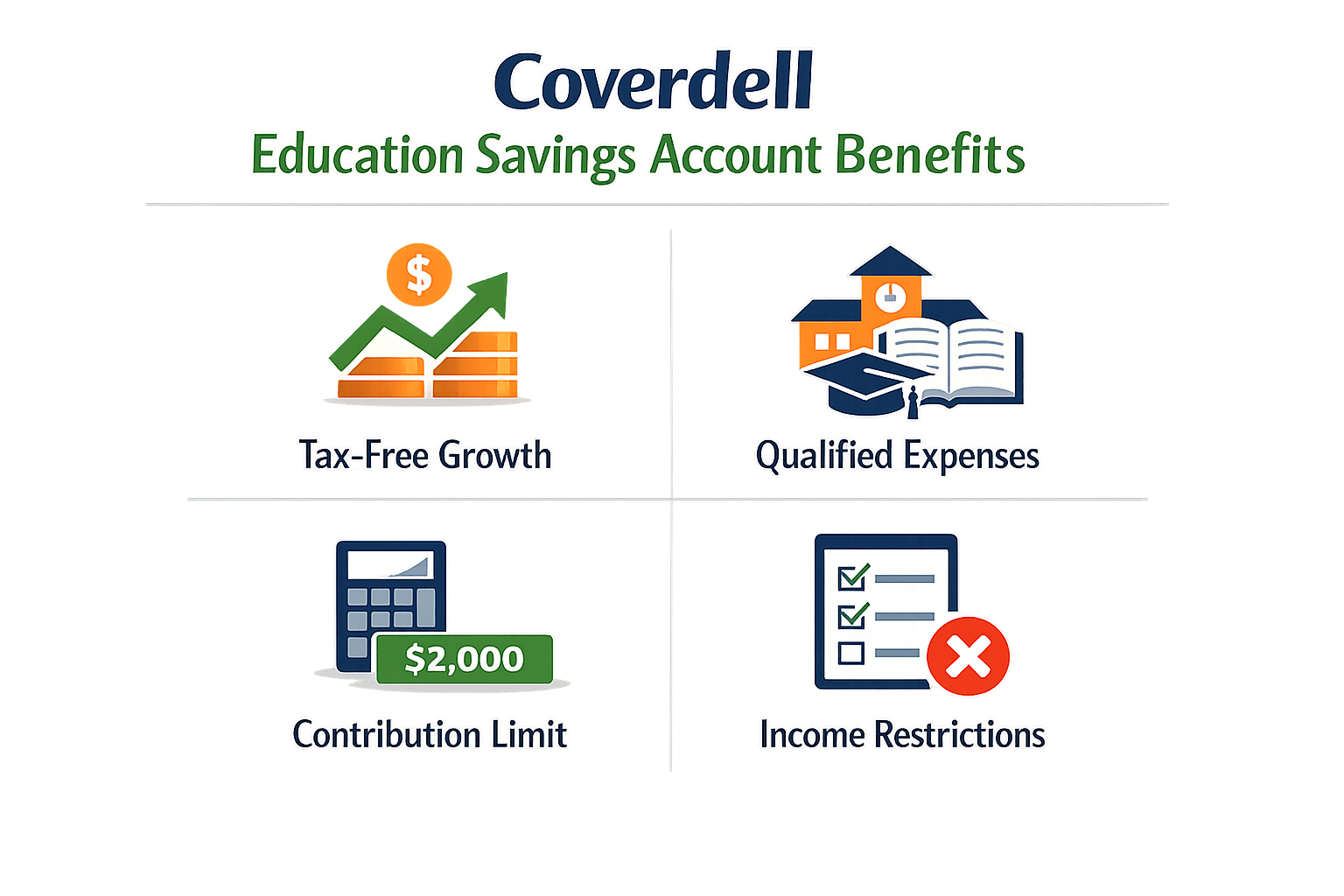
A Coverdell ESA is a tax-advantaged account designed to help families save for education expenses. The account allows contributions to grow tax-free, and withdrawals are also tax-free when used for qualified education expenses. The framework is straightforward: you contribute after-tax dollars, the account grows without annual tax on earnings, and distributions come out tax-free if they cover eligible costs.
The contribution limit is $2,000 per beneficiary per year. That's the total across all Coverdell ESAs for that child — if a parent, grandparent, and aunt each open separate accounts for the same beneficiary, the combined contributions still can't exceed $2,000 annually. This is a hard cap set by the IRS, and it's significantly lower than the limits you'll see with other education savings vehicles like 529 plans.
Who Qualifies for a Coverdell ESA
Eligibility to contribute depends on your Modified Adjusted Gross Income (MAGI). The IRS phases out contribution limits based on income brackets, which means higher earners may be restricted or entirely barred from contributing. The phase-out ranges differ for single filers and married couples filing jointly, and the calculation uses your MAGI rather than your standard adjusted gross income.
The beneficiary must be under age 18 when contributions are made, with an exception for beneficiaries with special needs. Once the beneficiary turns 30, any remaining funds must be distributed or rolled over to another eligible family member's Coverdell ESA. If funds remain in the account past age 30 without being used or transferred, the earnings portion becomes taxable and may be subject to a 10% penalty.
Key Benefits of the Coverdell ESA
The primary advantage is flexibility in how you use the funds. Qualified education expenses for a Coverdell ESA include both K–12 and higher education costs. That means you can withdraw funds tax-free to pay for private elementary school tuition, high school expenses, or college costs — a broader range than some other education savings accounts allow.
Qualified expenses cover tuition, fees, books, supplies, and equipment required for enrollment. For students attending at least half-time, room and board also qualify. The account can even cover certain technology purchases, including computers and internet access, as long as they're used primarily by the beneficiary during school years.
The amount of qualified education expenses allocated to your distributions from a Coverdell ESA is tax-free.
Another benefit: investment control. Unlike some education savings plans that limit you to a menu of pre-selected portfolios, Coverdell ESAs typically allow you to choose from a wide range of investment options — stocks, bonds, mutual funds, and other securities. This gives you the ability to tailor the investment strategy to your risk tolerance and time horizon.
How Contributions and Distributions Work
Contributions must be made in cash, and they're not tax-deductible at the federal level. The deadline for contributions is the tax filing deadline for that year (typically April 15 of the following year), not December 31. You can contribute for the 2025 tax year up until April 15, 2026, as long as you designate the contribution for the prior year.
When you take a distribution, the tax treatment depends on whether the withdrawal covers qualified education expenses. If the distribution amount exceeds the adjusted qualified education expenses for the year, part of the distribution becomes taxable. The earnings portion gets allocated proportionally — some tax-free, some taxable — based on the ratio of qualified expenses to total distributions.
For example, if you withdraw funds and also claim the American Opportunity Credit for the same expenses, you have to subtract the expenses used for the credit before calculating how much of the Coverdell ESA distribution qualifies as tax-free. The IRS requires this adjustment to prevent taxpayers from receiving multiple tax benefits for the same dollar of expense.
Rollovers and Transfers
You can roll over funds from one Coverdell ESA to another for the same beneficiary or transfer the account to a different family member without triggering taxes or penalties. The rollover must be completed within 60 days, and you're limited to one rollover per 12-month period per beneficiary.
Transferring to a family member works when the original beneficiary doesn't use all the funds. Eligible family members include siblings, parents, children, nieces, nephews, aunts, uncles, and first cousins. The new beneficiary must be under age 30 at the time of the transfer (again, with an exception for special needs beneficiaries). This flexibility allows families to reallocate education savings when circumstances change — for instance, if one child receives a scholarship and another needs additional funding.
How Coverdell Accounts Compare to 529 Plans
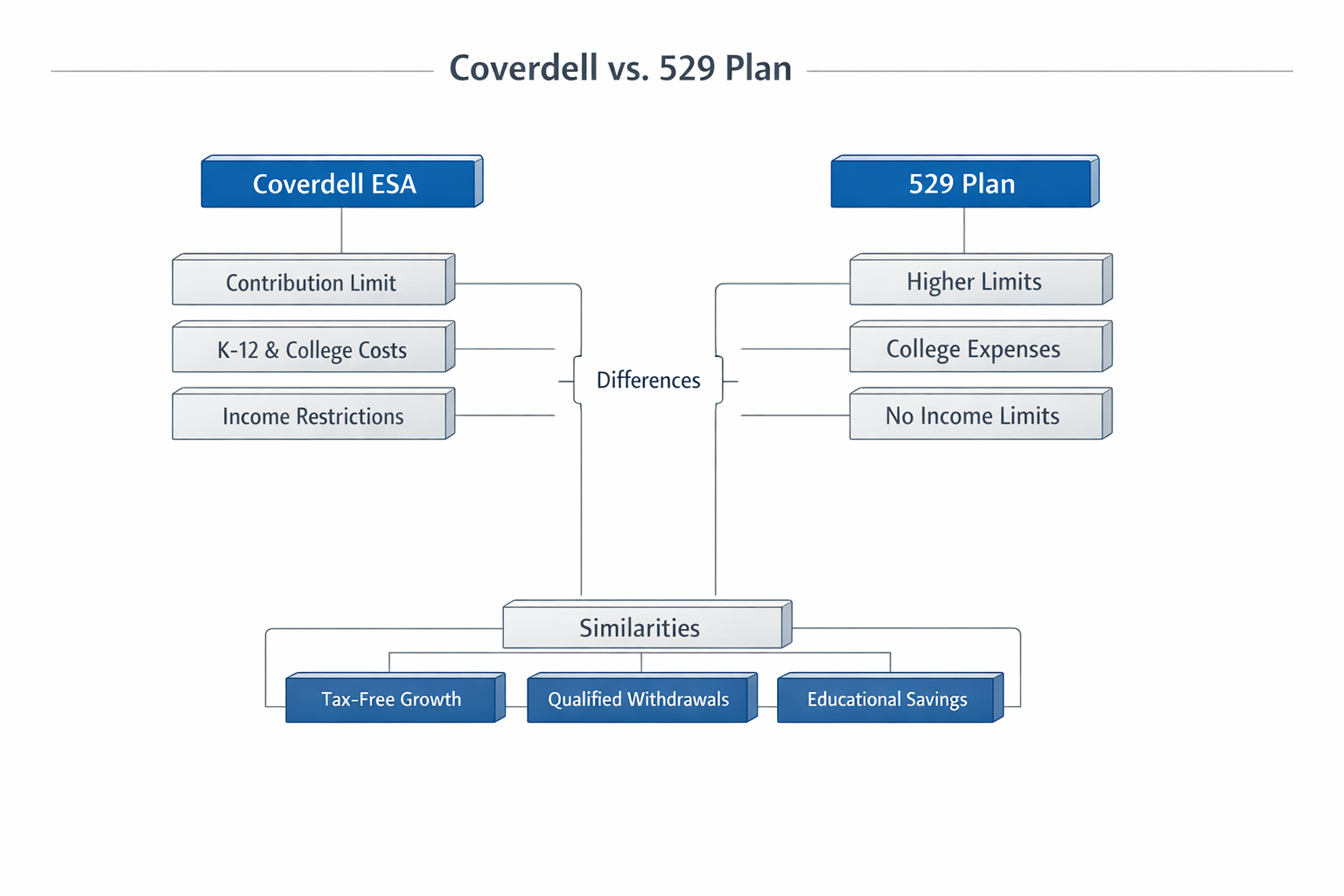
When you're comparing education savings options, the framework comes down to contribution limits, income restrictions, and flexibility. Both the Coverdell ESA and the 529 plan offer tax-free growth and tax-free withdrawals for qualified education expenses, but they work differently in practical terms.
Here's what that actually means: the Coverdell ESA caps contributions at $2,000 per beneficiary per year, while 529 plans typically allow contributions well into six figures over the life of the account — some states set lifetime limits above $500,000. That difference alone shapes which families can use which account effectively.
Contribution Limits and Income Restrictions
The Coverdell ESA's $2,000 annual limit applies regardless of how many people contribute to a single beneficiary's account. If grandparents, parents, and other relatives all want to contribute, the total across all contributors cannot exceed $2,000 in a given year.
Income restrictions further limit access. For single filers, the ability to contribute begins phasing out at modified adjusted gross income (MAGI) above $95,000 and disappears entirely at $110,000. For married couples filing jointly, the phase-out range runs from $190,000 to $220,000. The 529 plan has no income restrictions — anyone can contribute, regardless of earnings.
| Feature | Coverdell ESA | 529 Plan |
|---|---|---|
| Annual contribution limit | $2,000 per beneficiary | Varies by state; typically $300,000+ lifetime |
| Income restrictions | Phase-out begins at $95,000 (single) / $190,000 (joint) | None |
| Qualified expenses | K–12 tuition (up to $10,000/year), higher education | Primarily higher education; K–12 tuition (up to $10,000/year) |
| Investment control | Account owner selects investments | State plan determines investment options |
| Age limit for beneficiary | Must be used by age 30 | No age limit |
Qualified Expenses and Flexibility
Both accounts cover qualified higher education expenses — tuition, fees, books, supplies, and required equipment. The Coverdell ESA extends coverage to K–12 expenses beyond tuition, including computers, internet access, and certain academic tutoring. The 529 plan covers K–12 tuition up to $10,000 per year, but not the broader range of elementary and secondary school costs.
The difference between the two becomes clearer when you look at investment control. With a Coverdell ESA, the account owner directs investments across a range of options, similar to managing an IRA. The 529 plan restricts choices to the investment menus offered by the state plan, which typically include age-based portfolios and static allocation options.
Tax Treatment and Withdrawals
Distributions from both accounts are tax-free when used for qualified education expenses. The math works like this: you calculate adjusted qualified higher education expenses (AQHEE) by taking total qualified expenses and subtracting any tax-free educational assistance and any expenses used to claim an education tax credit. The portion of the distribution that exceeds AQHEE becomes taxable income, and the earnings portion may be subject to a 10% penalty.
For families weighing both options, understanding 529 plan contribution limits provides context for how much more capacity the 529 offers compared to the Coverdell ESA's fixed $2,000 ceiling. If you're also managing custodial accounts for your child, coordinating all three vehicles can optimize your overall education savings strategy.
Which Account Fits Your Situation
The honest answer: most families with higher incomes or those planning to save more than $2,000 per year will find the 529 plan more practical. The Coverdell ESA works best for families below the income thresholds who want broader K–12 expense coverage or prefer direct control over investment choices.
Some families use both — maximizing the $2,000 Coverdell ESA contribution for K–12 flexibility, then directing additional savings into a 529 plan for higher education. The framework depends on your income, your savings capacity, and whether you need coverage for elementary and secondary school expenses beyond tuition.
Tips and Tricks for Maximizing Your Coverdell Account
The $2,000 annual contribution limit makes every dollar in a Coverdell ESA count. The framework for maximizing this account isn't complicated — it's about coordinating distributions with other education benefits and understanding what the IRS allows. Here's what that actually means in practical terms.
Coordinate With Education Tax Credits
The Coverdell ESA works alongside education tax credits, but you can't double-dip. The math works like this: qualified education expenses used to justify a tax-free Coverdell distribution cannot also be claimed for an American Opportunity Credit or Lifetime Learning Credit. The IRS requires you to reduce your qualified higher education expenses by any amounts taken into account for education credits before calculating the tax-free portion of your Coverdell distribution.
In practical terms, this means tracking which expenses you're applying where. If you have $8,000 in qualified expenses and take a $4,000 American Opportunity Credit, you can still take a tax-free Coverdell distribution for the remaining $4,000 in expenses. The goal is getting in the right range — maximizing the credit (which directly reduces your tax bill) while still using the Coverdell funds tax-free.
Use Distributions for K-12 Expenses
A common misconception is that Coverdell accounts only work for college. The Coverdell ESA covers qualified elementary and secondary education expenses — tuition, fees, books, supplies, equipment, and certain room and board costs for K-12 students. This flexibility means you can tap the account earlier than a 529 plan allows for similar expenses.
The real question is whether using Coverdell funds for K-12 expenses makes sense for your specific situation. If you're paying private school tuition now and have a Coverdell account, those distributions are tax-free when used for qualified K-12 expenses. For families managing both K-12 and future college costs, understanding the 529 plan contribution limits alongside Coverdell rules helps you decide which account to fund and when to distribute.
Allocate Expenses Across Multiple Distributions
When you take distributions from a Coverdell ESA in the same year for both K-12 and higher education, the IRS requires you to allocate your total qualified education expenses between the distributions. The honest answer: this creates paperwork, but it also creates opportunity.
Step 1
Track expenses by category
Separate your qualified K-12 expenses from qualified higher education expenses. Keep receipts and documentation for each category — the IRS expects you to show which expenses justified which distribution.
Step 2
Calculate the tax-free portion for each distribution
The amount of qualified education expenses allocated to each distribution determines the tax-free portion. If you have $1,000 in K-12 expenses and take an $800 Coverdell distribution for those expenses, the full $800 is tax-free. If you have $5,000 in college expenses but take a $6,000 distribution, part of that distribution becomes taxable.
Step 3
Reduce expenses by tax-free assistance first
Before calculating the tax-free portion of your Coverdell distribution, subtract any tax-free educational assistance (scholarships, Pell grants, employer tuition assistance) and any expenses used for education credits. What's left is your adjusted qualified higher education expenses — the number that determines how much of your Coverdell distribution is tax-free.
The framework is straightforward: more qualified expenses relative to your distribution amount means more tax-free treatment. Less qualified expenses means part of the distribution becomes taxable income (and potentially subject to the 10% penalty if you're under 30).
Consider Scholarship Coordination
When a beneficiary receives a scholarship, Pell grant, or other tax-free educational assistance, the Coverdell distribution rules still apply — but with one exception. If the beneficiary receives a scholarship, the penalty (but not the income tax) on the earnings portion of a non-qualified distribution is waived up to the amount of the scholarship.
This matters when coordinating Coverdell funds with other aid. You can potentially increase education tax credits by including certain scholarships in the student's gross income, which then frees up more qualified expenses to apply against Coverdell distributions or education credits. The details depend on your circumstances, and worth understanding if your child receives significant scholarship aid.
Plan for the Age 30 Distribution Requirement
Coverdell ESA funds must be distributed by the time the beneficiary turns 30 (with exceptions for special needs beneficiaries). Any remaining balance after age 30 is distributed and taxed as income, with a 10% penalty on the earnings portion. The practical implication: if your child finishes school with funds remaining, you have options before the age 30 deadline.
You can roll over the Coverdell ESA to another family member under age 30 without tax consequences, as long as the new beneficiary is a qualifying family member of the original beneficiary. This keeps the funds in the family and preserves the tax-advantaged growth for another child's education expenses.
The short answer: if you're approaching the age 30 deadline with unused funds, talk to a licensed financial professional about rollover options and distribution timing. Depending on your circumstances, a strategic distribution plan in the final years can minimize tax impact.
Conclusion: Making Informed Education Savings Choices
Choosing the right education savings vehicle comes down to understanding the framework and matching it to your specific situation. The Coverdell ESA offers tax-free growth and withdrawals for qualified education expenses, but the $2,000 annual contribution limit and income restrictions make it a narrow fit for many families. For higher-income earners or those looking to save larger amounts, a 529 plan typically provides more flexibility and higher contribution limits without income phase-outs.
The Real Question: Which Account Fits Your Goals?
Most families benefit from comparing both options against their actual circumstances — current income, expected education costs, and whether they need to cover K–12 expenses alongside college. The Coverdell ESA's broader definition of qualified expenses can be valuable if you're planning for private elementary or secondary school tuition. In contrast, 529 plans often have higher contribution limits and no income restrictions, making them more accessible to a broader range of families.
The math works like this: if you're contributing the maximum $2,000 annually to a Coverdell ESA starting when your child is born, you'll have built a meaningful education fund by the time they reach college age — assuming consistent contributions and reasonable investment growth. But if your savings capacity exceeds that amount, or if your modified adjusted gross income puts you above the contribution phase-out range, a 529 plan may be the more practical starting point.
When You're Ready to Take the Next Step
Understanding these differences is crucial for making an informed decision about which savings vehicle aligns best with your financial situation and educational goals. For informational and educational purposes, this overview provides the framework — but your specific circumstances will determine the right approach. If you're weighing multiple education savings strategies or need to coordinate them with other financial goals, talk to a licensed financial professional who can help you build a plan that fits.
For more guidance on tax-advantaged savings vehicles and contribution strategies, explore our guide on 529 Plan Contribution Limits: How Much Can You Save in 2026?.
FAQ
What is a Coverdell ESA and how does it work?A Coverdell ESA is a tax-advantaged savings account designed for education expenses. Contributions grow tax-free, and withdrawals are tax-free when used for qualified K–12 or higher education costs. The annual contribution limit is $2,000 per beneficiary.
Who can contribute to a Coverdell ESA?Anyone can contribute to a Coverdell ESA for a beneficiary under age 18, but income restrictions apply. Single filers with MAGI above $110,000 and married couples filing jointly with MAGI above $220,000 cannot contribute.
What expenses qualify for tax-free Coverdell ESA withdrawals?Qualified expenses include tuition, fees, books, supplies, equipment, and room and board for K–12 and higher education. Technology purchases like computers and internet access also qualify when used primarily by the beneficiary.
How does a Coverdell ESA compare to a 529 plan?Coverdell ESAs have a $2,000 annual contribution limit and income restrictions but cover broader K–12 expenses. 529 plans have much higher contribution limits, no income restrictions, but more limited K–12 coverage (tuition only, up to $10,000/year).
What happens to Coverdell ESA funds when the beneficiary turns 30?Funds must be distributed or rolled over to another eligible family member's Coverdell ESA by age 30. Remaining funds become taxable income with a 10% penalty on earnings, unless the beneficiary has special needs.