
Introduction
Most people approach education savings the same way they approach New Year's resolutions — with good intentions and no framework. The result is predictable: confusion about how much to contribute, when to contribute, and what the actual limits are.
The 529 contribution limits 2026 set the framework for tax-advantaged education savings. For 2026, the annual contribution limit increases to $20,000 per beneficiary, but that's not the whole story. Understanding these limits means understanding how federal gift tax rules, state-specific lifetime maximums, and your own financial situation work together.
A 529 plan is a tax-advantaged savings plan operated by a state or educational institution designed to help families save for education expenses. The real question most families face isn't whether to open a 529 plan — it's how much they can contribute without triggering tax consequences or missing out on potential benefits. If you're navigating other tax-advantaged savings vehicles for retirement, the same principle applies — What Is a SEP IRA? A Guide for Self-Employed Workers shows how contribution limits and tax benefits create a framework for different savings goals.
What Makes 2026 Different
The $20,000 annual limit represents an increase from previous years, giving families more room to save. But here's what that actually means in practical terms: you can contribute up to $20,000 per beneficiary per year without using up your lifetime gift tax exclusion. For married couples, that doubles to $40,000 per beneficiary annually.
The benefit of a 529 plan comes from tax-free growth and tax-free withdrawals when funds are used for qualified education expenses. That combination — contribution flexibility, tax-free growth, and tax-free distributions — makes understanding the limits worth your time.
The math works like this: if you contribute within the annual limit, you avoid gift tax reporting requirements. If you want to contribute more in a single year, federal rules allow up to $95,000 per beneficiary ($190,000 for married couples) through a special five-year gift tax averaging provision. That's a powerful option for grandparents or families who want to front-load education savings, but it requires understanding how it affects your lifetime gift tax exclusion.
This guide breaks down the contribution limits, gift tax considerations, and practical strategies for maximizing your 529 plan contributions in 2026. The goal is getting in the right range for your circumstances — not hitting some theoretical maximum that doesn't fit your financial situation.
Understanding the Problem: The Importance of 529 Plans
College costs climb faster than most savings strategies can keep pace. Families often discover this gap too late — when acceptance letters arrive with financial aid packages that fall short. The framework for closing that gap starts with understanding how 529 plans work and why their contribution structure matters.
A 529 plan is a tax-advantaged savings vehicle operated by states or educational institutions. The real advantage isn't just the upfront tax deduction some states offer — it's the tax-free growth and tax-free withdrawals when the money goes toward qualified education expenses. That compounding benefit works best over time, which makes early contributions and consistent funding essential.
Why Contribution Limits Matter
Most people don't realize that 529 plans have no annual federal contribution cap. The catch: contributions cannot exceed the amount necessary to cover the beneficiary's qualified education expenses, and large contributions trigger gift tax considerations. For 2026, contributions exceeding $20,000 per beneficiary from a single contributor may require filing a gift tax return — though most families won't owe actual tax thanks to the lifetime gift tax exemption.
This structure creates a planning problem. Families who want to frontload savings need to understand the gift tax reporting threshold. Those who contribute gradually need to ensure they're saving enough to keep pace with education cost inflation. Both approaches require knowing the framework, not just guessing at a monthly amount.
The Real Question Families Face
The math works like this: a family starting when a child is born has roughly 18 years for contributions to compound. A family starting when the child enters high school has maybe four years. The contribution strategy for each scenario looks completely different, but both need to navigate the same gift tax thresholds and aggregate balance limits that vary by state.
Without understanding these limits, families either undersave — leaving a funding gap when tuition bills arrive — or oversave in ways that create unnecessary tax reporting burdens. For families considering other tax-advantaged strategies like SEP IRAs for self-employed parents, coordinating multiple savings vehicles adds another layer of complexity.
The goal is getting in the right range: enough to cover projected costs, structured to avoid gift tax complications, and aligned with your broader financial picture. That starts with knowing what the limits actually are and how they apply to your specific situation.
What Are the 529 Contribution Limits 2026?
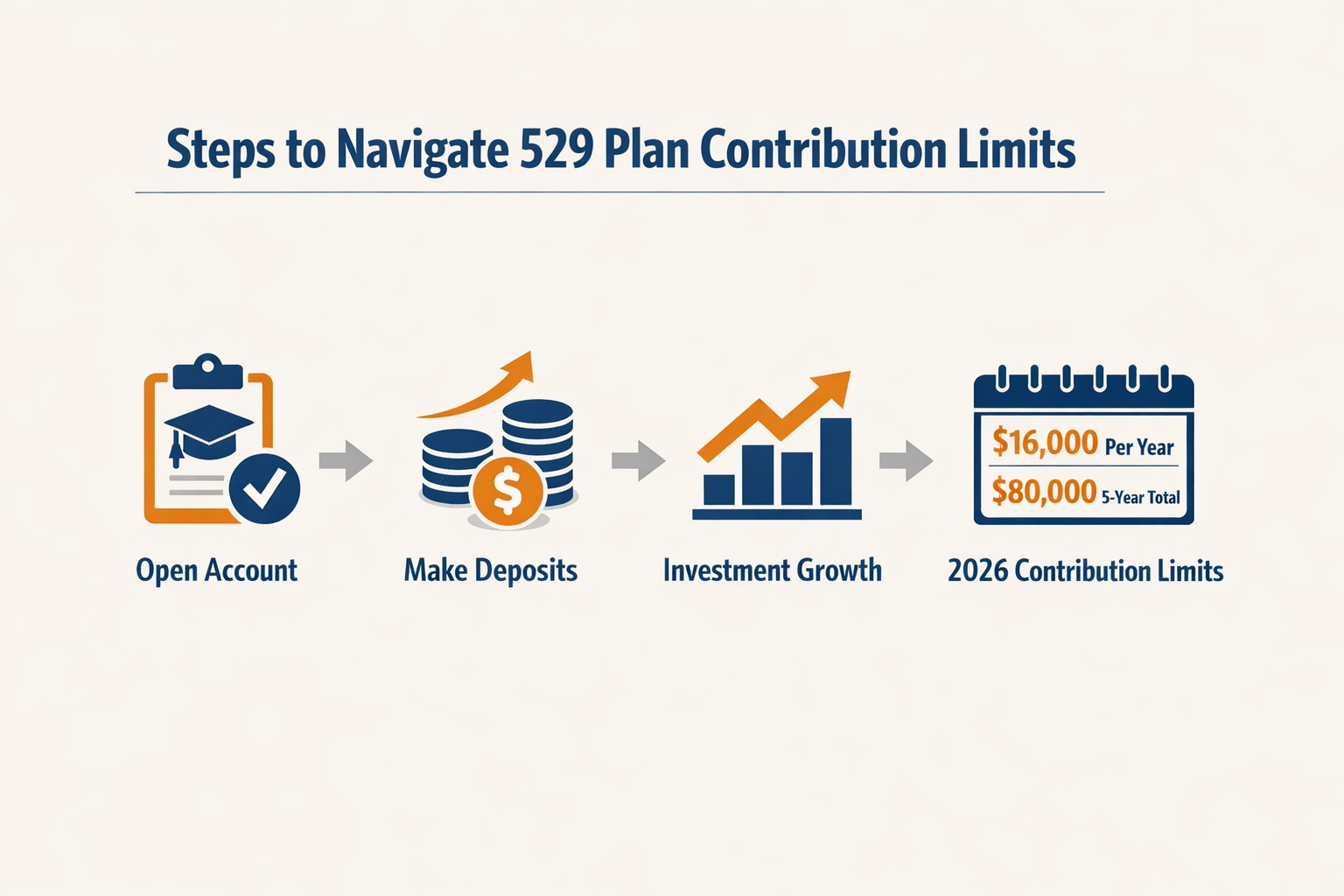
The math behind 529 contribution limits isn't as complicated as it sounds. Most families run into confusion because there are actually two different limits at work — the annual gift tax exclusion and the aggregate account maximum. Here's how to navigate both without triggering tax complications or leaving money on the table.
Understanding the 2026 Annual Gift Tax Exclusion
Starting January 1, 2026, you can contribute up to $20,000 per donor, per beneficiary without filing a gift tax return. This is the annual gift tax exclusion amount, and it applies to all gifts — not just 529 contributions. If you're married, you and your spouse can each contribute $20,000 to the same beneficiary's 529 plan, bringing the combined total to $40,000 per year with no gift tax paperwork.
The annual exclusion resets every calendar year. A contribution made on December 31, 2025 and another on January 1, 2026 counts as two separate annual gifts, even though they're one day apart.
The Five-Year Superfunding Option
For families who want to front-load a 529 account, the tax code allows a special election: you can contribute up to five years' worth of annual exclusions in a single year. In 2026, that means up to $100,000 per donor, per beneficiary — or $200,000 for married couples filing jointly.
Here's what that actually means in practical terms. If you contribute $100,000 in 2026 using the five-year election, you're essentially using your 2026, 2027, 2028, 2029, and 2030 annual exclusions all at once. You cannot make additional gifts to that beneficiary during those five years without exceeding the annual exclusion and potentially filing a gift tax return.
Step 1
Calculate your superfunding capacity
Multiply the annual exclusion by five: $20,000 × 5 = $100,000 per donor. If you're married, double it to $200,000. This is your maximum superfunding contribution for 2026 without gift tax consequences.
Step 2
File IRS Form 709 if superfunding
When you make a superfunding contribution, you must file Form 709 (United States Gift Tax Return) with your tax return for that year. The form tells the IRS you're electing to spread the gift over five years. No tax is owed — it's informational only — but skipping this step can create complications.
Step 3
Track the five-year period
Mark your calendar for the five-year window. If you superfund in 2026, you've used your annual exclusions for that beneficiary through 2030. Additional contributions during that period count against your lifetime gift and estate tax exemption unless they're under the annual exclusion amount in future years.
State-Specific Aggregate Limits
While the federal gift tax rules govern how much you can contribute annually without paperwork, each state sets its own aggregate account limit — the total amount that can be held in a 529 plan for a single beneficiary across all accounts in that state's program. These limits typically range from $300,000 to over $500,000, depending on the state.
The aggregate limit applies to the account balance, not contributions. If you contribute $200,000 and the account grows to $350,000 through investment gains, that growth counts toward the state's aggregate limit. Once the account reaches the state's maximum, you can't make additional contributions, but the account can continue to grow through investment returns.
Most families won't hit these aggregate limits unless they're planning for multiple degrees or professional school. The framework here is straightforward: contribute what makes sense for your education funding goals, stay within the annual gift tax exclusion (or use superfunding strategically), and monitor the account balance as it approaches your state's aggregate cap.
The goal is getting in the right range for your family's education expenses — not maximizing contributions for their own sake.
Contribution Timing and Investment Growth
When you contribute matters for investment growth, not for the contribution limit itself. A $20,000 contribution in January 2026 has twelve months to grow tax-free before the end of the year. The same contribution in December 2026 has one month. Over a decade or more, that timing difference compounds.
The honest answer is that most families benefit more from consistent contributions over time than from trying to time the market or front-load accounts aggressively. The exception: if you have a lump sum available (from a bonus, inheritance, or business sale) and a beneficiary with several years until college, superfunding can make sense. The money gets into the account immediately and starts growing tax-free right away.
For families balancing multiple financial goals — retirement savings, emergency funds, paying down debt — the contribution limit is less important than the contribution you can actually afford. A SEP IRA for self-employed workers or other retirement vehicles might take priority depending on your circumstances, and that's a reasonable trade-off to consider.
How Can You Maximize Your 529 Plan Contributions?
Maximizing your 529 plan contributions isn't about finding loopholes — it's about building a framework that fits your budget and timeline. The math works like this: consistent contributions over time, combined with tax advantages, create more flexibility than sporadic large deposits. Here's how to structure your approach.
Start Early and Contribute Regularly
The earlier you start, the more time your contributions have to grow tax-free. Even small monthly deposits add up. A family contributing $200 per month starting when a child is born accumulates significantly more than one making irregular larger contributions later. The compounding effect matters more than the size of individual deposits in most cases.
Automatic monthly contributions remove the decision-making friction. Set a realistic amount based on your household budget — something you can maintain through different financial seasons. Most 529 plans allow automatic transfers from checking accounts, making the process straightforward.
Leverage State Tax Benefits Where Available
Over 30 states offer either state income tax deductions or state tax credits for 529 plan contributions. The specific benefit varies by state — some offer deductions for contributions to any state's plan, while others require you to use the in-state plan to qualify.
Check your state's rules. In states with income tax deductions, the benefit often caps at a specific contribution amount per year. For instance, if your state offers a deduction up to $5,000 in contributions annually, hitting that threshold maximizes your state tax benefit without overextending your budget. The deduction reduces your taxable income, which translates to real savings at tax time.
Use Gift Tax Exclusion Strategies
Grandparents and other family members can contribute to a beneficiary's 529 plan, and these contributions count toward the annual gift tax exclusion. In practical terms, this means relatives can help fund education savings without triggering gift tax consequences, as long as contributions stay within the annual exclusion amount.
The five-year election allows a one-time contribution that counts as five years' worth of annual exclusions upfront. This strategy works well for grandparents who want to make a significant contribution while managing their estate planning. The contribution grows tax-free in the 529 plan, and it's removed from the donor's taxable estate immediately.
Coordinate Contributions Across Family Members
Multiple people can contribute to the same 529 account. Parents, grandparents, aunts, uncles — anyone can add funds. Instead of birthday gifts that get forgotten, family members can contribute directly to the 529 plan. Some plans offer gifting portals that make this process easier, allowing relatives to contribute online.
Communicate with family members about this option. When relatives ask what a child needs for holidays or birthdays, a 529 contribution often provides more long-term value than another toy. It also helps families stay under aggregate contribution limits while spreading the savings effort across multiple contributors.
Review and Adjust Your Strategy Annually
Your financial situation changes. Review your 529 contributions at least once per year — ideally when you're already looking at your household budget or filing taxes. Ask whether your current contribution level still makes sense given your income, expenses, and the beneficiary's timeline to college.
If you receive a raise or bonus, consider increasing your monthly contribution amount. If you're facing tighter cash flow, reducing contributions temporarily is better than stopping altogether. The goal is getting in the right range for your circumstances, not hitting an arbitrary number that strains your budget.
The cheapest college savings strategy is the one you can sustain for 18 years without derailing your other financial priorities.
Don't Sacrifice Retirement Savings
Here's the honest answer: your retirement savings come first. There are loans for college; there are no loans for retirement. If contributing the maximum to your 529 plan means you're not funding your 401(k) or IRA adequately, you're building the wrong foundation.
A balanced approach might look like this: contribute enough to your employer retirement plan to capture the full match, then allocate additional savings between retirement accounts and the 529 plan based on your timeline and priorities. For families with young children and decades until retirement, a heavier weight toward retirement accounts often makes sense. For families closer to college years, the balance might shift.
If you're self-employed, vehicles like a SEP IRA or SIMPLE IRA can provide significant retirement savings benefits alongside 529 contributions.
Consider Front-Loading in High-Income Years
If you have a year with unusually high income — a bonus, inheritance, or business sale — front-loading 529 contributions can make sense. You capture the tax benefits in a high-income year, and the funds have more time to grow tax-free.
This strategy works best when you're confident the funds won't be needed for other purposes and when you're already meeting your other savings goals. The five-year election mentioned earlier pairs well with this approach for large one-time contributions.
Conclusion
Planning for education expenses doesn't have to feel overwhelming. The framework is straightforward: 529 plans offer tax-advantaged growth, annual gift-tax exclusions let most families contribute $20,000 per beneficiary in 2026, and superfunding allows you to front-load five years of contributions — up to $100,000 per individual or $200,000 for married couples — without triggering gift-tax consequences. The real question is getting started with a strategy that fits your circumstances.
Most people don't realize that 529 contribution limits 2026 aren't federal caps on how much you can save — they're state-specific aggregate limits that range from $235,000 to over $500,000 per beneficiary. The annual gift-tax exclusion is the practical constraint for most families. If you're contributing within that range, you're building a solid foundation. If you're considering superfunding or multi-generational contributions, talk to a licensed financial professional about how those moves affect your estate plan.
The honest answer: starting early and contributing consistently matters more than maximizing every tax break. A $200 monthly contribution over 18 years, with modest growth, can cover a significant portion of college costs. When you're ready to take the next step, compare your state's plan benefits — deductions, fees, investment options — and choose a framework that aligns with your timeline. For families exploring how education savings fit into broader financial planning, understanding retirement account structures like SEP IRAs or business succession planning can help you balance competing priorities.
Education savings is one piece of a larger financial picture. The goal isn't perfection — it's building a plan you can sustain and adjust as your family's needs evolve.
FAQ
What are the 529 contribution limits for 2026?The annual gift tax exclusion for 2026 is $20,000 per donor, per beneficiary. Married couples can contribute up to $40,000 combined per beneficiary without gift tax reporting. Through superfunding, you can contribute up to $100,000 ($200,000 for couples) in a single year by electing to spread it over five years.
How does superfunding work for 529 plans?Superfunding allows you to contribute five years' worth of annual exclusions at once — $100,000 per donor or $200,000 for married couples in 2026. You must file IRS Form 709 to elect this treatment, and you cannot make additional gifts to that beneficiary during the five-year period without using your lifetime exemption.
Are there state-specific 529 contribution limits?Yes. Each state sets its own aggregate account maximum, typically ranging from $300,000 to over $500,000 per beneficiary. This limit applies to the total account balance, including investment gains, not just contributions. Once reached, no additional contributions are allowed.
Do 529 contributions reduce my taxable income?Federal law does not provide a deduction for 529 contributions. However, over 30 states offer state income tax deductions or credits for contributions to their 529 plans. The amount and rules vary by state, so check your state's specific benefits.
Can grandparents contribute to a 529 plan?Yes. Anyone can contribute to a 529 plan, including grandparents, relatives, and friends. Contributions from grandparents follow the same annual gift tax exclusion rules and can use the five-year superfunding election for larger one-time gifts.