Introduction
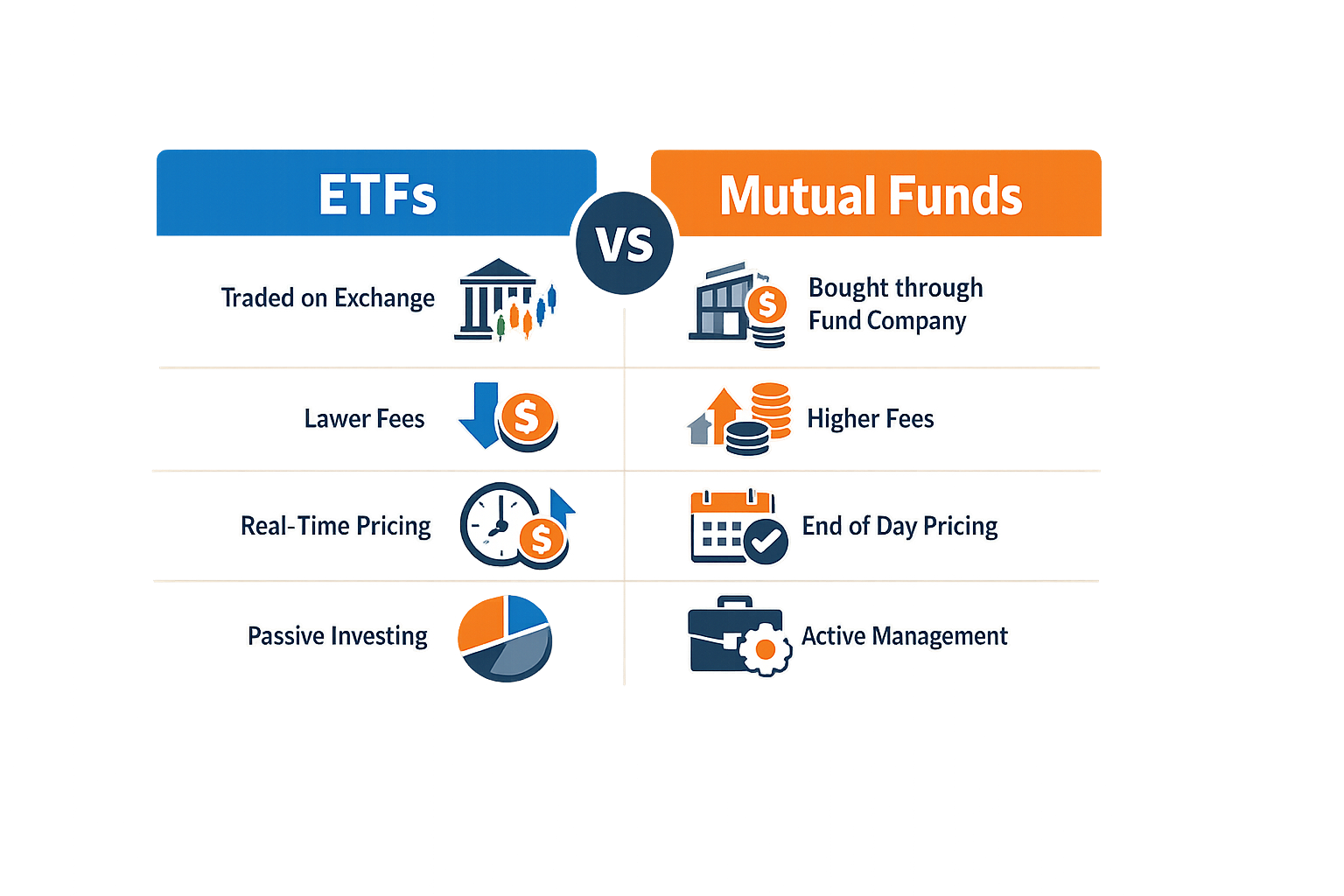
ETF vs. Mutual Fund: both pool money from many investors to buy a basket of stocks, bonds, or other assets. You own a share of the whole basket. The goal is the same — diversification without having to research and buy dozens of individual securities yourself.
Most people know they should be investing. Fewer know whether they should be buying ETFs or mutual funds — or what the difference even means in practical terms.
The difference between the two comes down to structure. ETFs trade on exchanges like stocks throughout the day. Mutual funds price once daily after the market closes. That structural difference cascades into differences in costs, tax efficiency, and how you actually buy and sell them. For someone building a retirement account with automatic monthly contributions, those differences matter. For someone making a one-time investment in a taxable brokerage account, they matter differently.
The honest answer is that most investors can build a solid portfolio with either vehicle. But the details — minimum investments, expense ratios, tax treatment, trading flexibility — determine which one fits your framework. If you're contributing to a 401(k) or IRA, you may not even have a choice; many employer plans offer only mutual funds, while self-directed brokerage accounts increasingly favor ETFs.
This article walks through the mechanics of each, the trade-offs that matter, and a framework for deciding which vehicle aligns with how you actually invest. The goal is getting in the right range for your circumstances, not finding a universal winner.
Understanding the Differences: ETF vs. Mutual Fund
Most investors approach the ETF vs. Mutual Fund decision the same way they approach choosing a phone plan — they know there are differences, they suspect those differences matter, but the details blur together until they just pick whatever their friend recommended. The result is predictable: confusion, second-guessing, and a nagging sense that they might be leaving money on the table.
The confusion isn't about laziness. It's about structure. ETFs and mutual funds both pool investor money to buy a diversified basket of securities, but the way they operate — how you buy them, what they cost, and how the tax bill shows up — diverges sharply once you look past the marketing brochures. For someone building a retirement account or funding a 529 plan, those structural differences translate directly into dollars kept or dollars lost over decades.
What Makes ETF vs. Mutual Fund Different?
The honest answer is that most people don't realize the choice between an ETF and a mutual fund isn't about which one is "better" in some universal sense. It's about which structure aligns with how you actually invest. Do you trade during market hours and want real-time pricing? Or do you prefer automatic monthly contributions that execute at day's end? Do you care more about minimizing expense ratios, or about avoiding surprise capital gains distributions in taxable accounts?
These aren't theoretical questions. A mutual fund investor who discovers a four-figure capital gains tax bill in December — despite never selling a share — learns the hard way that fund structure matters. An ETF investor who tries to set up automatic dollar-cost averaging and discovers their brokerage charges trade commissions learns the same lesson from a different angle.
Where the Confusion Compounds
The problem gets worse when you factor in account types. A SEP IRA or 401(k) shelters you from most tax differences between ETFs and mutual funds, which makes cost and convenience the primary variables. But in a taxable brokerage account, tax efficiency can swing thousands of dollars over a decade, and suddenly the ETF vs. Mutual Fund question has a different answer.
Then there's the cost structure. Expense ratios look straightforward on paper — 0.05% for an ETF, 0.50% for an actively managed mutual fund — until you add in transaction costs, bid-ask spreads, and the potential for short-term redemption fees on mutual funds or brokerage commissions on ETFs. The math works like this: a lower expense ratio doesn't guarantee a lower total cost if you're paying $10 per trade twice a month.
Most people don't lie awake wondering whether their investment vehicle trades on an exchange or settles at net asset value. They lie awake wondering whether they're building wealth efficiently or hemorrhaging fees they don't understand. The framework for answering that question starts with understanding what actually differs between these two structures — not just in theory, but in practical terms that show up in your account balance.
Breaking Down the Differences: ETF vs. Mutual Fund
The ETF vs. Mutual Fund decision comes down to four structural differences: how they're built, how they trade, what they cost, and how they're taxed. Here's what that actually means in practical terms.
Structure and Management
Mutual funds pool investor money into a single portfolio managed by a fund company. When you buy shares, you're buying directly from the fund itself at the net asset value calculated once per day after markets close. The fund issues new shares when investors buy and redeems shares when they sell.
ETFs work differently. They trade on exchanges like individual stocks, meaning you buy and sell shares from other investors throughout the trading day at market prices. The price moves constantly based on supply and demand, though it typically stays close to the underlying asset value.
Both structures can hold the same types of investments — stocks, bonds, or other securities. The difference is in how you access them.
Trading Mechanics
| Feature | Mutual Fund | ETF |
|---|---|---|
| Trading | Once daily at NAV | Continuous during market hours |
| Price | End-of-day calculation | Real-time market price |
| Order types | Dollar amount or shares | Shares only, with limit/stop orders |
| Minimum investment | Often $1,000–$3,000 | Price of one share |
Mutual funds execute all trades at the same price regardless of when during the day you place your order. If you submit a buy order at 10 a.m., you'll get the price calculated at 4 p.m. when markets close.
ETFs let you trade anytime the market is open, which means you can respond to intraday price movements. You can also use limit orders to control your entry price or stop-loss orders to manage risk — tools that don't exist with mutual funds.
The trade-off: ETF prices can drift slightly above or below the actual value of the underlying holdings, especially during volatile markets. Mutual funds eliminate that concern by always transacting at the calculated net asset value.
Cost Structure
Expense ratios measure the annual cost of owning the fund, expressed as a percentage of your investment. Both ETFs and mutual funds charge expense ratios, but ETFs typically run lower — often 0.03% to 0.25% for index-tracking funds, compared to 0.50% to 1.50% for actively managed mutual funds.
Mutual funds may also charge sales loads — upfront or back-end fees ranging from 3% to 5.75% of your investment. Front-end loads reduce your initial investment; back-end loads (also called redemption fees) apply when you sell. Many funds offer no-load share classes, but these often carry higher annual expenses instead.
ETFs don't charge sales loads, but you'll pay a brokerage commission each time you buy or sell, similar to trading stocks. Many brokers now offer commission-free ETF trading for select funds, which eliminates this cost for buy-and-hold investors.
For investors building positions gradually — say, monthly contributions to a retirement account like a SEP IRA — mutual funds often work better because you can invest exact dollar amounts without triggering multiple trading commissions.
Tax Efficiency
The taxable portion of a distribution from a mutual fund or ETF is treated as ordinary income, but the timing of those distributions differs significantly between the two structures.
Mutual funds generate taxable events when the fund manager sells securities inside the portfolio. If the fund realizes capital gains, it must distribute them to shareholders by year-end. You'll owe taxes on those distributions even if you didn't sell any shares yourself and even if you reinvested the distributions back into the fund.
ETFs rarely distribute capital gains because of how they're structured. When investors sell ETF shares, they're selling to other investors on the exchange — not back to the fund. The fund itself doesn't have to sell underlying securities to raise cash for redemptions, which means fewer taxable events.
Earnings from investments in both structures aren't taxed until they're distributed, either through withdrawals or as dividend and capital gain distributions. But ETFs give you more control over the timing because you trigger taxes primarily when you choose to sell, rather than when the fund manager makes portfolio changes.
For taxable brokerage accounts, this difference matters. In tax-advantaged accounts like 401(k)s or IRAs, it doesn't — all growth is tax-deferred regardless of structure.
Minimum Investments and Accessibility
Mutual funds often require initial minimums ranging from $1,000 to $3,000 for retail investors, though some workplace retirement plans waive minimums for automatic payroll contributions. Once you meet the minimum, you can invest any dollar amount in subsequent purchases.
ETFs have no minimums beyond the cost of a single share. If an ETF trades at $50 per share, that's your entry point. Some brokers now offer fractional share purchases, letting you invest any dollar amount even in higher-priced ETFs.
The practical difference: if you're starting with $500 and want to invest across multiple asset classes, ETFs give you more flexibility. If you're investing $5,000 and want to set up automatic monthly contributions of $200, a no-load mutual fund often makes more sense.
Choosing the Right Investment: Tips and Tricks
The honest answer: there's no universal winner in the ETF vs. Mutual Fund debate. The right choice depends on how you invest, what you're investing for, and how much attention you want to pay to the mechanics. Most people don't realize that the structural differences covered earlier translate directly into practical decision points — and those decision points look different depending on your circumstances.
Match the Vehicle to Your Trading Habits
If you invest on a schedule — monthly paycheck contributions, quarterly bonuses, annual windfalls — mutual funds remove friction. You set up automatic purchases, the fund company handles fractional shares, and you never think about market hours or bid-ask spreads. The math works like this: $500 every month buys exactly $500 worth of fund shares, down to the penny, regardless of the share price.
ETFs work better when you're making deliberate, timed decisions — rebalancing a portfolio, deploying a lump sum, or adjusting exposure based on market conditions. If you're comfortable placing limit orders and checking prices during the trading day, ETFs give you control. If that sounds like homework you'd rather skip, mutual funds are the straightforward choice.
Consider Your Account Type and Tax Situation
In tax-deferred accounts like 401(k)s, IRAs, and SEP IRAs, the tax-efficiency advantage of ETFs disappears. You're not paying capital gains taxes on distributions anyway, so the structural benefit evaporates. Here, the decision comes down to cost and convenience — and often, your employer's plan only offers mutual funds, so the choice is made for you.
In taxable brokerage accounts, ETF tax efficiency matters more. If you're building a long-term portfolio and want to minimize the annual tax drag from capital gains distributions, ETFs have a real edge. That edge compounds over decades — worth understanding if you're in a high tax bracket and holding for the long term.
Evaluate Costs in Context
Expense ratios matter, but they're not the whole story. A mutual fund charging 0.05% with no transaction fees beats an ETF charging 0.03% if you're paying $10 in commissions every month to buy it. The goal is getting in the right range — sub-0.20% for broad index exposure, sub-0.50% for sector-specific strategies — and then focusing on the total cost of ownership.
Some brokers offer commission-free ETF trading; others waive fees on proprietary mutual funds. Check what your platform charges before you assume one vehicle is cheaper. The difference between 0.04% and 0.08% matters less than the difference between $0 and $120 in annual transaction fees.
The cheapest option on paper isn't always the cheapest option in practice — transaction costs and trading behavior often outweigh a few basis points in the expense ratio.
Think About Minimum Investments
Mutual funds often carry minimum initial investments — $1,000, $3,000, sometimes $10,000 for certain share classes. ETFs have no minimums beyond the price of one share, which might be $50, $200, or $400 depending on the fund. For investors starting with smaller amounts, ETFs remove the barrier to entry.
That said, once you're past the minimum, mutual funds' fractional-share purchases mean every dollar goes to work. With ETFs, if you have $1,050 and shares cost $200, you're left with $50 in cash. Over time, that cash drag adds up if you're not reinvesting it.
Assess Your Need for Intraday Liquidity
Most long-term investors don't need to trade at 11:37 a.m. The ability to buy or sell ETFs during market hours is a feature you'll rarely use — unless you're actively managing risk, hedging positions, or responding to market events in real time. For buy-and-hold portfolios, end-of-day pricing is perfectly adequate.
If you're building a diversified portfolio inside a retirement account and rebalancing once or twice a year, intraday liquidity is a solution to a problem you don't have. Mutual funds' simplicity wins. If you're managing a taxable account with multiple asset classes and want the flexibility to adjust quickly, ETFs give you that option.
A Framework for Decision-Making
Here's a starting point based on common scenarios:
- Employer retirement plan (401(k), 403(b)): Use whatever's available — usually mutual funds. Focus on low costs and broad diversification.
- IRA with regular contributions: Mutual funds for automatic monthly investing; ETFs if you prefer lump-sum annual contributions.
- Taxable brokerage, long-term holding: ETFs for tax efficiency, especially in high-tax situations.
- Small initial investment, no regular contributions: ETFs to avoid mutual fund minimums.
- Active rebalancing or tactical adjustments: ETFs for trading flexibility and control.
The framework isn't rigid — plenty of investors use both. The real question is which vehicle reduces friction for your specific situation. When you're ready to take the next step, talk to a licensed financial professional who can map these principles to your actual accounts, tax bracket, and investment timeline.
Frequently asked questions
How do ETF vs. Mutual Fund tax treatments differ?
ETFs typically generate fewer capital gains distributions than mutual funds because of their in-kind redemption structure. When you sell an ETF share, you're selling to another investor on the exchange — the fund itself doesn't have to sell underlying securities. Mutual funds must sell holdings to meet redemptions, creating taxable events that get passed to all shareholders. In taxable accounts, this difference can save thousands in annual tax bills.
Which is better for automatic investing: ETF vs. Mutual Fund?
Mutual funds work better for automatic investing because they allow fractional shares and dollar-amount purchases. You can set up a $500 monthly contribution that buys exactly $500 worth of shares. ETFs require you to buy whole shares, so a $500 contribution might only buy two shares at $240 each, leaving $20 uninvested. Many brokers now offer fractional ETF shares, but mutual funds remain the simpler choice for scheduled contributions.
Do ETFs or mutual funds have lower fees?
ETFs generally have lower expense ratios than actively managed mutual funds — often 0.03% to 0.25% versus 0.50% to 1.50%. However, total cost depends on trading commissions, bid-ask spreads, and how often you trade. A mutual fund with no transaction fees and a 0.10% expense ratio can be cheaper than an ETF with a 0.05% ratio if you're paying $10 per trade monthly.
Can I use both ETFs and mutual funds in the same portfolio?
Yes, and many investors do. You might use low-cost mutual funds in your 401(k) or SEP IRA for automatic contributions, while holding tax-efficient ETFs in your taxable brokerage account. The key is understanding which vehicle fits each specific account type and investment goal, rather than forcing yourself to choose only one.
Conclusion
The ETF vs. Mutual Fund decision isn't about finding a universal winner — it's about matching the investment vehicle to your specific situation. ETFs offer intraday trading flexibility, typically lower expense ratios, and tax-efficient structures that benefit taxable accounts. Mutual funds provide automatic investment options, professional active management in many cases, and end-of-day pricing that removes the temptation to trade on emotion. Neither is inherently better; both serve different investor needs.
The framework for choosing comes down to three questions: How do you want to invest (lump sum vs. regular contributions)? Where is the money held (taxable brokerage vs. retirement account)? What level of involvement do you want in the investment process? If you're building wealth through consistent monthly contributions in a 401(k) or IRA, mutual funds often provide the smoother path. If you're managing a taxable portfolio with occasional rebalancing, ETFs may offer better tax efficiency and cost control.
Most diversified portfolios have room for both. A core holding of low-cost index mutual funds in your retirement accounts can sit alongside ETFs in your taxable brokerage account. The tax treatment of earnings — whether from ETFs or mutual funds — follows the same rules once distributed, so the real differences show up in how you access, trade, and manage the investments along the way. For investors building wealth across multiple account types, understanding what is a SEP IRA or exploring SIMPLE IRA options for small teams helps create a complete strategy that uses the right tools in the right places.
When you're ready to take the next step, talk to a licensed financial professional who can review your complete financial picture — income sources, tax situation, time horizon, and risk tolerance. The goal is building a portfolio structure that you'll actually stick with through market cycles, not chasing the investment type with the lowest expense ratio or the trendiest ticker symbol. The best investment is the one that fits your plan and keeps you invested.