
Introduction
Most people treat their Health Savings Account like a checking account — they put money in, they take money out for doctor visits, and they never think about what happens in between. The honest answer: that approach leaves thousands of dollars on the table.
An HSA isn't just a way to pay this year's medical bills with pre-tax dollars. It's one of the most tax-advantaged accounts available, and when you invest the balance instead of leaving it in cash, you're building a healthcare fund that can grow for decades. HSA investment strategies center on this principle: contribute pre-tax dollars, invest them in mutual funds or other securities, watch them grow tax-free, and withdraw them tax-free for qualified medical expenses. No other account type offers that combination.
Here's what that actually means in practical terms. If you're 35 years old with family HDHP coverage, you can contribute up to $8,550 in 2025. If you invest that money and earn a conservative 7% annual return, that single year's contribution could grow to over $65,000 by age 65 — all tax-free if used for medical expenses. Most people don't realize that after age 65, you can withdraw HSA funds for any purpose (paying ordinary income tax, just like a traditional IRA), making it a flexible retirement account as well.
The framework for HSA investment strategies starts with understanding eligibility and contribution mechanics. You can make contributions for 2025 through April 15, 2026, giving you flexibility in timing. Any eligible individual can contribute — you, your employer, or even family members. The key requirement: you must be covered by a high-deductible health plan (HDHP) and not be enrolled in Medicare or claimed as a dependent on someone else's tax return.
For small business owners and self-employed individuals, HSAs offer additional planning opportunities. Unlike 401(k) plans for small business owners, HSAs don't require complex administration or employer matching commitments, but they still provide meaningful tax benefits for both the business and the individual.
The real question is not whether to open an HSA — if you're eligible, the tax advantages make that decision straightforward. The real question is whether you're investing that money for long-term growth or letting it sit in a low-interest cash account. The difference between those two approaches compounds over decades, turning a healthcare savings account into a significant wealth-building tool.
Understanding the Challenge of HSA Growth
Most people treat their Health Savings Account like a glorified checking account — they contribute, they spend, and they never think about the money sitting there between medical bills. The result is predictable: thousands of dollars earning almost nothing while inflation quietly eats away at purchasing power. The real question is why so many account holders miss the investment opportunity sitting in plain sight.
The Cash Trap
The default setting for most HSAs is a basic savings account earning minimal interest. Many providers don't make it obvious that investment options exist, and even when they do, the process can feel like navigating a retirement plan you didn't sign up for. The math works like this: if you're keeping $5,000 in an HSA earning 0.5% interest while inflation runs at 3%, you're losing purchasing power every year — even though the account balance looks stable.
A common misconception is that HSAs are only for current medical expenses. That's one use, but it's not the framework the tax code rewards. HSAs are one of the few accounts offering triple tax advantages: tax-deductible contributions, tax-free growth, and tax-free withdrawals for qualified medical expenses. When you leave money in cash, you're using one of those three benefits and ignoring the other two.
Why People Don't Invest
The honest answer: most people don't realize it's an option, or they assume the account is too small to bother. Many HSA providers require a minimum cash balance before allowing investments — often $1,000 to $2,000 — which creates a psychological barrier. If you're living paycheck to paycheck or just starting to build the account, hitting that threshold feels distant.
Another barrier is complexity. The investment menus offered by HSA providers vary widely in quality. Some offer low-cost index funds; others offer expensive actively managed funds with high fees that quietly drain returns. Without a framework for evaluating options, many account holders default to doing nothing.
There's also a behavioral element: medical expenses feel unpredictable, so keeping everything liquid feels safer. The fear is that you'll invest the money, the market will drop, and you'll need cash for an emergency procedure. That's a legitimate concern if your entire HSA is invested aggressively, but it's not a reason to avoid investing altogether — it's a reason to think about allocation.
The goal isn't choosing between saving and investing. It's understanding that an HSA can do both if you build the right structure.
The Prohibited Transaction Risk
There's one more challenge worth understanding: HSAs come with strict rules, and violating them can be expensive. Deemed distributions occur when you engage in certain prohibited transactions with your HSA. If your account ceases to qualify as an HSA — for example, if you use it as security for a loan — the IRS treats the entire account balance as taxable income in that year. For someone with $20,000 in an HSA, that's a significant tax hit.
This doesn't mean HSAs are fragile or risky to invest. It means the framework has guardrails, and staying inside them is straightforward: don't borrow against the account, don't use it for non-qualified expenses if you want the tax benefit, and don't engage in self-dealing transactions. The rules aren't complicated, but they're non-negotiable.
Most people never come close to these boundaries. The real challenge isn't avoiding prohibited transactions — it's recognizing that an HSA is more than a spending account and treating it accordingly.
What Are the Best HSA Investment Strategies?
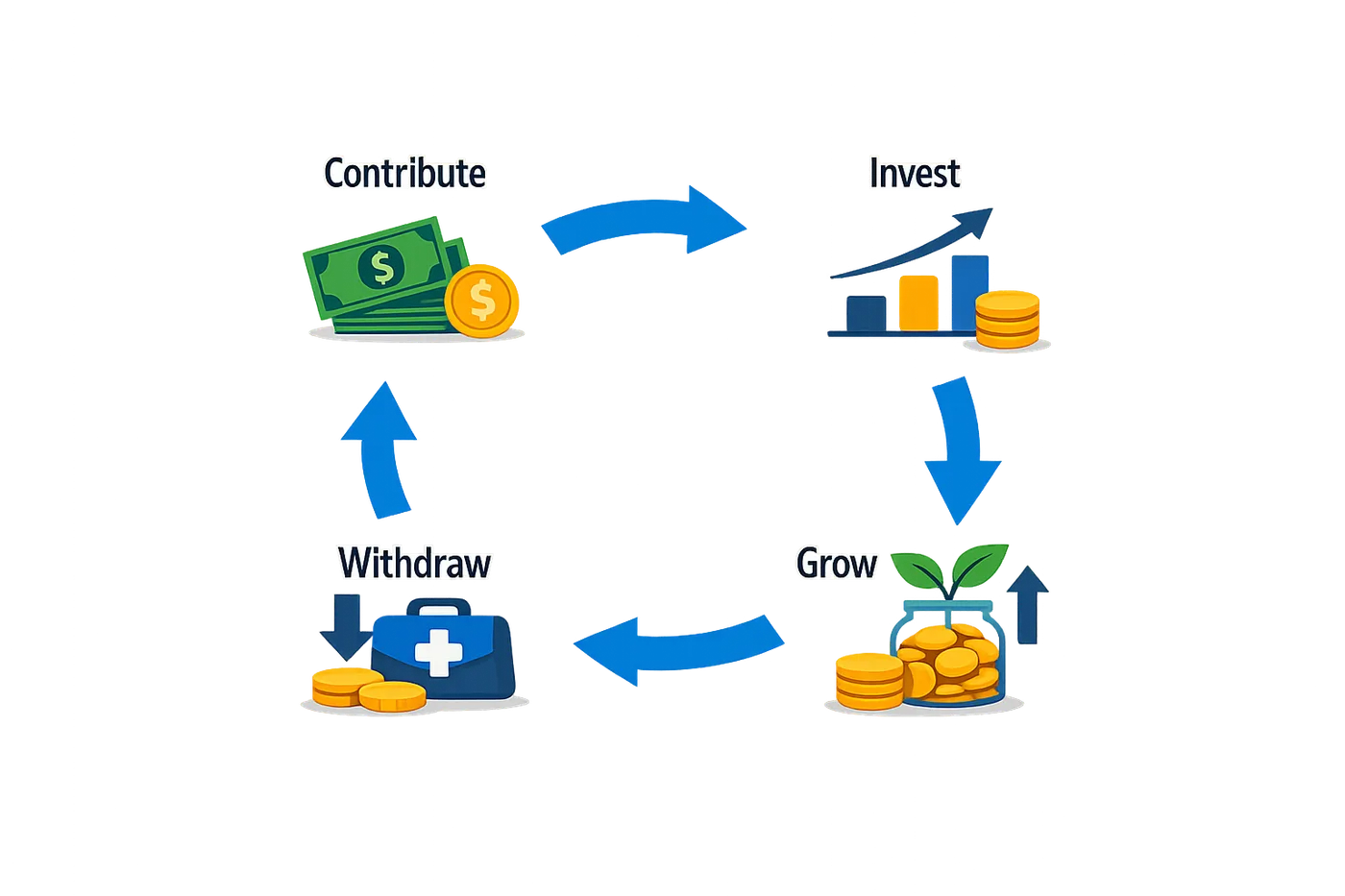
Most HSA providers offer investment options once your cash balance hits a minimum threshold — typically somewhere between $1,000 and $2,000. The framework for investing your HSA mirrors the approach you'd take with a SIMPLE IRA vs 401k for small business, but the tax treatment is even more favorable. Here's how to move from cash holdings to invested assets.
Step 1: Verify Your HSA Provider's Investment Platform
Step 1
Check investment availability
Log into your HSA account and locate the investment section. Not all HSA administrators offer investment options — if yours doesn't, you can transfer your HSA to a provider that does. The transfer process is straightforward and doesn't trigger taxes or penalties when done correctly.
Most platforms require you to maintain a cash reserve in your HSA before investing the rest. This reserve typically ranges from $1,000 to $2,000 and stays liquid for immediate medical expenses. Anything above that threshold can be moved into investment options.
Step 2: Build Your Cash Reserve First
Step 2
Establish your safety buffer
Before investing a dollar, fund your HSA to cover the required cash minimum plus a buffer for near-term medical expenses. A common framework: keep enough cash to cover your annual deductible, then invest the rest.
The math works like this: if your HDHP has a $3,000 deductible and your provider requires a $1,000 cash minimum, you'd want at least $3,000 in cash before moving additional contributions into investments. This prevents you from selling investments at a loss to cover an unexpected medical bill.
Step 3: Select Your Investment Mix
Step 3
Choose your asset allocation
Most HSA investment platforms offer mutual funds or ETFs spanning stock and bond categories. Your allocation depends on your time horizon — if you're investing for retirement decades away, a stock-heavy portfolio makes sense. If you're closer to needing the funds, a more conservative mix is appropriate.
A straightforward starting point for long-term growth: a diversified stock index fund or a target-date fund aligned with your expected retirement year. The goal is getting in the right range, not perfect precision. As you accumulate more in the account, you can refine the mix.
Step 4: Automate Contributions and Rebalancing
Step 4
Set up systematic investing
Once you've chosen your investment mix, set up automatic transfers from your HSA cash balance to your selected funds. Many platforms let you schedule monthly or quarterly transfers, which keeps your cash reserve at the target level while investing the excess.
Rebalancing — adjusting your portfolio back to your target allocation — matters more as your balance grows. An annual review is sufficient for most people. When one asset class has grown significantly, you sell a portion and buy the underweighted category to restore your original percentages.
Step 5: Understand the IRA Rollover Option
If you have funds in a traditional IRA or Roth IRA and want to jumpstart your HSA investments, the IRS allows a one-time qualified HSA funding distribution. The distribution must be made directly from the IRA trustee to the HSA trustee and cannot exceed your annual HSA contribution limit. The maximum depends on whether you have self-only or family HDHP coverage and your age at year-end.
You can't use an ongoing SEP IRA or SIMPLE IRA for this rollover. For this purpose, a SEP or SIMPLE is considered ongoing if an employer contribution is made for the plan year ending with or within your tax year.
Tips and Tricks for Maximizing HSA Investments
Once you've set up your HSA investment framework, a few strategic moves can amplify your long-term growth without adding complexity. Most people treat their HSA like a checking account — they contribute, they spend, they repeat. The real opportunity lies in treating it like a retirement account that happens to cover healthcare costs.
Let Your Contributions Compound Tax-Free
The interest or other earnings on the assets in your HSA are tax-free. That's not a deferral — it's permanent. Every dollar of growth stays in the account, compounding without the drag of annual capital gains or dividend taxes. For long-term growth, this means leaving contributions untouched whenever possible. Pay current medical expenses out of pocket if your budget allows, and let the HSA balance grow undisturbed. The math works like this: a $5,000 balance growing at 7% annually becomes roughly $19,700 in twenty years — all tax-free.
Choose Your HSA Trustee Strategically
You can establish your HSA through a trustee that is different from your health plan provider. Not all HSA administrators offer the same investment options. Some limit you to high-fee mutual funds; others provide access to low-cost index funds or even self-directed brokerage accounts. If your employer's default HSA custodian charges high fees or offers limited investment choices, you can open a second HSA with a different trustee and roll funds over. The account is portable — it stays with you regardless of employment changes.
The cheapest HSA provider is the one whose investment lineup matches your long-term allocation without forcing you into expensive actively managed funds.
Stay Within Contribution Limits Across All Accounts
If you have more than one HSA, your total contributions to all accounts can't exceed the annual limits. For 2025, that's $4,300 for self-only coverage and $8,550 for family coverage (plus the $1,000 catch-up if you're 55 or older). Exceeding these limits triggers a 6% excise tax on the excess amount each year it remains in the account. Track your contributions carefully, especially if you change jobs mid-year or if both you and your employer contribute.
Rebalance Without Tax Consequences
Unlike a taxable brokerage account, you can rebalance your HSA portfolio without triggering capital gains taxes. If your target allocation is 70% stocks and 30% bonds, and market gains push you to 80/20, you can sell equities and buy bonds inside the HSA with no tax bill. This flexibility makes HSAs particularly efficient for maintaining a disciplined asset allocation over decades. Rebalance annually or whenever your allocation drifts more than 5% from your target.
Keep Records of Medical Expenses
Even if you're paying out of pocket now to let your HSA grow, save receipts for qualified medical expenses. There's no time limit on HSA reimbursements. You can withdraw funds tax-free years later to reimburse yourself for expenses incurred after the HSA was established. This creates a secondary emergency fund: if you need liquidity, you can tap the HSA for past medical costs without penalty. For a deeper look at how tax-advantaged accounts fit into a broader retirement strategy, see our guide on SEP IRA Contribution Limits for 2026.
Coordinate HSA Strategy With Other Retirement Accounts
An HSA doesn't replace a 401(k) or IRA — it complements them. If your employer offers a 401(k) match, contribute enough to capture the full match before maxing out your HSA. After that, the priority depends on your tax situation and investment options. HSAs offer triple tax advantages (deductible contributions, tax-free growth, tax-free withdrawals for medical expenses), making them one of the most efficient vehicles available. Use them as part of a diversified retirement savings approach, not as a standalone solution. Compare how these accounts work alongside options like a Coverdell Education Savings Account for education funding or estate planning tools like a living trust for wealth transfer.
Conclusion
Most people treat their HSA like a checking account — pay the bill, move on. That approach leaves money on the table. The math is straightforward: contributions are tax-deductible, earnings grow tax-free, and withdrawals for qualified medical expenses come out tax-free. No other account structure offers that triple advantage.
The framework is simple. Build a cash buffer for near-term medical expenses. Once that's in place, invest the rest in a diversified portfolio aligned with your timeline and risk tolerance. The goal is getting in the right range — enough liquidity to cover what you'll spend this year, enough growth potential to build a healthcare reserve for retirement.
Here's what that actually means in practical terms: an HSA is portable, stays with you when you change jobs, and carries over year to year. After age 65, you can withdraw funds for any reason without penalty (though non-medical withdrawals are taxed as ordinary income). Before 65, stick to qualified medical expenses to preserve the tax-free treatment.
The honest answer: most people don't realize their HSA can function as a long-term investment vehicle. If you're in a position to pay current medical expenses out of pocket and let your HSA balance grow, you're building a tax-advantaged healthcare fund that compounds over decades. That's worth understanding.
When you're ready to take the next step, review your HSA provider's investment options and fee structure. If the choices are limited or the fees are high, consider whether your account allows transfers to a provider with better investment access.
Talk to a licensed financial professional about how HSA investing fits into your broader financial plan. Your specific situation — income, health status, other retirement accounts, and timeline — determines the right allocation. This article is for informational and educational purposes; it's not personalized advice.
Frequently asked questions
What are HSA investment strategies?
HSA investment strategies involve investing your Health Savings Account balance in mutual funds, ETFs, or other securities to achieve tax-free growth over time, rather than leaving funds in a low-interest cash account. These strategies maximize the triple tax advantage of HSAs for long-term healthcare and retirement planning.
How much should I invest in my HSA?
Invest any HSA balance above your required cash reserve and near-term medical expense needs. Most providers require maintaining $1,000–$2,000 in cash; a common strategy is keeping enough cash to cover your annual deductible and investing the remainder for long-term growth.
Can I use my HSA as a retirement account?
Yes. After age 65, you can withdraw HSA funds for any purpose without penalty (though non-medical withdrawals are taxed as ordinary income, like a traditional IRA). Before 65, withdrawals for qualified medical expenses remain completely tax-free, making HSAs powerful retirement savings vehicles.
What investments should I choose for my HSA?
For long-term growth, low-cost diversified stock index funds or target-date funds aligned with your retirement year work well. Your allocation depends on your time horizon — stock-heavy portfolios suit decades-long timelines, while conservative mixes fit shorter timeframes.
How do HSA investment strategies compare to other retirement accounts?
HSAs offer triple tax advantages that surpass 401(k)s and IRAs: tax-deductible contributions, tax-free growth, and tax-free withdrawals for medical expenses. After 65, they function like traditional IRAs for non-medical withdrawals, making them uniquely flexible retirement tools.
Learn how to invest your HSA for long-term growth and maximize your healthcare savings effectively.
Related reading
Alinea Invest Review: Features, Costs, and Is It Right for You?
Related reading
Reprise Financial Review: Is This Lender Right for Your Situation?