
Introduction
The SEP IRA contribution limits 2026 are $72,000 or 25% of compensation, whichever is lower. For self-employed individuals and small business owners, this represents a meaningful increase from prior years and reflects ongoing cost-of-living adjustments by the IRS.
Most self-employed professionals and small business owners don't lose sleep over contribution limits. They lose sleep wondering if they're saving enough for retirement — and whether they're leaving tax-advantaged dollars on the table.
The SEP IRA exists to solve that problem. It's a retirement account designed for people who don't have access to a corporate 401(k), offering higher contribution limits than a traditional IRA and simpler administration than most other business retirement plans.
Here's what that actually means in practical terms: if you're self-employed or run a small business, you can potentially set aside a substantial portion of your income for retirement while reducing your current tax burden. The catch — and it's not as complicated as it sounds — is understanding how the percentage-based calculation works and how it applies to your specific situation. Whether you're a sole proprietor, partnership, or S-corporation owner, the math works differently based on your business structure.
This guide breaks down the SEP IRA contribution limits 2026, explains how to calculate your maximum allowable contribution, and provides a framework for making the most of this retirement savings vehicle. The goal is getting in the right range for your circumstances — not chasing perfection in a tax code that adjusts annually.
Understanding the SEP IRA Contribution Limits 2026
Most people approach SEP IRA contribution limits the way they approach speed limits — they know the number exists, but they don't think much about why it matters until it's too late. The difference is that exceeding a contribution limit doesn't just cost you a fine. It can trigger tax penalties, create administrative headaches, and leave money on the table that could have been working for your retirement.
The math works like this: for 2026, the overall limit on SEP IRA contributions is $72,000. That's not a suggestion or a target — it's the ceiling. The actual amount you can contribute is the lesser of that $72,000 or 25% of your compensation. If you're self-employed, the calculation gets more complex because your compensation is your net self-employment income minus half your self-employment tax and the SEP contribution itself. Most people don't realize that last part, which is why many business owners overestimate how much they can actually put away.
Here's the real question: why does the limit matter beyond just staying compliant? The framework is about maximizing tax-deferred growth while you can. Every dollar you contribute reduces your current taxable income and grows tax-deferred until withdrawal. When you don't understand the limits, you either leave tax savings on the table by contributing too little, or you trigger excess contribution penalties by putting in too much. Neither outcome serves your retirement goals.
A common misconception is that the $72,000 limit applies per business or per account. It doesn't. If you have multiple businesses or contribute to other retirement plans, the limits interact in ways that require careful tracking. The total of all employer contributions across all plans generally can't exceed the lesser of 100% of compensation or $72,000 for 2026. If you're also contributing to a 401(k) as an employee elsewhere, those elective deferrals don't reduce your SEP limit, but employer contributions do.
For more context on how SEP IRAs fit into the broader retirement landscape for business owners and self-employed workers, see What Is a SEP IRA? A Guide for Self-Employed Workers.
The honest answer is that most business owners don't track these limits proactively. They wait until tax time, then scramble to figure out what they can contribute. By then, the year is over, and there's no room to adjust business income or compensation strategies that could have increased the contribution amount. The goal is getting in the right range early in the year, not discovering the limit when it's too late to plan around it.
The contribution limit isn't just a compliance rule — it's the boundary of your tax-planning opportunity for the year.
Worth understanding: if you do exceed the limit, the excess stays in the account and gets taxed as ordinary income, plus you owe a 6% excise tax on the excess for every year it remains uncorrected. The correction process involves removing the excess and any earnings attributable to it, which creates additional taxable events. In practical terms, an accidental over-contribution in January can still be causing tax problems in April two years later if not handled correctly.
The framework for staying within the limits starts with accurate compensation tracking and timely contribution calculations. For self-employed individuals, that means working with your tax preparer or using reliable calculation tools before making contributions, not after. For business owners with employees, it means understanding that SEP contributions must be uniform — if you contribute 20% of your compensation, you must contribute 20% for every eligible employee. The limit applies per person, but the percentage must be consistent.
How to Maximize Your SEP IRA Contributions in 2026
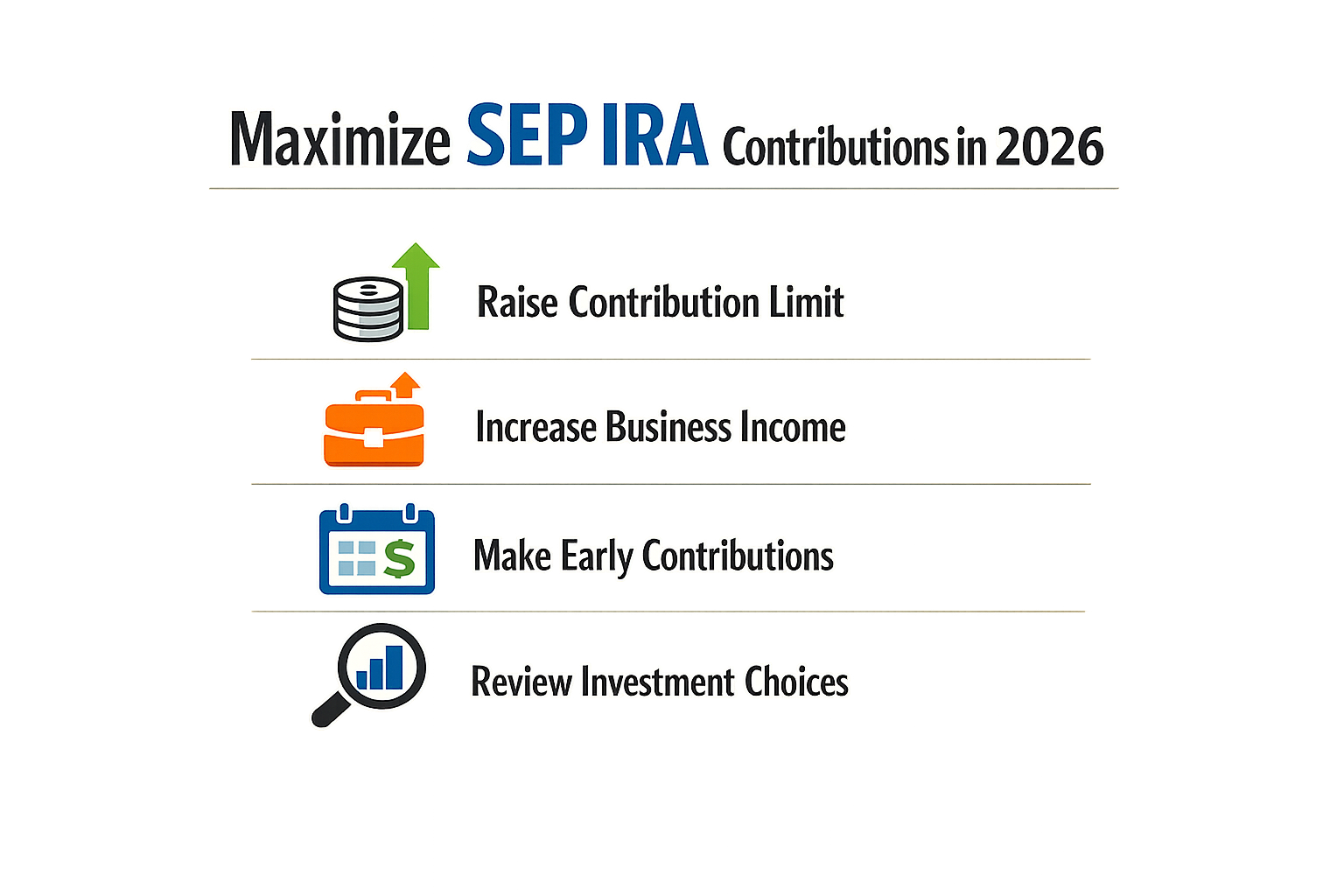
Maximizing your SEP IRA contributions in 2026 comes down to understanding the framework and working within it. The math is straightforward: you can contribute up to 25% of eligible compensation, with a hard cap of $72,000 for the year. Here's how to get in the right range for your situation.
Calculate Your Eligible Compensation First
Start by identifying what counts as eligible compensation. For employees, that's W-2 wages before SEP contributions. For self-employed individuals, the calculation is more involved — you're working with net self-employment income after deducting half of your self-employment tax.
Step 1
Determine your compensation base
For employees: use gross wages from Box 1 of your W-2. For self-employed individuals: take your net profit from Schedule C or Schedule K-1, subtract half of your self-employment tax, then subtract your SEP contribution itself. This creates a circular calculation that typically results in an effective rate closer to 20% of gross income rather than 25%.
The annual compensation limit caps at $360,000 for 2026. If you earn more than that, the excess doesn't count toward your contribution calculation. In practical terms, even someone earning $500,000 hits the $72,000 maximum contribution at the $360,000 threshold.
Set Up Consistent Contribution Timing
SEP IRA contributions don't have to happen monthly like payroll deductions. You have until your tax filing deadline — including extensions — to make contributions for the prior year. That flexibility is useful, but waiting until the last minute means you miss months of potential tax-deferred growth.
Step 2
Choose your contribution schedule
Decide whether you'll contribute quarterly, annually, or on another schedule that matches your cash flow. Self-employed individuals often find quarterly contributions align with estimated tax payments. The goal is consistency, not perfection — contributing $18,000 four times a year gets you to the same $72,000 as a single year-end deposit, but the earlier money has more time to compound.
If you're an employer contributing for employees, all eligible employees must receive the same percentage of compensation. You can't contribute 25% for yourself and 10% for your staff. The percentage must be uniform, though the dollar amounts will vary based on individual compensation levels.
Monitor the Contribution Calculation for Self-Employed Individuals
The self-employed contribution calculation trips up most people because it's not a simple percentage of your 1099 income. The formula accounts for both the employer and employee portions of the contribution, plus the self-employment tax deduction.
For a self-employed person targeting the $72,000 maximum in 2026, you'd need net self-employment income of roughly $387,000 after the self-employment tax deduction. The exact figure depends on your specific tax situation, but that's the ballpark.
Coordinate with Other Retirement Accounts
SEP IRA contributions don't reduce your ability to contribute to a traditional or Roth IRA — those have separate limits. You can contribute the full $72,000 to a SEP IRA and still put $7,000 (or $8,000 if you're 50 or older) into a personal IRA in the same year.
If you also maintain a solo 401(k) or other qualified plan, the rules get more complex. The $72,000 limit applies across all defined contribution plans combined, not per account type. What Is a SEP IRA? A Guide for Self-Employed Workers covers the distinctions between account types in more detail.
For business owners navigating complex tax strategies, the QBI Deduction Explained: How Business Owners Save on Taxes guide shows how retirement contributions interact with other tax-saving opportunities.
The framework for maximizing contributions is consistent: know your compensation base, apply the percentage limit, stay under the dollar cap, and contribute as early in the year as cash flow allows.
What Are the Best Strategies for SEP IRA Contributions?
Most people approach SEP IRA contributions with good intentions and no framework. They know the account exists, they understand the tax benefit, but they treat it like a New Year's resolution — something to handle when they get around to it. The result is predictable: missed deadlines, confused calculations, and contributions that don't match the business reality.
Here's what actually works when managing SEP IRA contributions.
Build Flexibility Into Your Planning
The most valuable feature of a SEP IRA is the one most people overlook: you're not required to contribute every year. If your business has a lean year, you can skip contributions entirely without penalty. If revenue spikes, you can maximize the contribution limit. This flexibility matters more than most retirement accounts offer.
The framework is straightforward. Calculate your maximum contribution based on net self-employment income, then decide what percentage makes sense for your current cash flow. You can contribute 25% of compensation one year and 10% the next — or nothing at all. The IRS doesn't penalize inconsistency; they only care that you follow the rules when you do contribute.
Understand What Counts as a Valid Contribution
Contributions must be made in money — cash, check, or money order. You can't transfer property, stock certificates, or equipment into a SEP IRA. This sounds obvious until you're looking at a business asset you'd like to move into a retirement account. The answer is always the same: sell it first, then contribute the proceeds if you're within the contribution limits.
For self-employed individuals, special rules apply when calculating your maximum deductible contribution. The calculation accounts for the self-employment tax deduction, which reduces your net earnings before you apply the contribution percentage. Most people get this wrong the first time they run the numbers. Talk to a licensed financial professional or use IRS worksheets to verify your math — the difference between the gross calculation and the actual allowable amount can be several thousand dollars.
Avoid Common Timing Mistakes
The deadline flexibility cuts both ways. You can wait until your tax return deadline to make contributions, but if you're also covering employees, you need to fund their accounts before you file. Missing that timing creates a compliance issue — you can't selectively delay employee contributions while funding your own account early.
For businesses with multiple employees, the written allocation formula matters more than most people realize. Once you set a contribution percentage for yourself, you must apply the same percentage to all eligible employees. You can't adjust individual contributions based on performance, tenure, or your personal preferences. The formula applies uniformly, or you're out of compliance.
If you're managing a small team, the What Is a SIMPLE IRA? A Guide for Small Teams article compares alternative retirement plans that may offer more flexibility for businesses with employees.
The cheapest mistake is the one you catch before filing — verify your contribution calculations against IRS worksheets before you write the check.
Track Your Documentation
When you establish a SEP IRA, you create a written agreement using IRS Form 5305-SEP or a prototype document from your financial institution. Keep a copy. If you're audited three years later, the IRS expects you to produce the original plan document showing when the SEP was established and what allocation formula you're following.
The same principle applies to contribution records. If you contribute $15,000 one year and $8,000 the next, document why. The IRS doesn't require justification for variable contributions, but having a clear record of your business income and the calculation method protects you if questions arise.
Plan Around Tax Filing Extensions
If you file for an extension, your SEP IRA contribution deadline extends with it. This gives you until October 15 to make contributions for the prior tax year — a full ten months after the year ends. Most people don't realize they can use this window to see how the full year's income shakes out before committing to a contribution level.
The practical benefit: you can wait until your tax preparer runs the final numbers, see exactly what your net self-employment income looks like, and then decide whether to maximize the contribution or scale it back based on cash flow needs.
For more context on how SEP IRAs fit into the broader retirement planning landscape, see What Is a SEP IRA? A Guide for Self-Employed Workers.
Conclusion
Understanding SEP IRA contribution limits 2026 gives self-employed individuals and small business owners a framework for building retirement savings that scales with income. The $72,000 maximum contribution limit — or 25% of compensation, whichever is lower — creates meaningful tax-advantaged savings opportunities for those with variable or high earnings.
The math is straightforward: calculate your net self-employment income, apply the 25% cap, and stay within the $72,000 ceiling. The annual compensation limit of $360,000 sets the upper boundary for contribution calculations. Most people don't realize that SEP IRAs require no annual filing and no catch-up contributions — the structure trades simplicity for flexibility.
For those ready to take the next step, What Is a SEP IRA? A Guide for Self-Employed Workers covers the foundational mechanics of how these accounts work. The real question is whether your income pattern and business structure make a SEP IRA the right fit compared to a solo 401(k) or SIMPLE IRA — each serves different needs.
The 2026 limits reflect cost-of-living adjustments that keep pace with inflation. Planning your contributions early in the year, tracking quarterly income, and coordinating with your tax preparer ensures you capture the full benefit without scrambling at the April deadline. Talk to a licensed financial professional about your specific situation — the framework is simple, but applying it correctly to your business requires understanding your complete financial picture.
As you build your retirement strategy, consider how it fits into your broader business planning. Business Succession Planning: Protecting Your Company's Future explores how retirement accounts integrate with long-term business continuity.
FAQ
What are the SEP IRA contribution limits 2026?The SEP IRA contribution limits 2026 are $72,000 or 25% of compensation, whichever is lower. For self-employed individuals, the effective rate is closer to 20% due to the circular calculation that accounts for the contribution itself and self-employment tax deductions.
How do I calculate my maximum SEP IRA contribution for 2026?For employees, multiply W-2 wages by 25% (up to the $72,000 cap). For self-employed individuals, take net self-employment income, subtract half your self-employment tax, then apply the IRS circular formula that typically yields an effective rate of 18.6-20% of gross income.
Can I contribute to both a SEP IRA and a traditional IRA in 2026?Yes. SEP IRA contributions don't reduce your ability to contribute to a traditional or Roth IRA. You can contribute the full $72,000 to a SEP IRA and still put $7,000 (or $8,000 if age 50+) into a personal IRA in the same year.
When is the deadline for SEP IRA contributions for 2026?You have until your tax filing deadline, including extensions, to make SEP IRA contributions for the prior year. With an extension, this gives you until October 15, 2027, to make 2026 contributions.