
Introduction
How to Invest in Dividend Stocks is a question most people ask when seeking passive income without trading every hour for a paycheck. Companies that share a portion of their profits with shareholders on a regular schedule offer a practical answer.
Here's what that actually means. When you own shares in a dividend-paying company, you receive cash payments — typically quarterly — based on the number of shares you hold. A company paying $2 per share annually sends you $200 if you own 100 shares, regardless of whether the stock price goes up or down that year. These payments can supplement retirement income, fund ongoing expenses, or be reinvested to accelerate portfolio growth.
The framework for dividend investing rests on three pillars: identifying companies with sustainable dividend payments, building a diversified portfolio across sectors and geographies, and managing the tax implications of dividend income. Many investors start with tax-advantaged accounts like IRAs or 401(k)s to defer taxes on dividend income while the portfolio compounds. For self-employed workers or small business owners, vehicles like a SEP IRA can accommodate larger annual contributions while sheltering dividend income from current taxation.
The Difference Between Dividend Stocks and Growth Stocks
Not all stocks pay dividends. Growth companies — particularly in technology or early-stage sectors — typically reinvest all profits back into expansion rather than distributing cash to shareholders. Dividend stocks tend to be mature, profitable companies with stable cash flows: utilities, consumer staples, financial institutions, and established industrial firms.
The trade-off is straightforward. Growth stocks offer potential for significant price appreciation but no immediate income. Dividend stocks provide regular cash flow but may experience slower price growth. Most balanced portfolios include both, with the allocation depending on your income needs, time horizon, and risk tolerance. A retiree seeking current income might hold 60–70% dividend stocks, while someone decades from retirement might hold 20–30% for diversification and reinvestment.
What This Guide Covers
This guide walks through the practical steps of dividend investing: opening the right type of account, evaluating dividend metrics like yield and payout ratio, selecting individual stocks or dividend-focused funds, and implementing a reinvestment strategy. The goal is getting in the right range for your specific situation, not chasing the highest yield or timing the perfect entry point.
For informational and educational purposes, the examples use round numbers and typical scenarios. When you're ready to take the next step, talk to a licensed financial professional about your specific tax situation, risk tolerance, and income goals. The framework here provides a starting point; your actual allocation depends on circumstances the article can't address.
Understanding the Challenge of Passive Income
Most people approach passive income the same way they approach New Year's resolutions — with good intentions and no framework. The result is predictable: they chase yields they don't understand, buy stocks based on headlines, and wonder why their portfolio feels more like a gamble than a strategy.
The real question is why building a dividend income stream feels so complicated when the concept sounds straightforward. You buy stocks that pay dividends, collect the cash, and repeat. In practical terms, though, beginners run into three obstacles that have nothing to do with market timing or picking winners.
The Information Overload Problem
Here's what that actually means: dividend investing requires you to evaluate metrics most people have never heard of — dividend yield, payout ratio, ex-dividend dates, qualified vs. non-qualified dividends. Financial media throws these terms around like everyone already knows them. They don't explain that a 12% yield might signal a company in trouble, or that reinvesting dividends in a taxable account creates a tax bill even when you never touch the cash.
The framework isn't as complicated as it sounds, but the learning curve is real. You're not just picking stocks — you're learning a new vocabulary, understanding tax implications, and building a mental model for how dividends fit into your broader financial picture.
The Discipline Gap
Most people don't realize that successful dividend investing requires saying no more often than saying yes. The stocks with the flashiest yields are often the ones with the shakiest fundamentals. A company paying out more than it earns isn't generous — it's unsustainable.
The difference between a dividend portfolio that compounds wealth and one that erodes capital comes down to discipline. That means resisting the temptation to chase high yields, sticking to a buying schedule when markets feel uncertain, and reinvesting dividends even when the amounts feel too small to matter. For informational and educational purposes, it's worth understanding that the math works like this: a 3% yield that grows 7% annually will outperform a 6% yield that never grows over any meaningful time horizon.
The Account Structure Question
A common misconception is that all investment accounts work the same way for dividend stocks. They don't. Dividends in a taxable brokerage account trigger tax bills every year. Dividends in a traditional IRA grow tax-deferred but get taxed as ordinary income when you withdraw them in retirement. Dividends in a Roth IRA grow tax-free if you follow the rules.
Your specific situation determines which account type makes sense. If you're self-employed and looking for tax-advantaged retirement savings, a SEP IRA might be a starting point for holding dividend stocks while deferring taxes on the income they generate. Small business owners with employees might also explore a SIMPLE IRA for retirement contributions. The goal is getting in the right range for your tax bracket and timeline, not finding a one-size-fits-all answer.
The cheapest mistake in dividend investing is chasing yield without checking whether the company can afford to keep paying it.
These challenges aren't dealbreakers. They're just the honest answer to why dividend investing takes more than opening a brokerage account and clicking "buy." The framework exists — most beginners just don't know where to find it.
How Do You Start Investing in Dividend Stocks?
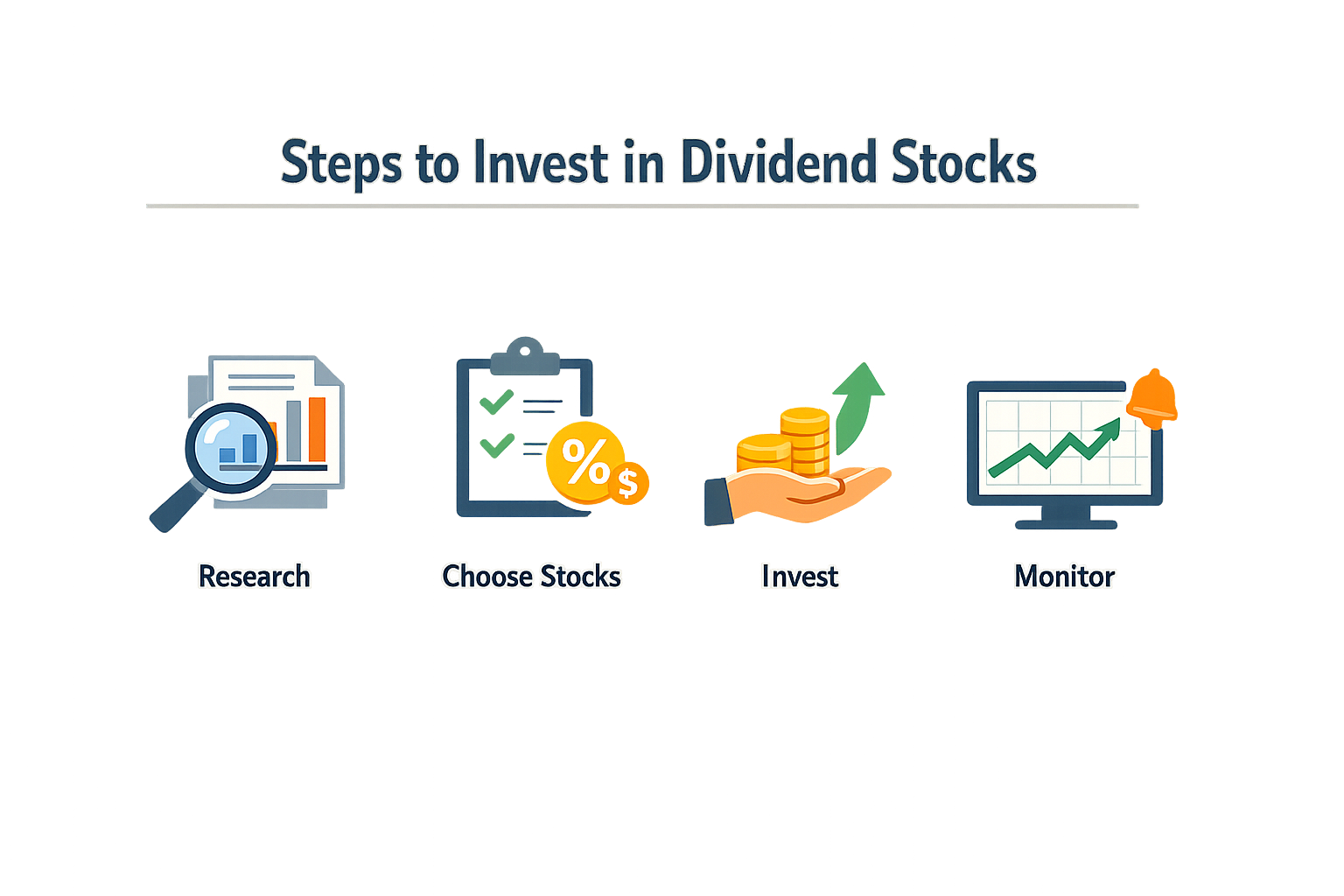
The framework for dividend investing is straightforward. The goal is getting in the right range — not perfection on day one, but a solid foundation you can build on.
Step 1: Open a Tax-Advantaged Account
Step 1
Choose the right account structure
Most dividend investors start with a traditional or Roth IRA, or contribute to an employer-sponsored 401(k) if available. Tax-advantaged accounts let dividends compound without triggering annual tax bills. If you're self-employed, a SEP IRA or SIMPLE IRA might be worth exploring — both allow higher contribution limits than standard IRAs and offer the same tax-deferred growth on dividend income.
The math works like this: dividends reinvested in a taxable brokerage account get taxed each year, even if you never touch the cash. In a tax-advantaged account, those dividends buy more shares immediately, and the tax bill waits until withdrawal (or never arrives at all, in the case of a Roth).
Step 2: Understand Ownership Structures
When you buy dividend stocks, who actually owns them matters for tax and legal purposes. The person who would have to include dividends in gross income is considered the shareholder. If stock is owned by tenants in common or joint tenants, each tenant is generally considered a shareholder of the corporation.
In practical terms: if you and a spouse hold dividend stocks jointly, you're both shareholders. Each of you reports your share of the dividend income. This isn't complicated, but it's worth understanding before you start building a portfolio with another person.
Step 3: Select Dividend-Paying Companies
Step 3
Evaluate dividend consistency and coverage
Look for companies with a track record of paying dividends consistently — ideally for at least five to ten years. Check the payout ratio (the percentage of earnings paid out as dividends). A ratio between 40% and 60% suggests the company can sustain its dividend even if earnings dip temporarily. Ratios above 80% are a red flag — the company may be paying out more than it can afford.
The real question is whether the dividend is sustainable. A high yield today means nothing if the company cuts the dividend next quarter. Start with established companies in stable industries — utilities, consumer staples, healthcare. These sectors tend to generate predictable cash flow, which supports reliable dividend payments.
Step 4: Decide Between Individual Stocks and Funds
You can buy individual dividend stocks or invest in dividend-focused mutual funds and exchange-traded funds (ETFs). Individual stocks give you control and transparency — you know exactly what you own. Funds offer instant diversification, which reduces the risk that one company's dividend cut tanks your income stream.
For most beginners, a dividend ETF or mutual fund is the more straightforward path. You get exposure to dozens or hundreds of dividend payers in a single purchase. As you gain experience, you can layer in individual stocks if you want more control.
Step 5: Set Up Automatic Dividend Reinvestment
Most brokers offer a dividend reinvestment plan (DRIP) that automatically uses your dividend payments to buy more shares. This is the simplest way to compound your returns without thinking about it. The dividends buy fractional shares, so nothing sits idle as cash.
When dividends are reinvested, they lose their character as dividends and become part of your account balance. That's not a problem — it just means the tax treatment shifts to capital gains when you eventually sell, rather than dividend income each year (in taxable accounts).
The goal isn't picking the perfect stock on day one — it's building a system that compounds reliably over decades.
Step 6: Monitor and Rebalance Periodically
Dividend investing isn't set-it-and-forget-it forever. Review your holdings once or twice a year. Check whether companies have maintained or increased their dividends. If a company cuts its dividend or shows signs of financial stress, consider reallocating that position.
Rebalancing doesn't mean constant trading. It means making sure your portfolio still matches your risk tolerance and income goals. If one stock grows to represent 20% of your portfolio when you intended 5%, trim it back. If a dividend gets cut, replace that holding with something more stable.
The framework is simple: open the right account, understand who owns what, pick sustainable dividend payers, decide between stocks and funds, reinvest automatically, and review periodically. Depending on your circumstances, the specifics will vary — but these steps give you a starting point that works for most people.
What Are the Best Strategies for Dividend Investing?
The difference between a dividend portfolio that compounds wealth and one that underperforms comes down to a few practical habits. Most people approach dividend investing with good intentions and no framework — they chase high yields without checking sustainability or ignore tax implications until April. Here's what actually matters when building a dividend strategy that works.
Reinvest Dividends to Accelerate Compounding
Reinvesting dividends is one of the most straightforward ways to grow a portfolio over time. When dividends are automatically reinvested to purchase additional shares, those new shares generate their own dividends — creating a compounding effect that builds momentum. Most brokerage platforms offer dividend reinvestment programs (DRIPs) that handle this automatically, often without transaction fees.
The math works like this: a $10,000 investment in a stock yielding 4% annually generates $400 in dividends the first year. If those dividends are reinvested, the second year's dividend is calculated on $10,400, not the original $10,000. Over decades, that compounding difference becomes substantial. For retirement accounts like IRAs or 401(k)s, reinvested dividends grow tax-deferred, amplifying the benefit.
Focus on Dividend Growth, Not Just High Yields
A common misconception is that the highest dividend yield is always the best investment. In practical terms, an unusually high yield often signals risk — the stock price may have dropped due to financial trouble, or the dividend may not be sustainable. The real question is whether the company has a track record of increasing its dividend over time.
Dividend growth investors look for companies that raise their payouts annually, even if the current yield is moderate. A stock yielding 2.5% today that grows its dividend by 8% per year will eventually outpace a stock yielding 6% with no growth. Dividend aristocrats — companies that have increased dividends for 25 consecutive years or more — demonstrate the financial stability and management discipline that support long-term income growth.
Diversify Across Sectors and Geographies
Concentrating dividend investments in a single sector or region introduces unnecessary risk. Economic cycles affect industries differently — energy stocks may thrive when oil prices rise but struggle during downturns, while consumer staples tend to remain stable regardless of economic conditions. A balanced dividend portfolio spreads holdings across multiple sectors to reduce the impact of any single industry's volatility.
Geographic diversification adds another layer of protection. International dividend stocks can provide exposure to different economic cycles and currency movements. Some investors use exchange-traded funds (ETFs) focused on global dividend payers to achieve this diversification without researching individual foreign companies. For those managing retirement accounts like a SEP IRA, diversification becomes even more critical as the portfolio grows.
Understand the Tax Treatment of Dividend Income
Not all dividend income is taxed the same way, and understanding the difference can affect your after-tax returns. Qualified dividends — those paid by U.S. corporations or qualified foreign companies on stocks held for a minimum period — are taxed at long-term capital gains rates, which are generally lower than ordinary income rates. Non-qualified dividends are taxed as ordinary income.
For tax-advantaged accounts like traditional IRAs, Roth IRAs, or 401(k)s, dividend taxation is deferred or eliminated entirely, making them ideal vehicles for dividend investing. In taxable brokerage accounts, investors need to track which dividends are qualified and plan accordingly. Some dividend strategies involve holding dividend-paying stocks in tax-advantaged accounts while keeping growth stocks in taxable accounts to optimize tax efficiency. Business owners might also consider how to invest in dividend stocks alongside QBI deduction planning to maximize tax efficiency.
The cheapest dividend strategy is the one where you understand the tax treatment well enough to avoid surprises at year-end.
Monitor Payout Ratios to Assess Sustainability
A dividend is only valuable if the company can afford to keep paying it. The payout ratio — the percentage of earnings paid out as dividends — is a key indicator of sustainability. A payout ratio below 60% generally suggests the company retains enough earnings to reinvest in growth and weather downturns. Ratios above 80% may indicate the dividend is at risk if earnings decline.
For real estate investment trusts (REITs) and master limited partnerships (MLPs), payout ratios are calculated differently due to unique tax structures, so investors need to adjust their analysis accordingly. The goal is getting in the right range for the specific investment type — not applying a one-size-fits-all rule.
Rebalance Periodically to Maintain Allocation Targets
As some dividend stocks outperform and others lag, portfolio allocation drifts away from the original plan. A stock that started as 5% of the portfolio might grow to 12% if it appreciates significantly, creating concentration risk. Periodic rebalancing — selling portions of overweight positions and adding to underweight ones — keeps the portfolio aligned with your risk tolerance and diversification goals.
Rebalancing doesn't need to happen frequently. Many investors review their portfolios quarterly or annually, making adjustments only when allocations drift beyond predetermined thresholds. In tax-advantaged accounts, rebalancing has no immediate tax consequences, making it simpler to execute.
Keep Costs Low and Avoid Overtrading
Transaction fees, management fees, and tax drag from frequent trading all reduce net returns. Dividend investing works best as a long-term strategy where positions are held for years, allowing compounding to work and minimizing turnover. Choosing low-cost index funds or ETFs for dividend exposure can reduce fees compared to actively managed funds.
For individual stock investors, limiting trades to necessary rebalancing and new purchases keeps costs manageable. The honest answer is that most dividend investors don't need to check their portfolios daily or react to short-term price movements — the framework is built for patience, not activity.
Frequently asked questions
What is the minimum amount needed to start investing in dividend stocks?
You can start investing in dividend stocks with as little as $100 through fractional shares or dividend-focused ETFs. Many brokers now allow fractional share purchases, making it possible to build a diversified dividend portfolio without needing thousands of dollars upfront.
How often are dividends paid?
Most U.S. dividend stocks pay quarterly, though some pay monthly, semi-annually, or annually. The payment frequency is set by the company's board of directors and disclosed in the dividend announcement.
What is a good dividend yield for beginners?
A dividend yield between 2% and 5% is generally considered reasonable for beginners. Yields below 2% may not provide meaningful income, while yields above 6% often signal higher risk or potential dividend cuts. Focus on sustainable yields backed by strong company fundamentals.
Can I lose money investing in dividend stocks?
Yes. Dividend stocks can decline in price, and companies can reduce or eliminate dividends during financial stress. Diversification across sectors and companies helps manage this risk, but dividend investing does not guarantee positive returns.
Should I reinvest dividends or take them as cash?
Reinvesting dividends accelerates portfolio growth through compounding, making it the preferred strategy for long-term wealth building. Taking dividends as cash makes sense if you need the income for current expenses, such as in retirement.
How are dividends taxed?
Qualified dividends are taxed at long-term capital gains rates (0%, 15%, or 20% depending on income). Non-qualified dividends are taxed as ordinary income. Dividends in tax-advantaged accounts like IRAs are not taxed until withdrawal (or not at all in Roth IRAs).
Conclusion
Dividend investing isn't complicated, but it does require a framework. The math is straightforward: identify companies with sustainable payout ratios, reinvest distributions to compound returns, and diversify across sectors to manage risk. Most people overthink the strategy and underthink the execution — they spend weeks researching the perfect stock and never open the brokerage account.
The honest answer is that getting started matters more than getting it perfect. A diversified portfolio of dividend-paying stocks, held in a tax-advantaged retirement account like an IRA or 401(k), gives you time to learn while your money works. The goal is getting in the right range — not timing the market, not chasing the highest yield, just building a position that generates income and grows over decades.
When you're ready to take the next step, talk to a licensed financial professional about how dividend stocks fit into your broader retirement planning strategy. Your specific situation — tax bracket, time horizon, risk tolerance — determines whether you prioritize growth, income, or a blend of both. For informational and educational purposes, this framework is a starting point. The real question is whether you're ready to move from reading about dividends to collecting them.
Most people don't realize that the difference between a comfortable retirement and a stretched one often comes down to decisions made in your 30s and 40s. Dividend stocks are one tool in that toolkit, alongside retirement account types like SEP IRAs for self-employed workers and other tax-advantaged savings vehicles. For business owners planning long-term wealth transfer, business succession planning complements dividend investing as part of a comprehensive financial strategy. The framework works. The execution is up to you.