
Introduction to Building Investment Accounts
Most people approach investment accounts backward. They pick investments first — stocks, bonds, mutual funds — then wonder where to hold them. The real question is the other way around: which account structure matches your goal, and then what goes inside it.
Here's what that actually means. An investment account is the container, not the contents. A 401(k) is an account type. So is a Roth IRA, a 529 plan, or a taxable brokerage account. Each container has different rules about contributions, withdrawals, and taxes. The investments you choose — the actual stocks, bonds, or funds — go inside these containers. The container you pick determines whether your gains are taxed now, later, or never.
The math works like this: two people can own identical investments and end up with drastically different outcomes based solely on which account held those investments. One person's gains might be taxed at ordinary income rates. Another's might grow tax-free for decades. The difference isn't luck or better stock picks — it's account structure. Understanding what types of retirement accounts exist and how they differ is the starting point for building a portfolio that actually matches your goals.
A common misconception: there's one "best" investment account everyone should use. In practical terms, most people need several account types working together. Retirement savings go in tax-advantaged accounts like 401(k)s and IRAs. Education savings go in 529 plans. Money you might need in five years goes somewhere with easier access and no early withdrawal penalties. The goal is getting in the right range for each goal, not finding one perfect account.
This article walks through the framework: what investment accounts actually are, why the account type matters more than most people realize, how to match accounts to specific goals, and the common mistakes that cost people thousands in unnecessary taxes or penalties. For informational and educational purposes — when you're ready to take the next step, a licensed financial professional can help you apply this framework to your specific situation.
Learn how to build investment accounts aligned with your financial goals, including strategies, common mistakes, and best practices.
What Are Investment Accounts?
An investment account is a financial account that holds assets like stocks, bonds, mutual funds, or other securities. Unlike a checking or savings account where your money sits idle, an investment account puts your money to work with the goal of growth over time. The account itself is the container; what you put in it determines how your money grows.
Most investment accounts fall into two broad categories: taxable accounts and tax-advantaged accounts. A taxable brokerage account gives you complete flexibility — you can deposit and withdraw money anytime, and you pay taxes on gains as they happen. Tax-advantaged accounts like 401(k)s, IRAs, and SEP IRAs offer tax benefits in exchange for following specific rules about contributions, withdrawals, and eligible investments.
How Investment Accounts Build Assets
When you open an investment account, you're establishing a legal structure to hold and grow your money. For employer-sponsored plans, this often means setting up a trust or custodial arrangement. For individual accounts like IRAs, a bank or brokerage acts as custodian, holding your assets in a vault or electronic custody system and maintaining permanent records of deposits and withdrawals.
The mechanics matter because they determine what you can invest in and how your assets are protected. A custodial account at a major brokerage gives you access to thousands of individual securities. A 401(k) plan might limit you to a menu of mutual funds chosen by your employer. The structure shapes your options.
Common Investment Account Types
The most common taxable account is a standard brokerage account. You fund it with after-tax dollars, invest in whatever the brokerage offers, and pay capital gains tax when you sell at a profit. There's no contribution limit and no penalty for withdrawals.
Tax-advantaged accounts include:
- 401(k) and 403(b) plans — employer-sponsored accounts funded through payroll deduction, often with employer matching
- Traditional and Roth IRAs — individual accounts with annual contribution limits and tax benefits
- SEP and SIMPLE IRAs — retirement accounts designed for self-employed individuals and small businesses
- 529 plans and Coverdell ESAs — education savings accounts with tax-free growth when used for qualified expenses
Each account type has specific rules about who can contribute, how much, and when you can access the money without penalty. The framework isn't complicated once you understand that the account type determines the tax treatment, and the investments inside the account determine the growth potential.
Why Investment Accounts Matter for Your Financial Goals
Most people treat investment accounts like they treat gym memberships — sign up with good intentions, check the balance occasionally, and hope something good happens. The difference is that an unused gym membership just wastes money. An investment account that doesn't match your goals can derail your entire financial plan.
Investment accounts aren't just containers for stocks and bonds. They're the framework that determines how your money grows, when you can access it, and what you'll pay in taxes along the way. A traditional IRA is a trust or custodial account set up for your exclusive benefit or your beneficiaries' benefit, created by a written document with specific legal requirements. That structure matters because it dictates contribution limits, withdrawal rules, and tax treatment — all of which change how the account serves your actual goals.
The Real Question: What Are You Trying to Accomplish?
The account type you choose should follow directly from what you're trying to do. Retirement accounts like IRAs and 401(k)s offer tax advantages in exchange for restrictions on when you can withdraw funds. Taxable brokerage accounts give you complete flexibility but no upfront tax break. Education savings accounts like 529 plans and Coverdell ESAs provide tax-free growth for qualified education expenses but come with penalties if you use the money for something else.
Here's what that actually means in practical terms: if you're saving for a house down payment in three years, a Roth IRA might work because you can withdraw your contributions penalty-free. But if you're saving for retirement in 30 years, that same Roth IRA serves a completely different purpose — long-term tax-free growth. The account structure doesn't change. Your goal does, and that changes everything about how you use it.
How Investment Accounts Fit Into Broader Financial Planning
Investment accounts don't exist in isolation. They sit alongside emergency funds, insurance coverage, estate planning documents, and debt management strategies. The common investment fund structure, when properly administered under applicable law and plan documents, allows assets to be pooled — but only when that pooling aligns with the legal framework governing the account.
Most people focus on picking investments — which stocks, which funds, what allocation. That's important, but it's secondary. The account structure determines the tax treatment, the contribution limits, and the withdrawal penalties. Those constraints shape what's possible. A 401(k) for small business owners operates under different rules than an individual IRA, which operates under different rules than a taxable brokerage account. Miss that distinction and you'll optimize the wrong variable.
The Framework: Match the Account to the Timeline
The math works like this: longer timelines tolerate more restrictions in exchange for better tax treatment. Shorter timelines require more flexibility, which usually means fewer tax advantages. Retirement accounts lock up your money until age 59½ (with some exceptions) but offer tax-deferred or tax-free growth. Taxable accounts let you withdraw anytime but tax your gains every year.
The account structure determines the tax treatment, the contribution limits, and the withdrawal penalties — those constraints shape what's possible.
For informational and educational purposes, here's the framework most financial professionals use: emergency funds and short-term goals (under three years) go in high-yield savings or money market accounts. Medium-term goals (three to ten years) might use taxable brokerage accounts with conservative allocations. Long-term goals (ten years or more) typically belong in retirement accounts where tax advantages compound over decades.
That's a starting point, not a prescription. Your specific situation — income level, tax bracket, employer benefits, estate planning needs — changes the calculation. A trust account set up by an employer or employee association introduces additional considerations around plan documents and fiduciary responsibilities. Those details matter.
Why This Matters More Than Most People Realize
The honest answer: most people don't realize how much the account structure affects the outcome. Two people with identical investment returns can end up with vastly different net results because one chose a Roth IRA and the other chose a traditional IRA. The difference isn't the investments. It's the tax treatment baked into the account type.
When you're ready to take the next step, talk to a licensed financial professional who can evaluate your specific circumstances. The goal is getting in the right range — matching account types to timelines, understanding the trade-offs, and building a structure that serves your actual goals rather than someone else's template.
How to Build an Investment Portfolio That Matches Your Goals
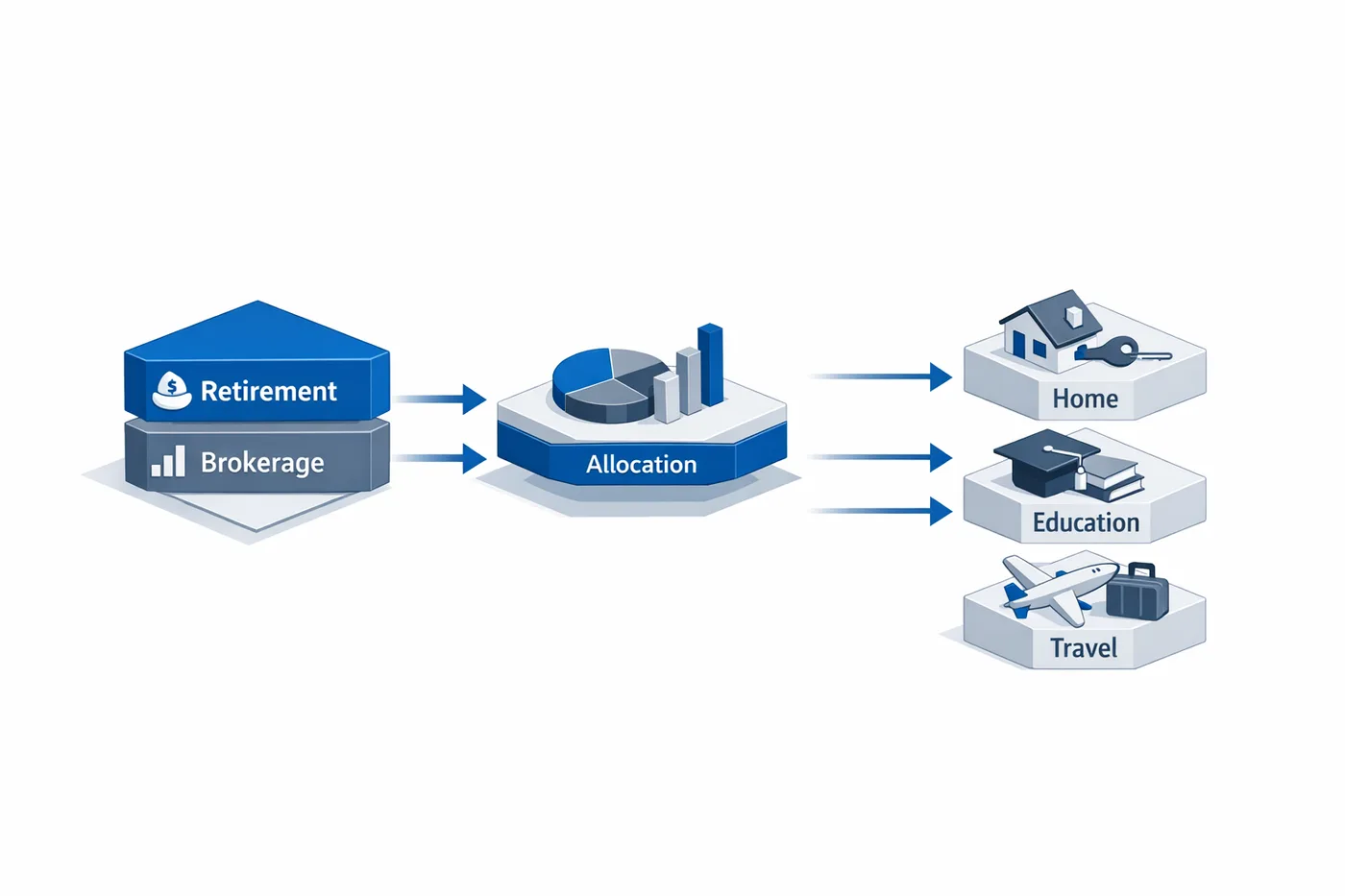
Most people approach building investment accounts the same way they approach assembling furniture — they skip the instructions and hope for the best. The result is predictable: a portfolio that doesn't quite fit together, missing pieces they didn't know they needed, and a nagging sense they should have started with a plan.
Here's what that actually means in practical terms. Building investment accounts that match your goals isn't about picking the hottest stocks or timing the market. The framework is straightforward: define what you're building toward, choose accounts that support those goals, and allocate your assets in a way that balances growth with your comfort level.
Step 1: Define Your Financial Goals and Timeline
The honest answer: you can't build investment accounts that match your goals until you know what those goals are. This isn't as complicated as it sounds.
Start by writing down what you're saving for and when you'll need the money. Retirement in 30 years is a different goal than a house down payment in 5 years. The timeline determines which account types make sense and how you allocate within them.
Most people need at least three buckets: short-term (0-3 years), medium-term (3-10 years), and long-term (10+ years). Short-term goals belong in savings accounts or money market funds, not investment accounts. Medium-term goals can handle moderate risk. Long-term goals can weather market volatility because time smooths out the bumps.
Step 1
List your goals with dollar amounts and dates
Write each goal as a specific target: "$40,000 for house down payment by 2028" or "$1.2 million for retirement by 2055." Vague goals produce vague portfolios.
Step 2: Choose the Right Account Types
The account type matters as much as what you put in it. Tax treatment changes the math significantly.
For retirement goals, start with tax-advantaged accounts. If your employer offers a 401(k) with a match, that's your first stop — the match is immediate return you can't get anywhere else. After you've captured the full match, consider an IRA. A traditional IRA is a trust or custodial account set up for your exclusive benefit, offering tax deductions now and tax-deferred growth. A Roth IRA offers no upfront deduction but tax-free withdrawals in retirement.
For those with access to small business retirement plans, SIMPLE IRA vs 401k options each have distinct contribution limits and administrative requirements worth understanding before you commit.
For non-retirement goals, taxable brokerage accounts offer flexibility. You can access the money anytime without penalties, though you'll pay taxes on gains and dividends each year. For education savings, 529 plans and Coverdell ESAs provide tax advantages if you use the money for qualified expenses.
Step 3: Determine Your Risk Tolerance and Asset Allocation
Risk tolerance is how much volatility you can handle without making bad decisions. It's part math, part psychology.
The math part: longer timelines allow higher stock allocations because you have time to recover from downturns. A common starting point is 110 minus your age as your stock percentage, with the rest in bonds. At 35, that's 75% stocks, 25% bonds. At 55, it's 55% stocks, 45% bonds.
The psychology part: if a 20% market drop would cause you to sell everything and hide under the bed, you need more bonds regardless of what the formula says. The goal is getting in the right range where you'll stick with the plan through market cycles.
Within stocks, diversify across company sizes (large, mid, small) and geography (U.S., international). Within bonds, diversify across durations and credit quality. Most people accomplish this through low-cost index funds rather than picking individual securities.
| Timeline | Typical Stock % | Typical Bond % | Risk Level |
|---|---|---|---|
| 30+ years | 80-90% | 10-20% | Higher |
| 15-30 years | 60-80% | 20-40% | Moderate |
| 5-15 years | 40-60% | 40-60% | Lower |
| 0-5 years | 0-20% | 80-100% | Minimal |
Step 4: Open Accounts and Fund Them Systematically
Once you know which account types you need and how to allocate within them, the mechanics are straightforward. Most major brokerages let you open accounts online in under 30 minutes.
Step 2
Set up automatic contributions
Schedule transfers to happen the day after your paycheck hits. Automation removes the monthly decision of whether to invest, which is when most people talk themselves out of it.
Start with whatever amount fits your budget. The difference between starting with $100 per month versus waiting until you can afford $500 per month is often years of compound growth. You can always increase contributions later.
For employer plans, contribution changes usually take effect within one or two pay periods. For IRAs and taxable accounts, you control the timing directly through your bank link.
Step 5: Rebalance Periodically
Market movements will push your allocation away from your target over time. Stocks outperform bonds, and suddenly your 70/30 portfolio is 80/20. Rebalancing means selling some of what grew and buying more of what lagged to get back to your target.
Most people rebalance once or twice a year. More frequent rebalancing adds trading costs without meaningful benefit. Less frequent rebalancing lets your portfolio drift too far from your intended risk level.
In tax-advantaged accounts, rebalancing doesn't trigger taxes, so you can do it freely. In taxable accounts, consider rebalancing by directing new contributions to underweight assets rather than selling appreciated positions.
Adjusting as Goals and Circumstances Change
Your portfolio isn't static. As you age, as goals get closer, as income changes, your accounts should adjust.
A common misconception: once you set your allocation, you're done. In practical terms, reviewing your overall strategy annually and adjusting when life changes — marriage, kids, job changes, inheritances, major expenses — is essential.
The framework stays the same even as the details change. Goals, timeline, risk tolerance, account types, allocation. When one of those inputs shifts, the output shifts too. That's not a failure of planning; it's the plan working as designed.
Best Practices for Managing Your Investment Accounts

Building investment accounts is the easy part. Managing them over time — through market swings, life changes, and the temptation to tinker — separates the people who reach their goals from the people who wonder where their money went.
The framework is straightforward: keep good records, don't touch what's working, and revisit your accounts when your life changes, not when the market moves. Here's what that actually means in practical terms.
Keep a Permanent Record of Every Transaction
Your brokerage sends statements, but those statements don't tell the whole story. You need a permanent record of every deposit, withdrawal, rollover, and beneficiary change — not for tax season, but for the day you need to prove what happened.
When you set up a trust or custodial account for a qualified plan, federal rules require a permanent record of assets deposited in or withdrawn from the vault. That's not decoration — it's accountability. The same principle applies to your personal investment accounts. If you can't reconstruct the history of an account, you can't defend it during an audit or pass it cleanly to your heirs.
Most people keep statements for a year, then delete them. The better approach: one folder per account, every statement saved, every confirmation letter filed. When you move money between accounts, save both the withdrawal confirmation and the deposit confirmation. When you update a beneficiary, print the confirmation page. The goal is getting in the right range where you can answer any question about an account without calling customer service.
Separate Accounts by Goal, Not by Convenience
A traditional IRA is a trust or custodial account set up in the United States for the exclusive benefit of you or your beneficiaries, created by a written document. That structure exists for a reason — to keep retirement money separate from everything else. Mixing goals in one account is how people end up pulling from their 401(k) to cover a kitchen remodel.
The framework: one account per goal. Retirement money stays in retirement accounts. Education savings stays in 529 plans or Coverdell ESAs. Emergency reserves stay in a taxable account you can access without penalty. When you're tempted to consolidate everything for simplicity, remember that simplicity costs you clarity. You can't track progress toward multiple goals when the money sits in one bucket.
For small business owners, this gets more complicated — you may have a SEP IRA, a solo 401(k), and personal accounts all running at once. The principle stays the same: each account serves one purpose, and you fund it in that order.
Rebalance on a Schedule, Not on a Feeling
Most people rebalance when they panic. The market drops, they sell stocks and buy bonds. The market recovers, they sell bonds and buy stocks. The math works against them every time.
The honest answer: rebalancing works when you do it on a schedule — once a year, same month, no exceptions. You check your target allocation (the mix you set when you built the portfolio), compare it to your current allocation, and move money from the overweight assets to the underweight assets. That's it. No market timing, no predictions, no feelings.
If your target is 60% stocks and 40% bonds, and the year ends with 65% stocks and 35% bonds, you sell 5% of your stock holdings and buy bonds with the proceeds. You're not guessing where the market goes next — you're enforcing the allocation you decided on when you weren't emotional.
The best rebalancing strategy is the one you'll actually follow, which means the one that doesn't require you to predict anything.
Review Beneficiaries After Every Major Life Event
Beneficiary designations override your will. If your IRA names your ex-spouse and your will names your current spouse, the IRA goes to your ex. Most people update their will after a divorce or remarriage. Fewer people update their beneficiary forms.
The framework: review beneficiaries after marriage, divorce, birth, death, or any change in your estate plan. Print the current designation, compare it to what you want, and file an update if anything's wrong. The goal is making sure the right people inherit the right accounts without a probate fight.
For retirement accounts, this matters even more — the wrong beneficiary can trigger unnecessary taxes or force a payout faster than your heirs wanted. When you're ready to take the next step, talk to a licensed financial professional about coordinating your beneficiary designations with your overall estate plan.
Don't Chase Performance or Abandon a Strategy Mid-Cycle
The most common mistake in managing investment accounts is switching strategies after a bad year. You pick a target allocation, the market drops, and you decide the allocation was wrong. So you pick a new one. The market drops again, and you pick another one. Five years later, you've been in four different strategies and none of them had time to work.
In practical terms: if you set an allocation based on your goals and timeline, that allocation doesn't change because the market moved. It changes when your goals or timeline change. A 35-year-old saving for retirement in 30 years doesn't need a different strategy after a 10% market drop — the timeline didn't change, so the allocation doesn't change.
This is where most people need outside help. It's easy to write down a strategy. It's harder to stick with it when your account balance drops 20% in six months. If you know you'll panic and sell, build that into your allocation from the start — more bonds, less volatility, lower long-term returns, but a strategy you can actually follow.
Common Mistakes to Avoid with Investment Accounts
Most people don't lose money because they picked the wrong stock. They lose it because they made one of three structural mistakes with their investment accounts — mistakes that compound quietly over decades until retirement math stops working.
The difference between a functional investment strategy and one that underperforms by 20% over thirty years often comes down to how the accounts are structured, not what's inside them. Here's what that actually means in practical terms.
Holding the Wrong Assets in the Wrong Accounts
Tax-advantaged accounts like IRAs and 401(k)s shelter growth from annual taxation. Taxable brokerage accounts don't. The framework is straightforward: assets that generate ordinary income or frequent taxable events belong in tax-advantaged accounts; assets that produce qualified dividends or long-term capital gains can live in taxable accounts without creating annual tax friction.
Most people do the opposite. They hold tax-efficient index funds in their IRA and actively traded positions in their brokerage account, turning every trade into a taxable event. The math works like this: a bond fund generating 4% annual interest creates a tax bill every year in a taxable account; the same fund in a traditional IRA defers that tax until withdrawal. An equity index fund held for decades in a taxable account generates minimal tax until you sell; the same fund in an IRA converts future long-term capital gains (taxed at preferential rates) into ordinary income (taxed at your marginal rate).
The IRS prohibits holding life insurance contracts inside IRAs and other qualified accounts, which removes one potential source of confusion — but the broader principle remains. Match the tax treatment of the investment to the tax treatment of the account.
Ignoring Beneficiary Designations and Account Titling
Beneficiary designations on retirement accounts override your will. Most people set them once when they open the account and never revisit them. The result: ex-spouses receive IRA balances, minor children inherit accounts without a custodian framework, or estates become the default beneficiary — triggering accelerated distribution timelines and unnecessary probate.
What Is a Living Trust? How It Works and Whether You Need One explores how beneficiary coordination fits into broader estate planning, but the mechanics at the account level are simpler. IRAs allow separate accounts or shares for each beneficiary, and these can be established before or after the owner's required beginning date. When separate accounts are created by the end of the year following the IRA owner's death, each beneficiary calculates required minimum distributions based on their own life expectancy rather than the oldest beneficiary's.
The separate account rules don't apply to beneficiaries of a trust unless the trust qualifies as an applicable multi-beneficiary trust. This creates a structural trap: clients who name a standard revocable trust as IRA beneficiary — intending to control distributions to children or grandchildren — often inadvertently force the entire IRA balance onto a compressed distribution schedule. The honest answer: beneficiary designation strategy requires coordination with trust structure, and most people don't realize the two are connected until it's too late to fix.
Chasing Performance Instead of Rebalancing
The most common misconception about portfolio management is that it requires frequent trading. The real question is whether your current allocation still matches your time horizon and risk tolerance. Most people answer that question by looking at last year's returns instead of next decade's goals.
Rebalancing means selling a portion of what went up and buying more of what went down, which feels wrong in the moment and correct over time. When equities outperform bonds for three consecutive years, your 60/40 portfolio drifts to 70/30 without a single intentional trade. You're now taking more risk than you planned, and you're positioned to suffer larger losses in the next downturn than your original framework contemplated.
The alternative — chasing last year's winner — compounds the problem. Investors pile into the best-performing asset class after it's already run up, then panic and sell after it corrects. The framework for avoiding this is mechanical: set a rebalancing threshold (most people use 5% drift from target allocation) and restore the original weights when any position crosses it. Depending on your circumstances, annual rebalancing may be sufficient; in volatile markets, semiannual reviews prevent larger drift.
The goal isn't picking winners — it's staying in the right range while the market does what it does.
Frequently Asked Questions About Investment Accounts
Most questions about investment accounts come down to the same concern: "Am I doing this right?" Here's what that actually means in practical terms.
What's the difference between a traditional IRA and a Roth IRA?
The short answer: when you pay taxes. Traditional IRAs give you a tax deduction now and tax your withdrawals later. Roth IRAs tax your contributions now and let you withdraw tax-free in retirement.
The math works like this: if you expect to be in a higher tax bracket in retirement, Roth contributions make sense. If you expect lower income later, traditional contributions typically win. Most people don't realize both account types follow the same contribution limits — the IRS treats them as a combined bucket.
Can I have multiple investment accounts?
Yes, and most people do. You might have a 401(k) through work, an IRA for additional retirement savings, and a taxable brokerage account for shorter-term goals. Each account type serves a different purpose.
The framework: tax-advantaged accounts (401(k), IRA, Roth IRA) prioritize retirement timelines and come with withdrawal restrictions. Taxable accounts offer complete flexibility but no tax shelter. A 401(k) for small business owners follows similar principles with additional contribution room.
What happens if my employer engages in a prohibited transaction with my IRA?
Your account retains its IRA treatment. A common misconception: people assume employer mistakes automatically disqualify the account's tax advantages. In practical terms, if your employer or the employee association managing your traditional IRA violates IRS prohibited transaction rules, your individual account status remains protected.
What are designated Roth accounts in employer plans?
These are separate accounts within 401(k), 403(b), or 457(b) plans that accept what the IRS calls "Roth contributions." The difference between these and regular plan contributions: you pay taxes on Roth contributions when you make them, but qualified distributions come out tax-free.
The real question is whether your plan offers this option. Not all employer plans include a Roth feature, even though the tax code allows it.
How do I know which account type to prioritize?
Start with accounts that come with free money — employer 401(k) matches always win. After that, the framework depends on your tax situation and timeline. High earners often max out traditional 401(k) contributions for the immediate deduction. People expecting higher future income lean toward Roth accounts.
Worth understanding: you don't have to choose just one. Most retirement savers use multiple account types to create tax diversification.
Can I move money between different investment accounts?
Depending on your circumstances, yes. IRAs allow direct transfers and rollovers between similar account types without triggering taxes. Moving from a 401(k) to an IRA typically qualifies as a rollover when you leave an employer. Moving from traditional to Roth accounts (conversions) is allowed but creates a taxable event.
The honest answer: each transfer type follows different rules. Talk to a licensed financial professional before moving retirement money — the penalties for mistakes are steep.
What's the penalty for withdrawing from retirement accounts early?
For most retirement accounts, withdrawals before age 59½ trigger a 10% penalty on top of regular income taxes. Some exceptions exist — first-time home purchases, certain education expenses, disability — but they're narrow.
Straightforward rule: retirement accounts are designed for retirement. Early access costs you twice: the penalty and the lost compound growth.
How often should I review my investment accounts?
Once or twice a year for most people. More frequent checking typically leads to emotional decisions based on short-term market moves. Less frequent review means you might miss rebalancing opportunities or forget to adjust contributions.
The goal is getting in the right range: enough attention to maintain your strategy, not so much that you're reacting to daily market noise.
Conclusion: Taking the Next Step with Your Investment Accounts
Building investment accounts that match your goals isn't about picking the perfect moment or finding a secret strategy. It's about understanding the framework — what accounts exist, how they work, and which ones align with what you're trying to accomplish. Most people overthink the entry point and underthink the structure. The math works like this: consistent contributions to the right account types, aligned with your timeline and tax situation, compound into meaningful outcomes over time.
The honest answer is that most households need a mix of account types. Tax-deferred accounts like 401(k)s and traditional IRAs handle retirement savings where you want the deduction now. Roth accounts handle goals where you want tax-free growth later. Taxable brokerage accounts handle everything else — the medium-term goals, the flexibility, the liquidity you might need before age 59½. Education savings belong in 529 plans or Coverdell ESAs if you're funding college. Business owners layer in SEP IRAs or SIMPLE IRAs depending on their structure. The goal is getting in the right range for your circumstances, not perfection.
A common misconception: you need to know exactly what you're doing before you start. You don't. You need to know enough to open the right account, fund it regularly, and avoid the mistakes that actually hurt — chasing performance, panic selling, ignoring fees, or letting accounts sit unfunded because you're waiting for clarity that never arrives. The framework is straightforward. Pick accounts that match your timeline and tax situation. Fund them consistently. Diversify across asset classes in a way that reflects your risk tolerance. Rebalance when allocations drift. That's the work.
When you're ready to take the next step, the most practical move is this: if you have access to an employer 401(k) with a match, fund it to the match level first. If you don't have employer access, open an IRA — Roth if you expect higher future tax rates, traditional if you want the deduction now. If you've maxed those and still have capacity, open a taxable brokerage account for flexibility. For education goals, a 529 plan or Coverdell ESA handles the tax advantages. For business owners, a SEP IRA or SIMPLE IRA may fit better than individual accounts. The sequence matters more than the speed.
Your specific situation will determine which accounts make sense and in what order. The framework above is a starting point, not a prescription. If you're navigating complex situations — multiple income sources, business ownership, estate planning considerations, or significant assets across account types — talk to a licensed financial professional who can map your full picture. For informational and educational purposes, the principles here give you the vocabulary and the structure. The execution depends on your circumstances, your timeline, and your capacity to fund the accounts consistently.
The real question isn't whether you can build investment accounts that match your goals. You can. The question is whether you'll start with the information you have now, or wait for perfect clarity that doesn't exist. Most people who reach their financial goals didn't have perfect information at the start. They had a framework, a timeline, and the discipline to fund accounts regularly. That's enough.
Related reading
How to Invest Your HSA for Long-Term Growth: A Guide to HSA Investment