
Introduction
Most people who work traditional jobs never think about quarterly tax payments. Their employer withholds taxes from every paycheck, and the system runs on autopilot. But if you're self-employed, run a business, or earn income from sources that don't withhold taxes automatically, the IRS expects you to make estimated tax payments throughout the year — not just when you file your annual return.
The short answer: quarterly tax payments are estimated tax payments made to the IRS on a quarterly basis to cover income that is not subject to withholding. The longer answer involves understanding when these payments are due, how to calculate them accurately, and what happens if you underpay or miss a deadline.
For business owners navigating these obligations alongside other financial planning priorities like business succession planning, getting the quarterly payment framework right is worth the effort. The math is not as complicated as it sounds, and the penalties for getting it wrong are avoidable.
This article walks through the practical steps for managing quarterly tax payments — when they're due, how to calculate what you owe, and strategies for staying ahead of deadlines. The goal is getting in the right range and avoiding surprises when tax season arrives.
Problem Statement
Quarterly tax payments sound straightforward until you're the one responsible for calculating and submitting them. The reality is that most self-employed individuals, freelancers, and small business owners face a cluster of challenges that make this obligation harder than it needs to be.
Calculating the Right Amount
The first hurdle is determining how much to pay. Unlike employees who have taxes withheld automatically from every paycheck, people who pay quarterly taxes must estimate their annual income and tax liability in advance. Income fluctuates — a strong first quarter doesn't guarantee the same revenue in the third. Expenses vary. Deductions shift. The math isn't static, and getting it wrong in either direction creates problems.
Pay too little, and you'll owe interest on the underpayment for the period you were short. The IRS doesn't wait until April 15 to start the clock on what you ought to have paid throughout the year. Pay too much, and you've essentially given the government an interest-free loan while your business could have used that cash for operations or growth.
Tracking Due Dates Across an Irregular Calendar
Quarterly tax payments aren't due on the first day of each quarter, and they don't fall on consistent intervals. The IRS uses a schedule that divides the year into four unequal periods, with due dates that shift depending on weekends and holidays. Missing a deadline — even by a day — triggers penalties and interest that compound the original miscalculation.
For business owners managing multiple priorities, these dates don't align with natural business cycles or cash flow patterns. You might have strong revenue in February but face a March 15 payment deadline when funds are already committed elsewhere.
Managing Cash Flow Against Tax Obligations
The tension between operating expenses and tax payments is real. When you're self-employed or running a small business, every dollar has a job. Payroll, inventory, rent, equipment, marketing — these demands don't pause while you set aside money for the IRS. The challenge isn't just calculating the right amount; it's ensuring that amount is available when the deadline arrives.
Many taxpayers find themselves in a cycle where they underpay one quarter to cover operational costs, then scramble to catch up the next quarter while also meeting the current obligation. This creates a compounding problem that gets harder to resolve as the year progresses.
Understanding What Happens When You Can't Pay in Full
Not every taxpayer can meet the full quarterly obligation on time. Income might have been lower than projected. An unexpected business expense might have consumed the cash you'd set aside. The question then becomes: what are your options?
The IRS offers payment arrangements, including online installment agreements that provide immediate approval notifications once you complete the application process. But understanding these options requires knowing they exist in the first place — and knowing them before you're already in penalty territory.
The real challenge isn't the quarterly tax system itself — it's the gap between what taxpayers are expected to know and what they actually discover only after making a costly mistake.
For business owners who also need to think about long-term planning — whether that's business succession planning or retirement contributions — the quarterly tax burden adds another layer of complexity to an already demanding financial picture. The framework exists, but navigating it without a clear understanding of the mechanics leaves too much room for error.
Solution Steps for Managing Quarterly Tax Payments
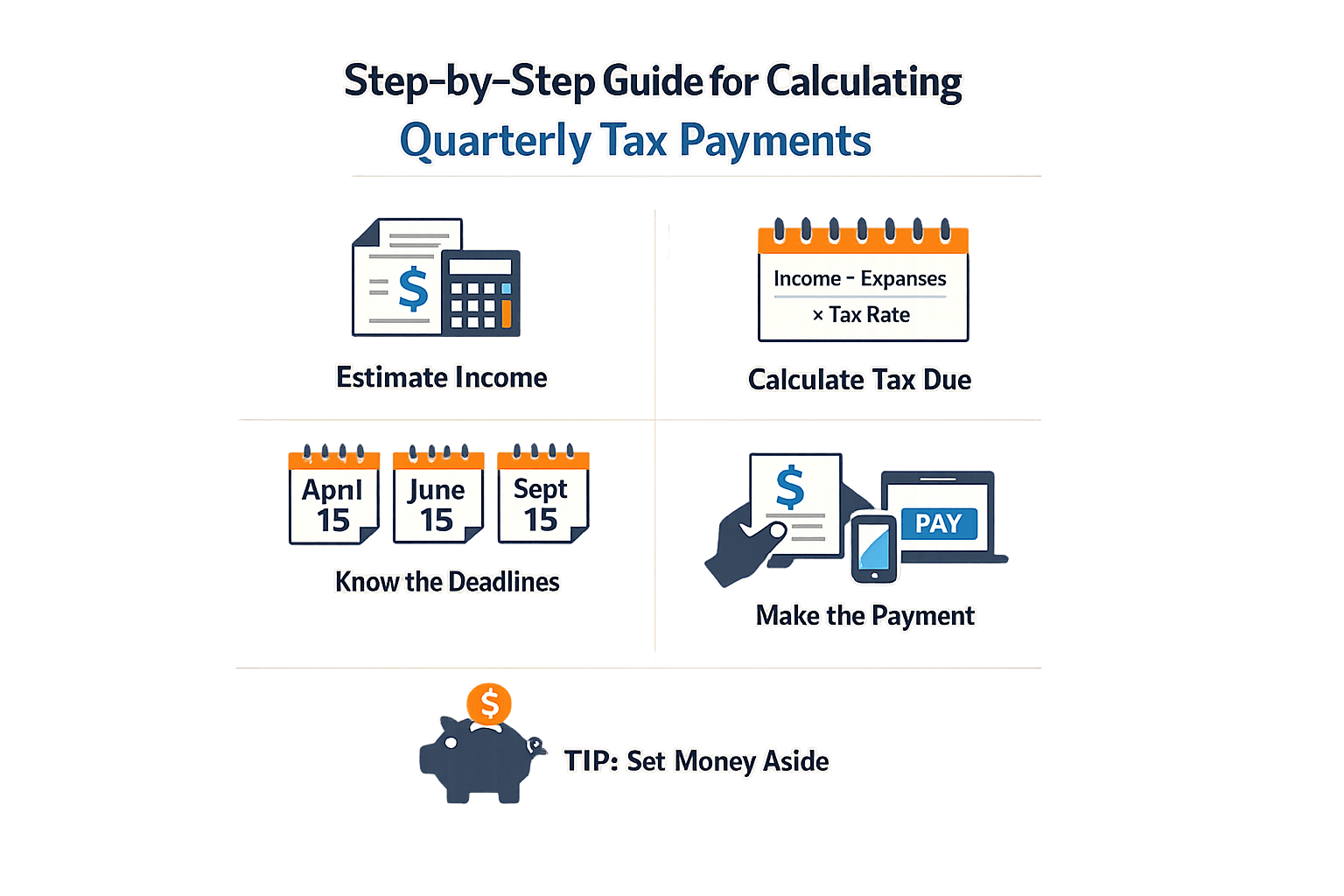
The framework for managing quarterly tax payments breaks down into four straightforward steps: estimating your income, calculating what you owe, tracking the deadlines, and making the payment. Most people overcomplicate this process, but the math is simpler than it looks once you understand the structure.
Step 1: Estimate Your Annual Income
Step 1
Project your full-year earnings
Start by estimating your total income for the year from all sources — freelance work, business profits, investment income, rental properties, or any other income that doesn't have taxes withheld. If you're self-employed, look at last year's numbers as a baseline and adjust for any expected changes. For variable income, it's better to overestimate slightly than to underpay and face penalties.
For many self-employed workers, this means reviewing quarterly profit-and-loss statements or tracking monthly revenue trends. If you're using retirement accounts like a SEP IRA for tax-advantaged savings, factor in those deductions when projecting your taxable income.
Step 2: Calculate Your Tax Liability
Step 2
Determine what you'll owe
Once you have your estimated income, calculate your expected tax liability. This includes federal income tax, self-employment tax (if applicable), and any state or local taxes. The current self-employment tax rate covers both the employer and employee portions of Social Security and Medicare. Apply your marginal tax rate to your projected taxable income after deductions.
The resulting annual payment amount becomes your baseline. Divide that number by four to get your quarterly payment. Worth understanding: you're not locked into this exact amount for all four quarters. If your income changes significantly during the year, you can adjust your payments accordingly.
Step 3: Mark the Quarterly Deadlines
Step 3
Track the payment schedule
Quarterly tax payments follow a specific calendar. The standard due dates are April 15, June 15, September 15, and January 15 of the following year. These dates shift slightly when they fall on weekends or holidays. The payment covers income earned during the preceding period, not a traditional calendar quarter.
Here's the breakdown of what each payment covers:
| Payment Period | Income Earned | Due Date |
|---|---|---|
| First Quarter | January 1 – March 31 | April 15 |
| Second Quarter | April 1 – May 31 | June 15 |
| Third Quarter | June 1 – August 31 | September 15 |
| Fourth Quarter | September 1 – December 31 | January 15 (next year) |
Notice the second and third quarters don't align with traditional three-month periods. This is an IRS quirk, not a mistake in your calculation.
Step 4: Submit Your Payment
Step 4
Choose your payment method
The IRS offers several ways to pay: electronic funds withdrawal, IRS Direct Pay (free online), credit or debit card (with processing fees), or mailing a check with Form 1040-ES. Electronic payments post faster and give you immediate confirmation, which matters if you're paying close to the deadline.
For the mailing option, send your payment to the address listed in the Form 1040-ES instructions for your state. Keep records of every payment — date, amount, and confirmation number if paying electronically. These records become essential if there's ever a question about whether you paid on time.
Adjusting Mid-Year
Your income rarely follows a perfect straight line through the year. If you earn significantly more or less than expected in any quarter, recalculate your remaining payments. The annualized income installment method lets you pay based on actual income earned to date rather than an even quarterly split. This approach requires more detailed record-keeping but can prevent overpayment if your income is seasonal.
For complex situations — multiple income streams, significant deductions, or irregular payment patterns — professional assistance helps ensure the calculations align with IRS requirements. The cost of getting it right the first time is typically less than the cost of fixing errors later.
Tips and Tricks for Quarterly Tax Payments
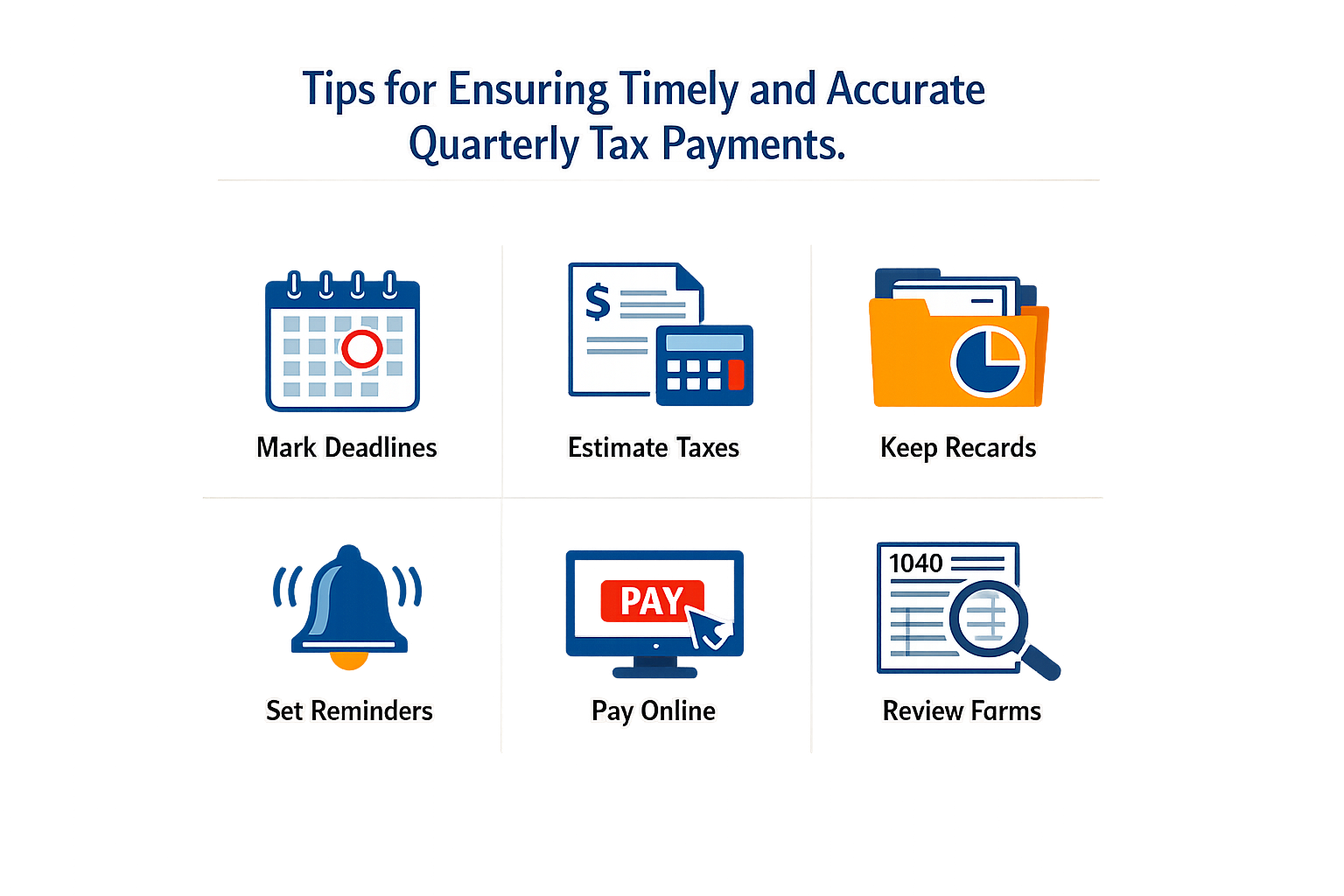
Making quarterly tax payments on time is half the battle. The other half is making sure the amounts are right and the process doesn't create unnecessary stress. Here's what actually works when managing quarterly tax payments throughout the year.
Set Calendar Reminders Two Weeks Before Each Due Date
The IRS doesn't send payment reminders. Mark your calendar for April 15, June 15, September 15, and January 15 — then set a second reminder two weeks earlier. That buffer gives you time to gather income records, run the calculations, and arrange payment without scrambling at the last minute. Most people who miss deadlines don't forget they owe taxes; they forget to check their numbers until it's too late to pull everything together.
Track Income and Expenses Quarterly, Not Annually
Waiting until tax season to organize receipts and income statements makes accurate quarterly estimates nearly impossible. Set up a simple system — a spreadsheet, accounting software, or even a dedicated folder — and update it every month. When the quarterly deadline approaches, your profit picture is already clear. This approach also surfaces deductible expenses you might otherwise forget, which directly lowers your tax obligation.
For self-employed workers contributing to retirement accounts, understanding the interplay between income and contributions matters. A SEP IRA allows deductions that reduce taxable income, which in turn affects quarterly payment calculations.
Pay Timely to Avoid Interest Charges
The math is straightforward: underpayment penalties accrue from the due date until you make the payment. Even if you can't pay the full amount, paying what you can by the deadline reduces the interest period. The IRS calculates underpayment interest quarterly, and the rate adjusts based on the federal short-term rate plus three percentage points.
Failure to pay the full installments on time can lead to additional financial burdens due to interest charges, highlighting the importance of accurate calculation and timely payment of quarterly tax obligations.
If cash flow is tight in a particular quarter, paying 90% on time is better than paying 100% two weeks late. The penalty applies to the unpaid portion for the period it remains unpaid, so partial payments still help.
Use IRS Direct Pay or EFTPS for Confirmation
Paper checks can get lost, and proving you mailed a payment on time is harder than it should be. IRS Direct Pay (for one-time payments) and the Electronic Federal Tax Payment System (EFTPS, for scheduled or recurring payments) both provide immediate confirmation. You get a confirmation number, a record of the transaction, and certainty that the payment posted to your account.
EFTPS also lets you schedule payments in advance. If you know your estimated amount in March, you can schedule all four quarterly payments at once and adjust individual installments later if your income changes.
Adjust Estimates When Income Shifts Mid-Year
Quarterly payments are estimates, not fixed obligations. If your income drops significantly in the third quarter — a client cancels a contract, a project falls through, seasonal work slows down — recalculate your remaining payments. The IRS allows annualized income installments, which means you can base each quarter's payment on actual year-to-date income rather than an even 25% split.
This is particularly useful for businesses with uneven revenue throughout the year. A landscape company that earns 70% of annual income between April and September shouldn't pay equal amounts in all four quarters. Annualizing prevents overpayment in slow quarters and underpayment penalties in busy ones.
What to Do If You Can't Pay the Full Amount
Missing a payment entirely is worse than paying late, and paying late is worse than paying partial. If you can't cover the full quarterly amount, pay what you can by the deadline. The underpayment penalty applies only to the shortfall, and paying something reduces the balance that accrues interest.
If you're facing ongoing payment difficulties, the IRS offers installment agreements that let you meet your tax obligation in monthly payments. According to IRS guidance, you can apply for an online payment agreement to spread the balance over time. Once approved, you receive immediate notification and can manage the agreement online. This option doesn't eliminate penalties or interest, but it does prevent more serious collection actions.
Keep Records of All Payments and Calculations
When you file your annual return, you'll reconcile estimated payments against your actual tax liability. If the IRS questions a payment or if you need to prove you paid on time, your confirmation numbers and payment records are the only evidence that matters. Keep digital copies of all confirmations, worksheets, and income documentation for at least three years.
This documentation also helps if you need to file an amended return or if the IRS later audits your tax year. The burden of proof is on you to show payments were made timely and in the correct amounts.
Conclusion
Quarterly tax payments aren't optional for most self-employed workers, freelancers, and business owners — they're a requirement that, when ignored, comes with interest charges and penalties. The framework is straightforward: estimate your annual income, calculate the tax, divide by four, and pay on time. The execution requires discipline, but the math itself isn't as complicated as it sounds.
The real question is whether you're treating estimated taxes as a quarterly obligation or waiting until April to face the full bill. Most people who struggle with quarterly payments aren't making calculation errors — they're not setting money aside throughout the year. The difference between staying current and falling behind often comes down to a separate savings account and calendar reminders.
For informational and educational purposes, this article covers the fundamentals of quarterly tax payment requirements and timing. Your specific situation — especially if you have multiple income streams, significant deductions, or a variable income pattern — may benefit from working with a licensed tax professional who can help you adjust estimates throughout the year.
When you're ready to take the next step in managing your business finances, understanding how retirement accounts like SEP IRAs can reduce your quarterly tax burden is worth exploring. The goal is getting in the right range with your estimates and staying ahead of the deadlines — both are achievable with a clear framework and consistent execution.