
Introduction
Most small business owners approach tax season the same way they approach root canals — with dread and the hope it'll be over quickly. The difference: tax deductions are the one part of the process that actually works in your favor. When you understand what qualifies and how to claim it, deductions become a straightforward framework for keeping more of what you earn.
The math works like this: every dollar you deduct is a dollar the IRS doesn't tax. For a business owner in the 24% tax bracket, a $10,000 deduction saves $2,400 in federal taxes. Add state taxes, and the savings compound. The real question isn't whether deductions matter — it's whether you're capturing everything you're entitled to claim.
Navigating the landscape of small business tax deductions can be daunting, but understanding the key elements significantly impacts your financial planning. One crucial aspect is the IRS's annual updates on contribution limits, which affect how you strategize deductions and savings. For instance, knowing the specific contribution limits for retirement accounts like 401(k)s is essential for maximizing tax advantages. According to the IRS, the 2026 401(k) contribution limit is set at $23,500 for employees under 50, with a $7,500 catch-up for those 50 and older.
This complete checklist covers the deductions most small businesses qualify for in 2026, organized by category and backed by current IRS guidance. The goal is getting in the right range — knowing what's deductible, what requires documentation, and where the common pitfalls hide. Whether you're a sole proprietor, partnership, or S-corporation, the framework remains consistent: ordinary and necessary business expenses are deductible, provided you can substantiate them.
Problem Statement
Most small business owners know tax deductions exist. The problem is knowing which ones apply to their specific situation and how to claim them correctly. The tax code doesn't announce itself — it sits in IRS publications, and unless you're reading those publications regularly, you're working from secondhand information that may or may not be current.
The financial impact of missing deductions is straightforward: you pay more tax than necessary. A missed retirement plan contribution deduction, for example, means both higher taxable income this year and less saved for retirement. The math compounds against you twice.
The Documentation Gap
The real challenge isn't that deductions are complicated — it's that the framework for claiming them changes based on your business structure. Sole proprietors deduct contributions for themselves on line 16 of Schedule 1 (Form 1040). Partnerships deduct them on Form 1065. Corporations use Form 1120 or 1120-S. Same economic activity, different paperwork, and the IRS expects you to know which form applies to you.
Most business owners discover they've been leaving money on the table only after their first professional tax review. By then, they've already filed returns for years that can't be amended without triggering additional scrutiny.
The Timing Problem
Tax deductions follow specific calendars that don't always align with your business year. If your tax year ends June 30, 2026, you deduct SEP contributions made for calendar year 2025 on that return. The contribution happens in one year, the deduction in another, and if you're not tracking both timelines, you either claim the deduction in the wrong year or forget to claim it at all.
Understanding how to figure your deduction can significantly impact your tax savings, making it important for small business owners to familiarize themselves with the process before filing rather than after. The IRS publishes worksheets for calculating self-employed contribution rates, but those worksheets assume you know they exist and where to find them.
For business owners managing 401(k) plans for small business owners, the complexity increases — contribution limits, employer match deductions, and employee deferrals all have separate rules and separate documentation requirements.
The Cost of Guesswork
When you're unsure whether an expense qualifies as a deduction, you have two options: claim it and risk an audit adjustment, or skip it and overpay your taxes. Neither option is good. The framework for determining deductibility exists, but it's scattered across multiple IRS publications, and most small business owners don't have time to cross-reference them all.
The goal isn't perfection — it's getting in the right range with documentation that supports your position if the IRS asks. That requires knowing what the IRS considers ordinary and necessary for your type of business, which varies more than most people realize.
Solution Steps
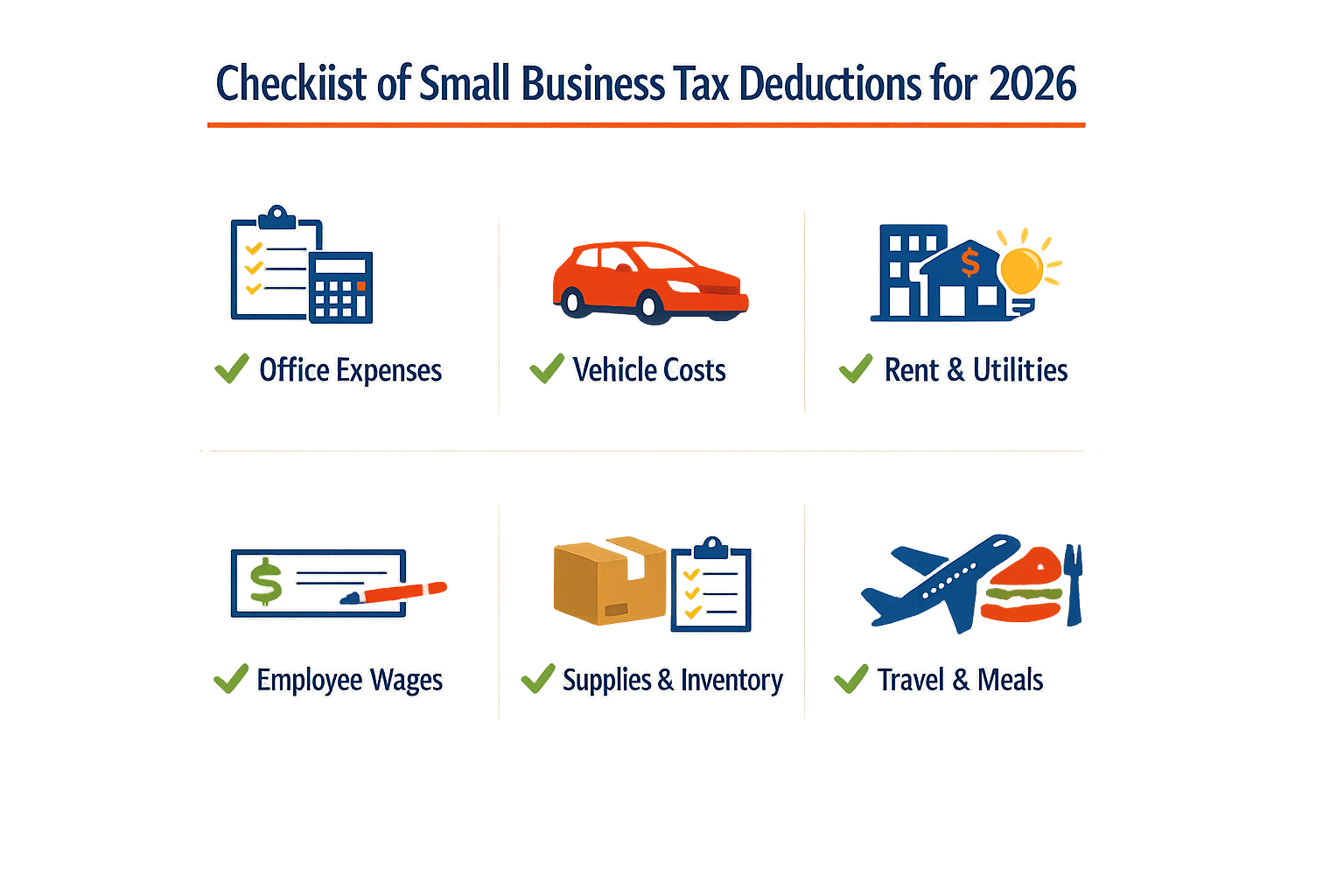
The framework for claiming small business tax deductions breaks down into categories. Here's what you can deduct, where to report it, and what the math looks like.
Retirement Plan Contributions
Retirement plan contributions represent one of the most powerful deduction categories for small business owners. The mechanics depend on your business structure and the type of plan you establish.
Sole proprietors and partnerships deduct employee contributions differently than owner contributions. Employee contributions go on Schedule C (Form 1040) for sole proprietors or Form 1065 for partnerships. Owner contributions — the ones you make for yourself — get deducted on line 16 of Schedule 1 (Form 1040). If you're a partner, your Schedule K-1 (Form 1065) shows your contribution amounts.
Corporations handle this more simply: all retirement plan contributions deduct on Form 1120 or 1120-S, regardless of whether they're for employees or owner-employees.
The contribution limits matter here. For 2026, the overall limit for defined contribution plans is $70,000 (or 100% of compensation, whichever is smaller). That $70,000 cap includes both employer contributions and any elective deferrals you make.
For detailed guidance on setting up retirement plans as a small business owner, see our guide on 401(k) for Small Business Owners: Plans, Setup, Costs, and Limits.
Self-Employment Tax Deduction
The self-employment tax deduction allows you to deduct the employer-equivalent portion of your self-employment tax — roughly half of what you pay. This deduction reduces your adjusted gross income but not your net earnings from self-employment.
Here's how it works: you calculate your self-employment tax on Schedule SE (Form 1040), then deduct half that amount on Schedule 1 (Form 1040), line 15. The deduction happens whether or not you itemize.
The math gets circular when you're also making retirement plan contributions for yourself. Your self-employment tax deduction reduces your net earnings, which affects your retirement contribution limit, which in turn affects your net earnings. The IRS Deduction Worksheet for Self-Employed walks through this calculation step by step.
Step 1
Calculate net profit
Start with your net profit from Schedule C (Form 1040), line 31, or Schedule F (Form 1040), line 34. If you're a partner, use the amount from Schedule K-1 (Form 1065), box 14, code A. Reduce this by any amount reported on Schedule SE (Form 1040), line 1b.
Step 2
Subtract self-employment tax deduction
Calculate your self-employment tax deduction (half of your self-employment tax) and subtract it from your net profit. This gives you your adjusted net earnings.
Step 3
Apply the plan contribution rate
Multiply your adjusted net earnings by your plan's contribution rate (using the reduced rate from the IRS rate table or worksheet). This gives you your maximum deductible contribution.
Step 4
Check the dollar limit
Compare your calculated contribution to the $70,000 limit. Your deduction is the smaller of the two amounts. If you made elective deferrals to a SEP, SIMPLE, or qualified plan, subtract those from the $70,000 before comparing.
The contribution rate you use isn't the plan's stated rate — it's a reduced rate that accounts for the circular dependency. The IRS Rate Table for Self-Employed provides pre-calculated reduced rates for common contribution percentages.
Business Expense Deductions
Ordinary and necessary business expenses deduct on the same form where you report business income. Sole proprietors use Schedule C (Form 1040), farmers use Schedule F (Form 1040), partnerships use Form 1065, and corporations use Form 1120 or 1120-S.
The standard categories include:
- Advertising and marketing — website costs, business cards, online ads, promotional materials
- Vehicle expenses — actual costs or standard mileage rate, parking, tolls (personal commuting doesn't count)
- Office supplies and equipment — computers, software, furniture, stationery
- Professional services — legal fees, accounting fees, consulting costs
- Insurance premiums — general liability, professional liability, business property insurance
- Rent and utilities — office space, warehouse, retail location (or home office deduction if applicable)
- Employee wages and benefits — salaries, health insurance, retirement contributions, payroll taxes
- Education and training — courses, conferences, subscriptions related to your business
- Travel and meals — business travel (50% limit on meals), lodging, transportation
The key requirement: the expense must be both ordinary (common in your industry) and necessary (helpful and appropriate for your business). It doesn't have to be indispensable, just reasonable.
Depreciation and Section 179
When you buy equipment, vehicles, or other tangible property for your business, you generally can't deduct the full cost in the year of purchase. Instead, you depreciate it over its useful life — unless you elect Section 179 expensing or bonus depreciation.
Section 179 lets you deduct the full cost of qualifying property in the year you place it in service, up to a limit. For tax years beginning in 2024 and 2025, the limit is $1,220,000, with a phase-out threshold of $3,050,000. (The IRS hasn't published 2026 limits yet, but they typically adjust for inflation.)
Qualifying property includes:
- Machinery and equipment
- Furniture and fixtures
- Most computer software
- Vehicles (with specific limits for cars and SUVs)
- Certain improvements to nonresidential real property
You can't use Section 179 to create a loss. The deduction is limited to your taxable income from the active conduct of any trade or business. Any excess carries forward to future years.
Bonus depreciation — currently 60% for property placed in service in 2024 — provides an alternative or supplement to Section 179. It has no dollar limit and can create a loss, but it's scheduled to phase down: 40% in 2025, 20% in 2026, and zero in 2027 unless Congress extends it.
| Feature | Section 179 | Bonus Depreciation |
|---|---|---|
| Dollar limit | $1,220,000 (2024-2025) | No limit |
| Can create loss? | No | Yes |
| Phase-out threshold | $3,050,000 (2024-2025) | None |
| Current rate | 100% | 60% (2024), phasing down |
Health Insurance Premiums
If you're self-employed and pay for your own health insurance, you can deduct 100% of the premiums for yourself, your spouse, and your dependents. This deduction goes on Schedule 1 (Form 1040), line 17, reducing your adjusted gross income.
The deduction is limited to your net profit from the business under which the insurance plan is established. If your business had a loss or minimal profit, your deduction is limited accordingly.
This deduction is separate from the premium tax credit for Marketplace insurance. You can't claim both for the same coverage. If you're eligible for employer-sponsored coverage (including through a spouse's employer), you generally can't take this deduction for months when that coverage was available.
Home Office Deduction
The home office deduction applies when you use part of your home exclusively and regularly for business. The space must be either your principal place of business or a place where you meet clients or customers in the normal course of business.
You have two calculation methods:
Simplified method: $5 per square foot of home office space, up to 300 square feet (maximum $1,500 deduction). No depreciation, no records of actual expenses required.
Regular method: Calculate the percentage of your home used for business, then deduct that percentage of mortgage interest (or rent), property taxes, utilities, insurance, repairs, and depreciation. Requires detailed records but often yields a larger deduction.
The exclusive use requirement is strict. If you use the space for both business and personal purposes, it doesn't qualify — even if business is the primary use. The IRS makes an exception for storing inventory or product samples if you have no other fixed location for your business.
Startup Costs and Organizational Expenses
Startup costs — expenses incurred before your business begins operating — get special treatment. You can deduct up to $5,000 of startup costs in your first year, but this amount reduces dollar-for-dollar once total startup costs exceed $50,000. Any costs you can't deduct immediately amortize over 180 months.
Qualifying startup costs include:
- Market research and analysis
- Advertising for the business opening
- Employee training before opening
- Travel and other costs to secure suppliers, distributors, or customers
- Professional fees for services related to starting the business
Organizational costs — expenses to create a corporation or partnership — follow the same rules: $5,000 immediate deduction (phasing out above $50,000 total costs), with the remainder amortized over 180 months.
The framework is straightforward once you know where each deduction belongs. The real question is whether you have the records to support the numbers when you file.
Tips and Tricks
Knowing which deductions exist is one thing. Actually claiming them without triggering an audit or leaving money on the table is another. The difference comes down to record-keeping and understanding how the IRS expects you to organize your financial life.
Keep receipts and digital records in one system
Most small business owners start with a shoebox. By April, they're sorting through crumpled gas station receipts trying to reconstruct a year of mileage. The honest answer: if you can't prove it, you can't deduct it. Set up a system now — whether that's a dedicated business bank account, accounting software, or a mobile app that scans receipts — and use it consistently. The IRS doesn't care how sophisticated your system is; they care that it's complete and contemporaneous.
Separate personal and business expenses from day one
The fastest way to complicate your tax return is to run personal expenses through your business account or vice versa. Open a dedicated business checking account and use it exclusively for business transactions. If you're a sole proprietor working from home, this separation becomes even more important — the IRS looks closely at home office deductions, and clean records make the difference between a smooth filing and a lengthy explanation.
For retirement contributions, the math works like this: if you're self-employed, you deduct contributions for employees on your business return, but contributions for yourself go on a different line of your personal return. Sole proprietors report them on Schedule 1 (Form 1040), line 16. Partnerships show the owner's contributions on Schedule K-1. The forms differ by business structure, but the principle is the same — keep employee contributions separate from owner contributions in your records.
Track mileage and vehicle use in real time
If you use your car for business, the IRS allows you to deduct either actual expenses (gas, maintenance, depreciation) or the standard mileage rate. Most small business owners find the standard rate simpler, but you need a mileage log. That means recording the date, destination, business purpose, and miles driven for every trip. Reconstructing this in April from memory doesn't hold up under scrutiny. Use a mileage-tracking app or keep a notebook in your car and log trips as they happen.
Understand the self-employment tax deduction structure
When you're self-employed, you pay both the employer and employee portions of Social Security and Medicare taxes. The deduction for the employer-equivalent portion reduces your adjusted gross income, but it's not a business expense — it goes on your personal return. This is one of those areas where the numbers depend on each other: your self-employment tax is based on your net earnings, but your net earnings calculation includes the deduction for half of that tax. The IRS provides worksheets to work through this, but the short answer is you'll deduct roughly 7.65% of your net self-employment income as the employer portion.
For retirement plan contributions, the deduction calculation is similar. If you contribute to a SEP-IRA or solo 401(k), the contribution rate in your plan document gets reduced by a factor that accounts for the self-employment tax deduction. The IRS publishes rate tables in Publication 560 to simplify this, but the principle is straightforward: you can't contribute based on gross income because your deductions reduce the income you're contributing from.
Use the business tax account for real-time information
The IRS offers a business tax account portal where sole proprietors, partnerships, S corporations, and C corporations can view their tax information on record. This isn't just for filing — it's a tool for tracking estimated payments, checking balances, and confirming that the IRS has processed your returns. Accessing your tax information online can streamline the process of identifying potential deductions and maximizing savings, especially when you're comparing current-year numbers to prior years or checking whether estimated payments are covering your liability.
For more on how retirement plan structures intersect with small business tax planning, see 401(k) for Small Business Owners: Plans, Setup, Costs, and Limits.
Double-check forms by business structure
Where you report deductions depends on how your business is organized. Sole proprietors use Schedule C or Schedule F. Partnerships file Form 1065. C corporations use Form 1120; S corporations use Form 1120-S. The deductions themselves are often the same, but the forms and line numbers differ. If you're a partner in a partnership, your share of the business's deductions flows through to you on Schedule K-1, and you report them on your personal return. Missing this step means either overpaying or filing an incomplete return.
Review the checklist quarterly, not annually
Waiting until December to think about deductions means you've already missed opportunities. Review your deduction checklist every quarter. Did you buy equipment that qualifies for Section 179? Are you on track with retirement contributions? Have you documented all your business travel? Quarterly reviews let you adjust spending, accelerate purchases into the current year if beneficial, or defer income to smooth out your tax liability. The goal is getting in the right range, not scrambling in the final week of the year.
Conclusion
Understanding and utilizing small business tax deductions isn't about finding loopholes — it's about claiming what you're legally entitled to and keeping more of what you earn. The framework is straightforward: track ordinary and necessary business expenses, maintain clean records, and know which categories apply to your specific situation. Most business owners leave money on the table not because the deductions are complicated, but because they don't have a system for documenting them.
The math works like this: every legitimate deduction reduces your taxable income, which directly lowers what you owe. For self-employed individuals, this also reduces self-employment tax. When you understand how to figure your deduction — particularly for retirement contributions where the calculation can be more involved — you're not just saving on this year's taxes, you're building a foundation for long-term financial stability.
Staying informed about the latest IRS publications and contribution limits helps you make decisions that align with your financial goals. For instance, knowing the specific contribution limits for retirement accounts like 401(k)s is essential for maximizing your tax advantages — the 2026 limit is set at $23,500 for employees under 50, with a $7,500 catch-up for those 50 and older. If you're exploring retirement savings strategies as part of your overall tax planning, 401(k) plans for small business owners offer a structured approach to building long-term wealth while reducing current-year taxable income.
The honest answer: tax strategy is part of financial planning, not separate from it. When you're ready to take the next step, talk to a licensed financial professional who can review your specific situation and help you build a framework that works for your business structure, income level, and long-term goals. The deductions are there — the difference is having a system to capture them and the guidance to use them effectively.
Explore essential small business tax deductions for 2026 with this complete checklist to maximize your savings.
Related reading
Coverdell Education Savings Account: Overview, Qualifications