
Introduction
Most small business owners don't lose sleep over insurance policy details. They lose sleep wondering how to keep their best employees when larger competitors offer comprehensive benefits packages.
Group health insurance is health coverage offered to a group of people, typically provided by employers to their employees. For small businesses, it represents one of the most significant employee benefits decisions — and one of the largest line items in the operating budget. The math works differently than individual health insurance: when you pool risk across multiple employees, insurers can offer more predictable pricing and often better coverage options.
The real question is whether offering group health insurance makes sense for your specific business situation. The answer depends on factors like your team size, your industry's competitive landscape, your state's regulations, and your business's financial position. Understanding the framework — what group health insurance actually is, how it's structured, and what it costs — is the starting point for making that decision. For businesses thinking about long-term stability, health benefits often fit into broader planning strategies, similar to how business succession planning protects a company's future.
Here's what that actually means in practical terms: group health insurance isn't just about compliance or checking a benefits box. It's about building a compensation package that helps you compete for talent while managing costs in a way that doesn't put your business at risk. The framework for evaluating group health insurance starts with understanding what options exist, what they actually cost, and how the numbers work for businesses at different stages of growth.
This article breaks down group health insurance for small businesses — the types of plans available, the cost structures you'll encounter, and the decision framework for choosing coverage that fits your team and your budget. The goal is getting in the right range for your situation, not finding a one-size-fits-all answer that doesn't exist.
Problem Statement
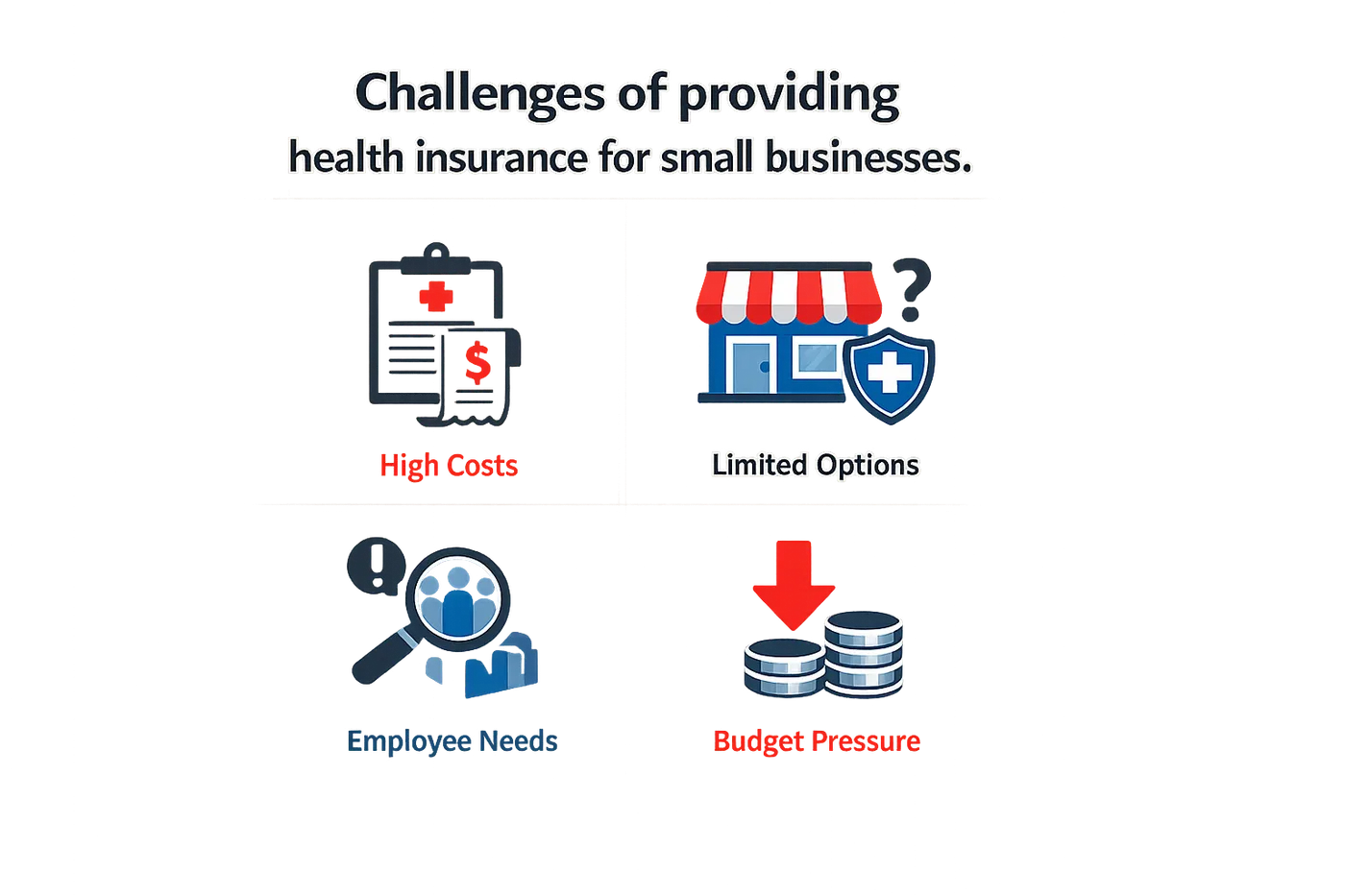
Small business owners face a different set of challenges when it comes to providing group health insurance compared to larger companies. The math doesn't work the same way — smaller pools mean less negotiating power, higher per-employee administrative costs, and fewer options from carriers who prefer to write policies for larger groups. Most owners want to offer competitive benefits to attract and retain good people, but the price tag often feels out of reach.
The Coverage Calculation Problem
The first challenge is understanding what coverage actually costs and who needs to be included. To maintain certain tax advantages and plan structures, employers need to meet minimum coverage requirements. For qualified plans, the IRS generally requires coverage for at least the lesser of 50 employees or the greater of 40% of all employees or two employees. If you have only one employee, that employee must be covered.
This creates a real tension point for businesses hovering around these thresholds. A company with 15 employees can't cover just the owner and one key person without running into compliance issues. The framework requires broader participation, which drives up total cost even when the business would prefer a more selective approach.
Administrative Burden and Complexity
The second major challenge is the administrative load. Larger companies have HR departments and benefits specialists who handle enrollment, compliance, COBRA administration, and annual renewals. Small businesses rarely have that infrastructure. The owner or office manager ends up learning about continuation coverage rules, non-discrimination testing, and reporting requirements while also running the actual business.
This administrative complexity compounds during growth phases. A business that starts with 10 employees and grows to 60 faces changing rules and requirements along the way. Understanding when you cross thresholds that trigger new compliance obligations — and what those obligations actually are — requires either significant time investment or outside help, both of which cost money.
The Cost-Benefit Tension
The third challenge is the fundamental cost-benefit calculation. Premiums for small group plans typically run higher per employee than large group rates because the risk pool is smaller and the insurer's administrative costs don't scale down proportionally. At the same time, small businesses often operate on tighter margins and have less predictable cash flow than established larger companies.
This creates a real dilemma: offer robust coverage and strain the budget, or offer minimal coverage and struggle to compete for talent. Many small business owners find themselves stuck between what they can afford and what they know their employees need. The decision often comes down to whether the business can absorb a significant fixed cost that doesn't directly generate revenue but is essential for building a stable team.
For business owners evaluating their overall compensation and benefits strategy, understanding retirement plan options can provide additional context — see our guide on what is a SIMPLE IRA for another piece of the benefits puzzle.
Solution Steps
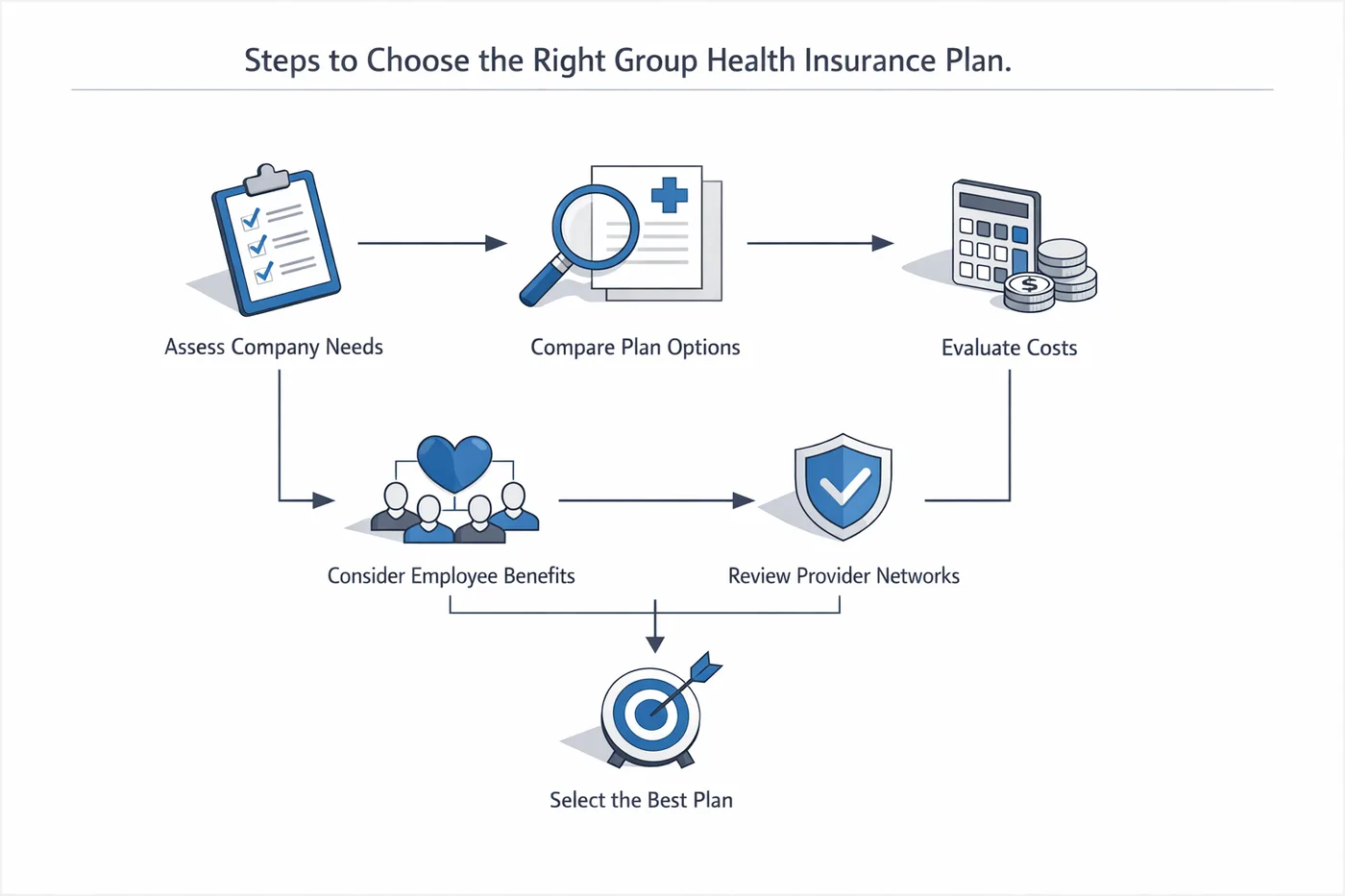
Choosing the right group health insurance for small business starts with understanding what you're trying to accomplish. Most small business owners approach this decision backward — they look at premiums first, then try to figure out what they're buying. The framework that actually works: start with your employees' needs, then find the plan structure that delivers those benefits at a cost your business can sustain.
Assess Your Employees' Coverage Needs
Before you talk to a single broker or log into a marketplace, inventory what your team actually needs. The math is straightforward: younger employees with no dependents typically prioritize low premiums and catastrophic coverage, while employees with families need broader networks and predictable out-of-pocket costs. Ask about prescription drug needs, whether anyone requires ongoing specialist care, and if dental and vision coverage matter to your workforce.
This isn't about conducting a formal survey. A few conversations during team meetings or one-on-one check-ins will surface the patterns. When you know whether your team skews toward preventive care or chronic condition management, you can evaluate plans that actually fit rather than guessing at coverage tiers.
Step 1
Inventory employee healthcare priorities
Talk to your team about their current healthcare usage — prescription needs, specialist visits, family coverage requirements. Document whether the majority need comprehensive networks or would accept narrower options for lower premiums. This inventory becomes your baseline for evaluating plan designs.
Determine Your Budget and Contribution Strategy
The next step is setting your employer contribution level. Most small businesses cover 50% to 75% of employee-only premiums, with lower percentages for dependent coverage. The key question: what percentage can you commit to for the long term? A generous contribution you can't sustain through a lean year creates more problems than a modest contribution you honor consistently.
Calculate your total annual cost by multiplying your expected contribution percentage by the projected premium, then by your employee count. Add 10% for enrollment fluctuations and rate increases. If that number fits your operating budget with room for variability, you have a workable framework. If it doesn't, adjust your contribution percentage before you start shopping for plans — the plan design comes after the budget, not before.
Evaluate Plan Types and Coverage Options
With your needs inventory and budget set, you can evaluate plan structures. The main decision: HMO, PPO, or high-deductible health plan (HDHP). HMOs typically offer the lowest premiums but require in-network care and referrals for specialists. PPOs cost more but provide out-of-network coverage and direct specialist access. HDHPs pair high deductibles with lower premiums and often include Health Savings Account (HSA) eligibility.
For most small businesses, the right answer depends on your team's healthcare usage patterns from step one. If your employees rarely use healthcare and value lower premiums, an HDHP with HSA contributions makes sense. If they have established provider relationships or need frequent specialist care, a PPO's flexibility justifies the higher cost. HMOs work well when your team is concentrated in one geographic area with strong local networks.
When you're comparing specific plans, look beyond the premium. Compare deductibles, out-of-pocket maximums, prescription drug tiers, and network breadth. A plan with a $500 lower annual premium but a $2,000 higher deductible isn't actually cheaper for employees who use their coverage.
| Plan Type | Best For | Trade-off |
|---|---|---|
| HMO | Teams in one area, lower utilization | Requires in-network care, referrals needed |
| PPO | Established provider relationships, frequent specialists | Higher premiums, more flexibility |
| HDHP | Healthy employees, HSA savers | High deductibles, lower premiums |
Consider Supplemental Coverage Options
Once you've selected a primary medical plan, evaluate supplemental options that address gaps in coverage. Dental and vision insurance typically run $30 to $60 per employee per month and are often valued more highly than their cost suggests. Disability insurance, both short-term and long-term, protects your employees' income if they can't work due to illness or injury.
These supplemental benefits often come as voluntary options where employees pay the full premium through payroll deduction. Even if you're not contributing to the cost, offering access to group rates provides value. Employees can't typically buy individual dental or disability coverage at the same rates available through group plans.
For businesses considering HDHPs, employer contributions to Health Savings Accounts can make high-deductible plans more attractive to employees. Even modest monthly HSA contributions ($50 to $100) help offset the higher out-of-pocket costs and demonstrate that you're thinking about total healthcare costs, not just premiums. If you're also offering retirement benefits like a SIMPLE IRA, coordinating your benefits communication helps employees understand their complete compensation package.
Review and Compare Quotes from Multiple Carriers
With your plan requirements defined, request quotes from at least three carriers or work with a broker who represents multiple insurers. The goal isn't finding the absolute cheapest option — it's finding the best value for your specific situation. Compare total costs (premium plus expected out-of-pocket), network adequacy for your employees' locations, and the carrier's reputation for claims processing and customer service.
Pay attention to rate guarantees and renewal terms. Some carriers offer aggressive first-year pricing then implement steep increases at renewal. Ask about rate history for similar-sized groups and what factors drive renewals. A carrier with stable, predictable increases is often worth a modest premium difference over one with volatile pricing.
Don't skip the administrative requirements comparison. Some carriers offer streamlined online enrollment and employee self-service portals; others require paper forms and manual processing. For a small business without dedicated HR staff, administrative simplicity has real value.
Make Your Selection and Plan Your Enrollment
Once you've selected a carrier and plan design, the final step is planning your enrollment period. You'll need to communicate the plan details to your team, collect enrollment forms, and coordinate the effective date with your carrier. Most small businesses need 2 to 4 weeks between decision and effective date to handle enrollment logistics.
Prepare a simple comparison document showing the plan's key features: premium costs (employer and employee portions), deductibles, out-of-pocket maximums, and copays for common services. Include information about how to find in-network providers and access the carrier's member portal. The clearer your enrollment communication, the fewer questions you'll field after the plan goes live.
Set up a process for ongoing administration — how employees request changes, how new hires enroll, and how you'll handle qualifying life events that trigger special enrollment periods. These administrative details matter more than most small business owners expect. A solid plan with poor administration creates frustration; an adequate plan with smooth administration keeps everyone satisfied.
Tips and Tricks
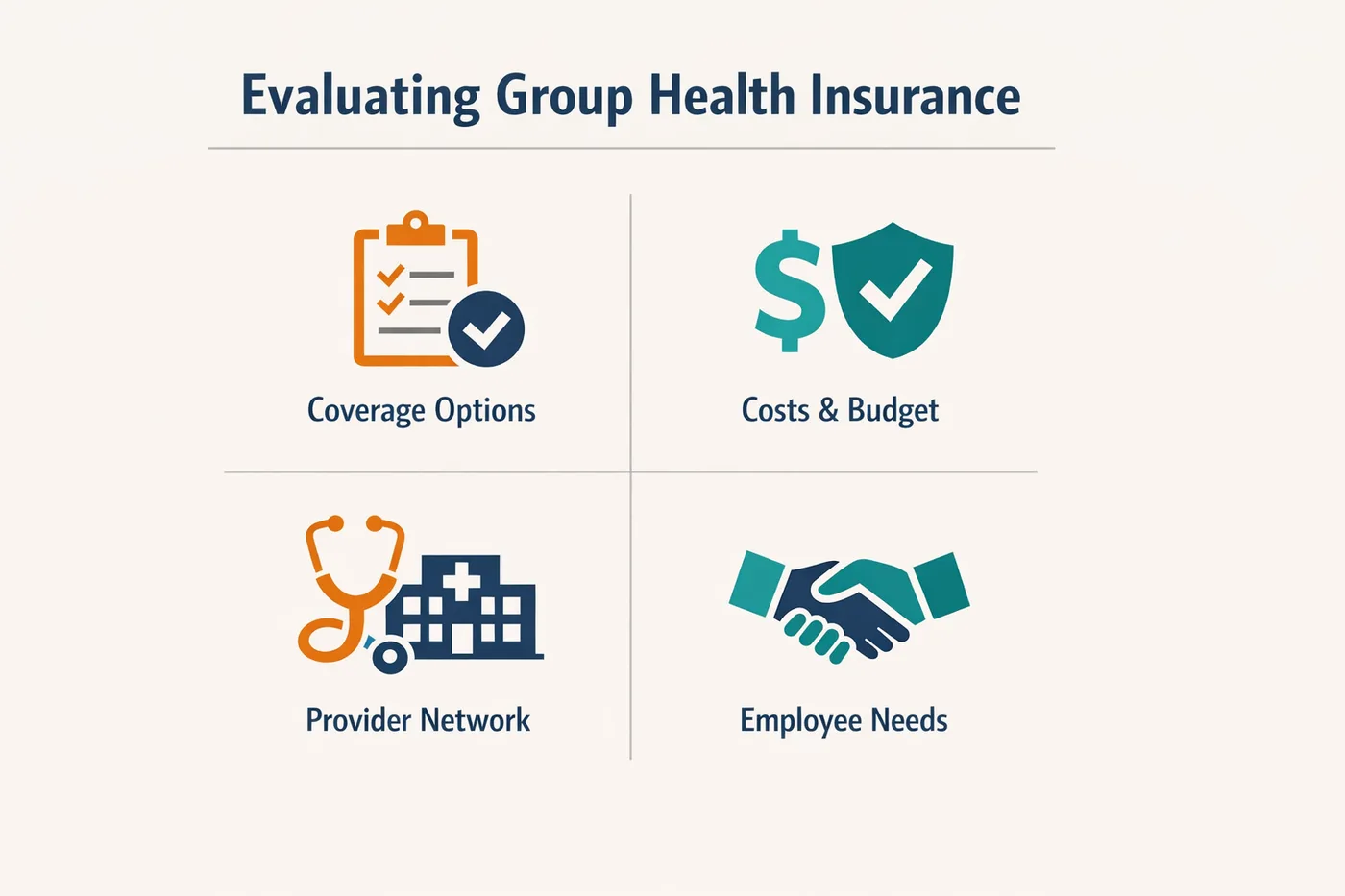
Choosing group health insurance for small business isn't just about picking a plan and moving on. The real work happens in the details — how you structure contributions, which supplemental options you offer, and how you communicate the value to your team. Most small business owners make decisions in a vacuum, then wonder why enrollment is low or costs spiral. Here's what that actually means in practical terms.
Consider Health Savings Account-Compatible Plans
If you're offering a high-deductible health plan (HDHP), your employees may be eligible to open Health Savings Accounts (HSAs). The framework here is straightforward: HDHPs have lower premiums, and HSAs let employees set aside pre-tax dollars for medical expenses. The math works like this — you save on premium costs, and your team gets a tax-advantaged savings vehicle.
Employers can make contributions to employees' HSAs, and those contributions are deductible on your business income tax return for the year you make them. If you allocate a contribution to the prior year, you still deduct it in the year you actually made the payment. That flexibility matters when you're managing cash flow and tax obligations at year-end.
Understand What Counts as "Other Coverage"
A common misconception: employees with an HDHP can't have any other health coverage. The honest answer is more nuanced. Employees can still qualify for HSA contributions even if they have additional coverage for accidents, disability, dental care, vision care, long-term care, or telehealth services. Workers' compensation and liability coverage don't disqualify them either.
What does disqualify them? Coverage that substantially duplicates the HDHP or provides comprehensive benefits outside the high-deductible structure. For example, if an employee's spouse has a traditional low-deductible plan that also covers the employee, that employee can't contribute to an HSA. When you're explaining plan options to your team, clarify these boundaries — most people don't realize how specific the rules are.
Communicate the Total Value, Not Just the Premium
Employees see the paycheck deduction. They don't always see the employer contribution, the network discounts, or the preventive care that costs them nothing. The difference between a plan that feels valuable and one that feels like a burden often comes down to communication.
Create a simple benefits summary that shows:
- What you pay as the employer
- What the employee pays per paycheck
- What services are covered at no cost (annual physicals, screenings)
- How to access telehealth or urgent care
- Where to find in-network providers
Most small businesses hand employees a 40-page policy document and call it done. That's not communication — that's compliance. If you want your team to understand what they have, explain it the way you'd explain it to a friend.
Review Your Plan Annually, Not Every Three Years
Carrier rates change. Your workforce changes. Claims experience changes. Waiting until renewal feels urgent means you're negotiating from a weak position. Instead, review your plan every year — even if you're happy with your current carrier.
Ask your broker or administrator:
- How did our claims compare to projections?
- Are there plan design changes that could lower costs without cutting coverage?
- What's the competitive landscape for our employee count and industry?
- Are there wellness incentives or HSA contribution strategies we're not using?
The goal is getting in the right range, not finding perfection. But you can't get there if you're only looking at the issue when the renewal notice arrives.
The cheapest plan is rarely the best plan — but the most expensive plan is rarely necessary either. The framework is finding the coverage your team will actually use at a cost your business can sustain.
Don't Overlook Ancillary Benefits
Dental and vision coverage aren't legally required, but they're often the benefits employees notice most. A root canal or a new pair of glasses feels more immediate than the abstract protection of a high medical deductible. For many small businesses, adding dental and vision costs less than a 10% increase to the total benefits budget — and the return in employee satisfaction is significant.
Same principle applies to life insurance and disability coverage. What Is a SIMPLE IRA? A Guide for Small Teams discusses how small businesses can offer retirement benefits without the complexity of a 401(k) — the same logic applies here. You don't need a Fortune 500 benefits package. You need a package your team values and you can afford.
Plan for Enrollment Support
Open enrollment isn't intuitive, especially for employees who've never chosen a health plan before. Depending on your circumstances, you might need to explain deductibles, co-pays, co-insurance, out-of-pocket maximums, and network tiers — all concepts that sound like a foreign language to someone picking coverage for the first time.
Offer a group meeting where employees can ask questions. Provide one-on-one time with your broker or HR contact. Send reminder emails with deadlines and decision-making resources. The more support you give during enrollment, the fewer confused calls you'll get in February when someone doesn't understand why their urgent care visit wasn't free.
Conclusion
Offering group health insurance for small business isn't just about checking a compliance box — it's about building a workplace where people want to stay. The right plan protects your team's health and your company's financial stability. The framework is straightforward: understand your options, calculate what you can afford, and choose coverage that fits your business size and goals.
The math works like this: start with your budget, factor in tax advantages, and weigh the cost against employee retention and productivity. Most small businesses find that the investment pays for itself through lower turnover and a stronger talent pool. Whether you choose a fully insured plan, a level-funded arrangement, or a health reimbursement option, the goal is getting in the right range for your specific situation.
When you're ready to take the next step, talk to a licensed financial professional who understands small business benefits. They can help you navigate enrollment periods, contribution limits, and plan design. For businesses looking to build a comprehensive benefits strategy, business succession planning can complement your health insurance framework by protecting your company's long-term stability.
The honest answer: group health insurance isn't one-size-fits-all. But with the right framework and a clear understanding of your options, you can build a benefits package that works for your team and your bottom line. The difference between a plan that drains resources and one that strengthens your business comes down to choosing coverage that aligns with your goals — not just what the broker happens to be selling that week.
Explore group health insurance for small business: options, costs, and tips for choosing the right plan.
Related reading
QSEHRA Explained: A Health Benefit for Small Employers
Business Exit Strategy: 5 Paths to a Successful Transition
Family Business Succession Planning: Keeping It in the Family
Related reading
Buy-Sell Agreement Insurance: How It Protects Business Partners