
Introduction
Most people don't lie awake wondering about spreadsheets. They lie awake wondering whether they're saving enough, spending too much, or just guessing their way through every financial decision. A family budget answers those questions — not by restricting what you do, but by showing you what you're already doing and whether it matches what you want.
Here's what that actually means: a family budget is a plan that outlines expected income and expenses so you can manage finances effectively. It's not about perfection. It's about knowing whether your mortgage, groceries, insurance, and retirement contributions fit together in a way that doesn't require a second mortgage to fund summer camp.
The framework matters because families operate differently than individuals. One person's discretionary spending is another person's non-negotiable. One partner sees eating out as entertainment; the other sees it as convenience. Without a shared budget, those differences turn into arguments. With one, they turn into trade-offs everyone agreed to in advance. For more on structuring financial plans that account for long-term priorities, see What Is a Living Trust? How It Works and Whether You Need One.
The honest answer is that most families don't fail at budgeting because they lack discipline. They fail because they build budgets that require discipline no one actually has. A budget everyone can follow starts with categories broad enough to absorb real life — the school fundraiser you forgot about, the car repair that wasn't optional, the birthday gift you didn't plan for in January. It adjusts as you go. And it treats savings like a fixed expense, not whatever's left over at the end of the month.
This article walks through how to build that budget: the steps that matter, the traps that don't, and the adjustments that turn a plan on paper into a tool your family actually uses. The goal isn't accounting for every dollar. The goal is knowing where your money goes and making sure it goes where you want it to.
Problem Statement
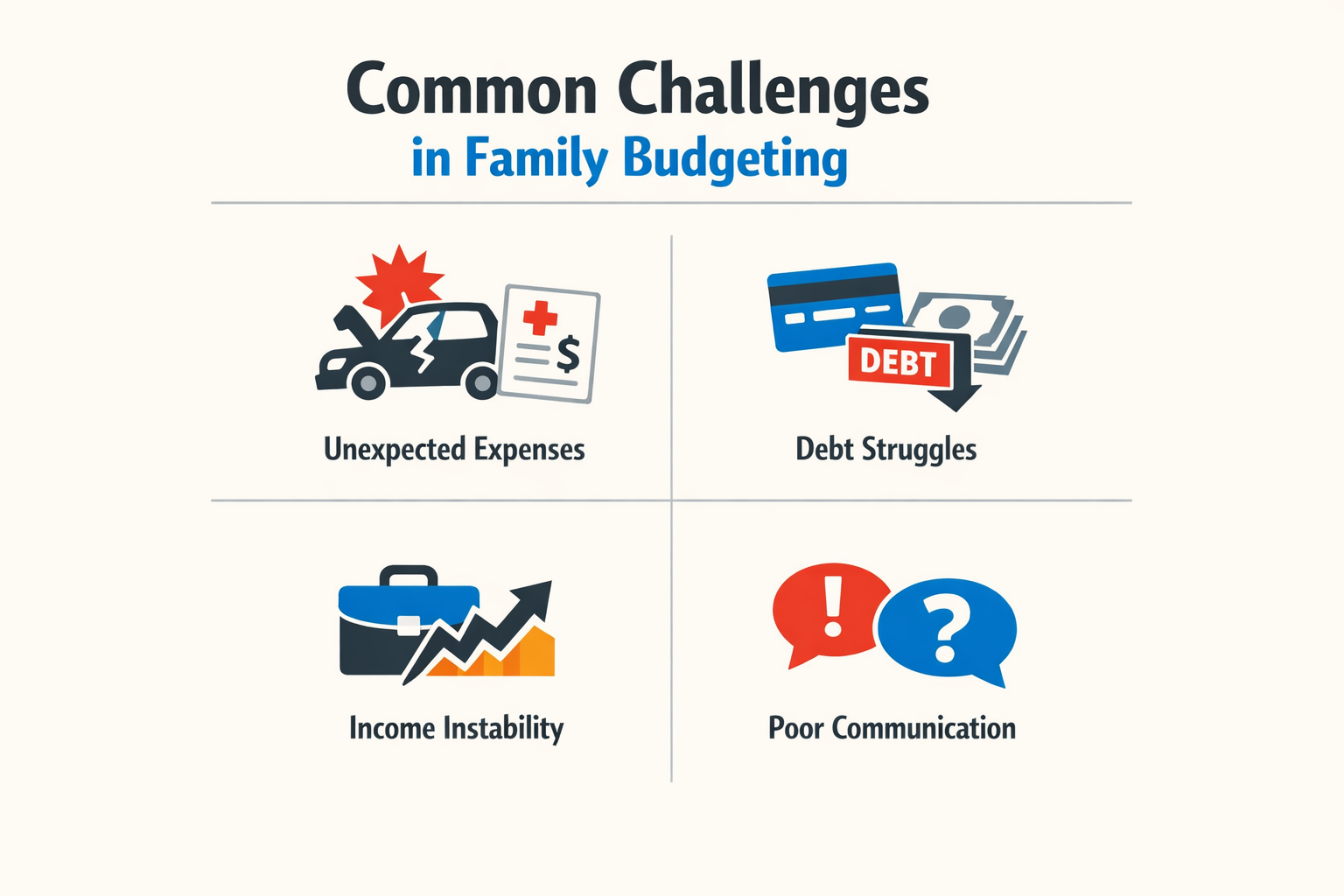
Most families don't fail at budgeting because they lack discipline. They fail because the framework doesn't match how money actually moves through a household. One person tracks every receipt while another doesn't remember what they spent yesterday. Kids need new shoes the same week the car needs tires. The budget says one thing, but life keeps saying something else.
The real question is why budgets break down even when everyone agrees they're important. Here's what that actually means in practical terms.
The Income Side Gets Complicated Fast
When both spouses work, the math seems straightforward — add the paychecks together and build from there. But tax withholding, retirement contributions, and insurance premiums mean the number on the pay stub isn't the number that hits the account. If you or your spouse can be claimed as a dependent on someone else's return, the standard deduction calculation changes, which affects how much of your income is actually available for household expenses.
Freelancers and business owners face a different version of the same problem. Income arrives irregularly, tax obligations aren't withheld automatically, and the line between business and personal expenses blurs. A budget built on predictable monthly income doesn't survive first contact with quarterly estimated tax payments.
Everyone Has a Different Relationship With Spending
One spouse sees a $200 grocery bill as normal. The other sees waste. One considers a streaming service essential. The other considers it optional. These aren't right-or-wrong disagreements — they're different frameworks colliding. A budget that doesn't account for these differences becomes a source of conflict instead of a planning tool.
Kids add another layer. They don't understand why they can't have what their friends have, and explaining budget categories to a seven-year-old rarely goes well. Teenagers want independence but don't yet grasp that independence costs money the family doesn't have infinite amounts of.
The Framework Doesn't Flex
Most budgets treat every month like it's January. But December has holiday spending. August has back-to-school costs. June has summer camp. A rigid monthly budget that doesn't account for predictable irregular expenses breaks the first time one of those expenses arrives.
Then there are the unpredictable ones. The water heater fails. Someone needs an emergency dental visit. The dog eats something expensive and stupid. A budget with no margin for the unexpected isn't a budget — it's a wish.
The cheapest budget is the one the whole family actually follows, not the one that looks perfect on paper.
Tracking Becomes a Second Job
Some families start strong — every transaction logged, every category monitored, every dollar accounted for. Then life happens. Someone forgets to save a receipt. Another person uses cash and doesn't remember where. The tracking system that seemed manageable in week one feels like a part-time job by week four.
The honest answer: if the system requires more effort than the family can sustain, the system fails. It doesn't matter how accurate it is if no one keeps it updated.
No One Agrees on the Goal
One person wants to pay off debt. Another wants to save for a vacation. A third wants to increase retirement contributions. All three goals are reasonable, but a budget can't optimize for everything at once. Without a shared priority, every budget conversation becomes a negotiation about whose goal matters more.
For families managing estate planning fundamentals or setting aside funds for education, the competing priorities multiply. The budget isn't just about this month's expenses — it's about this decade's financial security.
Solution Steps to Create a Family Budget
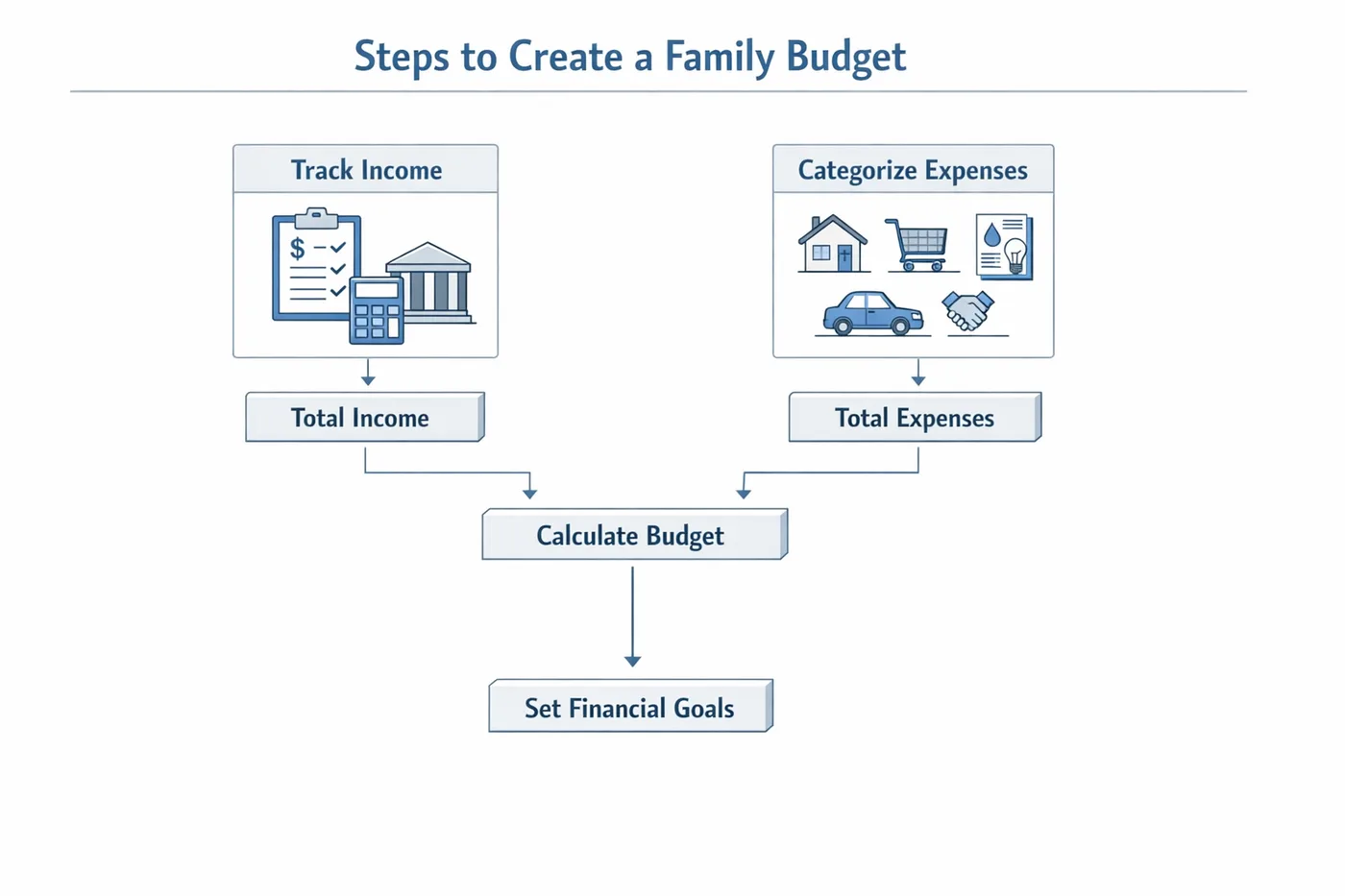
Creating a family budget that everyone can follow starts with a framework, not a spreadsheet. The math works like this: you need to see where money comes in, where it goes out, and where the gaps are. Most families skip the second part — they track income and expenses but never build in the adjustment steps that make a budget sustainable.
Here's the step-by-step process that turns intentions into a working system.
Step 1: Calculate Your Total Household Income
Start with your combined monthly income after taxes. Include wages, self-employment income, and any predictable sources like rental income or investment distributions. If income varies month to month, use a conservative average from the past six months.
Step 1
List all income sources
Write down every source of household income: paychecks, side work, benefits, and recurring transfers. Use net figures — what actually hits your account — not gross pay. If you're self-employed, subtract estimated quarterly tax payments before you count the income.
For families managing education expenses, understanding tax credits can affect your take-home calculation. The American opportunity credit, for example, returns up to $2,500 per eligible student — 100% of the first $2,000 in qualified expenses plus 25% of the next $2,000. That credit changes your effective income during school years.
Step 2: Track Every Expense for One Full Month
Most people underestimate spending by 20 to 30 percent because they forget irregular expenses. Track everything for 30 days: fixed costs like rent and insurance, variable costs like groceries and gas, and discretionary spending like dining out and subscriptions.
Use whatever method you'll actually stick with — a notebook, a spreadsheet, or a budgeting app. The goal is accuracy, not perfection.
Step 3: Categorize and Prioritize Your Spending
Group expenses into three buckets: essentials (housing, utilities, food, transportation, insurance), financial goals (debt repayment, retirement contributions, emergency fund), and discretionary (everything else).
Essentials and financial goals get funded first. Discretionary spending gets what's left. If the math doesn't work — if essentials and goals exceed income — you have a structural problem that requires either increasing income or reducing fixed costs, not trimming the grocery budget by five dollars.
Step 4: Set Realistic Spending Limits by Category
Assign a monthly limit to each category based on your tracking data and your priorities. Start with what you actually spent, then adjust based on where you want to be. A budget that requires cutting grocery spending in half won't last two weeks.
| Category | Current Spending | Target Budget | Adjustment |
|---|---|---|---|
| Housing | $1,800 | $1,800 | Fixed |
| Groceries | $900 | $850 | -6% |
| Dining Out | $400 | $250 | -38% |
| Subscriptions | $180 | $100 | -44% |
The difference between current and target is where the work happens. Small cuts across multiple categories add up faster than big cuts in one area.
Step 5: Build in Adjustments and Periodic Reviews
A static budget fails the first time an unexpected expense appears. Build adjustment steps into the system: review spending weekly for the first month, then monthly once the budget stabilizes. When actual spending exceeds the budget in one category, decide immediately whether to pull from another category or whether the budget limit was unrealistic.
For families with retirement accounts or education savings plans, contribution calculations follow a similar step-by-step process. You calculate available funds, determine contribution limits, subtract existing commitments, and adjust based on financial goals. The framework is the same whether you're budgeting monthly expenses or annual retirement contributions.
The budget that works is the one you'll actually follow — and that means building in room for adjustments before you need them.
Step 6: Get Everyone on the Same Page
A family budget only works when everyone who spends money understands the limits and agrees to them. That doesn't mean every family member gets veto power over every line item, but it does mean explaining the framework and the trade-offs.
For younger children, that might mean a simple conversation about needs versus wants. For teenagers and adults, it means showing the full picture: here's what comes in, here's what goes out, here's what we're prioritizing, and here's where we have flexibility.
If you're looking for ways to protect your family's financial foundation beyond monthly budgeting, a 401(k) for small business owners can provide tax-advantaged retirement savings that work alongside your household budget.
Tips and Tricks for Effective Family Budgeting

Building a family budget is one thing. Sticking to it is another. The difference between a budget that works and one that gets abandoned after two months comes down to how you maintain it and whether everyone stays engaged.
Make Budget Reviews a Regular Event
Set a standing monthly meeting — 30 minutes, same day each month. Review what came in, what went out, and where you landed against your targets. This isn't about blame; it's about visibility. When everyone sees the numbers together, adjustments feel collaborative rather than punitive.
Keep the meeting short and focused. Cover spending trends, upcoming expenses, and one adjustment if needed. Skip the meeting and the budget becomes theoretical.
Use Separate Accounts for Different Goals
One checking account for everything creates confusion. Consider opening separate accounts for specific purposes: one for monthly bills, one for discretionary spending, one for emergency savings. When money has a clear job, it's harder to accidentally spend the car insurance fund on takeout.
This approach works especially well for dual-income households. Each spouse can manage day-to-day spending from a shared account while maintaining visibility into the bigger financial picture.
Understand How Tax Filing Status Affects Your Budget
Your tax filing status — single, married filing jointly, or head of household — directly impacts your take-home pay and available credits. For example, if you qualify to file as head of household, you may be eligible for certain tax credits that affect your monthly cash flow. Understanding these qualifications helps you budget more accurately throughout the year.
If you're married and both spouses contribute to tax-advantaged accounts, coordinate those contributions. When both spouses have family coverage under separate health plans, contribution limits apply to the household, not individually — the limit is typically split equally unless you agree otherwise. Getting this wrong means either leaving money on the table or facing penalties.
Track Progress Without Obsessing
Check your budget weekly, not daily. Daily monitoring creates anxiety without adding value. Weekly check-ins let you catch problems early — a forgotten subscription, an unexpected charge — without turning budget management into a second job.
Use whatever tracking method actually gets used. A spreadsheet works if you'll open it. An app works if you'll check it. A notebook works if you'll write in it. The best system is the one you'll maintain.
Build in Small Rewards
Budgets that feel like punishment don't last. When you hit a savings milestone or stay under budget for three months straight, acknowledge it. The reward doesn't need to be expensive — a nice dinner out, a small purchase someone's been wanting, an afternoon doing something free but fun.
The goal is creating positive associations with budget discipline. If staying on track feels like deprivation, you're less likely to stick with it long-term.
The budget that works is the one the whole household actually follows, not the one that looks perfect on paper.
Adjust for Life Changes Immediately
Job change, new baby, kid starting college, parent moving in — any major life event requires a budget revision within the first month. Don't wait for the next quarterly review. Sit down, run the new numbers, and update the plan.
Minor adjustments happen too. Grocery costs creep up, insurance premiums change, subscriptions multiply. Review your variable categories every few months and reset baselines as needed.
Keep Everyone Informed, Not Just Involved
You don't need a family meeting for every budget decision, but everyone should know the current state. Post the month's spending targets somewhere visible. Share updates on progress toward big goals. When kids see the vacation fund growing or the debt balance shrinking, they understand why certain spending choices matter.
For households with older children, consider giving them visibility into age-appropriate parts of the budget. A teenager who sees the real cost of car insurance and phone bills develops better financial instincts than one who just hears "we can't afford that."
What to Do When You Go Over Budget
It will happen. You'll overspend in a category, an emergency will blow through your buffer, or you'll simply miscalculate. The response matters more than the mistake.
First, figure out where the money came from — did you pull from savings, skip another category, or carry a balance? Second, decide whether this was a one-time event or a sign your budget needs adjustment. Third, make a plan to rebalance over the next month or two.
Going over budget once doesn't mean the system failed. Ignoring it and hoping it resolves itself does.
Consider Professional Guidance for Complex Situations
Most families can build and maintain a budget without outside help. But if you're managing multiple income streams, navigating a major financial transition, or trying to coordinate retirement contributions with current expenses, talking to a licensed financial professional can clarify your options. For households juggling retirement account types like 401(k)s and IRAs, professional input helps you maximize contributions without overextending your monthly budget.
A one-time consultation often costs less than the mistakes it prevents. You're not looking for someone to manage your money — you're looking for someone to confirm your framework makes sense given your specific situation.
Conclusion
Most families don't fail at budgeting because they picked the wrong spreadsheet or downloaded the wrong app. They fail because they built a system no one wanted to follow. A family budget that actually works is one the whole household understands, agrees to, and can adjust when life changes — not a rigid set of rules handed down from one person.
The framework is straightforward: track what you're spending now, set realistic targets based on your actual priorities, and review the numbers together every month. When everyone knows where the money goes and why, the budget stops feeling like a constraint and starts feeling like a plan. That shift — from obligation to framework — is what makes it sustainable.
If you're ready to take the next step and think about how budgeting fits into longer-term financial planning, understanding tools like Coverdell Education Savings Accounts can help you build education savings into your household framework. The honest answer is that most families who stick with a budget for six months find it becomes part of their routine — not because it's easy, but because it removes the guesswork from decisions they were already making.
Start with one month. Track, adjust, and talk about it. The goal isn't perfection; it's getting everyone in the same room, looking at the same numbers, and agreeing on what matters most.
Learn how to create a family budget everyone can follow with practical steps and tips for managing finances effectively.
Related reading
30-Day Budget Challenge: Transform Your Finances in One Month