
Introduction
Most people don't lie awake wondering about budgeting systems. They lie awake wondering why there's more month than money, or how they'll ever save enough for retirement when everyday expenses keep climbing.
Embarking on a 30-day budget challenge can be a transformative experience for your finances. The framework is straightforward: commit to tracking every dollar that comes in and goes out for one full month. What you discover in those 30 days often surprises people — not because they're spending recklessly, but because they've never had a clear picture of their financial landscape.
Consider a common scenario: a 35-year-old earning $90,000 annually, with a $280,000 mortgage and two kids. Without tracking, it's easy to assume you're doing fine because the bills get paid. But when you actually map out where the money goes — the $800 monthly dining budget you didn't realize existed, the subscription services that add up to $150, the grocery bill that could drop 20% with meal planning — the math works like this: small redirections compound into meaningful savings.
For many households, retirement planning feels abstract until you see the connection between daily spending and long-term security. A 401(k) for Small Business Owners: Plans, Setup, and Costs might seem like a separate financial conversation, but the challenge reveals whether you're actually funding it consistently or letting discretionary spending crowd out contributions.
A common misconception is that budgeting means cutting out all enjoyment. The honest answer: it means understanding the trade-offs. When you know exactly what you're spending on entertainment, you can decide whether that amount reflects your priorities or whether you'd rather redirect some of it toward debt reduction, emergency savings, or investment accounts. The difference between intentional spending and passive spending is control.
This challenge works because it creates a baseline. After 30 days of tracking, you'll know your real numbers — not estimates, not guesses, but actual data. That baseline becomes the foundation for every financial decision that follows, from insurance coverage calculations to retirement contribution rates to estate planning considerations. Worth understanding: you can't optimize what you haven't measured.
Problem Statement
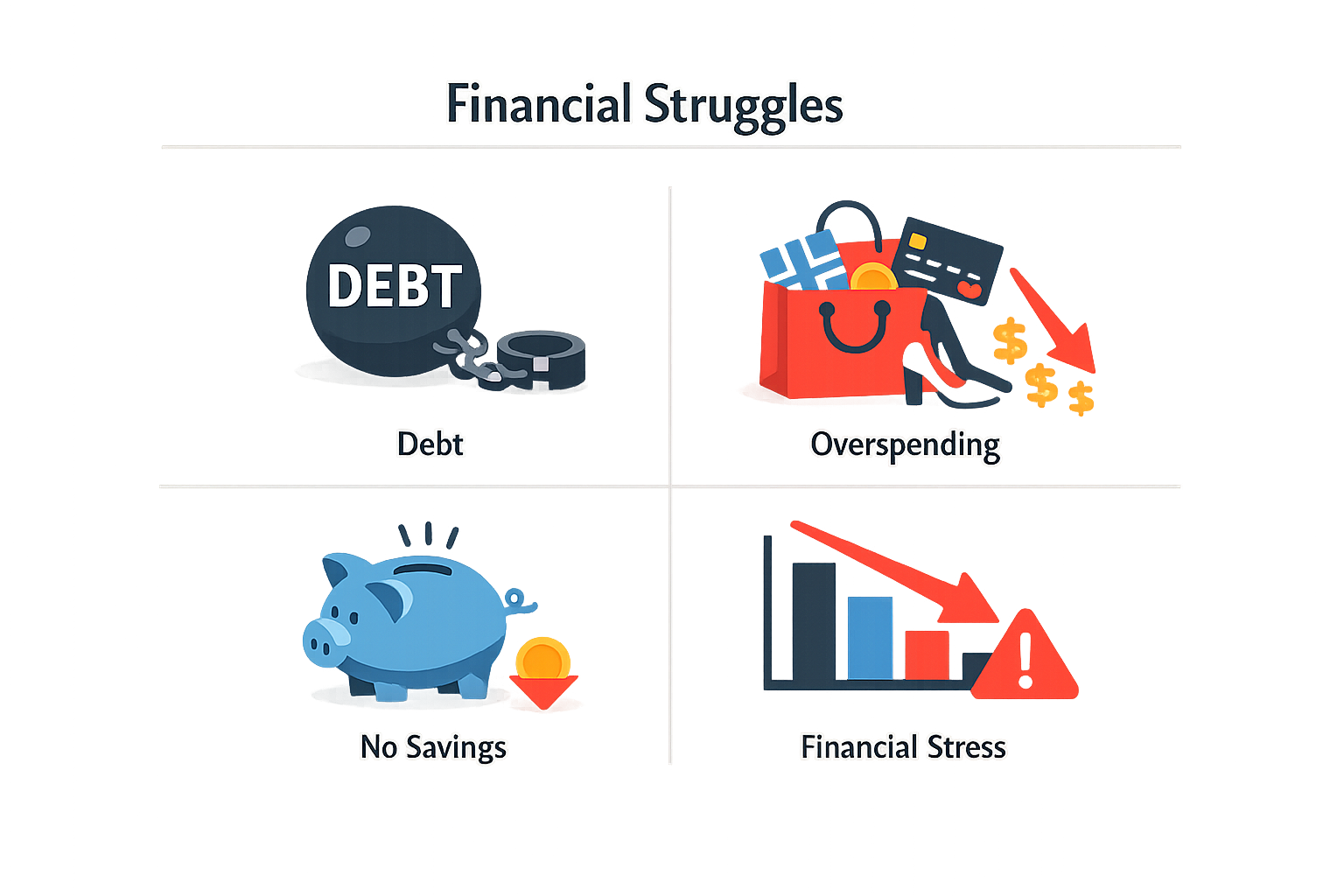
Most people don't struggle with earning money — they struggle with knowing where it goes. The paychecks arrive, the bills get paid, and somehow there's less left over than expected. No emergency fund builds up. Retirement contributions stay minimal. The gap between what you earn and what you keep feels frustratingly wide.
The real question is why budgeting feels impossible when the math seems straightforward. Part of the answer lies in invisible spending — the subscriptions that auto-renew, the convenience purchases that add up, the dining expenses that feel reasonable in isolation but alarming in aggregate. Without a framework for tracking these patterns, even high earners find themselves living paycheck to paycheck.
The Income Illusion
A common misconception is that earning more automatically solves money problems. In practical terms, lifestyle inflation often matches income growth. The family earning $90,000 faces the same percentage of financial stress as the family earning $60,000 if spending scales proportionally. Understanding your modified adjusted gross income matters for tax planning, but daily financial health depends on the gap between what comes in and what goes out.
Many households operate without clear visibility into their spending categories. Grocery costs blend with restaurant meals. Entertainment merges with essential subscriptions. When tax season arrives or a major expense hits, the lack of categorized data makes it nearly impossible to identify where adjustments could happen. This is where a structured approach like exploring retirement planning frameworks can provide clarity — not just for long-term savings, but for understanding how current spending impacts future security.
The Motivation Gap
Starting a budget feels like starting a diet — initial enthusiasm followed by the weight of daily discipline. The difference between knowing to track expenses and actually doing it consistently represents the gap where most financial improvement plans fail. Motivation fades when the process feels punitive rather than informative.
The framework needs to shift from restriction to awareness. A 30-day budget challenge works not because it imposes harsh limits, but because it creates a structured period for gathering data about your actual financial behavior. You're not cutting everything out — you're learning what everything actually costs and whether those costs align with your priorities.
What Gets Measured Gets Managed
Without measurement, financial decisions happen in a vacuum. You might know your mortgage payment and your car loan, but the accumulated cost of convenience — delivery fees, premium streaming tiers, impulse purchases — remains abstract until it's tracked. The honest answer is that most people can't name their top five spending categories by dollar amount without looking at statements.
This lack of clarity makes it impossible to make informed tradeoffs. Saving for retirement, building an emergency fund, or planning for education costs requires knowing what's available to redirect. When every dollar feels spoken for but you can't articulate where they all went, the problem isn't income — it's visibility.
The goal isn't perfection in 30 days. It's building enough awareness to make one or two meaningful changes that compound over time.
Solution Steps: How to Take the 30-Day Budget Challenge
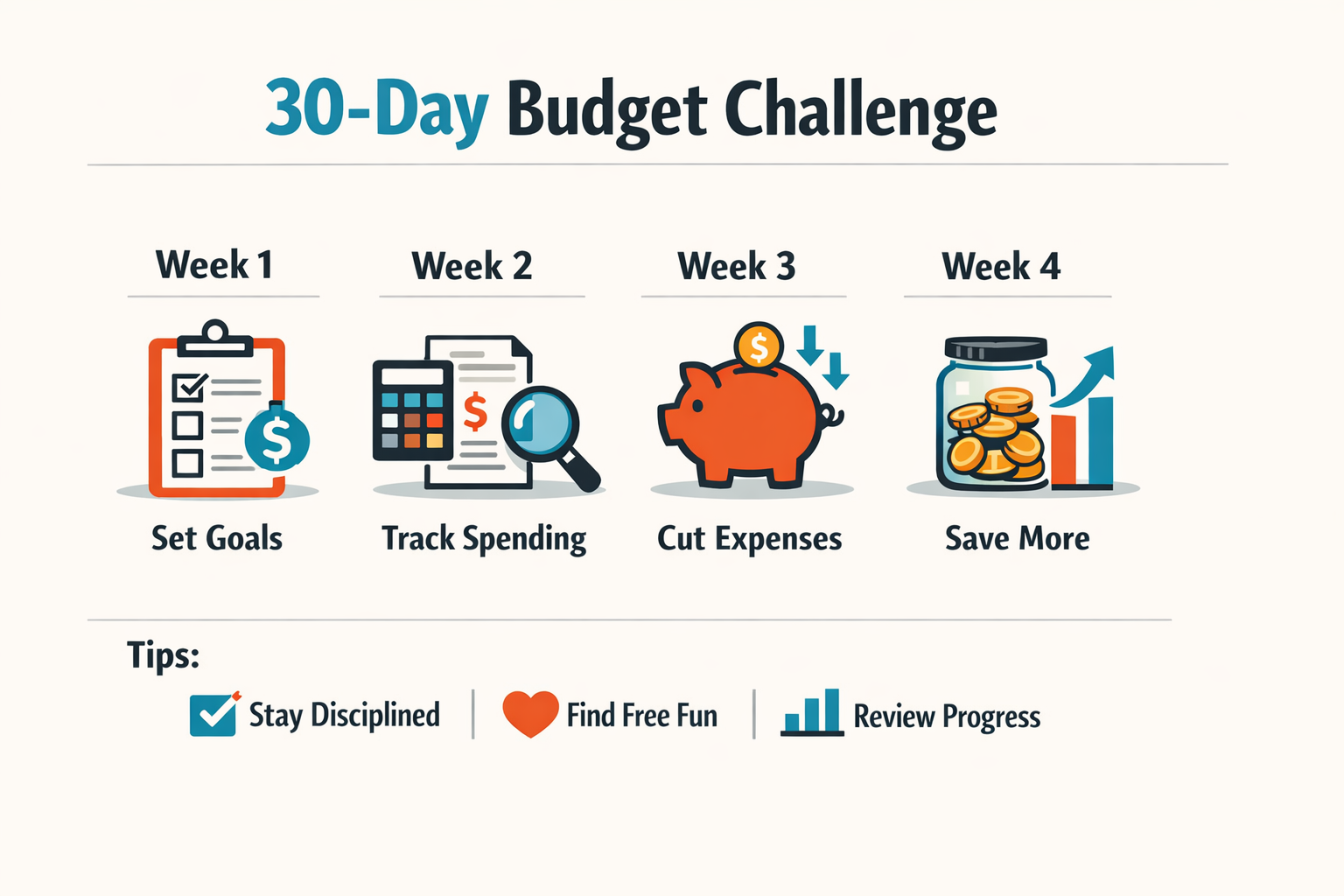
The framework for the 30-day budget challenge breaks down into four weekly phases, each building on the last. Most people don't realize that sustainable budgeting isn't about restriction — it's about creating a system that matches your actual spending patterns to your stated priorities.
Week One: Establish Your Baseline
Step 1
Track every dollar
For the first seven days, write down every transaction. Coffee, parking meters, subscription renewals — everything. Don't change your behavior yet. The goal is getting an honest picture of where your money actually goes, not where you think it goes.
Step 2
Calculate your net income
Add up all income sources for the month after taxes and deductions. If you're self-employed, account for quarterly tax obligations. For those with retirement contributions through work, your net income is what hits your checking account, not your gross pay.
Step 3
Categorize your spending
Sort your tracked expenses into groups: fixed costs (rent, insurance, minimum debt payments), variable necessities (groceries, utilities, gas), and discretionary spending (dining out, entertainment, shopping). Most households find that discretionary spending accounts for 20-35% of their budget, though they estimate it closer to 10-15%.
The difference between what you earn and what you spend is your starting point. If that number is negative, you're not alone — the math just needs adjusting.
Week Two: Build Your Framework
Step 4
Set spending targets by category
Using your Week One data, assign a dollar amount to each category. Start with fixed costs — those don't negotiate. Then allocate money to variable necessities based on your actual three-month average, not your ideal. What's left goes to discretionary spending and savings.
A common misconception is that you need to cut discretionary spending to zero. The real question is whether your current discretionary spending aligns with what matters most to you. If dining out brings genuine value but subscription services you forgot about don't, the framework makes that visible.
Step 5
Identify one category to optimize
Pick a single spending category where you see the biggest gap between current spending and your target. For most people, this is either groceries, dining out, or recurring subscriptions. Focus your energy there for Week Two.
For self-employed individuals managing both personal and business expenses, this phase requires extra attention to separating the two. Business expenses flow through different tax treatment, and mixing them creates confusion in both your personal budget and your business accounting.
Week Three: Implement and Adjust
Step 6
Use your targets as guardrails
Each day, check your spending against your category targets. When you're approaching a limit, you have options: shift money from another category, defer the purchase, or adjust the target if you've learned something new about your actual needs.
The goal is getting in the right range, not hitting exact numbers. If you budgeted $600 for groceries and spent $640, that's not failure — it's data. Either your target was unrealistic or you had an unusual month. Adjust accordingly.
Step 7
Automate what you can
Set up automatic transfers for savings on payday. Schedule fixed bills for the same day each month. The less you have to remember, the more mental energy you have for the decisions that actually matter.
Week Four: Lock In the Habit
Step 8
Review and reconcile
Compare your actual spending to your targets across all categories. Calculate your savings rate — the percentage of net income you kept rather than spent. For most households starting a budget challenge, hitting 5-10% is realistic progress.
The honest answer: most people don't maintain a detailed budget forever. What they do maintain is the awareness of their spending patterns and a framework for making trade-offs. That's the habit worth locking in.
Step 9
Set your next 30-day goal
Pick one specific financial target for the next month. Build your emergency fund to $1,000. Increase your retirement contribution by 1%. Pay an extra $100 toward your highest-interest debt. One concrete goal beats three vague intentions.
The framework works because it's built on your actual behavior, not an idealized version of how you think to spend. When you're ready to take the next step beyond the 30-day challenge, the same principles scale to longer-term planning — you're just working with annual numbers instead of monthly ones.
Tips and Tricks for Success
The 30-day budget challenge works when you build small, sustainable habits rather than attempting a complete financial overhaul overnight. Most people abandon budgets not because they lack discipline, but because they set unrealistic expectations or lose track of what they're actually trying to accomplish. Here's what actually makes the difference between finishing the challenge and giving up halfway through.
Start with One Category at a Time
Instead of tracking every dollar from day one, focus on a single spending category for the first week. Pick the one that causes the most financial stress — for most people, that's dining out, groceries, or subscription services. Track only that category meticulously, letting the rest of your spending continue as normal. This approach builds the tracking habit without the overwhelm that comes from monitoring fifteen different budget lines simultaneously.
Once you've got a week of solid data on that first category, add a second one. By week three, you'll have a clear picture of your biggest spending areas without the mental fatigue of trying to account for every coffee purchase from day one.
Use the Tools You'll Actually Check
A budgeting app only works if you open it. If you're someone who checks your phone constantly, a mobile app makes sense. If you prefer sitting down with a laptop once a week, a spreadsheet might be the better choice. The framework matters less than consistency — whether you're using a sophisticated app or a notebook, the goal is getting in the right range, not achieving perfect precision.
For those who find digital tools overwhelming, the envelope method still works: allocate cash to physical envelopes labeled with spending categories. When the envelope is empty, that category is done for the month. It's straightforward and provides immediate visual feedback that no app notification can match.
Build in Flexibility from the Start
A budget that doesn't account for reality won't survive contact with your actual life. Include a "miscellaneous" or "buffer" category of 5-10% of your monthly income for unexpected expenses. This isn't permission to overspend — it's acknowledgment that car repairs, birthday gifts, and forgotten bills exist.
When something unexpected hits that buffer category, you're not derailing the entire budget. You're using the system exactly as designed. The difference between a sustainable budget and a restrictive one often comes down to whether you planned for the unplannable.
Track Progress, Not Perfection
Missing a day of tracking doesn't mean the challenge is over. Spending $20 more than planned on groceries doesn't invalidate the entire month. The real question is whether you're building awareness of where your money goes and making intentional decisions about future spending.
Most people don't realize that the actual benefit of the 30-day budget challenge isn't hitting every target perfectly — it's developing the muscle memory of checking your financial position before making purchases. That habit, once established, continues long after the 30 days end.
For those managing retirement accounts alongside current budgets, understanding contribution limits and tax implications becomes part of the broader financial picture. A SIMPLE IRA vs 401k comparison can help small business owners align their budgeting strategy with long-term retirement planning.
Review Weekly, Adjust Monthly
Set aside 15 minutes every Sunday to review the past week's spending. Look for patterns, not individual transactions. Did you overspend in one category? Underspend in another? The goal isn't judgment — it's information. Use that information to adjust the following week's approach.
At the end of the 30 days, compare your actual spending to what you thought you were spending before the challenge started. The gap between perception and reality is usually where the biggest opportunities for improvement live. In practical terms, most people discover one or two categories where they're spending 30-50% more than they estimated, and one or two where they're spending less.
The budget that works is the one you'll actually follow for more than 30 days.
Connect Spending to Goals
Every dollar you redirect from low-value spending to high-priority goals reinforces why you're doing this challenge in the first place. When you skip the $15 lunch out and pack food from home, that's not deprivation — it's a conscious choice to fund something that matters more. Maybe it's building an emergency fund, paying down debt, or saving for a specific purchase.
Write down your top three financial goals and keep them visible. When you're tempted to make an impulse purchase, check whether it moves you toward or away from those goals. The honest answer usually becomes obvious quickly.
The framework of the 30-day budget challenge isn't complicated — track what comes in, track what goes out, and make intentional decisions about the gap between them. The tricks that make it work are the ones that acknowledge you're a human with competing priorities, not a spreadsheet with perfect self-control.
Conclusion
The 30-day budget challenge isn't about perfection — it's about building a framework that works for your specific situation. Over the past month, you've tracked spending, identified patterns, and made adjustments that align with your financial goals. The real question now is whether these habits stick beyond day 30.
Most people don't realize that the challenge's value comes from the system you've built, not the month itself. You've created a baseline understanding of where your money goes, which expenses are negotiable, and where you have room to redirect funds toward savings or debt reduction. That baseline is what makes the next three months, six months, and year different from the ones before.
For a 35-year-old earning $90,000 annually with a mortgage and family expenses, this challenge might have revealed that dining out consumed more of the budget than expected, or that small recurring subscriptions added up to meaningful monthly costs. The goal wasn't to eliminate those expenses entirely — it was to make informed decisions about which ones matter and which ones don't. That's the framework that carries forward.
The honest answer: budgeting gets easier after the first month, not harder. The initial tracking phase requires the most effort because you're establishing new patterns. Once those patterns are in place, the monthly check-ins take 20 minutes instead of two hours. You know your numbers, you know your priorities, and you know when something's off.
If you're looking to build on this foundation, consider how retirement savings fit into your monthly allocation. Understanding the difference between account types and contribution limits helps you make the most of what you're setting aside. For small business owners specifically, comparing retirement plan options can clarify which structure matches your cash flow and employee benefit goals.
The 30-day budget challenge is a starting point, not a finish line. The habits you've built this month — tracking, reviewing, adjusting — are the ones that compound over time into financial stability and flexibility. When you're ready to take the next step, the framework is already in place.
Join the 30-Day Budget Challenge to transform your finances and establish better money habits.
Related reading
What Is a Living Trust? How It Works and Whether You Need One
Related reading
Budgeting Basics: Starting Your First Budget - A Step-by-Step Guide