
Introduction
Most people don't lie awake wondering about budgets. They lie awake wondering why there's more month than money, why the savings account stays empty, or how they'll ever get ahead. The honest answer: without a framework for your money, you're flying blind.
A budget is that framework. In practical terms, it's a written plan that shows what money comes in and where it goes out. When you're starting your first budget, you're not signing up for deprivation or spreadsheet drudgery — you're building a tool that tells you whether you can afford something before you buy it, not after.
The difference between people who feel in control of their finances and people who don't usually comes down to this: one group knows their numbers, the other guesses. This guide walks through the steps to move from guessing to knowing. You'll learn how to track what you actually earn, categorize what you actually spend, and adjust the plan when reality doesn't match the forecast.
For many households, budgeting connects to broader financial goals — building an estate plan, funding retirement accounts, or setting aside education savings. Those strategies work better when you know how much discretionary income you have to allocate. Starting your first budget is the foundation that makes the rest possible.
The goal here is getting in the right range, not achieving perfection. Your first budget won't be your last budget. It's a starting point that you'll refine as you learn what works for your situation.
Understanding the Budgeting Challenge
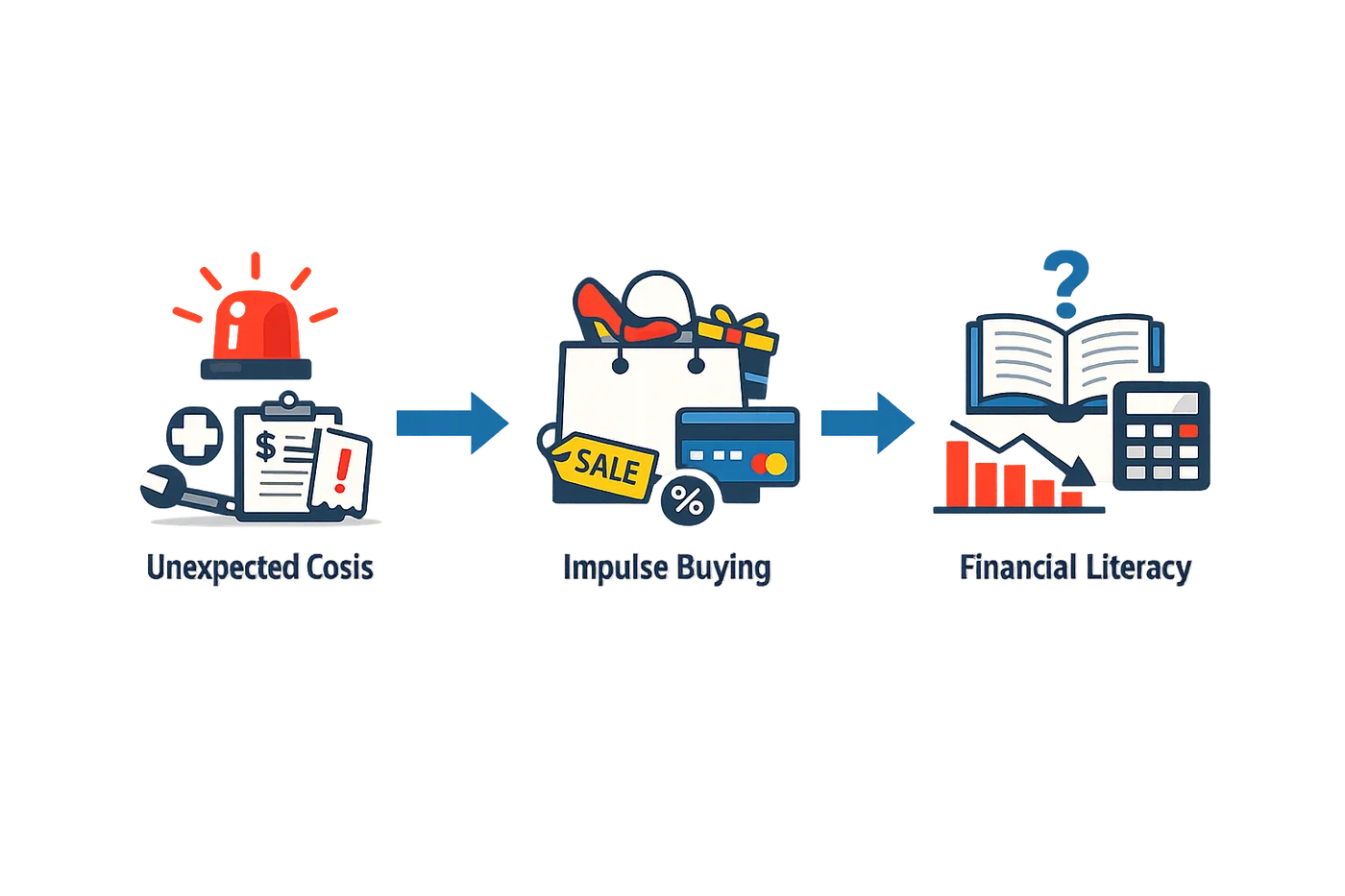
Most people don't avoid budgeting because they lack discipline. They avoid it because the process feels overwhelming, abstract, or punitive. The word "budget" itself carries baggage — it sounds like restriction rather than clarity. The real question is: what makes starting your first budget so difficult, and why do so many attempts fail in the first month?
The answer lies in three common obstacles. First, people don't know where their money actually goes. Without tracking, spending feels like a black box — you know money leaves your account, but the details blur together. Second, the tools and frameworks available often assume you already understand terms like "discretionary spending" or "zero-based budgeting," creating a knowledge gap before you even start. Third, most budgeting advice treats the process as a one-time setup rather than an ongoing adjustment, which means the first unexpected expense derails the entire system.
The Cost of Not Starting
The impact of avoiding a budget isn't always immediate, but it compounds. Without a clear picture of income versus expenses, small financial leaks become large ones. Subscriptions renew unnoticed. Overdraft fees accumulate. Savings goals remain abstract rather than funded. The difference between someone who tracks spending and someone who doesn't isn't usually income — it's awareness.
For households managing multiple financial priorities — retirement contributions, insurance premiums, education savings — the lack of a budget creates blind spots. You might be overpaying in one category while underfunding another, but without a framework, the imbalance stays hidden. The honest answer: most people don't realize how much clarity a simple tracking system provides until they implement one.
Why Generic Advice Falls Short
Most budgeting obstacles stem from trying to apply someone else's system to your specific situation. A framework built for a dual-income household with employer benefits won't map cleanly onto a single-income household with variable freelance income. The categories, percentages, and priorities shift depending on your circumstances.
This is where many people stall. They download a template, realize it doesn't fit their reality, and abandon the effort. The math works like this: if your system doesn't reflect how money actually moves through your life, you won't trust it. And if you don't trust it, you won't use it.
The cheapest budget is the one you'll actually maintain — even if it's a spreadsheet and a bank statement.
The framework matters less than the habit. Whether you use an app, a spreadsheet, or a notebook, the act of recording and reviewing creates the awareness that changes behavior. Most people don't need a perfect system on day one. They need a starting point and permission to adjust it as they learn what works.
Steps to Start Your First Budget
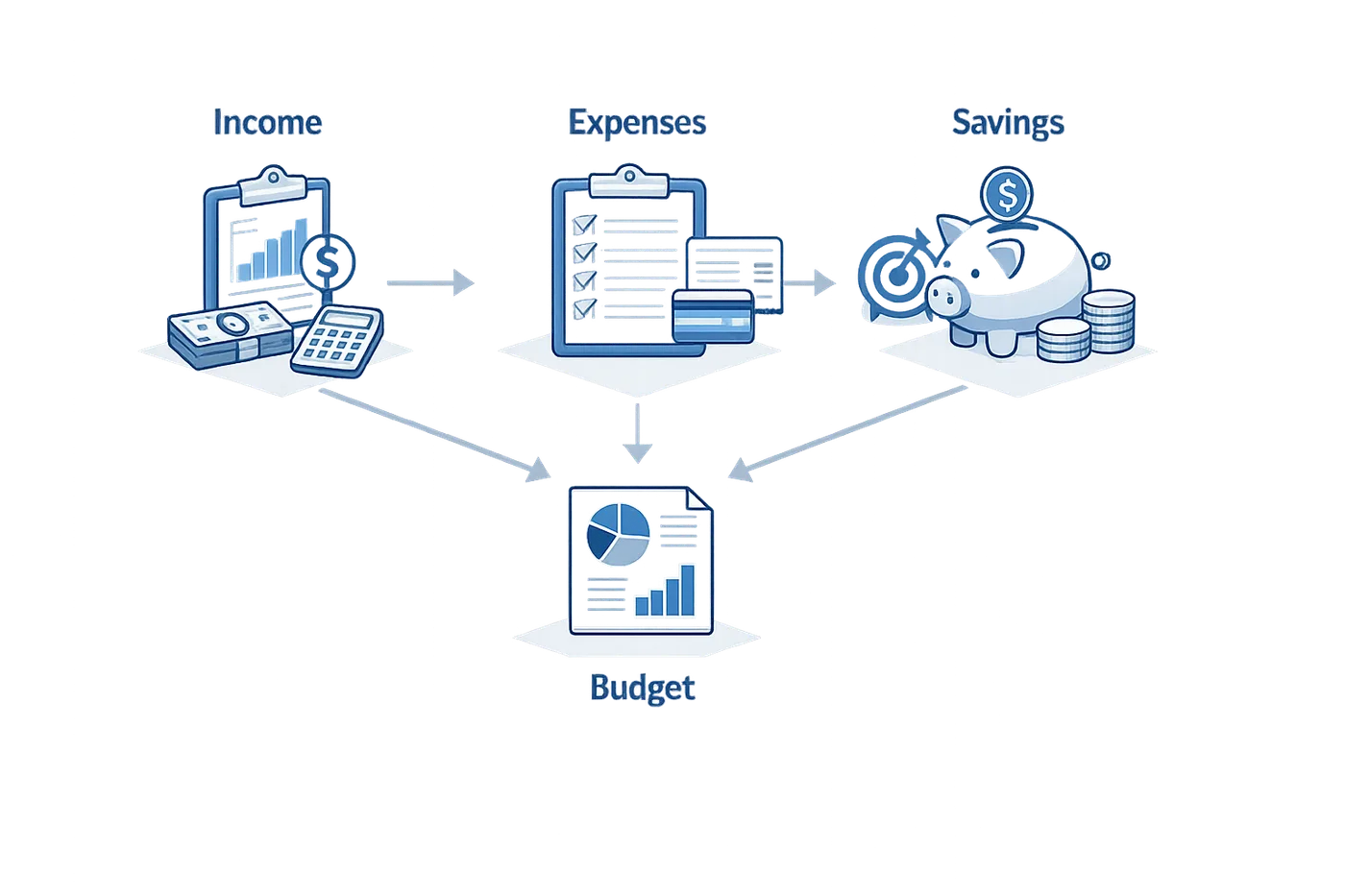
Starting your first budget doesn't require special software or a degree in accounting. It requires honest numbers and a framework you'll actually use. Here's how to build one that works.
Step 1: Track Your Current Spending
Step 1
Document where your money goes
Before you can plan where money should go, you need to know where it's going now. Spend two weeks tracking every expense — rent, groceries, coffee, subscriptions, everything. Use a notebook, a spreadsheet, or your bank's transaction history. The goal is a complete picture, not perfection.
Most people underestimate spending by 20 to 30 percent when they guess. The math only works when the starting numbers are real.
Step 2: Calculate Your Take-Home Income
Step 2
Identify your actual available funds
Your budget runs on what hits your bank account, not your gross salary. Add up your monthly take-home pay after taxes, insurance premiums, and retirement contributions. If your income varies, use your lowest typical month as the baseline — you can always adjust up, but planning on money that doesn't show up creates problems.
For self-employed individuals or those with irregular income, average the last six months and subtract 15 percent for taxes and estimated quarterly payments. It's better to overestimate obligations than to scramble at tax time.
Step 3: List Your Fixed Expenses
Step 3
Identify non-negotiable monthly costs
Fixed expenses are the bills that show up every month at roughly the same amount: rent or mortgage, car payment, insurance premiums, minimum debt payments, utilities. Write them down with their actual amounts. These are your baseline — the floor your budget must cover before anything else gets allocated.
Step 4: Categorize Your Variable Expenses
Step 4
Group discretionary spending
Variable expenses are everything else: groceries, gas, dining out, entertainment, clothing, personal care. Use your two-week spending log to estimate monthly amounts for each category. These are the line items where you have control — where cutting back actually creates room in the budget.
Don't create 30 categories. Six to eight is enough: groceries, transportation, dining and entertainment, personal care, household items, miscellaneous. Too many categories means too much tracking, and tracking is where most first budgets fail.
Step 5: Assign Every Dollar a Job
Step 5
Allocate income to categories
Subtract your fixed expenses from your take-home income. What's left gets divided among your variable expense categories, savings, and debt payoff. The goal is zero — every dollar assigned before the month starts. If you have money left over, put it toward an emergency fund or extra debt payments. If you're short, adjust the variable categories until the math works.
A budget isn't about restriction — it's about deciding where your money goes before it disappears into categories you didn't choose.
This is where most people get stuck. They want the budget to allow for everything they're currently spending, plus savings, plus debt payoff. The math doesn't work that way. Something has to give, and the budget shows you exactly what.
Step 6: Build in a Small Buffer
Life doesn't follow a spreadsheet. Car repairs happen. Kids need new shoes. The water heater fails. If your budget allocates every dollar with zero margin, the first surprise derails everything.
Keep a miscellaneous or buffer category with 5 to 10 percent of your variable spending. It's not for regular expenses — it's for the things you didn't see coming. When the month ends and the buffer is untouched, move it to savings. When it gets used, you're covered without blowing the whole framework.
Step 7: Review and Adjust Monthly
Step 7
Compare actual spending to the plan
At the end of each month, compare what you actually spent to what you budgeted. Where did you overspend? Where did you come in under? Adjust next month's numbers based on what you learned. A budget is a working document, not a contract — it gets better as you use it.
The first three months are calibration. You're learning what the real numbers are, what categories need more room, and where you consistently overestimate. By month four, the framework starts to feel natural.
For more structured approaches to managing finances as your situation becomes more complex, see our guide on 401(k) for Small Business Owners: Plans, Setup, and Costs.
Tips and Tricks for Budgeting Success

Creating a budget is the easy part. Sticking to it for more than a month — that's where most people hit the wall. The difference between a budget that becomes a habit and one that gets abandoned by February comes down to a few practical strategies.
Build in flexibility from day one
The tightest budget is not the best budget. If you allocate every dollar with military precision, the first unexpected expense — a car repair, a medical copay, a forgotten subscription — throws the entire system off. Most people respond by abandoning the budget entirely rather than adjusting it.
Start with ranges instead of fixed amounts. If groceries typically run $400 to $500, budget $500 and treat anything under that as a win. If you're consistently under budget in one category, reallocate that money to savings or another goal rather than spending it just because it's there.
Automate the non-negotiables
The bills that must be paid — rent, insurance, minimum debt payments — should never require a decision. Set up automatic payments so they leave your account before you see the money. The same goes for savings: if you're waiting until the end of the month to see what's left over, there won't be anything left over.
This approach removes willpower from the equation. You're not deciding whether to save this month; you're deciding how much to save when you set up the automation, and then the system handles it. For anyone managing self-employment income or side work, understanding how retirement contributions fit into your overall financial picture can help with long-term planning — resources like SEP IRA Contribution Limits for 2026: What You Need to Know explain how those accounts work alongside your budget.
Track spending without obsessing over it
You don't need to log every coffee purchase in real time. What matters is knowing where the money actually goes, not where you think it goes. Most people underestimate spending in a few key categories — restaurants, subscriptions, and small recurring charges that add up.
Check your accounts once a week. Compare what you spent to what you budgeted. If you're consistently over in one area, either cut back or admit that your original budget was unrealistic and adjust the allocation. The goal is getting in the right range, not hitting an arbitrary number.
A budget that reflects how you actually live will always outperform a budget that reflects how you think you live.
Use the budget to make trade-offs visible
The real value of a budget is not restricting spending — it's making the cost of one choice clear in terms of another choice. When you see that eating out four times this week means pushing a savings goal back by a month, the decision becomes concrete rather than abstract.
This is particularly useful for larger purchases. If you want something that costs $1,200, break it down: that's $100 a month for a year, or $50 a month for two years. Seeing it in monthly terms makes it easier to decide whether it's worth reallocating money from another category.
Revisit and adjust quarterly
Your budget should change as your life changes. A budget that worked in January may not work in June when insurance premiums adjust, when you get a raise, or when a major expense like a wedding or a move enters the picture. Set a recurring calendar reminder every three months to review your budget and adjust the allocations.
During that review, look for categories where you're consistently over or under budget. If you've been under budget on groceries for three months straight, lower that allocation and move the difference to a goal that matters more. If you've been over budget on transportation, either cut back or acknowledge that your original estimate was too low and adjust accordingly.
Conclusion
Most people who never start a budget don't fail because they lack discipline — they fail because they never had a framework. The difference between hoping your money lasts and knowing where it goes comes down to the steps outlined above: tracking what you earn, naming where it goes, and adjusting when reality proves your first guesses wrong.
Starting your first budget isn't about restriction. It's about visibility. When you know what's coming in and what's going out, you stop reacting to your bank balance and start controlling it. The 50/30/20 framework gives you a starting point. The envelope method or zero-based approach gives you a structure. The monthly review gives you the feedback loop that turns a spreadsheet into a working system.
The honest answer: your first budget won't be perfect. You'll underestimate grocery costs, forget about annual subscriptions, and blow past your entertainment category at least once. That's not failure — that's data. Each month you track and adjust, the budget gets tighter. Each time you catch an irregular expense before it surprises you, the system proves its value.
For many households, budgeting works hand-in-hand with broader financial planning — understanding how much to allocate toward retirement accounts, education savings, or insurance coverage. If you're building a financial foundation that includes those pieces, our guide on 401(k) for Small Business Owners: Plans, Setup, and Costs covers one key component of long-term planning that complements a working household budget.
The goal isn't perfection. The goal is getting in the right range — knowing your fixed costs are covered, your goals are funded, and your variable spending stays within bounds you set intentionally. When you're ready to take the next step, the framework is here. The math works the same whether you earn $40,000 or $400,000. What changes is the scale, not the structure.
Most people don't realize how much control they gain just by naming their dollars and tracking where they go. Start with one month. Track everything. Adjust the categories. Run it again. That's how a budget stops being a theory and starts being a tool.
Related reading
30-Day Budget Challenge: Transform Your Finances in One Month
How to Create a Family Budget Everyone Can Follow
Related reading
How to Invest Your HSA for Long-Term Growth: A Guide to HSA Investment