
Introduction to QSEHRA
Most small business owners don't lose sleep over complex benefit structures. They lose sleep over how to take care of their team without breaking the bank. The math on traditional group health insurance often doesn't work when you're running a business with 10, 20, or 30 employees — premiums keep climbing, and the administrative burden feels like hiring another person just to manage the paperwork.
QSEHRA offers a different framework. Instead of shopping for a one-size-fits-all group plan, employers set a monthly allowance and reimburse employees for the individual health coverage they choose themselves. The employer gets a tax deduction, the employee gets help paying for coverage, and nobody has to navigate the group insurance marketplace if it doesn't make sense for their situation.
Here's what that actually means in practical terms: if you're a small employer, you decide how much you can afford to contribute toward employee health costs each month. Employees purchase their own individual health insurance (often through the marketplace), submit proof of coverage and expenses, and you reimburse them up to the allowance you've set. The IRS has specific rules about how this works, but the basic concept is straightforward. For businesses looking to build comprehensive employee benefits alongside retirement planning options like a SIMPLE IRA, QSEHRA can fill the health coverage gap without the complexity of traditional group plans.
How QSEHRA Fits Into Small Business Benefits
The arrangement works because it acknowledges a simple reality: not every small business can afford or administer a traditional group health plan. QSEHRA provides a middle ground between offering nothing and committing to the full infrastructure of group coverage. Employees maintain control over their insurance choices, and employers maintain control over their budget.
The framework has limits and requirements — employers must offer the arrangement on the same terms to all eligible employees, and there are annual caps on reimbursement amounts that adjust each year. But for businesses that fall into the sweet spot (fewer than 50 employees, no group plan in place), it's worth understanding as a tool in the benefits toolkit.
The Problem Small Employers Face
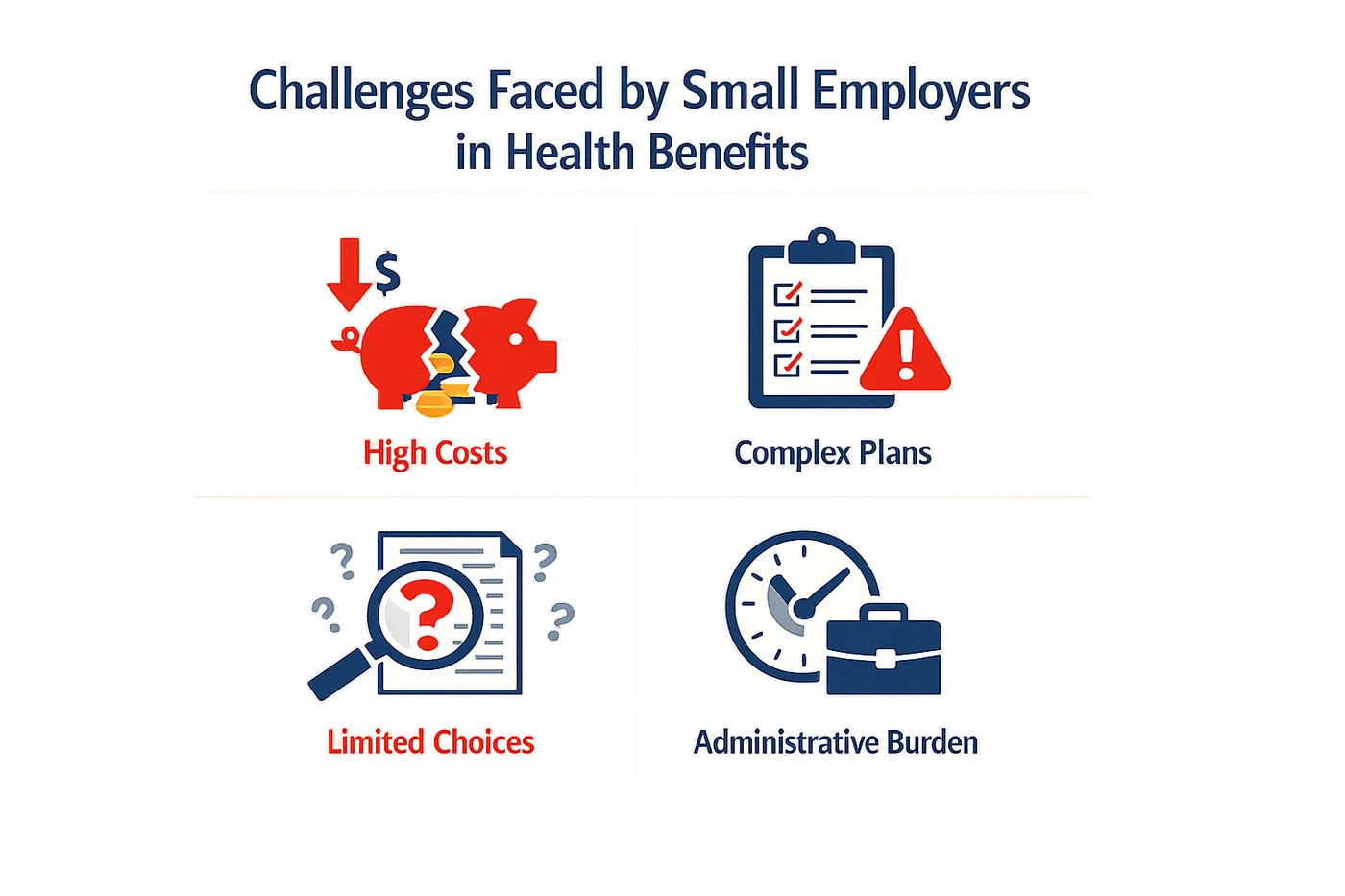
Most small employers don't lose sleep over tax code technicalities. They lose sleep wondering how to keep good people when they can't afford the same health benefits as larger competitors. The math is straightforward: group health insurance premiums have climbed faster than revenue for most small businesses, and the administrative burden of managing a traditional group plan often requires expertise and staff time that a 10-person operation simply doesn't have.
The core challenge breaks down into three pieces. First, traditional group health plans require minimum participation thresholds and employer contribution levels that strain tight budgets. Second, the administrative complexity — from ERISA compliance to COBRA notifications — demands resources most small employers can't spare. Third, employees have different needs: one person values a high-deductible plan paired with an HSA, another needs comprehensive family coverage, and a third already has spousal coverage and would prefer cash compensation instead.
The Cost Ceiling
Group health insurance premiums for small businesses often run $7,000 to $8,000 per employee annually for single coverage, and significantly more for family plans. For a business with narrow margins, committing to that fixed cost — regardless of revenue fluctuations — creates real financial risk. Unlike larger employers who can negotiate better rates and spread risk across hundreds of employees, small employers pay higher per-person premiums and have less bargaining power with insurers.
The result: many small employers either skip health benefits entirely or offer plans with such high deductibles and limited networks that employees question their value. Neither option solves the underlying problem of competing for talent in a market where health benefits are a baseline expectation.
The Administrative Burden
Running a group health plan means navigating enrollment windows, qualifying life events, nondiscrimination testing, and regulatory filings. It means fielding employee questions about coverage details, coordinating with brokers and carriers, and maintaining compliance documentation. For a business owner who's also the primary salesperson, operations manager, and often the bookkeeper, those hours add up quickly.
Smaller employers often lack dedicated HR staff, which means the business owner or office manager handles benefits administration on top of their primary responsibilities. The complexity isn't just a time drain — it's a compliance risk. Miss a COBRA notification deadline or fail to properly document a qualifying event, and the penalties can be substantial.
The Flexibility Gap
Traditional group plans operate on a one-size-fits-most model. The employer selects a plan (or a small menu of plans), and employees choose from those options. But in a small team, individual circumstances vary widely. One employee might be a healthy 25-year-old who wants catastrophic coverage and low premiums. Another might be a 50-year-old managing a chronic condition who needs comprehensive coverage and predictable copays. A third might have excellent coverage through a spouse's employer and would rather receive the employer's health benefit contribution as additional salary.
Group plans can't easily accommodate that range. The employer pays the same contribution for each employee regardless of their actual needs or usage, and employees who don't value the specific plan offered still count against participation requirements. The framework doesn't bend — it forces everyone into the same structure whether it fits or not.
For small employers trying to compete for talent without the budget or infrastructure of larger companies, these challenges create a real bind. They want to offer meaningful health benefits, but the traditional path is often financially unsustainable or operationally impractical. Understanding business succession planning can help employers think strategically about long-term sustainability, including how benefits fit into the larger picture of retaining key employees and building organizational stability.
How QSEHRA Can Solve These Challenges
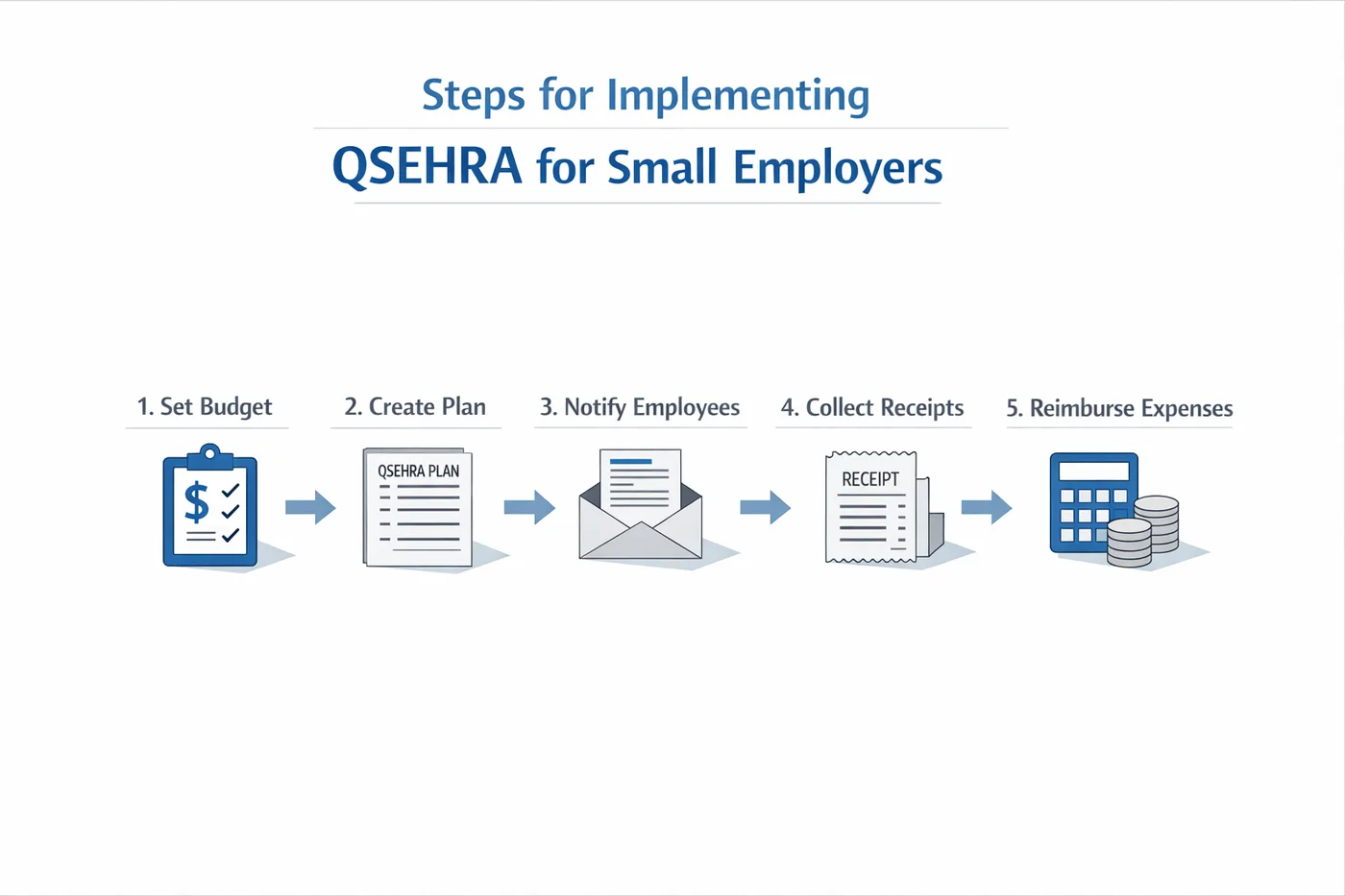
QSEHRA gives small employers a framework for providing health benefits without the administrative burden of traditional group plans. The structure is straightforward: you set a monthly allowance, employees purchase their own health insurance, and you reimburse them up to your chosen amount. The flexibility means you control costs while employees get coverage that fits their needs.
The math works like this: you decide what your business can afford each month, set that as your reimbursement cap, and employees handle the rest. They buy individual health insurance — often through the marketplace — submit proof of coverage and premium payments, and you reimburse them. The reimbursements are tax-deductible for your business and tax-free for employees when they have minimum essential coverage.
Setting Up Your QSEHRA
Step 1
Determine your reimbursement amounts
Start by calculating what your business can realistically commit each month. QSEHRA lets you set different amounts for employees with self-only coverage versus family coverage, but all employees in the same category must receive the same allowance. The IRS sets annual maximums — for 2025, those caps exist but vary by coverage type — so work within those boundaries and your budget.
Step 2
Draft your plan documents
You need written documentation that outlines your QSEHRA terms: who's eligible, how much you'll reimburse, what expenses qualify, and how employees submit claims. This doesn't require complex legal language, but it does need to be clear and consistent. The document serves as both your internal guide and the reference employees use to understand their benefits.
Step 3
Notify employees before coverage begins
The IRS requires you to provide written notice to eligible employees at least 90 days before the start of the plan year — or when they become eligible if that's later. The notice must explain the reimbursement amounts, the requirement that employees maintain health coverage, and how the arrangement affects their eligibility for premium tax credits if they shop on the marketplace.
Step 4
Establish a reimbursement process
Decide how employees will submit documentation — receipts, insurance cards, premium statements — and how quickly you'll process reimbursements. Most small employers handle this monthly, reviewing submissions and issuing payments on a regular schedule. The process doesn't need sophisticated software; a simple spreadsheet and file system work for many businesses with fewer than 50 employees.
Understanding the Tax Advantages
QSEHRA reimbursements reduce your taxable income the same way wages do, but they're not subject to payroll taxes. That means you avoid the 7.65% employer portion of FICA on every dollar you reimburse. For employees, the reimbursements don't count as taxable income as long as they maintain minimum essential coverage — typically any individual health insurance policy qualifies.
The arrangement works differently from business succession planning strategies or retirement accounts like a SEP IRA, where contribution limits and eligibility rules follow different frameworks. QSEHRA is specifically designed for health benefits, and the tax treatment reflects that narrow focus.
What Qualifies for Reimbursement
QSEHRA covers health insurance premiums and medical expenses that would qualify as deductible under IRS rules. That includes doctor visits, prescriptions, dental and vision care, and most out-of-pocket costs. It does not cover expenses that aren't primarily for medical care — gym memberships, vitamins, cosmetic procedures.
The framework is simpler than it sounds: if the expense would count toward a medical deduction on a personal tax return, it generally qualifies for QSEHRA reimbursement. Employees submit documentation, you verify the expense fits the rules, and you process the payment up to their monthly allowance.
The goal is getting in the right range — an allowance that helps employees afford coverage without overextending your business budget.
Eligibility and Coverage Requirements
To offer QSEHRA, your business must employ fewer than 50 full-time equivalent employees and cannot offer a group health plan. Every employee who's worked for you for at least 90 days must be eligible, though you can exclude part-time workers, seasonal employees, and those under age 25. You cannot pick and choose beyond those categories — if someone meets your eligibility criteria, they're in.
The arrangement requires employees to maintain minimum essential coverage. That's IRS language for health insurance that meets basic standards — individual marketplace plans, employer coverage from a spouse's job, Medicare, Medicaid, or TRICARE all count. Without that coverage, the reimbursements become taxable income to the employee.
Tips and Tricks for Maximizing QSEHRA Benefits

Setting up a QSEHRA is one thing. Getting the most value from it — for both your business and your employees — requires a framework. The goal isn't perfection; it's getting in the right range for your specific situation.
Understand the Tax Advantages
The math works like this: QSEHRA reimbursements are tax-deductible for your business and tax-free for employees who maintain minimum essential coverage. That's a double benefit most small employers don't fully realize. When you reimburse an employee for their health insurance premium, you're not paying payroll taxes on that amount, and the employee doesn't report it as income. The framework is straightforward — document everything, follow the contribution limits, and keep records of employee coverage.
Set Contribution Levels That Match Your Budget
Most small employers approach benefit budgets the same way they approach hiring — with good intentions and no clear parameters. Here's a starting point: decide what percentage of an individual premium you can realistically cover, then set your monthly allowance accordingly. You don't have to max out the annual limits. A $300 monthly allowance that you can sustain is worth more than a $600 allowance you'll resent six months in.
The real question is whether the contribution level makes a meaningful difference to employees. If your allowance covers 40 to 60 percent of a typical individual premium in your area, you're in a reasonable range. Anything less might not move the needle; anything more is generous but not required.
Communicate the Benefit Clearly
A common misconception: employees will automatically understand what a QSEHRA is and how to use it. They won't. Most people have never heard the term. Explain it in practical terms — "the company will reimburse you up to X dollars per month for your health insurance premiums, tax-free, as long as you have qualifying coverage."
Provide a simple reimbursement process. A one-page form, a monthly submission deadline, and a consistent payment schedule are enough. The easier you make it, the more employees will actually use the benefit. When employees don't submit reimbursement requests, the benefit costs you nothing — but it also delivers nothing.
Coordinate with Other Business Tax Strategies
If you're already working with a tax professional on strategies like the QBI deduction, mention your QSEHRA. The deduction for QSEHRA contributions reduces your net business income, which can affect your qualified business income calculation. It's not complicated, but it's worth understanding how the pieces fit together.
The cheapest benefit is the one employees actually use — and a QSEHRA only works if reimbursement requests get submitted on time.
Keep Records You Can Hand an Auditor
The IRS expects documentation. That means proof of employee coverage, records of reimbursement requests, and a clear trail showing you followed the nondiscrimination rules. Most small employers don't get audited, but the ones who do wish they'd kept better records. A simple spreadsheet tracking monthly allowances, submitted receipts, and reimbursement dates is usually enough.
Store employee insurance cards or coverage verification letters in a secure file. If an employee leaves mid-year, document when their eligibility ended. The goal is a paper trail that makes sense to someone who wasn't there when you set it up.
Review and Adjust Annually
Contribution limits change. Employee headcount changes. Your budget changes. Review your QSEHRA setup every year before the plan renews. If you've grown past 50 employees, you're no longer eligible for a QSEHRA going forward — though existing arrangements can continue under certain conditions. If your financial situation has improved, consider increasing the allowance. If it's tighter, you can reduce it for the next plan year as long as you notify employees in advance.
The honest answer: most small employers set a QSEHRA and forget about it. The ones who get the most value treat it like any other business expense — review it, adjust it, and make sure it's still serving its purpose.
Conclusion: Embracing QSEHRA
QSEHRA offers small employers a straightforward framework for providing health benefits without the complexity of traditional group plans. The math is simple: employers set a monthly allowance, employees purchase their own coverage, and both sides benefit from tax advantages. For businesses with fewer than 50 employees, this arrangement delivers flexibility that group plans can't match.
The real advantage is control. Employers decide the reimbursement amount, employees choose the coverage that fits their situation, and the administrative burden stays manageable. No network restrictions, no plan design committees, no carrier negotiations. Just a defined contribution that employees use for qualified medical expenses.
The framework works because it aligns employer budgets with employee needs. Employers get predictable costs and tax deductions. Employees get tax-free reimbursements for coverage they actually want. When you're ready to take the next step, talk to a licensed financial professional who can walk through the setup requirements and compliance details specific to your business.
Most small employers don't realize how accessible health benefits can be. QSEHRA removes the barriers that made group coverage impractical and replaces them with a structure that scales with your team. For businesses looking to attract talent and support their employees without overextending their budget, it's worth understanding how this arrangement fits into your overall compensation strategy.