
Introduction to Buy-Sell Agreements
Most business partners spend months negotiating who does what, who owns what percentage, and how profits get split. Then they shake hands, file the paperwork, and get to work. The question nobody wants to ask: what happens if one of you dies tomorrow?
A buy-sell agreement answers that question before it becomes a crisis. It's a legal contract between business owners that establishes exactly what happens to an owner's stake when they exit the business — whether through death, disability, retirement, divorce, or simply wanting out. The agreement sets the terms: who can buy the departing owner's share, how the business gets valued, and how the purchase gets funded.
Here's what that actually means in practical terms. When a triggering event occurs — say a partner passes away — the agreement activates automatically. It typically gives the surviving partners the right (and sometimes the obligation) to purchase the deceased partner's ownership stake at a pre-determined price or using a pre-agreed valuation formula. This prevents the deceased partner's family from becoming unwanted business partners and prevents the surviving partners from losing control of the company they built.
The Role of Buy-Sell Agreement Insurance
The framework is straightforward, but the math gets real fast. If three equal partners each own a third of a business valued at $3 million, a departing partner's stake is worth $1 million. Most businesses don't have a spare million sitting in the bank account. That's where buy-sell agreement insurance comes in.
Buy-sell agreement insurance — typically structured using life insurance policies — provides the funding mechanism that makes the agreement work. Each partner is insured for an amount equal to their ownership stake, with the other partners or the business itself as beneficiaries. When a triggering event occurs, the insurance proceeds provide immediate cash to purchase the departing owner's share at the agreed-upon price.
The cheapest buy-sell agreement is the one that's already funded when you need it — not the one you scramble to finance during a crisis.
Without insurance funding, surviving partners face impossible choices: drain the business of working capital to buy out the departing owner's family, take on debt that could sink the company, or watch the family force a sale of the entire business to extract their value. Insurance funding removes those scenarios from the table.
The honest answer: most small business partnerships operate without these protections. The assumption is that everyone will stay healthy, stay married, stay motivated, and retire at roughly the same time. That assumption works until it doesn't — and when it fails, the consequences destroy businesses and relationships that took decades to build. A buy-sell agreement backed by appropriate insurance coverage is the framework that protects what you've built, regardless of what happens next.
The Need for Protection in Business Partnerships
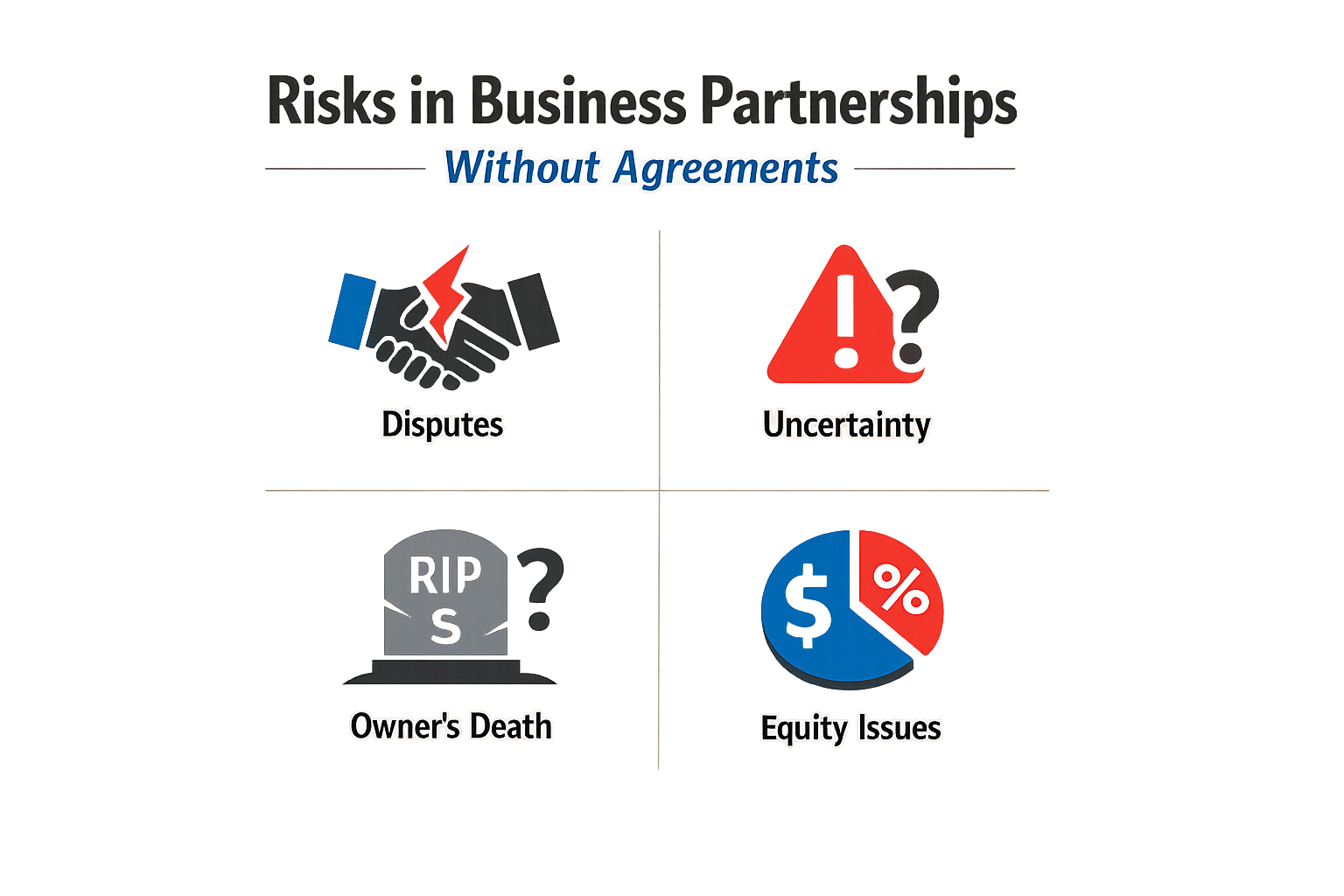
Most business partners don't think about what happens when someone wants out — until someone wants out. A partner retires, gets divorced, becomes disabled, or passes away. Without a framework in place, the remaining partners face an immediate problem: who gets the departing partner's share, at what price, and on what timeline.
The math is straightforward. In a three-partner firm where each owns a third, one partner's unexpected death means their spouse or estate suddenly owns a third of the business. The surviving partners now have a co-owner who may have no interest in running the company, no expertise in the industry, and every reason to demand immediate cash value for an illiquid asset. That's the scenario a buy-sell agreement prevents.
What Happens Without Protection
When a triggering event occurs — death, disability, retirement, divorce, or voluntary exit — and no agreement exists, the business faces several simultaneous risks. Ownership becomes uncertain. The departing partner's interest may transfer to heirs, a former spouse, or creditors who have no stake in the company's success. Valuation disputes arise immediately because there's no pre-agreed formula. The remaining partners may lack the cash to buy out the interest even if they can negotiate a price.
Business continuity suffers during these disputes. Banks and vendors get nervous when ownership is in flux. Key employees start looking for stable opportunities elsewhere. Customers wonder whether the company will honor long-term commitments. The operational distraction alone can damage revenue while partners argue over terms that should have been settled years earlier.
The Cost of Uncertainty
The real question is whether the business can survive the transition period. A company worth several million dollars on paper may have minimal liquid assets. Real estate, equipment, and accounts receivable don't convert to cash quickly enough to fund a buyout. The remaining partners either finance the purchase at whatever terms they can negotiate under pressure, or they accept a new co-owner they didn't choose.
The cheapest buy-sell agreement is the one you fund before you need it — the most expensive is the one you negotiate after a triggering event.
Valuation becomes a battleground without a predetermined method. The departing owner's family wants fair market value based on the company's best year. The remaining partners argue for a discount because the business is suddenly less stable. Both sides hire appraisers. Legal fees accumulate. The company's value may actually decline during the dispute, making the whole argument academic.
Tax complications multiply when ownership transfers without planning. Estate taxes, gift taxes, and income tax consequences depend on how the transaction is structured. A properly designed buy-sell agreement addresses these issues in advance, when all parties can think clearly and negotiate fairly. An improvised buyout during a crisis rarely optimizes for tax efficiency.
The framework exists to prevent these problems. A buy-sell agreement establishes the rules before emotions and urgency take over. It defines triggering events, sets the valuation method, determines the funding source, and creates a timeline everyone understands. The goal is getting in the right range on all these variables while the partners still agree on what's fair.
Steps to Establish a Buy-Sell Agreement
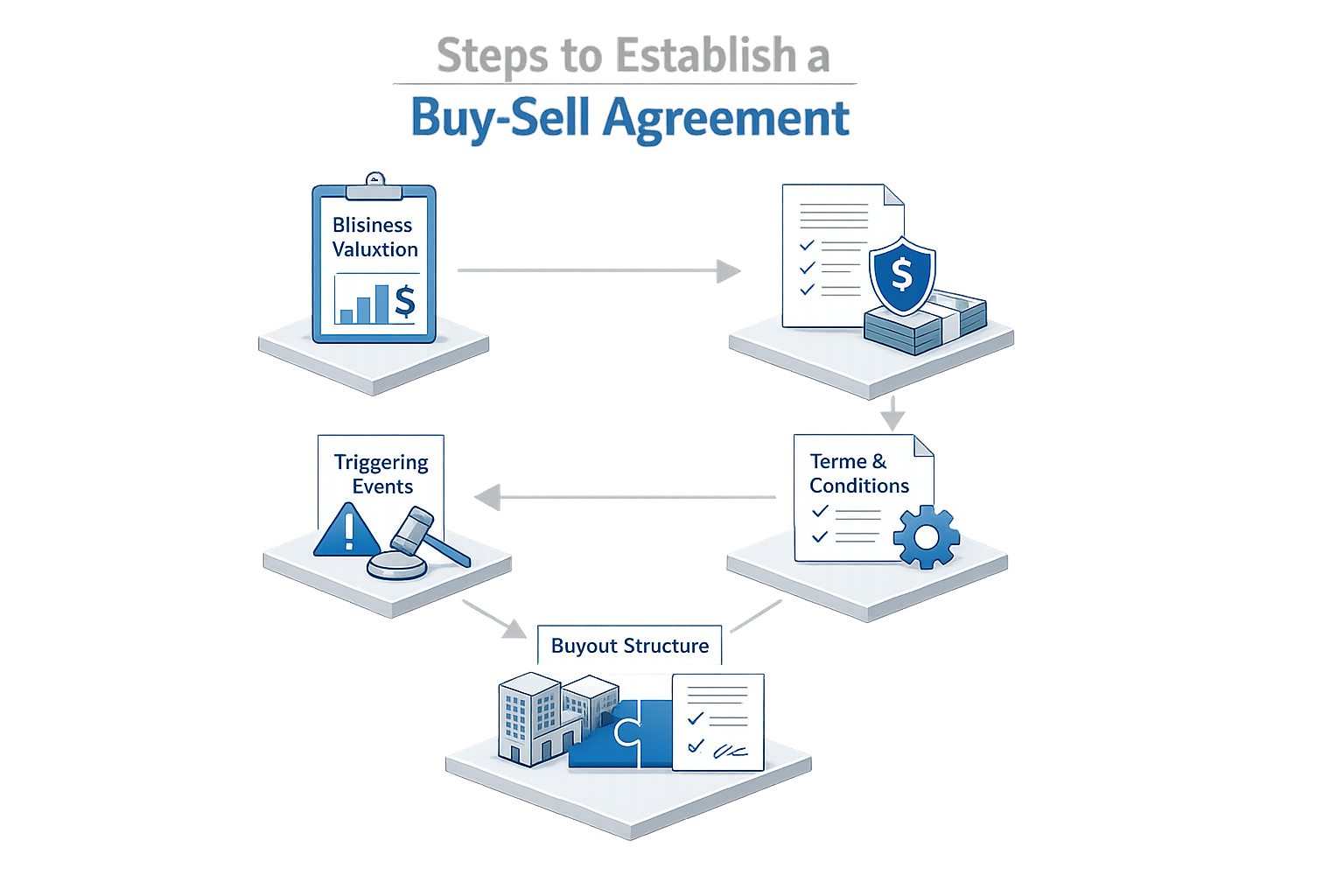
Creating a buy-sell agreement isn't as complicated as it sounds, but it does require attention to detail and coordination between partners, legal counsel, and often financial professionals. The framework follows a logical sequence — define the triggering events, set the valuation method, arrange the funding, and document everything in writing.
Most partnerships delay this conversation until a crisis forces it. The better approach is treating the buy-sell agreement as foundational infrastructure, established when relationships are strong and everyone's thinking clearly.
Identify Triggering Events
Start by listing the specific events that trigger a buyout. Common triggers include death, disability, retirement, voluntary exit, divorce, bankruptcy, or loss of professional license. Each partner needs to agree on which events apply and whether the buyout is mandatory or optional in each scenario. The goal is eliminating ambiguity — when an event happens, everyone knows what comes next.
Some agreements distinguish between voluntary and involuntary departures. A partner who retires at 65 might receive different terms than one who leaves to join a competitor. The key is documenting these distinctions before emotions run high.
Establish the Valuation Method
The valuation method determines what a departing partner's share is worth. Options include fixed dollar amounts (updated annually), formulas based on revenue or earnings multiples, independent appraisals, or a combination. The method needs to be fair, clear, and executable without requiring unanimous agreement at the time of exit.
Many agreements use a formula tied to trailing twelve-month earnings, adjusted for one-time events. Others require an annual valuation by an independent appraiser, with the cost split among partners. The worst outcome is a method that sounds reasonable on paper but proves impossible to execute when tested.
Arrange Funding Through Insurance
The math works like this: if each partner's share is worth $1 million, the remaining partners need $1 million in cash to execute the buyout. Most partnerships fund this through life insurance, with each partner owning a policy on the others (cross-purchase structure) or the entity owning policies on all partners (entity-purchase structure).
Buy-sell agreement insurance ensures the cash is available when needed, without forcing the business to liquidate assets or take on debt. Disability insurance can fund buyouts triggered by long-term disability. The policies are typically structured so that death benefit proceeds received under the partnership exception remain tax-free to the recipient.
Document the Agreement in Writing
Once partners agree on triggers, valuation, and funding, an attorney drafts the formal buy-sell agreement. This document specifies each partner's rights and obligations, payment terms (lump sum or installments), and dispute resolution procedures. All partners sign, and the agreement is filed with the business's corporate records.
The agreement should reference the insurance policies by policy number and specify how proceeds are applied to the purchase price. If the business owns the policies, the corporate records need to show the entity as owner and beneficiary. If partners own policies on each other, the agreement documents that structure.
Review and Update Regularly
A buy-sell agreement isn't a one-time document. Business values change, partners' circumstances shift, and tax laws evolve. Schedule a formal review every 2-3 years, or whenever a major event occurs — adding a new partner, significant revenue growth, changes in ownership percentages, or updates to estate plans.
During each review, confirm that insurance coverage still matches current valuations. A policy purchased when each partner's share was worth $500K won't cover a buyout when that share has grown to $2M. Adjusting coverage before it's needed is straightforward; scrambling to find funding during a crisis is not.
Tips and Tricks for Effective Buy-Sell Agreements
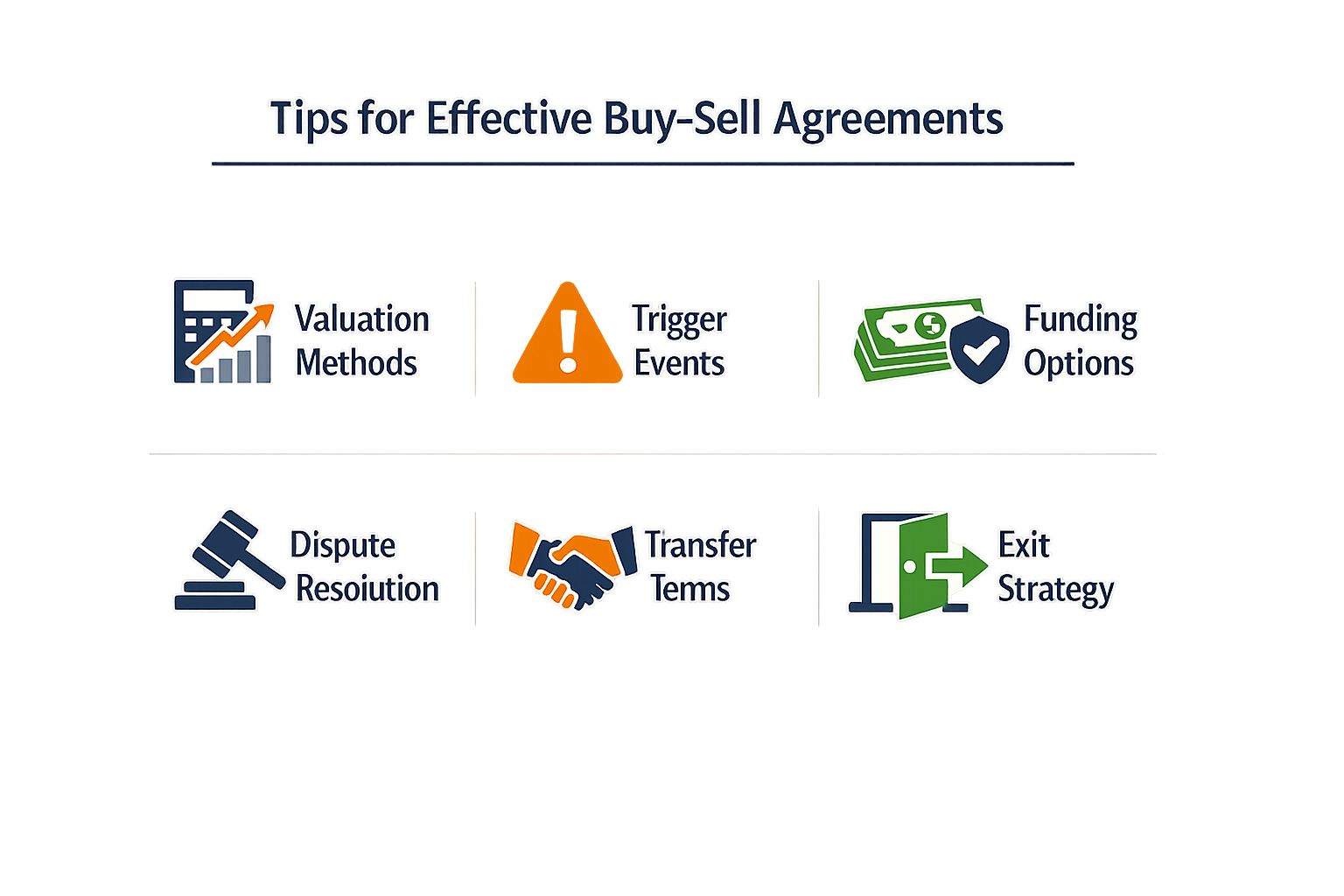
A buy-sell agreement is only as good as the thought that goes into it. Most partnerships draft one because their attorney or accountant mentioned it, then file it away and never look at it again. The real work happens when you treat the agreement as a living framework that evolves with your business.
Fund the Agreement Properly
The most common mistake is creating a buy-sell agreement without a funding mechanism. The agreement itself doesn't create cash — it just creates an obligation. If a triggering event occurs and the remaining partners don't have the funds to buy out the departing owner's share, the agreement becomes a legal headache instead of a solution.
Life insurance is the most straightforward funding method for death-triggered buyouts. The acquirer maintains the life insurance contract on the insured to ensure that funds are available to purchase assets or satisfy liabilities upon the insured's death. Each partner owns a policy on the other partners, with death benefits equal to their buyout obligation. The premiums are predictable, and the payout is guaranteed when it's needed most.
Review and Update Regularly
Business valuations change. A company worth $500,000 when you drafted the agreement might be worth $2 million five years later. If your buy-sell agreement still uses the original valuation formula or a stale fixed price, it's not protecting anyone.
Schedule a formal review every two to three years, or whenever a major business event occurs — a new product line, a significant client win, a shift in market conditions. Update the valuation method if needed, adjust insurance coverage amounts, and confirm that the triggering events still make sense for your current partnership structure.
Understand the Tax Implications
The tax treatment of a buyout depends on how the agreement is structured. In some cases, the basis in an insurance policy transfers when ownership changes, which can affect the tax-free status of the death benefit. The research shows that when a corporation acquires a policy, the basis may be linked to the original owner's basis, highlighting the importance of understanding tax implications in buy-sell agreements. source
Work with a tax professional who understands business succession. The difference between a cross-purchase structure and an entity-purchase structure can have significant tax consequences for both the departing owner and the remaining partners.
Define Triggering Events Clearly
Most agreements cover death, disability, and voluntary departure. But what about divorce, bankruptcy, or criminal conviction? What if a partner wants to sell to an outside buyer? What if a partner stops showing up but won't formally resign?
The more specific your triggering events, the fewer disputes you'll have later. Define disability with objective criteria — not just "unable to work," but "unable to perform essential job functions for 90 consecutive days as certified by two independent physicians." Specify whether a voluntary departure requires six months' notice or can happen immediately.
Get Independent Valuations
When a triggering event occurs, emotions run high. The departing partner's family wants top dollar. The remaining partners want to preserve cash for operations. A pre-agreed valuation method — preferably one that uses an independent third-party appraiser — removes the negotiation from the worst possible moment.
Some agreements use a formula based on revenue multiples or book value. Others require a formal appraisal every year, with that value locked in until the next annual review. The specific method matters less than having one that all partners agreed to when nobody was under pressure.
The best buy-sell agreement is the one you never have to use — but when you do, it works exactly as intended because you planned for specifics, not generalities.
Coordinate with Estate Plans
A buy-sell agreement doesn't exist in isolation. It intersects with each partner's personal estate plan, especially regarding beneficiary designations and estate tax planning. If a partner's will assumes their business interest passes to their spouse, but the buy-sell agreement requires a buyout, those documents are in conflict.
Make sure your estate planning attorney and your business attorney are talking to each other. The buy-sell agreement should complement your overall wealth transfer strategy, not contradict it.
Conclusion: The Importance of Buy-Sell Agreements
Buy-sell agreement insurance isn't about planning for disaster — it's about removing uncertainty. When business partners know exactly what happens if someone exits, retires, or passes away, they can focus on building the business instead of worrying about what-ifs. The framework is straightforward: define the triggering events, establish a fair valuation method, and fund the agreement so the money is there when needed.
Most business partnerships start with optimism and end with questions no one wants to answer under pressure. A properly structured buy-sell agreement answers those questions in advance. It protects the departing partner's family by guaranteeing fair compensation. It protects the remaining partners by preventing unwanted third parties from acquiring ownership. And it protects the business itself by ensuring continuity when leadership changes.
The honest answer is that most small business owners put this off longer than they should. The conversation feels premature when everyone's healthy and the business is growing. But the time to establish the agreement is before you need it — when valuations are clear, relationships are strong, and everyone can negotiate from a position of calm.
The cost of establishing a buy-sell agreement is predictable and manageable. The cost of not having one — family disputes, forced liquidation, or losing control of the business you built — is neither. When you're ready to take the next step, start with an honest conversation among all partners about what each person wants to happen if circumstances change. That conversation, documented properly and funded appropriately, becomes the foundation of a buy-sell agreement that actually works.