
Introduction
Most people don't lie awake wondering about IRA conversion strategies. They lie awake wondering how to save for retirement when the tax-advantaged accounts designed for that purpose won't let them contribute.
For high earners, Roth IRAs offer a compelling benefit: tax-free growth and tax-free withdrawals in retirement. The problem is the income ceiling. Once your modified adjusted gross income crosses certain thresholds, the IRS phases out your ability to contribute directly to a Roth IRA. For married couples filing jointly, that phase-out begins at $150,000 and completes at $160,000.
The backdoor roth ira conversion provides a workaround. This strategy allows individuals who earn too much for direct Roth contributions to still fund a Roth IRA through a two-step process: contribute to a traditional IRA (which has no income limits for contributions, only for deductibility), then convert those funds to a Roth IRA. The conversion itself has no income restrictions.
Navigating the world of retirement accounts can be daunting, especially for high earners who find themselves restricted by income limits. The backdoor Roth IRA approach involves making a nondeductible contribution to a traditional IRA and then converting it to a Roth IRA. However, the tax implications matter — particularly the pro-rata rule, which can affect the taxability of the conversion if you have other traditional IRA funds.
The framework is straightforward, but the execution requires attention to timing, tax reporting, and existing IRA balances. For those considering this strategy, understanding the nuances is key to avoiding unexpected tax bills and maximizing the benefits of tax-free retirement growth.
Problem Statement: Income Limits on Roth IRA Contributions
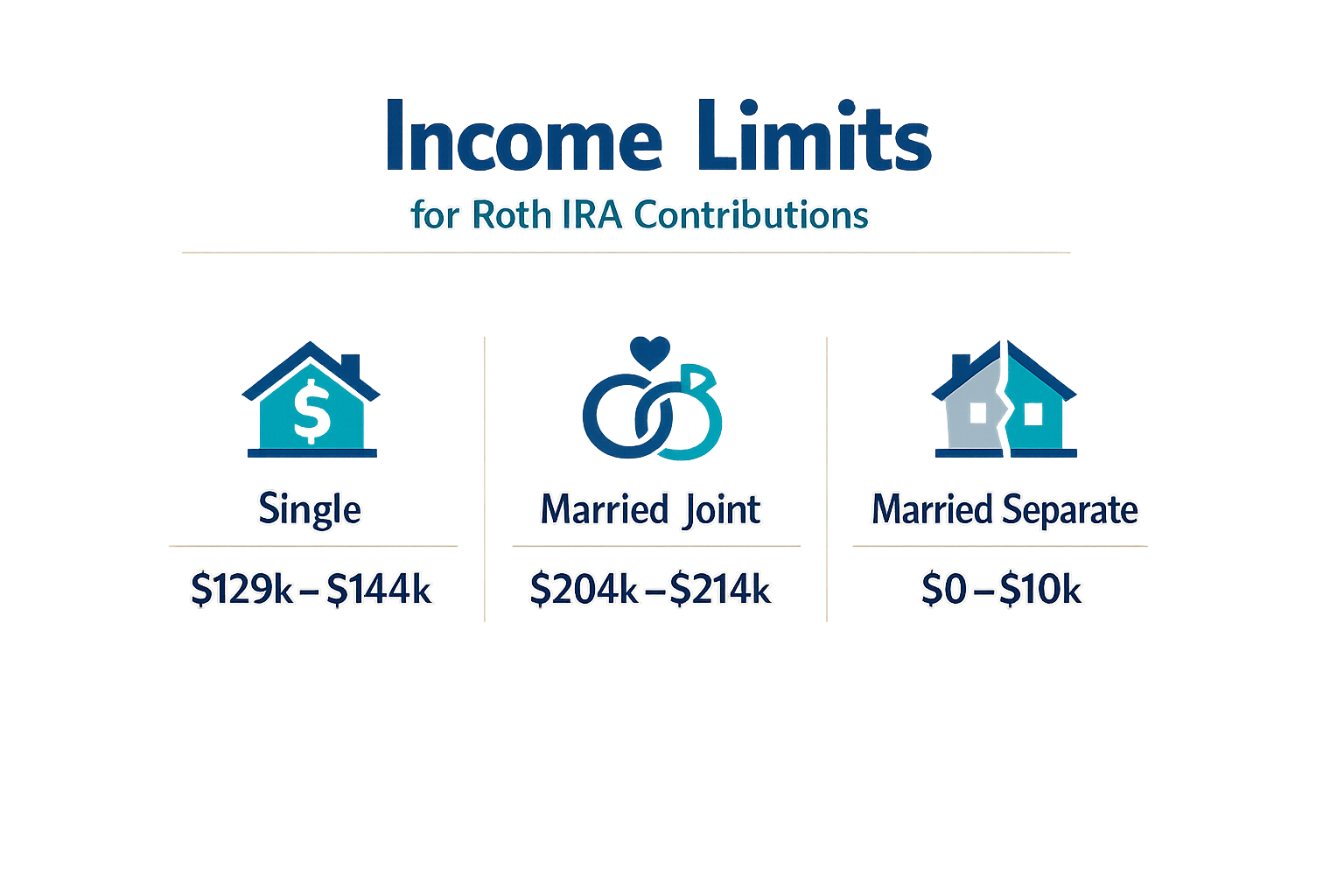
Roth IRAs offer tax-free growth and tax-free withdrawals in retirement — a powerful combination for long-term wealth building. The problem: the IRS restricts who can contribute directly based on income. Once your earnings cross certain thresholds, your ability to make direct Roth IRA contributions phases out and eventually disappears entirely.
Here's where the math works. For single filers and heads of household, the phase-out begins at a modified adjusted gross income (MAGI) of $150,000. If your income reaches that level, you can still make a partial contribution, but the amount you're allowed to contribute decreases as your income rises. Once your MAGI hits $160,000 or more, direct Roth IRA contributions are off the table completely.
Married couples filing jointly face a different set of numbers, though the structure is the same. The phase-out range runs from $236,000 to $246,000 in modified AGI. Below $236,000, you can contribute the full amount. Above $246,000, direct contributions aren't permitted. The difference between these two filing statuses matters when you're planning your approach.
Why These Limits Create a Planning Gap
The income restrictions don't align with the realities of retirement savings needs. A household earning $250,000 faces the same long-term retirement challenges as one earning $200,000 — often more so, given higher living costs and lifestyle expectations. Yet the lower-earning household can contribute directly to a Roth IRA while the higher-earning one cannot.
This is where the backdoor Roth IRA conversion strategy enters the picture. The framework exists because the IRS places income limits on Roth IRA contributions but not on Roth IRA conversions. That distinction creates a legal pathway for high earners to fund Roth accounts indirectly, even when direct contributions are blocked.
The IRS restricts Roth contributions by income, but conversions have no income ceiling — that's the opening high earners use.
Most people don't realize that traditional IRA contributions have no income limits for the act of contributing itself. You can always put money into a traditional IRA regardless of how much you earn. The income limits on traditional IRAs apply only to whether those contributions are tax-deductible. For high earners executing a backdoor Roth strategy, the deductibility question is irrelevant — the contribution is made on an after-tax basis from the start, specifically because it's destined for conversion.
The real question is whether the added complexity and potential tax implications of the backdoor approach are worth it for your specific situation. That depends on factors like your existing traditional IRA balances, your time horizon until retirement, and your current versus expected future tax rates.
Solution Steps: How to Execute a Backdoor Roth IRA
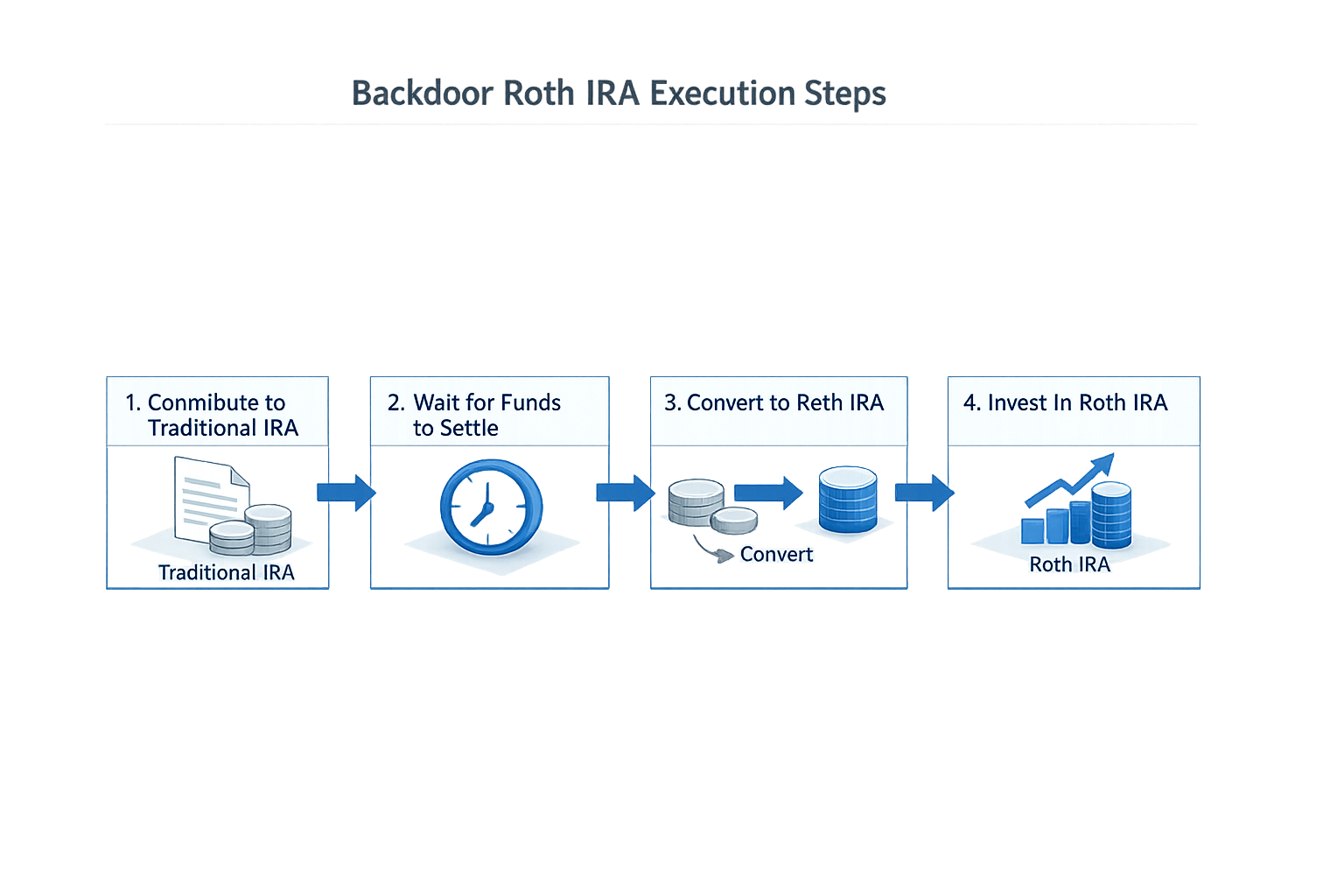
The backdoor Roth IRA conversion process follows a straightforward two-step framework. The IRS recognizes three methods for converting traditional IRA funds to a Roth IRA, and understanding which one fits your situation makes the process cleaner.
The Conversion Methods
You have three ways to move money from a traditional IRA to a Roth IRA. The first is a rollover — you receive a distribution from the traditional IRA and contribute it to the Roth IRA within 60 days. The second is a trustee-to-trustee transfer, where you direct the traditional IRA trustee to transfer the amount directly to the Roth IRA trustee. The third is a same-trustee transfer, where both accounts are held at the same financial institution.
Most people use the trustee-to-trustee transfer because it eliminates the risk of missing the 60-day deadline and avoids having the funds in your hands during the conversion.
Step 1
Make a nondeductible contribution to a traditional IRA
Contribute to a traditional IRA without taking a tax deduction. The contribution limit is the same as it would be for a direct Roth contribution, but there's no income restriction on making nondeductible traditional IRA contributions. Keep records of this nondeductible contribution — you'll need them for tax reporting.
Step 2
Convert the traditional IRA to a Roth IRA
Once the contribution settles in your traditional IRA, initiate the conversion to a Roth IRA. Contact your financial institution and request either a trustee-to-trustee transfer or a same-trustee transfer. The converted amount is treated as a distribution from the traditional IRA and a qualified rollover contribution to the Roth IRA.
Understanding the Tax Treatment
Here's what that actually means for your tax return: any amount converted to a Roth IRA is included in your gross income for the taxable year in which the distribution or transfer occurs. The exception is any portion treated as a return of basis — that part isn't taxable.
If you made a nondeductible contribution and convert it immediately, most of the conversion should be tax-free because you're converting your basis. The math works like this: you already paid tax on the money you contributed, so you're only taxed on any earnings that accumulated between the contribution and the conversion.
Timing Considerations
The conversion can happen in the same year as the contribution or in a later year. Many people convert shortly after contributing to minimize earnings that would be taxable. There's no waiting period required by the IRS, though some financial institutions may have processing timelines.
The taxable portion of the conversion gets reported on your tax return for the year the conversion occurs, not the year you made the original contribution if those are different years.
Tips and Tricks for a Successful Backdoor Roth IRA
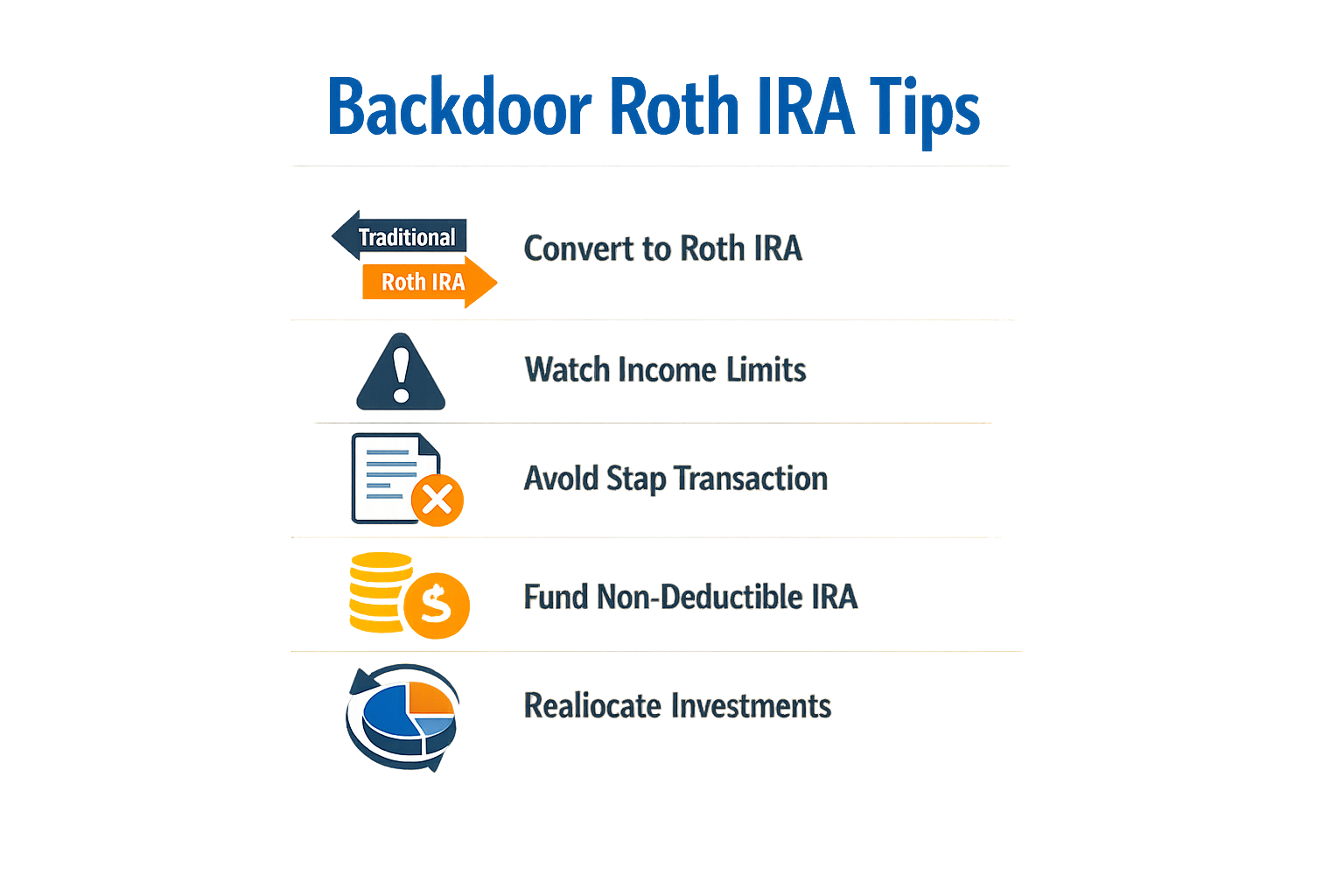
Executing a backdoor Roth IRA conversion correctly means understanding the details that keep the process clean and tax-efficient. Most people get tripped up on timing, withholding, and how the IRS treats contributions across multiple accounts. Here's what actually matters when you're setting this up.
Timing Your Contributions and Conversions
The date you make your initial contribution to the traditional IRA matters for tax reporting. When you move that money to the Roth IRA, the IRS treats the contribution as having been made on the original date — not the conversion date. This means if you contribute in December and convert in January, the contribution year is still the earlier calendar year.
For practical purposes, most people execute both steps in the same tax year to keep their paperwork straightforward. The framework here is simple: contribute to the traditional IRA, then convert to the Roth IRA within a short window — ideally days or weeks, not months.
Understanding Withholding Requirements
One detail worth understanding: certain conversion methods don't require tax withholding. When you execute a trustee-to-trustee transfer from your traditional IRA to your Roth IRA with the same or a different custodian, the financial institution isn't required to withhold taxes at the time of conversion. This gives you more control over your tax planning.
The real question is whether you want withholding or not. If you're converting a nondeductible contribution with minimal earnings, the tax bill should be small or zero. In that case, skipping withholding means more money lands in your Roth account immediately.
Filing Requirements for Married Couples
Married individuals face a specific rule when converting funds to a Roth IRA. Both spouses must file a joint return in the year of the conversion, and the modified adjusted gross income calculation uses the couple's combined income. This requirement exists even though the backdoor Roth IRA strategy itself works around income limits.
In practical terms, if you're married and filing separately, the backdoor Roth IRA conversion isn't available to you that year. The math only works with joint filing status.
Distribution Rules and Ordering
Once your conversion is complete, understanding how distributions work from your Roth IRA helps with long-term planning. The IRS applies ordering rules that determine which dollars come out first when you take a distribution. Conversion contributions have their own treatment in this hierarchy, separate from regular contributions and earnings.
This matters if you're younger than 59½ and might need to access the funds. The ordering rules affect whether a withdrawal triggers taxes or penalties, depending on your circumstances.
The cheapest conversion is the one you execute cleanly the first time — no amended returns, no surprise tax bills, no cleanup work two years later.
Keeping Clean Records
Document every step. Your traditional IRA contribution, the amount of any earnings before conversion, and the conversion itself all need to appear on the right tax forms. Form 8606 tracks nondeductible contributions and conversions — filing it correctly is what keeps the IRS from treating your conversion as fully taxable income.
Most people don't realize that missing or incorrect Form 8606 filings can create tax problems years later. The framework is straightforward: contribute, convert, document. Skip the documentation step and you're building a tax headache.
Conclusion
The backdoor Roth IRA conversion offers high earners a practical framework for building tax-free retirement savings when direct Roth IRA contributions aren't available. The math is straightforward: contribute to a traditional IRA, convert to a Roth IRA, and position those funds for tax-free growth. For individuals earning above the Roth IRA income limits — $150,000 for single filers and $236,000 for married couples filing jointly in 2025 — this strategy provides access to benefits that would otherwise be out of reach.
The process requires attention to detail, particularly around timing and the pro-rata rule, but it's not as complicated as it sounds. Most people don't realize that the IRS has maintained this conversion pathway consistently since Roth IRAs were introduced in 1998, making it a stable planning tool rather than a temporary loophole. The key is understanding your specific situation: whether you have existing traditional IRA balances, how quickly you can execute the conversion, and whether the tax implications align with your broader financial goals.
When you're ready to take the next step, talk to a licensed financial professional who can evaluate whether this strategy fits your circumstances. The framework is solid, but the execution depends on your individual tax situation, existing retirement accounts, and long-term planning objectives. For high earners looking to build tax-diversified retirement savings, the backdoor Roth IRA conversion remains one of the most straightforward tools available.
Learn how high earners can utilize the Backdoor Roth IRA to contribute to retirement savings despite income limits.
Related reading
What is a Contingent Beneficiary? Meaning and Why You Need One