
Introduction
Most people don't lie awake wondering about their full retirement age. They lie awake wondering whether they can afford to retire at all — and whether claiming Social Security early will solve that problem or create a bigger one down the road.
Understanding your full retirement age is crucial when planning for Social Security benefits. This age, determined by your birth year, dictates when you can claim full benefits without any reductions. For many, the temptation to claim benefits early is strong, but doing so can lead to a permanent reduction in monthly payments.
The math works like this: your full retirement age is the baseline. Claim before that age, and your monthly benefit drops. Wait past that age, and your benefit increases. The difference between these choices can add up to tens of thousands of dollars over a retirement that might last 20 or 30 years.
The real question is not just when you can claim, but when to claim based on your specific situation. That decision depends on your health, your other income sources, whether you plan to keep working, and how long you expect to need the income. Conversely, delaying your claim past your full retirement age can increase your benefits — worth understanding when you're mapping out your retirement timeline.
This framework applies whether you're planning years ahead or approaching retirement age right now. The goal is getting in the right range for your circumstances, not finding a one-size-fits-all answer that doesn't exist.
Problem Statement
Most people approach Social Security claiming the same way they approach New Year's resolutions — with good intentions and no framework. The result is predictable: confusion about when they can actually claim their full benefit, what happens if they claim early, and whether waiting longer makes financial sense.
The honest answer is that Full Retirement Age isn't as straightforward as it sounds. It's not 65 for everyone, and it's not the same as the earliest age you can claim benefits. This creates three common misconceptions that cost retirees thousands of dollars over their lifetimes.
The Early Claiming Trap
Many people assume they can claim Social Security as soon as they're eligible at age 62. The math works like this: claiming before your Full Retirement Age means accepting a permanent reduction in your monthly benefit. That reduction isn't temporary — it follows you for the rest of your retirement.
The reduction isn't small. Depending on how early you claim, you could receive 25% to 30% less each month than if you'd waited until your Full Retirement Age. For someone entitled to $2,000 monthly at Full Retirement Age, claiming at 62 could mean receiving only $1,400 instead — a $600 monthly difference that compounds over decades.
The Birth Year Confusion
A common misconception is that Full Retirement Age is the same for everyone. It's not. Your Full Retirement Age depends entirely on your birth year, and it ranges from 66 to 67 for most people retiring today. Someone born in 1957 has a different Full Retirement Age than someone born in 1960, even though they might be retiring around the same time.
This creates planning problems. People often base their retirement timeline on what worked for their parents or friends, not realizing the rules have shifted. The framework changed gradually, and most people don't realize where they fall in the timeline.
The Delayed Retirement Credit Mystery
On the other end, there's confusion about what happens if you wait past your Full Retirement Age to claim benefits. The short answer: your benefit increases by a specific percentage for each month you delay, up to age 70. But most people don't understand how that credit works or whether it makes sense for their specific situation.
The real question is whether the increase from delayed claiming outweighs the years of benefits you're forfeiting by waiting. That calculation depends on your health, your other income sources, and your overall financial picture — factors that vary significantly from one person to the next.
The cheapest retirement mistake is the one you don't realize you're making until the checks start arriving.
Understanding these distinctions — between earliest eligibility, Full Retirement Age, and delayed retirement credits — is worth the effort. The difference between claiming at the right time and claiming at the wrong time can mean tens of thousands of dollars over a 20- or 30-year retirement.
Solution Steps to Understand Full Retirement Age
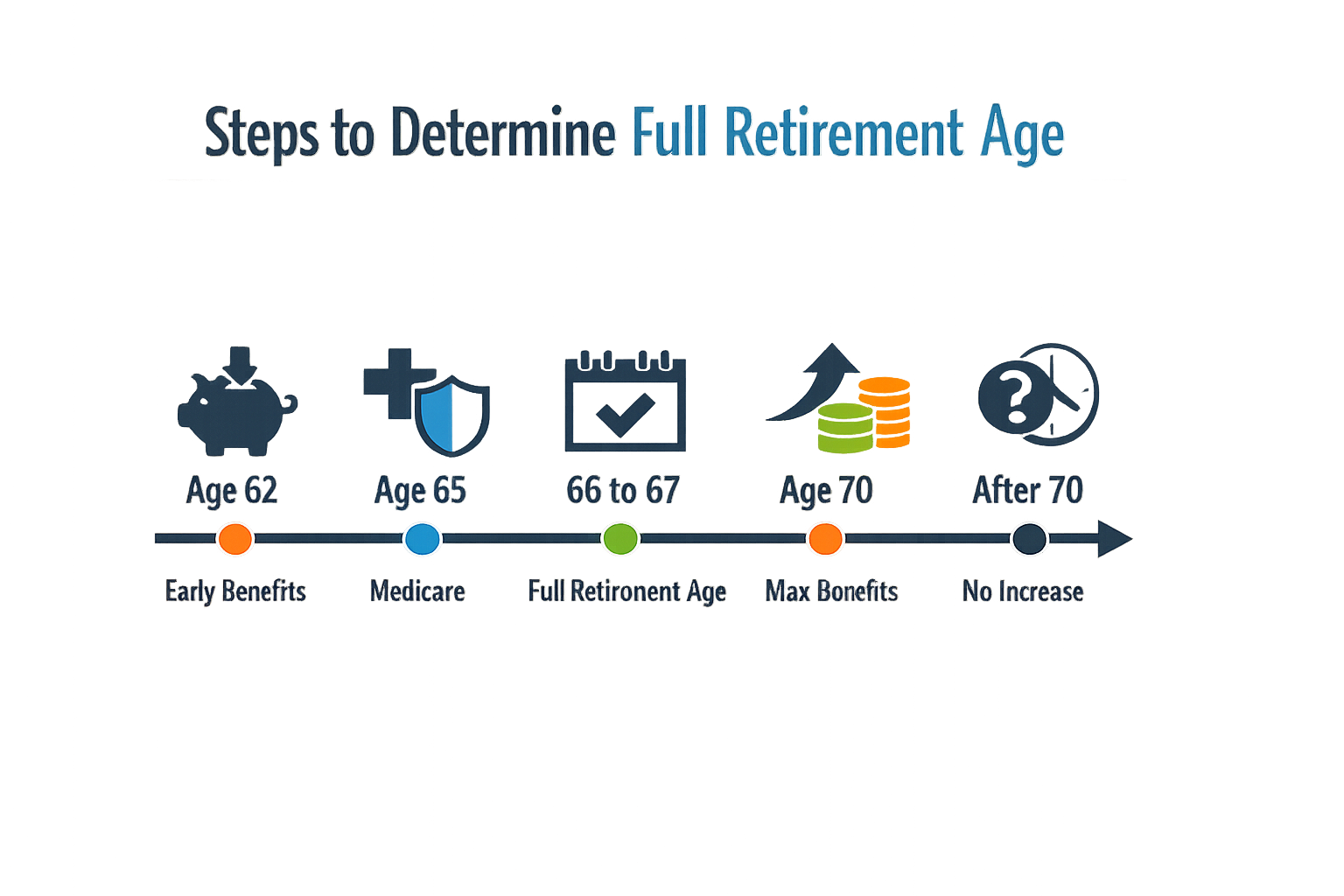
Determining your social security full retirement age doesn't require complex calculations or professional software. The framework is straightforward once you know where your birth year falls in the schedule.
Step 1: Identify Your Birth Year
The first step is simple: locate your birth year. Full retirement age is determined entirely by when you were born. The Social Security Administration uses birth year ranges to assign specific ages, so you'll need your exact year — not an approximation.
Step 1
Find your birth year range
Write down your birth year and compare it to the official Social Security Administration schedule. Birth years fall into distinct brackets, each with its own full retirement age. If you were born between 1943 and 1954, your full retirement age is 66. For those born in 1960 or later, it's 67. The years in between follow a graduated schedule that increases by two months per year.
Step 2: Calculate Your Exact Full Retirement Age
Once you've identified your birth year range, the math works like this: if you were born in a transitional year (1955–1959), your full retirement age is 66 plus a specific number of months. For example, someone born in 1957 reaches full retirement age at 66 years and 6 months.
Step 2
Add the month increment
For birth years 1955 through 1959, add two months to age 66 for each year after 1954. A 1955 birth year means 66 and 2 months; 1956 means 66 and 4 months; and so on. This graduated approach bridges the gap between the older 66-year standard and the current 67-year standard.
Step 3: Mark Your Claiming Window
With your full retirement age identified, you can map out your claiming options. You're eligible to claim as early as age 62, but doing so triggers a permanent reduction in your monthly benefit. Waiting past your full retirement age increases your benefit up to age 70.
Step 3
Map your timeline
Create a simple timeline with three markers: age 62 (earliest eligibility), your full retirement age (no reduction or increase), and age 70 (maximum delayed credits). Understanding this window helps you see the trade-offs between claiming early for immediate income versus waiting for higher monthly payments.
Step 4: Review Your Earnings Record
Your benefit amount is calculated from your 35 highest-earning years, adjusted for inflation. Before you finalize any claiming decision, verify that the Social Security Administration has an accurate record of your earnings history.
Step 4
Check your statement
Request your Social Security statement online or by mail. Review each year's reported earnings for accuracy. If you spot errors — missing years, incorrect amounts, or gaps — contact the SSA to correct them before you claim. These corrections can take time, so start this step well before your planned retirement date.
Most people don't realize that errors in your earnings record can reduce your benefit calculation. The framework for correcting these issues is straightforward, but it requires documentation like W-2s or tax returns from the years in question.
Step 5: Consider Your Health and Longevity
Full retirement age is the break-even point in the claiming decision, but your personal health and family longevity patterns matter. If you're in excellent health with a family history of longevity, delaying past full retirement age may make financial sense. If health concerns suggest a shorter retirement, claiming earlier could be the better choice.
This step doesn't involve precise actuarial calculations. In practical terms, ask yourself: do you expect to live into your mid-80s or beyond? The honest answer to that question shapes whether waiting for higher monthly payments or claiming earlier for more total years of income serves you better.
Step 6: Factor in Spousal and Survivor Benefits
If you're married, divorced after at least 10 years of marriage, or widowed, spousal and survivor benefit rules add another layer to the timing decision. A lower-earning spouse may be eligible for up to 50% of the higher earner's benefit at full retirement age. Survivor benefits can be as high as 100% of the deceased spouse's benefit.
Step 6
Evaluate household strategy
Review both spouses' earnings records and projected benefits. In many cases, the higher earner delays claiming to maximize the survivor benefit, while the lower earner claims earlier. This approach protects the surviving spouse's income if the higher earner passes first.
The goal is getting in the right range for your household, not optimizing to the exact month. When you're ready to take the next step, talk to a licensed financial professional who can model different claiming scenarios based on your specific situation.
Tips and Tricks for Navigating Full Retirement Age
Understanding your social security full retirement age is one thing — planning around it is another. Most people know their FRA number but don't think through what happens when they claim before it, at it, or after it. The math works like this: your claiming decision locks in a percentage that stays with you for life. Here's what that actually means for your retirement income.
Coordinate Your Claiming Strategy With Other Income Sources
Your Social Security benefit doesn't exist in isolation. If you have a 401(k), IRA, or pension, the timing of your Social Security claim affects how you draw from those accounts. Some people delay Social Security to 70 while living on retirement savings in their 60s. Others claim early because they need the income immediately. The framework depends on your specific situation — how much you have saved, what other income you expect, and how long your savings need to last.
One common misconception: claiming Social Security early frees up your retirement accounts to grow longer. In practical terms, that growth rarely offsets the permanent reduction in your monthly benefit. The honest answer is that most financial professionals suggest preserving Social Security's higher delayed-retirement credits when possible, especially if you're in good health and have other assets to tap first.
Factor in Spousal and Survivor Benefits
Married couples have more variables to consider. A lower-earning spouse can claim a spousal benefit based on the higher earner's record, but only after the higher earner files. Survivor benefits also hinge on when the deceased spouse claimed. If the higher earner delays until 70, the surviving spouse inherits that larger benefit for life. That's worth understanding when you're deciding whether to claim early or wait.
For couples where one spouse significantly out-earned the other, the higher earner's claiming age often matters more than the lower earner's. The goal is getting in the right range for your household, not optimizing each benefit in isolation. When you're ready to take the next step, talk to a licensed financial professional who can model different scenarios based on both spouses' earnings records and life expectancies.
Watch How Earnings Affect Benefits Before Full Retirement Age
If you claim before your social security full retirement age and continue working, the earnings test applies. In 2025, if you earn above a certain threshold, Social Security withholds part of your benefit — $1 for every $2 over the limit if you're under FRA for the full year, or $1 for every $3 over a higher limit in the year you reach FRA. Once you hit your full retirement age, the earnings test disappears entirely. You can earn any amount without affecting your benefit.
This isn't a penalty — withheld benefits get recalculated into your payment once you reach FRA, so you eventually recover most of it. But in the short term, it reduces your monthly check. If you plan to work into your 60s, claiming before FRA often makes less sense unless you need the income immediately. The difference between claiming at 62 versus waiting until your full retirement age can be 25% to 30% of your monthly benefit, and that reduction is permanent.
Plan for Taxes on Social Security Benefits
Most people don't realize that Social Security benefits can be taxable depending on your total income. The IRS uses a formula called "combined income" — your adjusted gross income, plus nontaxable interest, plus half your Social Security benefit. If that total exceeds certain thresholds, up to 85% of your benefit becomes taxable. For many retirees, this means strategic withdrawals from retirement accounts and careful timing of other income sources.
The real question is whether your other retirement income pushes you into the taxable range. If you have significant distributions from a 401(k) or traditional IRA, those count toward the combined income calculation. Roth IRA distributions, on the other hand, don't count because they're already tax-free. Depending on your circumstances, it may make sense to convert some traditional IRA funds to Roth before you start Social Security, reducing future taxable income. This is a starting point — tax strategy gets complex quickly, and a licensed tax professional can model your specific numbers.
Consider Longevity and Health in Your Decision
The break-even analysis is straightforward: if you live past your early 80s, delaying Social Security usually pays off. If you don't, claiming early gives you more total dollars. The challenge is that no one knows their lifespan in advance. Family health history, current health status, and lifestyle factors all play a role, but they're not guarantees.
If you're in excellent health and your parents lived into their 90s, delaying benefits often makes financial sense. If you have serious health concerns or a family history of shorter lifespans, claiming earlier might be the better move. For informational and educational purposes, most analyses assume an average life expectancy, but your specific situation is what matters. When longevity is uncertain, some people split the difference — claiming at full retirement age rather than at the earliest or latest possible date.
Conclusion
Understanding your social security full retirement age is one of the most practical steps you can take when planning for retirement. The framework is straightforward: your birth year determines when you can claim full benefits without reduction, and that age serves as the baseline for every other claiming decision you'll make. Whether you choose to claim early, at full retirement age, or delay until 70, the math compounds — for better or worse — over decades of benefit payments.
The real question is whether your retirement timeline aligns with your financial needs and health outlook. Claiming early means accepting a permanent reduction, while delaying increases your monthly benefit. Neither choice is universally right; both depend on your specific situation. The goal is getting in the right range for your circumstances, not chasing a perfect number that doesn't exist.
Most people don't realize how much control they actually have over their Social Security income. The difference between claiming at 62 and waiting until full retirement age can mean thousands of dollars annually for the rest of your life. By understanding these rules and how they interact with your other retirement income sources, you can make more informed decisions about your retirement timeline. When you're ready to take the next step, talk to a licensed financial professional who can help you map out how Social Security fits into your broader retirement strategy.
Learn about Full Retirement Age and when you can claim your full Social Security benefits.
Related reading
What to Do With an Old 401(k): 401k Rollover Options
529 Plan Explained: Benefits of a Tax-Advantaged Way to Save
Key Person Insurance: A Critical Safety Net for Small Businesses