Introduction to Power of Attorney
Most people don't think about what is a power of attorney until something goes wrong. A sudden illness, an accident, or a business emergency forces the question: who can sign the paperwork when you can't?
A power of attorney is a legal document that gives someone else the authority to act on your behalf in legal or financial matters. The person you choose — called your agent or attorney-in-fact — steps into your shoes for specific decisions you define in the document. This isn't about giving up control. It's about making sure the right person has the authority to handle your affairs if you're unavailable or unable to do so yourself.
The framework is straightforward. You (the principal) grant authority to your agent through a written document that meets your state's legal requirements. Your agent can then manage bank accounts, pay bills, make investment decisions, or handle real estate transactions depending on the scope you define. For business owners planning succession, this document becomes critical for maintaining operations during unexpected absences.
Why This Matters for Financial Planning
Power of attorney sits at the intersection of estate planning, retirement preparation, and risk management. Without it, your family may need to petition the court for guardianship or conservatorship — a process that's expensive, public, and slow. The court decides who manages your affairs, and that person may not be who you would have chosen.
The document becomes active based on terms you set. Some take effect immediately upon signing. Others activate only when you become incapacitated, verified by one or two physicians. The timing depends on your situation and comfort level with delegating authority.
Most people need this as part of their financial foundation, alongside wills and beneficiary designations. It's not a document for the elderly or the sick. It's a document for anyone who wants to control who makes decisions when they can't make them personally. The goal is getting the framework in place before you need it — because once you need it, it's often too late to create one.
The Importance of Having a Power of Attorney
Most people don't think about what is a power of attorney until they're sitting in a hospital waiting room or watching a parent struggle to manage their own finances. By then, the window to set one up properly may have closed.
The real question is what happens when someone becomes unable to make decisions and hasn't designated anyone to act on their behalf. The answer is court intervention — expensive, time-consuming, and public.
When Incapacity Strikes Without Documentation
Without a power of attorney in place, families face a legal void. No one — not a spouse, not an adult child, not a business partner — automatically has the authority to access bank accounts, pay bills, sell property, or make medical decisions for an incapacitated person.
The only remedy is a court-appointed guardianship or conservatorship. This process requires filing a petition, undergoing a competency hearing, and waiting for a judge to grant authority. The timeline stretches from weeks to months. Legal fees accumulate quickly, often reaching thousands of dollars.
During the gap between incapacity and court approval, critical decisions stall. Mortgage payments miss deadlines. Insurance lapses. Investment opportunities pass. Medical providers wait for authorization while family members argue about next steps.
The Financial and Emotional Cost
The math works like this: a guardianship proceeding typically costs $3,000 to $10,000 in legal and court fees, depending on complexity and whether family members contest the appointment. Annual oversight fees add another $1,000 to $2,000 as the court monitors the guardian's actions.
Compare that to setting up a durable power of attorney — often a few hundred dollars with an attorney, or even less using state-approved forms. The difference isn't just financial. Business succession planning demonstrates how advance preparation prevents operational paralysis when key decision-makers become unavailable.
The emotional toll is harder to quantify but equally real. Family members who expected to help find themselves legally powerless. Siblings who agree on everything still must navigate a formal court process. The person who needs help experiences their independence stripped away in a public forum.
A power of attorney preserves dignity by letting people choose their decision-maker before the choice is taken from them.
Specific Scenarios Where Absence Creates Crisis
Consider a small business owner who suffers a stroke without a power of attorney in place. The business bank accounts freeze. Employees can't be paid. Vendors demand payment while no one has authority to sign checks. The company that took decades to build can collapse in weeks.
Or a retiree with dementia whose adult children discover they can't access retirement accounts to pay for memory care. The funds exist, but without legal authority, the financial institution cannot release them. The family must petition for guardianship while care costs accumulate.
Even routine situations become complicated. A healthy person traveling abroad who's injured in an accident leaves their spouse unable to manage affairs at home. Without proper documentation, the spouse may need court intervention just to refinance a mortgage or access a safe deposit box.
The Framework for Protection
A power of attorney solves these problems by creating authority before it's needed. The person creating it (the principal) designates someone they trust (the agent) to act on their behalf if they become unable to act themselves.
The document specifies exactly what powers the agent receives — financial management, real estate transactions, business operations, tax matters, or all of the above. It takes effect either immediately or upon incapacity, depending on how it's drafted.
Most importantly, it keeps decision-making private, efficient, and in the hands of people who know the principal's values and wishes. No court hearings. No public scrutiny. No months-long delays while bills go unpaid.
The honest answer: setting up a power of attorney isn't about expecting disaster. It's about having a framework in place so that if something happens, the people you trust can help you without legal obstacles in their way.
Types of Power of Attorney and How It Works
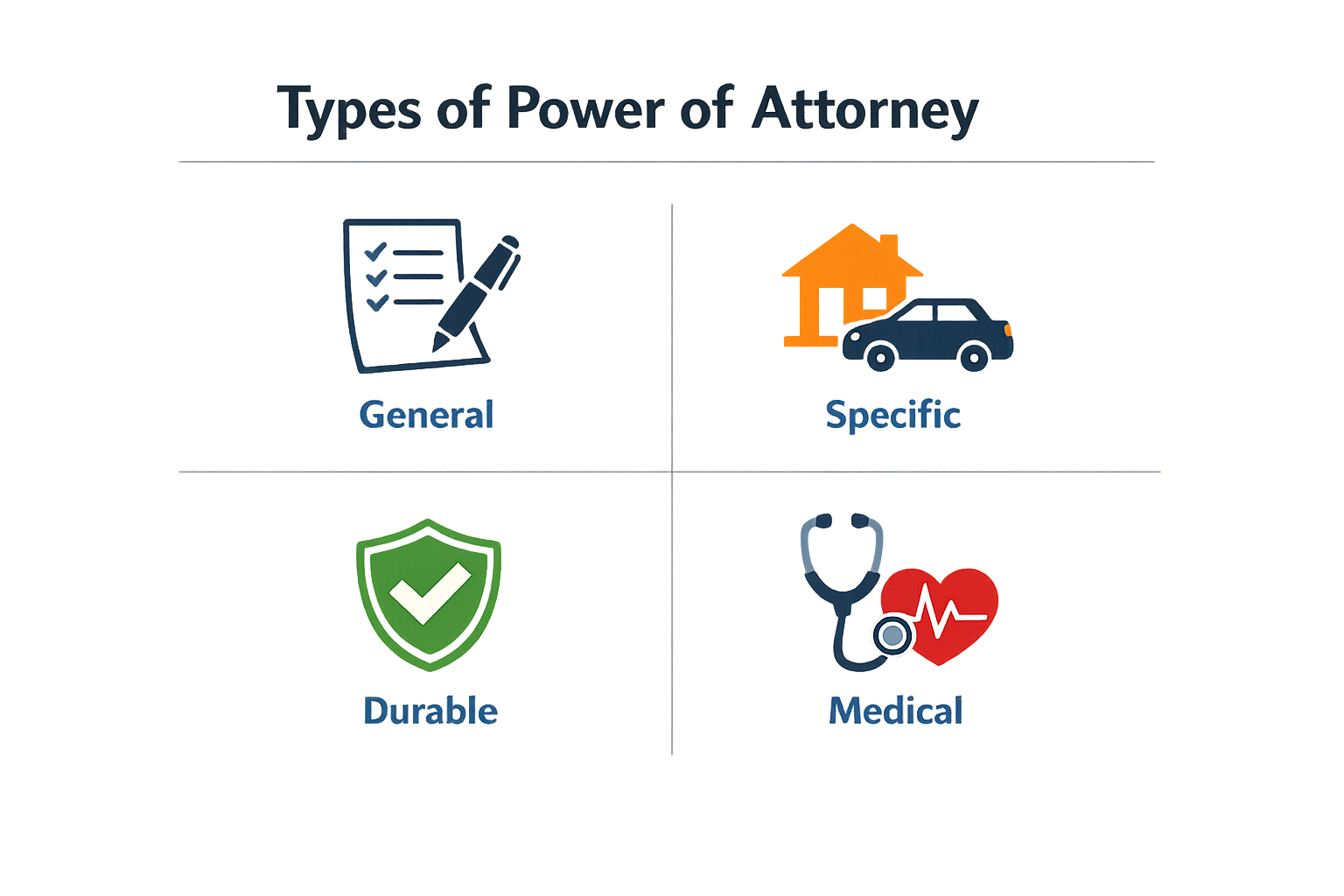
A power of attorney isn't a single document with one set of rules. It's a framework with different versions designed for different situations. The type you need depends on what decisions you're delegating, how long you want the authority to last, and whether you're planning for current needs or future incapacity. Here's what that actually means in practical terms.
General Power of Attorney
A general power of attorney gives your agent broad authority to handle financial and legal matters on your behalf. The agent can manage bank accounts, pay bills, file taxes, buy or sell property, and make investment decisions. The scope is wide — essentially anything you could do yourself, your agent can do under this arrangement.
The catch: a general power of attorney typically ends if you become incapacitated. That's the opposite of what most people need for long-term planning. It works well for temporary situations — you're traveling abroad for six months, recovering from surgery, or managing a business deal while unavailable. Once you're back or the specific task is complete, you can revoke it.
Durable Power of Attorney
A durable power of attorney solves the incapacity problem. The word "durable" means the document remains valid even if you become mentally or physically unable to make decisions. This is the version most people need for estate planning.
The framework is straightforward: you grant authority that survives incapacity. Your agent can continue managing your finances, paying your mortgage, handling insurance claims, and making legal decisions when you can't. Without this durability clause, the power of attorney becomes worthless exactly when it's most needed — when you're in the hospital, dealing with dementia, or otherwise unable to function.
Durable powers of attorney can be effective immediately or "springing" — meaning they only activate when a specific event occurs, typically a doctor's certification of incapacity. The immediate version gives your agent authority right away, which sounds risky but often makes practical sense. Most people choose a trusted family member and want them able to help without jumping through hoops to prove incapacity first.
Limited or Specific Power of Attorney
A limited power of attorney narrows the scope to specific tasks or time periods. You might grant authority to sell one piece of real estate, manage a single bank account, or handle a business transaction while you're unavailable. Once the task is complete or the time period expires, the authority ends.
This version protects both you and your agent. The agent can't be accused of overstepping because the boundaries are clearly defined in the document. You maintain control over everything else. It's common in real estate closings, business deals, and situations where you need help with one thing but don't want to delegate broader authority.
Medical Power of Attorney (Healthcare Proxy)
A medical power of attorney — also called a healthcare proxy or healthcare power of attorney — is separate from financial powers. This document names someone to make medical decisions when you can't communicate your wishes. Your agent can consent to treatment, choose doctors and facilities, access medical records, and make end-of-life decisions based on your known preferences.
The medical power of attorney typically works alongside a living will or advance directive, which states your preferences about life-sustaining treatment. The power of attorney names who decides; the living will guides what they should decide. Most people need both.
Medical powers of attorney are almost always durable — they're specifically designed for incapacity. An agent who can only make medical decisions while you're conscious serves no practical purpose. The document activates when your doctor determines you can't make or communicate healthcare decisions yourself.
How Power of Attorney Actually Works
The mechanics are simpler than the legal language suggests. You (the principal) sign a document granting authority to someone else (the agent or attorney-in-fact). The agent presents this document to banks, healthcare providers, government agencies, or whoever needs to see proof of authority. If the document meets legal requirements and the institution accepts it, the agent can act on your behalf.
Most powers of attorney require notarization. Some require witnesses in addition to a notary. Financial institutions often want to see the original document or a certified copy, not a photocopy. Some banks and brokerages have their own power of attorney forms and prefer you use theirs — worth checking before you finalize your document.
The agent's authority comes with legal responsibility. They must act in your best interest, keep accurate records, avoid conflicts of interest, and never use your assets for their own benefit. These are fiduciary duties, meaning the law holds your agent to a high standard. If they abuse the power, they can face civil and criminal penalties.
You can revoke a power of attorney anytime you're mentally competent. Put the revocation in writing, notify your agent, and inform any institutions that have a copy of the original document. If you've granted a durable power of attorney and later become incapacitated, you can't revoke it — which is why choosing the right agent matters more than choosing the right document format.
| Type | Scope | Survives Incapacity | Common Use |
|---|---|---|---|
| General | Broad financial/legal | No | Temporary absence |
| Durable | Broad financial/legal | Yes | Long-term planning |
| Limited | Specific task/time | Depends on document | Single transaction |
| Medical | Healthcare only | Yes | Medical decisions |
For more on related planning strategies, see Business Succession Planning: Protecting Your Company's Future.
The real question isn't which type of power of attorney you need — most people need a durable financial power of attorney and a medical power of attorney. The question is who you trust to use that authority responsibly and whether your document will hold up when institutions ask to see it.
How to Set Up a Power of Attorney
Setting up a power of attorney isn't as complicated as it sounds, but it does require attention to detail. The goal is creating a document that clearly defines what your agent can do, when they can do it, and how the arrangement ends. Most people complete the process in a few weeks, though the timeline depends on whether you work with an attorney and how complex your situation is.
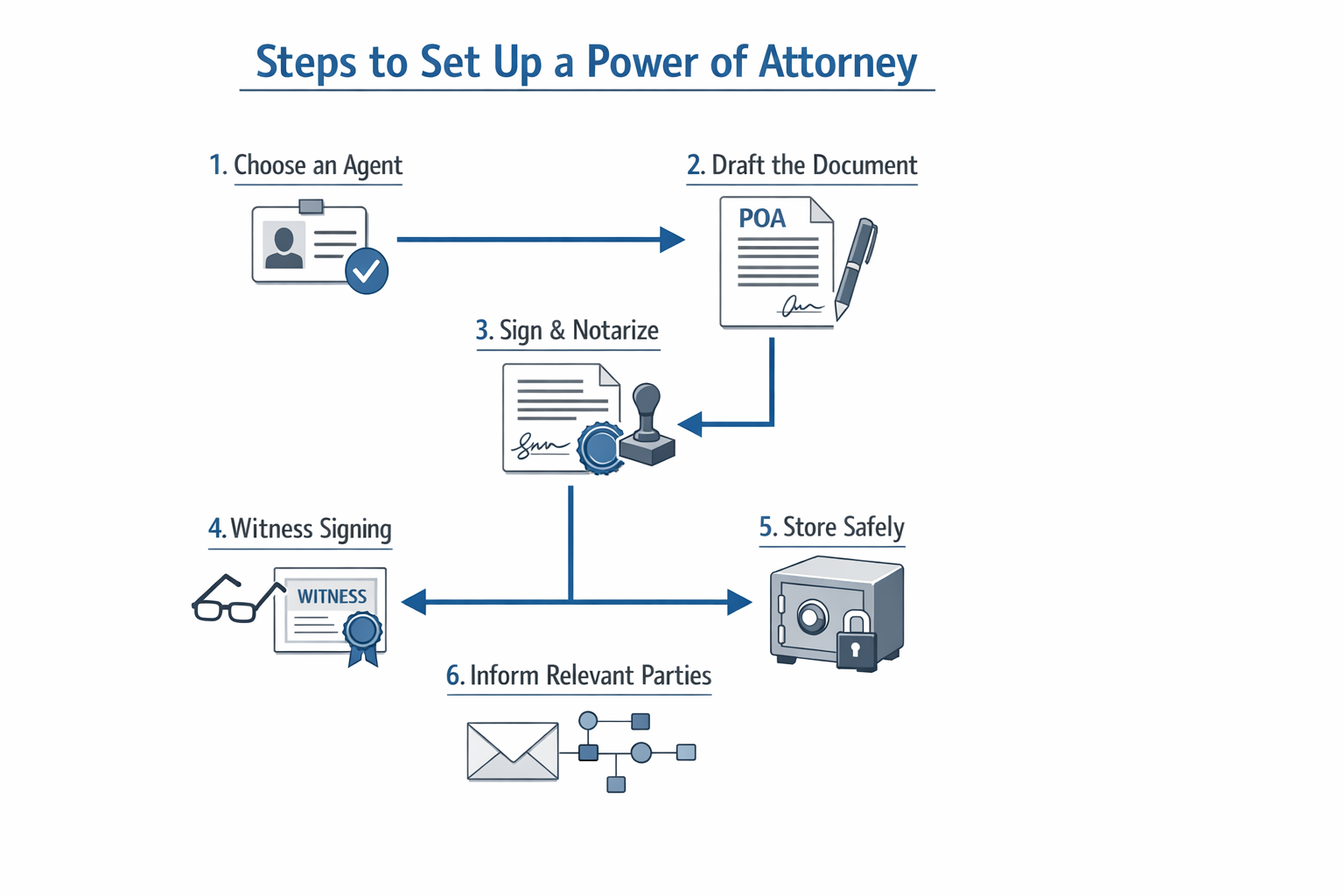
The framework is straightforward: decide what powers you're granting, choose your agent, draft the document using your state's requirements, sign it properly, and distribute copies to the right people. Each step matters — a power of attorney that doesn't meet your state's formalities might not be recognized when your agent needs to act.
Step 1: Determine What Powers You Need to Grant
Step 1
Identify the scope of authority
Start by listing what you need your agent to handle. Financial matters typically include banking, bill payment, tax filings, and property transactions. Medical decisions cover treatment choices, care facilities, and end-of-life preferences. Be specific — "manage my finances" is too broad for most institutions to accept without pushback.
Most people need either a durable financial power of attorney, a medical power of attorney, or both. A general power of attorney works for temporary situations like a planned absence, but it becomes invalid if you lose capacity. If you're planning for potential incapacity — which is the most common reason to set one up — the document needs to state explicitly that it remains effective if you become unable to make decisions yourself.
Step 2: Choose Your Agent and Successor
Step 2
Select a trustworthy representative
Your agent should be someone who understands your values, can handle financial or medical complexity, and will act in your interest even when it's difficult. This is typically a spouse, adult child, or close family member, but it doesn't have to be. Name at least one successor agent in case your first choice can't serve.
The honest answer: this decision matters more than the document's exact wording. An agent with broad powers and poor judgment creates more problems than a limited power of attorney with a competent agent. Talk to your potential agent before you finalize anything — they need to know what you expect and be willing to take on the responsibility.
Step 3: Draft the Document
Step 3
Create a compliant document
You have three options: use your state's statutory form (if available), work with an estate planning attorney, or use a reputable online legal service. Statutory forms are free and meet minimum requirements, but they're often generic. An attorney costs more but can customize the document for complex situations. Online services fall somewhere in the middle.
Your state's requirements determine what the document must include. Most states require specific language about durability, clear identification of the principal and agent, and detailed descriptions of granted powers. Some states have additional rules about medical decisions or real estate transactions. You may need professional help to set up a trust if your situation involves managing assets for beneficiaries or coordinating with business succession planning.
Step 4: Sign and Notarize the Document
Step 4
Execute with proper formalities
Sign the power of attorney in front of a notary public. Some states also require witnesses — typically two adults who aren't related to you or named in the document. Check your state's rules before you schedule the signing. The notary verifies your identity and that you're signing voluntarily, which helps prevent challenges later.
For medical powers of attorney, some states require you to sign in front of healthcare witnesses or file the document with a state registry. Financial institutions often want their own internal forms in addition to your power of attorney, so ask ahead of time what they'll accept.
Step 5: Distribute Copies and Store Safely
Step 5
Provide access to key parties
Give your agent the original or a certified copy. Provide copies to your attorney, financial institutions, healthcare providers, and any successor agents. Keep the original in a secure but accessible location — not a safe deposit box that only you can open.
Your agent can't act on your behalf if they can't prove they have authority. Banks and medical facilities will want to see the actual document, not just hear that one exists. Some people keep a list of who has copies so they can retrieve them if they need to revoke the power of attorney later.
When the Document Takes Effect
Most durable powers of attorney take effect immediately upon signing, even though your agent typically won't use them until you need help. Some people prefer a "springing" power of attorney that only activates when a doctor certifies you're incapacitated. The trade-off: springing documents create an extra hurdle when your agent needs to act quickly, and some institutions won't accept them.
In practical terms, an immediate power of attorney with a trustworthy agent gives you more flexibility. Your agent can help with routine tasks while you're still capable, and they're ready to step in without delay if something happens. The key is choosing someone who won't abuse that access.
Tips for Choosing an Agent and Drafting a Power of Attorney
Setting up a power of attorney isn't just about filling out forms — the person you choose and how you structure the document determine whether it actually works when you need it. Most people approach this the way they approach picking an executor for a will: they choose someone they like and hope for the best. The framework below gives you a clearer starting point.
Selecting the Right Agent: Trust and Capability
The agent you name will have legal authority to act on your behalf, so the decision comes down to two things: trust and capability. Trust means you believe they'll act in your interest even when you can't supervise them. Capability means they can actually handle the responsibilities — managing finances, navigating healthcare decisions, or dealing with institutions that demand documentation.
Most people choose a spouse, adult child, or sibling. That works when the person has both qualities. When they don't, you're better off naming someone with the right skills and building in oversight through a co-agent or requiring regular accountings. A common misconception: the person who loves you most is automatically the best choice. In practical terms, the person who can handle conflict with a hospital administrator or manage a brokerage account without freezing up is often more valuable.
Financial responsibility matters more than most people realize. An agent managing financial decisions needs a track record of solvency and the ability to keep accurate records. If you're naming someone to handle business decisions or retirement accounts, their fiduciary experience — their history of managing similar responsibilities — becomes part of the equation. The goal is getting in the right range: someone who won't misuse the authority and won't panic when institutions push back.
Drafting the Document: Specificity and Legal Compliance
A power of attorney is only as good as its clarity. Vague language creates problems when banks, healthcare providers, or government agencies review it. The document should specify exactly which powers the agent has: paying bills, accessing retirement accounts, making medical decisions, selling property. If a power isn't listed, the agent may not be able to exercise it.
State law governs what makes a POA valid. Most states require the document to be signed, witnessed, and notarized. Some states have additional requirements for healthcare POAs or real estate transactions. Using a state-specific form or working with an attorney familiar with local rules reduces the chance that an institution will reject the document when you need it most.
The difference between a general POA and a limited one is scope. A general power of attorney gives the agent broad authority across financial and legal matters. A limited POA restricts the agent to specific tasks — selling a house, managing a single account, handling one transaction. If you're setting up a POA for a defined purpose, limiting the scope reduces risk and makes the agent's role clearer.
Durable language is what keeps the POA valid if you become incapacitated. Without it, the document terminates the moment you can't make decisions — exactly when you need it most. The phrase "this power of attorney shall not be affected by my subsequent incapacity" or similar wording (depending on state law) is what makes it durable. If you're setting up a POA for incapacity planning, confirm the document includes durable language.
Building in Safeguards and Oversight
Even when you trust your agent completely, safeguards make the arrangement more transparent. Requiring the agent to provide periodic accountings — a summary of actions taken and funds managed — creates a paper trail. Naming a co-agent who must approve major decisions adds a check on authority. Some people include a provision allowing a third party (an attorney, family member, or advisor) to review the agent's actions.
The honest answer: most POAs don't include formal oversight because people assume trust is enough. It usually is. But when it isn't, the lack of safeguards turns into a legal mess that's harder to untangle than the original problem. If the agent will be managing significant assets or making healthcare decisions over a long period, the extra structure is worth the effort.
For business owners, the stakes are higher. An agent with authority over business operations needs a clear framework — which decisions they can make independently, which require board approval, and how they interact with co-owners or partners. A power of attorney that doesn't account for business structure can create conflicts that disrupt operations.
Reviewing and Updating the Document
A power of attorney isn't a one-time task. Relationships change, financial situations shift, and state laws evolve. Reviewing the document every few years — or after major life events like marriage, divorce, the birth of a child, or a move to a new state — ensures it still reflects your situation.
If you need to revoke a POA, the process is straightforward: execute a written revocation, notify the agent, and inform any institutions that have a copy of the original document. Some people assume that creating a new POA automatically cancels the old one. It doesn't, unless the new document explicitly states it revokes all prior powers of attorney. Without clear revocation, you can end up with two agents who both believe they have authority.
When you're ready to take the next step, talk to a licensed attorney in your state. They can confirm the document meets local requirements, help you think through the right structure for your situation, and make sure the language holds up when institutions review it. Most estate planning attorneys include POAs as part of a broader package with wills and healthcare directives, which makes sense — these documents work together, and setting them up at the same time keeps them consistent.
Conclusion: The Essential Role of Power of Attorney
A power of attorney is one of those documents most people don't think about until they need it — and by then, it's often too late. The framework is straightforward: you designate someone you trust to make decisions on your behalf if you can't make them yourself. Whether that's managing your bank accounts during a medical emergency or making healthcare decisions when you're incapacitated, the right power of attorney keeps your affairs moving forward instead of grinding to a halt.
The difference between having a properly executed power of attorney and not having one comes down to control. Without one, your family faces court proceedings, legal fees, and delays at a time when they're already dealing with stress. With one in place, your chosen agent can step in immediately — paying bills, managing investments, or communicating with doctors — all according to your documented wishes.
Here's what that actually means in practical terms: setting up a power of attorney isn't about preparing for the worst-case scenario. It's about making sure the people you trust can help you when you need it most. The types — durable, medical, limited, springing — give you options to match your specific situation. The setup process, while requiring some attention to state-specific rules and notarization, is manageable for most people working with a qualified attorney.
The honest answer is that most estate plans remain incomplete without a power of attorney. You might have a will that addresses what happens after you're gone, but a power of attorney addresses what happens while you're still here but unable to act. That gap matters. Business succession planning often includes power of attorney provisions to ensure company operations continue smoothly during an owner's incapacity.
When you're ready to take the next step, talk to a licensed attorney in your state who can draft a document that meets local requirements and reflects your specific circumstances. The framework exists to protect you and the people you care about — using it is just a matter of following through.
Related reading
Revocable vs Irrevocable Trust: Key Differences
Related reading
What Is Probate? Understanding the Probate Process and How to Avoid It