Introduction
Most people know they need an estate plan. Fewer understand that trusts come in fundamentally different forms, each with distinct trade-offs. A revocable trust is a legal arrangement that allows you to maintain complete control of your assets during your lifetime, with the flexibility to modify or dissolve it at any time. The difference between a revocable trust and an irrevocable trust isn't just technical — it determines who controls your assets, how they're protected, and what happens when you're gone.
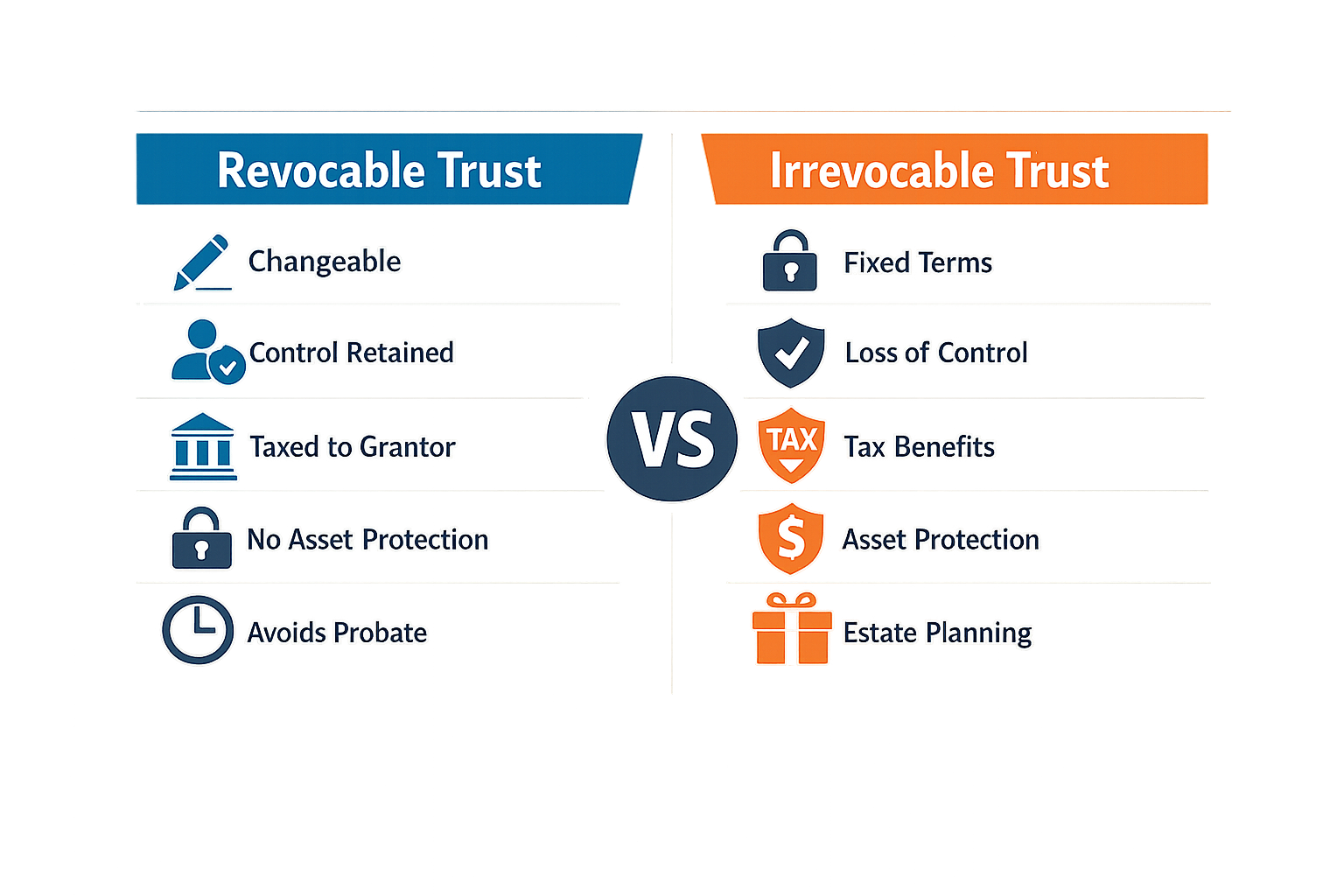
A revocable trust functions like a flexible container you control completely during your lifetime. You can add assets, remove them, change beneficiaries, or dissolve the trust entirely. An irrevocable trust works differently: once you transfer assets into it, you generally can't take them back or make changes without meeting specific legal requirements or obtaining beneficiary consent.
The framework for choosing between them starts with a straightforward question: what matters more right now — maintaining complete control over your assets, or achieving specific protection and tax outcomes that require giving up that control? For many families, understanding the mechanics of both options is the starting point for business succession planning and broader wealth transfer strategies.
Why the Distinction Matters in Estate Planning
The revocable trust structure addresses a common estate planning goal: avoiding probate while keeping your options open. Because you retain control, the assets in a revocable trust remain part of your taxable estate and accessible to creditors during your lifetime. That's not a flaw — it's the cost of flexibility.
Irrevocable trusts solve different problems. By permanently transferring assets out of your estate, they can reduce estate tax exposure and shield assets from creditors and legal claims. The trade-off is real: you're giving up direct control in exchange for protection and tax treatment that revocable structures can't provide.
In practical terms, many estate plans use both structures. A revocable trust might hold your primary residence and liquid assets you want to access easily, while an irrevocable life insurance trust holds your policy to keep the death benefit outside your taxable estate. The goal is getting the right tool for each specific asset and objective, not picking one trust type for everything.
Understanding the Problem: Trusts in Estate Planning
Most people approach trusts the same way they approach tax forms — with a vague sense that they're important and a strong preference for avoiding them entirely. The terminology alone creates confusion: revocable, irrevocable, living, testamentary, grantor, beneficiary. By the time someone explains the difference between a revocable trust and an irrevocable trust, many people have already tuned out.
The real question is what happens to your assets when you're no longer around to manage them — or when you're unable to make decisions. A trust is a legal arrangement where one party (the trustee) holds and manages assets for the benefit of another party (the beneficiary). The confusion arises because the two main types of trusts — revocable and irrevocable — operate under fundamentally different rules, with different tax consequences, different levels of control, and different degrees of asset protection.
How Does a Revocable Trust Work?
With a revocable trust, the person who creates it (the grantor) retains the ability to modify, amend, or completely dissolve the trust at any time during their lifetime. This flexibility sounds appealing — and for many estate planning situations, it is. The grantor can serve as their own trustee, managing the assets directly, and can change beneficiaries or terms as circumstances change.
An irrevocable trust works differently. Once established, the grantor generally cannot modify the terms or reclaim the assets without the consent of the beneficiaries or a court order. The grantor effectively relinquishes ownership and control. For people accustomed to maintaining direct control over their financial affairs, this feels uncomfortable — like handing over the keys and hoping for the best.
The Tax and Estate Planning Problem
The difference in control creates a corresponding difference in how these trusts are treated for tax and estate purposes. Because the grantor of a revocable trust maintains control over the assets, those assets remain part of their taxable estate. When the grantor dies, the trust typically becomes irrevocable, and the assets are included in the gross estate for federal estate tax purposes.
With an irrevocable trust, the assets are generally removed from the grantor's taxable estate — assuming the trust is structured properly and the grantor doesn't retain certain powers or benefits. This can provide estate tax benefits for larger estates, but it comes at the cost of giving up control during the grantor's lifetime.
The Asset Protection Problem
Another common misconception: many people assume that placing assets in any trust automatically shields them from creditors or legal judgments. In practical terms, a revocable trust offers minimal asset protection during the grantor's lifetime. Because the grantor retains control and can revoke the trust at will, creditors can typically reach those assets just as they could reach assets held in the grantor's name directly.
An irrevocable trust, by contrast, may offer stronger asset protection — precisely because the grantor has given up ownership and control. Once assets are transferred into a properly structured irrevocable trust, they may be shielded from the grantor's creditors. The trade-off, again, is control: you cannot protect assets you still control.
For more context on protecting business assets and planning for succession, see our guide on Business Succession Planning: Protecting Your Company's Future.
The Probate Problem
Both revocable and irrevocable trusts can help assets avoid probate — the court-supervised process of distributing a deceased person's estate. Probate can be time-consuming, expensive, and public. Assets held in a trust (of either type) typically pass directly to beneficiaries according to the trust terms, bypassing probate entirely.
The difference is timing and flexibility. A revocable trust allows the grantor to adjust beneficiary designations and asset allocations as life circumstances change — children are born, marriages occur, financial situations shift. An irrevocable trust locks in those decisions at the time of creation, making it difficult to adapt to changing family dynamics or financial needs.
The Medicaid and Long-Term Care Problem
For individuals concerned about long-term care costs and Medicaid eligibility, the distinction between trust types becomes critical. Medicaid has a five-year lookback period for asset transfers. Assets in a revocable trust are counted as available resources for Medicaid eligibility purposes because the grantor retains control. Assets transferred to an irrevocable trust may not be counted — but only if the transfer occurred outside the lookback period and the trust is structured to meet specific requirements.
This creates a planning dilemma: transferring assets to an irrevocable trust early enough to satisfy Medicaid rules means giving up control years before you might actually need long-term care. Waiting too long means the assets remain countable, potentially disqualifying you from benefits or requiring you to spend down the assets before qualifying.
The cheapest estate plan is the one that actually matches your goals — not the one with the most complicated structure.
The framework for choosing between a revocable trust and an irrevocable trust depends on what you're trying to accomplish: maintaining control and flexibility, reducing estate taxes, protecting assets from creditors, or planning for Medicaid eligibility. Most people don't realize these goals often conflict with each other — you cannot simultaneously maintain full control over assets and remove them from your taxable estate or shield them from creditors. Understanding that trade-off is the starting point for making an informed decision.
Solution Steps: Choosing the Right Trust for Your Needs

Step 1: Define Your Estate Planning Objectives
Start by writing down what you want to happen to your assets. The honest answer for most families falls into one of three categories: maintaining control and flexibility during your lifetime, protecting assets from creditors or estate taxes, or providing for beneficiaries with specific conditions. A revocable trust serves the first goal. An irrevocable trust serves the second and third.
Step 1
List your primary concerns
Identify whether your top priority is retaining the ability to modify your plan as circumstances change, or whether you're willing to give up control now in exchange for asset protection or tax benefits later. This single distinction drives most of the decision.
The difference between these two paths is permanent. Once you fund an irrevocable trust, you typically can't change your mind without court intervention or beneficiary consent. A revocable trust lets you adjust the terms whenever your situation shifts.
Step 2: Evaluate Your Current Financial Picture
Look at the size of your estate and your exposure to estate taxes. For most families, estate tax isn't a factor — the federal exemption sits well above what the average household will accumulate. If your estate is below that threshold, the tax advantages of an irrevocable trust may not justify the loss of control.
Consider your liquidity needs too. An irrevocable trust removes assets from your direct ownership, which means you can't access them freely if you need cash. A revocable trust keeps everything within reach — you remain the owner for all practical purposes.
Step 3: Assess Your Asset Protection Needs
If you're in a profession with high liability exposure, or if you're concerned about creditor claims, an irrevocable trust creates a legal barrier between you and your assets. The trade-off is giving up control. A revocable trust offers no creditor protection because you retain ownership — creditors can reach assets in a revocable trust just as easily as they can reach assets in your name.
The same logic applies to Medicaid planning. Assets in a revocable trust count toward Medicaid eligibility limits. Assets in an irrevocable trust, if transferred well before you apply for benefits, may not. The timing and structure matter, and the rules vary by state.
Step 4: Consider Your Beneficiary Situation
Think about who will inherit your assets and whether they need structured protection. If you're leaving assets to minor children, a beneficiary with special needs, or someone who struggles with financial management, an irrevocable trust can impose conditions and safeguards that a revocable trust can also provide — but the irrevocable version adds permanence.
For straightforward transfers to adult children or a surviving spouse, a revocable trust usually handles the job without the complexity. You can name beneficiaries, specify distribution terms, and avoid probate — all while keeping the ability to update the plan if relationships or circumstances change.
Step 2
Map out your beneficiary needs
Write down each beneficiary's age, financial competence, and any special circumstances like disability or substance issues. If protective structures are needed, determine whether those protections must be permanent or whether you want the flexibility to adjust them.
Step 5: Understand the Administrative Commitment
Both trust types require ongoing administration, but irrevocable trusts demand more. You'll need a separate tax ID, annual tax filings, and meticulous record-keeping. The trustee — which may not be you — has fiduciary duties that carry legal liability. A revocable trust is simpler: you can serve as trustee, the trust uses your Social Security number, and you report everything on your personal tax return.
The cost difference extends beyond setup. Irrevocable trusts often require regular legal and accounting fees to maintain compliance. Revocable trusts have lower ongoing costs, though you'll still need to fund the trust properly and keep beneficiary designations current.
Step 6: Talk to a Licensed Financial Professional
Once you've worked through the steps above, you have a framework for the conversation with an estate planning attorney. They'll translate your objectives into the right legal structure. The math works like this: if you need asset protection or tax benefits and you're comfortable giving up control, an irrevocable trust is worth exploring. If you value flexibility and your estate doesn't face significant tax or creditor exposure, a revocable trust is the starting point.
For families navigating business succession planning, the choice between trust types often intersects with ownership transfer strategies — another reason to get professional guidance tailored to your specific situation. Business owners may also benefit from understanding QBI deduction strategies and retirement options like a SEP IRA or SIMPLE IRA.
The cheapest trust is the one that matches your actual goals, not the one with the lowest setup fee.
Depending on your circumstances, you may end up using both types — a revocable trust for liquid assets and personal property, and an irrevocable trust for life insurance proceeds or other assets earmarked for specific purposes. The framework is getting in the right range, then refining the details with someone licensed to practice in your state.
Tips and Tricks: Navigating Trusts Effectively
Setting up a trust isn't as complicated as it sounds, but it does require attention to detail and a clear understanding of your goals. Most people approach trust planning the same way they approach their attic — they know they should organize it, but they're not sure where to start. Here's what actually matters when you're ready to take the next step.
Start with Your Goals, Not the Trust Type
The real question isn't "Should I set up a revocable trust or an irrevocable trust?" It's "What am I trying to accomplish?" If your primary concern is avoiding probate while maintaining full control of your assets, a revocable trust is the straightforward answer. If you're focused on asset protection, Medicaid planning, or reducing estate taxes, an irrevocable trust may be worth the trade-offs. Write down your top three estate planning priorities before you talk to anyone about trust documents — it clarifies the conversation.
Understand Trustee Powers and Flexibility
Trust arrangements can include more flexibility than most people realize. For example, trustees may have discretionary power to make distributions to beneficiaries based on specific needs or circumstances. In some cases, a trustee can invade the corpus (the principal assets) to provide for a beneficiary's health or maintenance. This kind of flexibility can be particularly valuable in family situations where circumstances change over time. When you're drafting trust documents, think through who you trust to make those judgment calls — and whether you want those decisions guided by strict rules or broader discretion.
Work with a Licensed Professional
Trust laws vary by state, and the tax implications can be complex — especially when dealing with multi-beneficiary trusts, retirement accounts, or business assets. A licensed estate planning attorney can help you structure the trust correctly and avoid common pitfalls. If tax efficiency is part of your goal, consult a tax advisor as well. The cost of professional guidance is typically far less than the cost of fixing a poorly drafted trust or dealing with unintended tax consequences later.
For business owners, business succession planning often intersects with trust planning, particularly when the goal is transferring ownership while protecting the business from creditors or estate taxes.
Review and Update Regularly
A revocable trust gives you the flexibility to amend or revoke it as your life changes — marriage, divorce, births, deaths, or changes in financial circumstances. An irrevocable trust, by contrast, is much harder to modify. Either way, your trust documents should be reviewed every three to five years, or whenever a major life event occurs. Beneficiary designations, asset titles, and trustee appointments all need to stay current. Most people set up a trust and then forget about it — that's a mistake.
Keep Clear Records
Whether you choose a revocable or irrevocable trust, maintain organized records of all trust assets, amendments, and trustee actions. If the trust holds investment accounts, real estate, or business interests, document the basis, valuation dates, and any distributions. Clear records make administration easier for your trustee and beneficiaries — and they reduce the risk of disputes or confusion down the line.
Conclusion: Making Informed Decisions About Trusts
The choice between a revocable trust and an irrevocable trust comes down to what matters most in your specific situation — flexibility or protection. A revocable trust gives you control and the ability to adjust as life changes. An irrevocable trust locks in asset protection and potential tax benefits, but at the cost of that control. Neither is universally better; they solve different problems.
Most people approaching estate planning for the first time underestimate how much their circumstances will shift over the next decade. A revocable trust accommodates those shifts — you can add assets, remove beneficiaries, or dissolve the trust entirely if your priorities change. That flexibility makes it a practical starting point for families building their first estate plan. The tradeoff is straightforward: assets in a revocable trust remain part of your taxable estate and accessible to creditors during your lifetime.
Irrevocable trusts demand more certainty upfront. Once you transfer assets into one, you're committing to the structure. That permanence is the source of their power — creditor protection, estate tax reduction, and Medicaid planning all hinge on the fact that you no longer legally own those assets. For families with significant estates, business owners planning succession, or individuals managing long-term care costs, that tradeoff often makes sense. But it requires working with a licensed professional who understands the tax code and your state's trust laws.
The real question isn't which trust is better. The real question is whether a trust solves a problem you actually have. If you're trying to avoid probate, simplify asset transfer, or maintain privacy, a revocable trust handles that. If you're trying to shield assets from estate taxes or protect wealth from future creditors, an irrevocable trust is the tool. If you're not sure which problem you're solving, that's the conversation to have with a financial professional before you commit to either structure.
When you're ready to take the next step, the framework is simple: inventory your assets, clarify your goals, and talk to someone who specializes in estate planning in your state. Trust laws vary, and the details matter. For business owners, business succession planning often intersects with trust strategy — the two frameworks reinforce each other when structured correctly. Start with the problem, not the solution, and the right trust structure becomes clear.
Estate planning isn't about perfection. It's about getting in the right range — building a structure that protects what matters and adapts when it needs to. A revocable trust does that for most families. An irrevocable trust does it for situations where protection outweighs flexibility. Both work, in the right context. The honest answer is that most people need professional guidance to choose correctly — and that's not a weakness, it's just the reality of working with legal structures that carry long-term consequences.
Frequently asked questions
What is the main difference between a revocable trust and an irrevocable trust?
A revocable trust allows you to maintain complete control over your assets and make changes or dissolve the trust at any time during your lifetime. An irrevocable trust permanently transfers assets out of your control, and you generally cannot modify or revoke it without beneficiary consent or court approval.
Can a revocable trust protect assets from creditors?
No. Because you retain control over assets in a revocable trust, creditors can typically reach those assets just as they could reach assets held in your name directly. Only irrevocable trusts, where you've given up ownership and control, may provide creditor protection.
Does a revocable trust reduce estate taxes?
No. Assets in a revocable trust remain part of your taxable estate because you maintain control during your lifetime. When you die, the trust becomes irrevocable and the assets are included in your gross estate for federal estate tax purposes.
When should I consider an irrevocable trust instead of a revocable trust?
Consider an irrevocable trust if you need asset protection from creditors, want to reduce estate tax exposure, or are planning for Medicaid eligibility. The trade-off is giving up control over those assets permanently.
Do I need both types of trusts?
Many estate plans use both structures. A revocable trust might hold your primary residence and liquid assets for flexibility, while an irrevocable life insurance trust holds your policy to keep the death benefit outside your taxable estate. The right approach depends on your specific goals and assets.