Introduction
When deciding between a Roth IRA or 401k, most people don't lose sleep over retirement account acronyms. They lose sleep wondering if they're putting their money in the right place.
The question of Roth IRA or 401k isn't really about picking a winner. It's about understanding how these accounts work, what your employer offers, and where you'll get the most value from each dollar saved. Since 1998, when Roth IRAs were introduced as a new retirement savings option, workers have had more flexibility — and more decisions to make — about how to structure their retirement contributions.
Here's what that actually means in practical terms. A 401(k) gives you a tax deduction now and taxes your withdrawals later. A Roth IRA works the opposite way — no deduction now, but tax-free withdrawals in retirement. Your current tax rate, your employer's match policy, and your expected tax situation decades from now all factor into which account deserves your first dollar.
The framework isn't as complicated as it sounds. Most financial professionals recommend a layered approach: capture free money first (employer match), then fund tax-free growth (Roth IRA), then maximize pre-tax savings (back to the 401(k)). The real question is how to adjust that framework for your specific situation — whether you're early in your career with a lower tax rate, mid-career with peak earnings, or approaching retirement with a clear picture of your future income.
The goal is getting in the right range, not finding a perfect answer. Understanding the trade-offs between these accounts gives you a starting point for building a retirement savings strategy that makes sense for where you are now and where you're headed.
Problem Statement
Most people know they need to save for retirement. The confusion starts when they realize they have multiple account types pulling in different directions — each with its own contribution limits, tax treatment, and withdrawal rules. There are limited dollars to contribute each month, and the decision about where to send them isn't as straightforward as it sounds.
The core tension: your employer offers a 401(k), possibly with a match. You also qualify for a Roth IRA, which offers tax-free growth and withdrawal flexibility. Both accounts have merit. Both have contribution deadlines. And if you're like most people, you don't have enough cash flow to max out both accounts in the same year.
The typical approach is to split contributions between accounts without a clear framework. Some people fund the 401(k) up to the match, then stop. Others max the Roth IRA first because they've heard it's more flexible. A few ignore the Roth entirely and dump everything into the workplace plan. None of these strategies is universally wrong, but none of them is universally right either.
What is the Real Question About Roth IRA or 401k?
The problem isn't that one account is better than the other. The problem is that the right funding order depends on variables most people don't know how to weight: current tax bracket versus expected future bracket, the presence or absence of an employer match, investment options inside each account, and how soon you might need access to the money.
Without a decision framework, you're left guessing. And when you're guessing with retirement dollars, the cost of getting it wrong compounds over decades. The math works like this: a $5,000 contribution to the wrong account at age 30 doesn't just cost you $5,000 — it costs you that $5,000 plus 35 years of growth on the tax advantage you didn't capture.
Most people don't realize that the funding order question has a structure. It's not about picking the "best" account in the abstract. It's about matching account characteristics to your specific tax situation, employer benefits, and financial goals. The framework exists. The next section walks through it step by step.
Solution Steps
The math works like this: most people should approach retirement savings in a specific order, not as an either-or choice. Here's the framework for deciding where your next dollar goes.
Step 1: Capture the Full Employer Match
Step 1
Start with free money
If your employer offers a 401(k) match, contribute at least enough to capture the full match before funding any other account. A 50% or 100% match represents an immediate guaranteed return you can't replicate anywhere else. This takes priority over tax considerations.
Most plans match 50% to 100% of contributions up to 3–6% of salary. Check your plan document or ask HR for the exact formula. If you're contributing less than the match threshold, you're leaving compensation on the table.
Step 2: Evaluate Your Current and Future Tax Situation
Once you've captured the match, the choice between additional 401(k) contributions and Roth IRA funding depends on your tax bracket — now and in retirement.
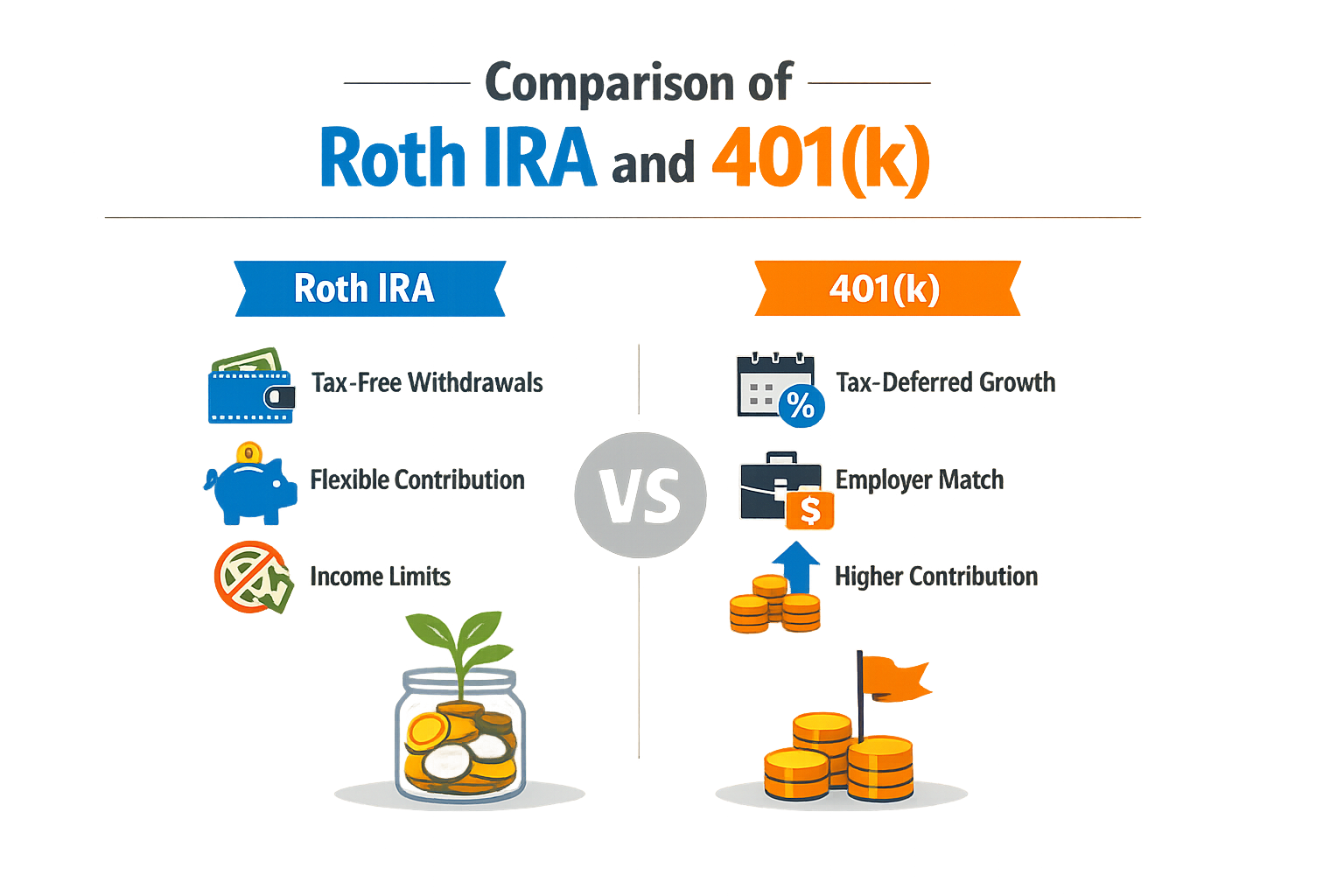
| Factor | Traditional 401(k) | Roth IRA |
|---|---|---|
| Tax treatment | Pre-tax contributions, taxed at withdrawal | After-tax contributions, tax-free qualified withdrawals |
| Income limits | None | Phase-out begins at $146,000 (single) / $230,000 (married) for 2025 |
| Contribution limit | $23,500 (2025) | $7,000 (2025) |
| Employer match | Yes | No |
| Required distributions | RMDs at age 73 | No RMDs during owner's lifetime |
Roth contributions are made with after-tax dollars, meaning they are included in your income, but qualified distributions from these accounts are not taxed. If you expect to be in a higher tax bracket during retirement — or if current rates are historically low — Roth accounts become more attractive.
Step 3: Consider Contribution Limits and Flexibility
After maxing the employer match, your next decision depends on whether you've hit account limits and how much flexibility you need.
The 401(k) allows significantly higher contributions — $23,500 in 2025 versus $7,000 for a Roth IRA. If you're trying to save aggressively, maxing the 401(k) first gives you more capacity. But Roth IRAs offer advantages the 401(k) doesn't: you can withdraw contributions (not earnings) anytime without penalty, and there are no required minimum distributions during your lifetime.
For most people, the practical sequence looks like this: contribute enough to the 401(k) to get the full match, then fund a Roth IRA up to the annual limit, then return to the 401(k) to increase contributions toward the maximum.
Step 4: Factor in Rollover Opportunities
When considering retirement account contributions, it's important to understand the rollover rules, as they can affect long-term financial planning. You can roll over amounts from a 401(k) to a Roth IRA, though you'll owe taxes on the converted amount in the year of the rollover.
Consider rolling over amounts from a 401(k) to a Roth IRA for potential tax benefits, especially if you expect to be in a higher tax bracket during retirement. This strategy works best during years when your income is temporarily lower — between jobs, during a sabbatical, or in early retirement before required distributions begin.
The goal is getting in the right range, not optimizing to the dollar — tax law changes, life circumstances shift, and a diversified tax treatment across accounts gives you flexibility later.
Tips and Tricks
Maximizing your retirement contributions isn't about following a single formula — it's about building a framework that adapts to your changing circumstances. Here's what that actually means in practical terms.
Revisit Your Strategy When Life Changes
Your optimal funding strategy shifts with major life events. A promotion that bumps you into a higher tax bracket makes the Roth IRA more attractive for current contributions. Marriage, a new child, or a career change all trigger moments to reassess which account deserves priority. The goal is getting in the right range for your current situation, not locking into a permanent plan.
Understand the Age-Flexibility Advantage
Roth IRAs offer a structural benefit that's worth understanding: you can make contributions after age 70½, unlike traditional IRAs. This matters most for people working later in life or those who want to continue building tax-free savings into their seventies. The framework is straightforward — if you're earning income and meet the modified AGI limits, Roth contributions remain available regardless of age.
Separate Employer Plans from Personal Contributions
A common misconception trips people up: employer contributions under SEP arrangements or SIMPLE IRA plans don't affect your Roth IRA contribution limit. The two systems run on separate tracks. You can max out employer-sponsored retirement accounts and still contribute the full annual limit to a Roth IRA, assuming you meet the income requirements. The math works independently for each account type.
Employer contributions and personal IRA limits operate on separate tracks — maxing out one doesn't reduce your capacity for the other.
Track Your Combined IRA Contributions
If you're contributing to both Roth and traditional IRAs in the same year, your total contributions across all IRAs cannot exceed the annual limit. The limit applies to the combined total, not each account individually. This is where people sometimes overfund accidentally — they treat each IRA as having its own independent limit when the IRS counts them together.
Consider the Withdrawal Timeline
Most people don't realize that Roth IRA contributions (not earnings) can be withdrawn anytime without penalty or tax. This creates a flexibility layer that 401(k)s don't offer. If you're building both accounts and need emergency access before retirement, the Roth IRA provides a safety valve. That doesn't mean it should be treated as a savings account, but the structural difference is worth understanding when deciding where to direct extra dollars.
Coordinate with Spousal Income
For married couples, the higher earner's 401(k) match might justify prioritizing that account first, while the lower earner focuses on maxing out a Roth IRA. This split strategy can optimize both the employer match and the tax diversification benefits. The honest answer: there's no universal rule, but coordinating contributions between spouses often produces better outcomes than each person following the same funding sequence.
Conclusion
The honest answer: there's no universal right choice between a Roth IRA or 401(k). The framework that works depends on your current tax bracket, your employer match, and your best guess about where tax rates will be when you retire.
Here's what that actually means in practical terms: if your employer offers a match, fund your 401(k) up to that match first — that's free money with an immediate 100% return. After that, the decision gets more interesting. If you're early in your career and expect your income to rise, a Roth IRA often makes more sense because you're paying taxes at today's lower rate. If you're in your peak earning years and need the tax deduction now, maxing out your 401(k) contributions might be the better move.
Most people don't realize they don't have to choose just one. The goal is getting in the right range: contribute enough to capture your full employer match, then decide whether additional dollars go to a Roth IRA (for tax-free growth) or more 401(k) contributions (for immediate tax savings). Your specific situation — income level, tax bracket, retirement timeline, and whether you expect to be in a higher or lower bracket in retirement — determines the right mix.
The difference between getting this right and getting it wrong compounds over decades. A 30-year-old who prioritizes the employer match and then funds a Roth IRA will have a very different tax picture at 65 than someone who ignored the match entirely or put everything in a taxable brokerage account. The framework is straightforward: match first, then Roth or traditional based on your tax situation, then increase contributions as income allows.
When you're ready to take the next step, understanding how Roth conversions work can add another layer of tax strategy to your retirement planning. For now, the most important move is starting — whether that's a 401(k), a Roth IRA, or both. Talk to a licensed financial professional about your specific circumstances, especially if your income is near the Roth IRA contribution limits or if you're considering a backdoor Roth strategy.
Qualified distributions from a Roth IRA are not includible in gross income, and income earned in the account is generally not taxable — but only if you follow the rules. Understanding the penalties and additional taxes that apply when IRA rules aren't followed is crucial for protecting the tax advantages you've built. The math works like this: small mistakes in timing or contribution limits can trigger penalties that erase years of careful planning.
Frequently asked questions
Should I contribute to a Roth IRA or 401k first?
The optimal sequence for most people is to contribute enough to your 401(k) to capture the full employer match, then fund a Roth IRA up to the annual limit, then return to the 401(k) to increase contributions. This approach captures free money first, then builds tax-free growth, then maximizes pre-tax savings.
What is the difference between a Roth IRA or 401k?
A Roth IRA or 401k differs primarily in tax treatment and contribution limits. A 401(k) offers pre-tax contributions and employer matching, with a 2025 limit of $23,500. A Roth IRA uses after-tax dollars for tax-free withdrawals in retirement, with a 2025 limit of $7,000 and income restrictions.
Can I contribute to both a Roth IRA or 401k in the same year?
Yes, you can contribute to both a Roth IRA or 401k in the same year. The contribution limits are separate: $23,500 for a 401(k) and $7,000 for a Roth IRA in 2025. However, Roth IRA contributions phase out at higher income levels ($146,000 for single filers, $230,000 for married couples).
When does a Roth IRA or 401k make more sense?
A Roth IRA or 401k decision depends on your current versus expected future tax bracket. If you expect higher taxes in retirement or are currently in a lower bracket, a Roth IRA makes more sense. If you're in peak earning years and need the immediate tax deduction, additional 401(k) contributions may be better.
Explore the differences between Roth IRA vs. 401(k) contributions and discover which account to prioritize for funding.
Related reading
What Is Estate Planning? Estate Planning Basics: What You Need to Know